Showing posts with label library book. Show all posts

Tuesday, January 13, 2015

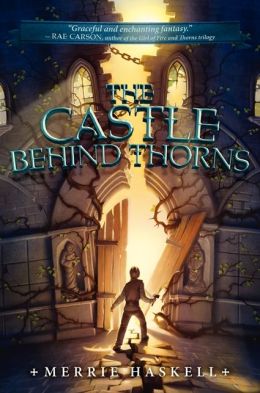
The Castle Behind Thorns (2014)

The Castle Behind Thorns. Merrie Haskell. 2014. HarperCollins. 336 pages. [Source: Library]

Sand woke, curled in the ashes of a great fireplace. Surprised to find himself waking at all, for he had no memory of falling asleep, Sand scrambled to his feet. Soot billowed from him in a cloud and sneaked up his nose. He sneezed four great sneezes that came back in lonely echoes from the vast room beyond the fireplace. Sand had never slept in a fireplace before. He never wanted to again. But he hesitated inside the fireplace, one foot suspended in midair, afraid to leave. In the room beyond, everything was broken. Every single thing.

I loved, loved, loved The Castle Behind Thorns. It is a retelling of Sleeping Beauty, I suppose. It puts a definite spin on it that is completely different from the original, but that is completely fascinating. Sand, the hero, wakes up in a fireplace in a castle that he's only heard stories about. The castle being abandoned quite suddenly when his own father was not yet grown. He finds himself very alone; he's the only living thing in the castle. (No growing plants, no bugs or insects, no birds, no mice, nothing). He keeps the panic to a minimum, in my opinion. Especially considering the situation! He's in an abandoned castle surrounded by hostile, vicious thorns. He explores. He plans. He mends. He learns and adapts. He's hungry and thirsty and tired. He finds a way to survive. In his exploring, he finds the family's crypt. He restores a body that had fallen, placing the young girl's body back gently and carefully.  Several days later, or some time later, readers meet the heroine Perrotte...

The Castle Behind Thorns is a beautiful story with memorable, well-developed characters. I enjoyed every minute of this one! The mystery is quite good! I would definitely recommend this one!

Read the Castle Behind Thorns
  • If you enjoy fairy tale retellings
  • If you enjoy good/great storytelling
  • If you like fantasy novels with a touch of magic
  • If you like mysteries 
  • If you like survival stories

© 2015 SukaYuka.com of SukaYuka's Book Reviews

Monday, January 12, 2015

In The Kingdom of Ice

In the Kingdom of Ice: The Grand and Terrible Polar Voyage of the USS Jeannette. Hampton Sides. 2014. 454 pages. [Source: Library]

I enjoy reading nonfiction. I do. The topic is polar exploration--the North Pole to be precise. (I've read more about the South Pole, by the way.) The good news is that In the Kingdom of Ice: The Grand and Terrible Polar Voyage of the USS Jeannette is fascinating and thorough. It is detailed and focused on personalities and contexts. (Two of the personalities explored are George Washington De Long and James Gordon Bennett, Jr.)

The trip is presented in great detail. Before the trip: how/when De Long became interested in polar exploration, finding financial backers for the trip, finding THE ship, finding men to go with him, finding resources and materials, doing the research, picking and choosing what research to rely on, planning and organizing, etc. During the trip: before the Jeannette got trapped in ice--what it was like on a day-to-day, week-to-week basis, the dangers, the joys, etc., trapped in the ice on ship--what it was like to spend YEARS (I believe almost two years?) on a ship that's trapped in the ice, what it was like to be stuck with the same people in such close quarters for those years, trapped ON the ice with NO ship--what it was like in the final months as thirty-something men with limited provisions and supplies, men not in the best health, fought to survive and reach land and civilization. After the trip: what it was like for the survivors to encounter land and civilization again, who survived, etc.

Most everything is given context and brought to life. That being said, it doesn't mean every person is likable!

I enjoyed reading this one. I found it to be a quick read--just a day or two at most.

© 2015 SukaYuka.com of SukaYuka's Book Reviews

Sunday, January 11, 2015

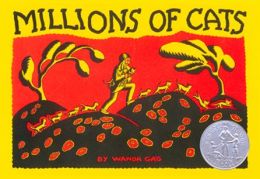
Millions of Cats (1928)

Millions of Cats. Wanda Gag. 1928. Penguin. 40 pages. [Source: Library]

Once upon a time there was a very old man and a very old woman. They lived in a nice clean house which had flowers all around it, except where the door was. But they couldn't be happy because they were so very lonely. 
"If we only had a cat!" sighed the very old woman. "A cat?" asked the very old man. "Yes, a sweet little fluffy cat," said the very old woman. "I will get you a cat, my dear," said the very old man.
And he set out over the hills to look for one. 

Millions of Cats is a Newbery Honor book from 1929.

Premise/Plot: A very old man and a very old woman long for a cat. The husband goes on a quest to bring back a "sweet little fluffy cat" to please them both. Is his quest successful? Yes. A little too successful. For in fact he finds
Cats here, cats there,
Cats and kittens everywhere,
Hundreds of cats,
Thousands of cats,
Millions and billions and trillions of cats.
How is he ever to choose just ONE cat from so many?! Especially since as he picks up or pets each one he sees, he finds it to be the prettiest cat. He can't bring himself to leave any of the cats behind. But it isn't practical to bring home hundreds, thousands, millions, billions, and trillions of cats. You can probably guess what his wife's response will be! Surely, they can't keep them all. For better or worse, he lets the cats decide amongst themselves. One scrawny cat remains, but, it may be the best one of all.

My thoughts: I loved this one growing up. I loved the repetition. I thought it was a fun story. I didn't--at the time--take the man's conclusion that the trillions of cats ate each other up literally. Is the book violent? Perhaps. Perhaps not. See for yourself.  "They bit and scratched and clawed each other and made such a great noise that the very old man and the very old woman ran into the house as fast as they could. They did not like such quarreling." This one might pair well with Eugene Field's "The Duel." (The gingham dog and the calico cat).

Have you read Millions of Cats? Did you like it? love it? hate it?

© 2015 SukaYuka.com of SukaYuka's Book Reviews

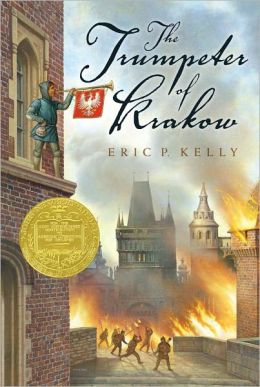
Revisiting The Trumpeter of Krakow (1928)

The Trumpeter of Krakow. Eric P. Kelly. 1928. Simon & Schuster. 208 pages. [Source: Library]

It was in late July of the year 1461 that the sun rose one morning red and fiery as if ushering in midsummer's hottest day. His rays fell upon the old city of Krakow and the roads leading up to it, along which rolled and rocked a very caravan of peasants' wagons. 

In the summer of 2011, I read and reviewed Eric P. Kelly's The Trumpeter of Krakow. I remember really enjoying it though I found it plot-driven instead of character driven. Because I had good memories of reading it, I thought I would reread it for Hope Is the Word's Newbery Through the Decades. Unfortunately, I didn't end up enjoying it as much as I did the first time.

I'm not sure if this was because I wasn't in the right mood for this one. Or if it was because since I knew how it ended there just wasn't enough to keep me reading.

The first time I read it: action, mystery, suspense, what will happen next?!

The second time I read it: this is boring, so boring, when will I get to the good part?

I was surprised by my own reaction this time since in my review, I wrote "There is never a dull moment in The Trumpeter of Krakow" and "The novel is exciting."
 

© 2015 SukaYuka.com of SukaYuka's Book Reviews

Saturday, January 10, 2015

Seuss on Saturday #2

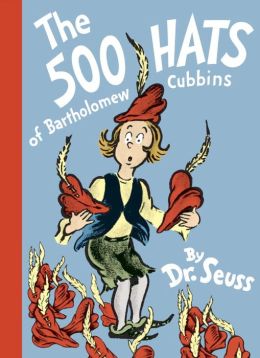
The 500 Hats of Bartholomew Cubbins. 1938/1965. Random House. 56 pages. [Source: Library]

First sentence:
 In the beginning, Bartholomew Cubbins didn't have five hundred hats. He had only one hat. It was an old one that had belonged to his father and his father's father before him. It was probably the oldest and the plainest hat in the whole Kingdom of Didd, where Bartholomew Cubbins lived.
Premise/plot. Bartholomew Cubbins gets into big, big trouble when he "refuses" to remove his hat in the presence of the king. The king gets more and more flustered as he sees the "insolence" of Bartholomew. To Bartholomew's credit, he is trying very hard to remove his hat. But every time he removes a hat, another appears on his head. What is going on?! What will the king do?!

My thoughts: I have only read this one twice. It definitely has more text than And To Think That I Saw it On Mulberry Street. And it also is written in prose. It does not rhyme. The story is just as over-the-top as And To Think That I Saw It On Mulberry Street, but it definitely has a different feel to it. According to Wikipedia, it was received well by reviewers. What did I think? Well, it was silly. I think the key to enjoying it is in focusing on the king and his reaction to the "problem." Seeing the king and those close to him try to solve the problem. For example, at one point he calls in seven black-gowned magicians:
Low and slow, they were chanting words that were strange...
"Dig a hole five furlongs deep,
Down to where the night snakes creep,
Mix and mold the mystic mud,
Malber, Balber, Tidder, Tudd."
In came seven black-gowned magicians, and beside each one stalked a lean black cat. They circled around Bartholomew Cubbins muttering deep and mysterious sounds.
It's never fun to be frustrated yourself. But the king's frustration proves comical. There are no real questions answered in this one.  But the ending proves satisfying enough.

Have you read The 500 Hats of Barthomew Cubbins? Did you like it? love it? hate it? What age do you think it works best for?

If you'd like to join me in reading or rereading Dr. Seuss' picture books (chronologically) I'd love to have you join me! The next book I'll be reviewing is The King's Stilts.


© 2015 SukaYuka.com of SukaYuka's Book Reviews

Monday, January 5, 2015

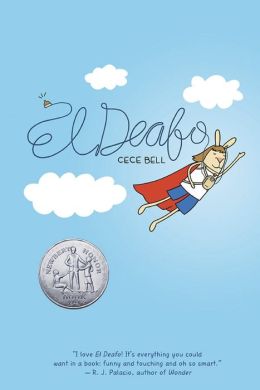
El Deafo (2014)

El Deafo. Cece Bell. 2014. Harry N. Abrams. 233 pages. [Source: Library]

I put El Deafo on hold at the library not knowing it was a graphic novel. In a way, I'm glad I didn't know. I don' t read many graphic novels, there are, of course, exceptions to every rule. El Deafo is a coming-of-age memoir in graphic novel format. I loved it. I really loved it. It surprised me in all the right ways.

It begins simply, "I was a regular little kid. I played with my mom's stuff. I watched TV with my big brother, Ashley, and my big sister, Sarah. I rode on the back of my father's bicycle. I found caterpillars with my friend Emma. And I sang. 'We all live in a yellow submarine, a yellow submarine--' But then everything changed." A childhood illness at the age of 4--meningitis--leaves her deaf.

The memoir covers many years of her childhood, from the age of four through her sixth grade year in school. In a way it is about her growing up deaf, growing up different. But in many ways, it is about so much more than that: it's about family and friendship and belonging and struggling to belong. It is about her wanting and needing a 'true' friend. It is about her mishaps in friendships. There are a few untrue friends before there is the one that is true. It is very much about identity: how she sees herself, her struggle to be comfortable with herself, to accept and love herself. Another aspect of El Deafo which I very much enjoyed is Cece's first crush.

In her imagination, she's closer to being there, in that place. She imagines that she is a superhero, El Deafo, the super-hero self stands up for herself to her friends AND her family. Her super-hero self lets others know what she's feeling, when she's mad, when her feelings are hurt, etc. Her superhero self is brave and courageous letting others know that she doesn't need people to talk really loudly or really slowly. Her superhero self lets people know that she hates it when they call her "my deaf friend" or "that deaf kid."

El Deafo is set in the 1970s, I believe. There are plenty of cultural references to place it in that decade. I really enjoyed the scenes where she was watching TV.

So, yes, El Deafo is in my opinion about so much more than growing up deaf. This book is easy to love and oh-so-easy to recommend.

© 2015 SukaYuka.com of SukaYuka's Book Reviews

Sunday, January 4, 2015

Meet Father Christmas

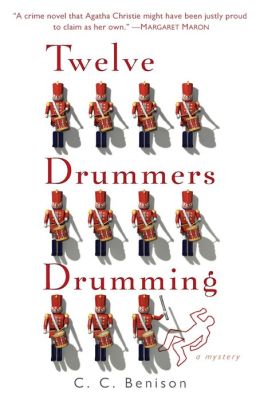
Twelve Drummers Drumming. Father Christmas Mystery #1. C.C. Benison. 2011. Doubleday. 384 pages. [Source: Library]

Twelve Drummers Drumming is the first in the Father Christmas mystery series by C.C. Benison. Tom Christmas, the hero, is a vicar in the village of Thornford Regis. He's a widower with a nine year old daughter, Miranda. Both are still healing and adapting. Tom's wife was murdered. So why settle in Thornford? Tom and his daughter were visiting his sister-in-law and her husband about a year before the novel opens. There was a funeral in the village that day, but, the vicar was missing. Tom Christmas (Father Christmas as people can't help calling him!) stepped in and performed the funeral service. When the position became available, Tom wanted the job for keeps. But village or hamlet life isn't all cozy. There are a few mysteries to be solved. And since Inspector Bliss and Inspector Blessing aren't quick to solve cases, Tom's skills come in handy. Tom is good at observing things, and, it helps that people can't seem to help confiding in him and telling their secrets.

So there are two murders to solve in Twelve Drummers Drumming. I won't say a word about the crimes and the clues. I hate having mysteries spoiled! Just as important as the clues, if not MORE important than the clues are the characters. That I can safely comment on! I really enjoyed the depth of the characters!

Overall, I would say that Twelve Drummers Drumming is an entertaining and satisfying read. I enjoyed spending time with the characters. I would recommend it!

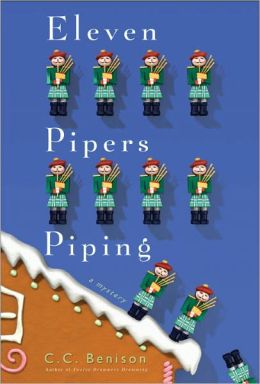
Eleven Piper Piping. Father Christmas Mystery #2. C.C. Benison. 2012. Delacorte. 474 pages. [Source: Library]

I think I enjoyed the second Father Christmas mystery even more than the first. Tom Christmas is the vicar of Thornford Regis. He is also the chaplain to a traditional Scottish pipe band, The Thistle But Mostly Rose South Devon Pipe Band. While Tom's daughter, Miranda, is having a sleepover, and his housekeeper, Madrun, is panicking about a failed yorkshire pudding, Tom Christmas is off--for better or worse--to the Burns Supper. But the weekend is problematic. The horrible weather--the blizzard-like conditions--means that half the band is unable to come, which leaves us with ELEVEN pipers piping. But while half the band is unable to make it through the storm, there is one unexpected guest that shows up at the local hotel where the Burns supper is being held. That guest is Judith Ingley, a retired nurse. Though usually women aren't allowed to attend, they don't turn her away in the storm.

Eleven Pipers Piping IS a murder mystery. So I won't share any details about the crime(s) or victim(s). I will say that the reader gets to spend plenty of time with Father Christmas as he interacts with the whole village before, during, and after the crime. I really enjoyed the setting very much. The characterization didn't disappoint.

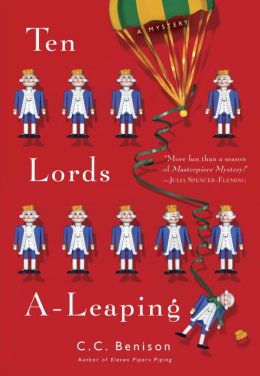
Ten Lords A-Leaping. Father Christmas #3. C.C. Benison. 2013. Delacorte. 512 pages. [Source: Library]

I wish I could give a rating for the first half and a rating for the second half.

Ten Lords A-Leaping is the third book in the Father Christmas series. In Eleven Pipers Piping, Father Christmas brings up a fund raiser idea to help pay for repairs on the church building. It involves sky diving. Ten Lords A-Leaping sees the event through. It is NOT set in Thornford Regis, unfortunately. I think I would have enjoyed it more if it had been.

So. The novel opens with the sky diving. In his jump, Tom has a little accident in the landing with his ankle, an accident that changes his plans and prolongs his visit in that part of the country. He is asked to stay over at Eggescombe Park. First, he's stuck there because of his own injury, then, he's stuck there because of a murder.

I really found myself hating the first half of the book. The series has never been squeaky clean, previous titles in the series have had a few words now and then that keep it from being perfectly clean. Still, it wasn't enough to keep me from reading, from wanting to read on in the series. But Ten Lords A-Leaping turns smutty. And smut in a creepy, inappropriate way. To the book's credit, Tom ends up feeling disgusted by the end of the novel with his own experience. But still.

Even though I really disliked much of the beginning and middle, I kept reading. And the mystery aspects of the novel began to grow on me a bit. I can't say that I "liked" it better than the first two in the series. I can't even say that I "liked" the majority of the characters. There were plenty of despicable characters. I'd say there were more despicable characters than nice ones. But. That is part of the genre, I suppose.

I enjoyed this one enough by the end, but, honestly I was a bit disappointed with this one.
© 2015 SukaYuka.com of SukaYuka's Book Reviews

Saturday, January 3, 2015

Seuss on Saturday #1

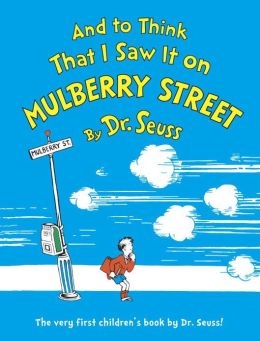
And to Think That I Saw It On Mulberry Street. Dr. Seuss. 1937/1964. Random House. 40 pages. [Source: Library]

First sentence:
When I leave home to walk to school, Dad always says to me, "Marco, keep your eyelids up and see what you can see."
Premise/Plot: While Marco is on his way home, he plans what to say to his father when he asks what he's seen. Marco really sees just a horse and wagon. But what he imagines he sees, well, it gets outlandish. What will he end up telling his father? a pack of lies? or the truth?

My thoughts: It's been years since I read this one. And it is a bit dated when you think about it. For example, as Marco gets carried away with his story, he imagines a reindeer pulling a sled. But he stops himself by adding,
Say--anyone could think of that,
Jack or Fred or Joe or Nat--
Say, even Jane could think of that.
Also of note, it includes a "Chinese man who eats with sticks..." and the illustration of course is not ideal. I'm not mentioning these things to say that the book is "bad" and doesn't belong in your child's library. Just noting that times have changed quite a bit since 1937!!!

Overall, I'd say I liked this one. Didn't necessarily "love" it. But I like it. How many picture books from the 1930s are still in print?! Well, I suppose there's The Story of Ferdinand, Mike Mulligan and His Steam Shovel, Madeline, and The Story of Babar. There may be others as well.

Have you read And To Think I Saw It On Mulberry Street? Did you like it? love it? hate it? I'd love to know what you think of it!

If you'd like to join me in reading or rereading Dr. Seuss' picture books (chronologically) I'd love to have you join me! The next book I'll be reviewing is The 500 Hats of Bartholomew Cubbins.

© 2015 SukaYuka.com of SukaYuka's Book Reviews

Friday, January 2, 2015

Cartwheeling in Thunderstorms (2014)

Cartwheeling in Thunderstorms. Katherine Rundell. 2014. Simon & Schuster. 256 pages. [Source: Library] Mild spoilers.

The heroine of Cartwheeling in Thunderstorms is a girl named Will Silver (full name Wilhelmina, don't dare call her Wilhelmina though!). Will loves living on a farm in Zimbabwe. Her father doesn't own the farm--Captain Browne does--but he manages it. She can't remember her mother, but, life there with her father and her friends (mostly farm workers and local boys) and her animals is near perfect. Until her father dies from malaria. Just like her mother.

After his death, Captain Browne is her legal guardian. The problem? Well, this older gentlemen has fallen head over heels in love with a horrible woman with an evil plan. At least that's how Will sees it. Will soon finds herself heading off to England and boarding school. The situation seems bleak. And it is. And I think that's one reason why I didn't exactly love Cartwheeling in Thunderstorms. It is a bleak middle grade read with little hope. I like hope. I need hope. Will finds herself in dozens of desperate situations, and, it doesn't get better, it just ends. True to life? Probably. Is it important to be true to life and authentic? Sure.

Will is displaced. She's out of her element in England and at school. She's never interacted with girls her own age. She's never formally attended school. She's never had to follow rules. So she struggles with EVERYTHING. For example, she struggles with the concept of staying inside, staying inside classrooms and buildings during school, of staying in her room at night and sleeping. She can't understand why no one will let her sleep outside wherever she wants whenever she wants. She can't understand why no one wants to be near her despite the fact that she hasn't changed clothes or taken a bath or washed her hair or even brushed her hair in three weeks or so. She gets angry when people tell her to use a fork and knife to eat. So it's an understatement to say she's out of her element.

The book is interesting enough, I suppose. But I didn't really enjoy it very much.

© 2015 SukaYuka.com of SukaYuka's Book Reviews

Wednesday, December 31, 2014

Greenglass House (2014)

Greenglass House. Kate Milford. 2014.  Houghton Mifflin Harcourt. 384 pages. [Source: Library]

I had very high expectations for Kate Milford's Greenglass House. I loved, loved, LOVED Kate Milford's The Boneshaker. My love for that one hasn't faded a bit since I first read it. (I've reread it at least once or twice since.) Greenglass House is one that I've been looking forward to reading for most of the year. Almost a book I NEEDED to read instead of merely being one I wanted to read. And the opening paragraph was wonderful:
There is a right way to do things and a wrong way, if you're going to run a hotel in a smugglers' town. You shouldn't make it a habit to ask too many questions, for one thing. And you probably shouldn't be in it for the money. Smugglers are always going to be flush with cash as soon as they find a buyer for the eight cartons of fountain pen cartridges that write in illegal shades of green, but they never have money today. You should, if you are going to run a smugglers' hotel, get a big account book and assume that whatever you write in it, the reality is, you're going to get paid in fountain pen cartridges. If you're lucky. You could just as easily get paid with something even more useless. Milo Pine did not run a smugglers' hotel, but his parents did.Unfortunately, for me, the book proved disappointing. However, just because it was an almost for me does not mean that it would prove equally disappointing to other readers. I think it could definitely work for other readers. In fact, the very elements that annoyed me may be what another reader loves best of all about the book.
For a book set during the Christmas holidays, this is a very un-Christmas-y book. Christmas proves to be the last thing on every character's mind. So if you pick up the book thinking, A Christmas book! A Christmas mystery! How delightful! You may be disappointed.

Greenglass House is very much a mystery. It is a puzzle-solving mystery. It is a book that celebrates brainstorming. Milo, our hero, finds a map. He doesn't know anything at all about the map. Just that one of the new guests must have dropped it--either on purpose or by accident--on his/her way into the inn. Perhaps he first becomes curious out of boredom or frustration. It is the holidays. The inn never has--that he can recall--had guests over the winter holidays. So when three or four guests appear within an hour or two of each other, he's annoyed. Guests mean work. If not work for him directly, then work for his parents. And the guests range from slightly eccentric to VERY eccentric.

Greenglass Mystery is more than a mystery. I can't talk about it without spoiling it, however.

So what annoyed me most about the Greenglass House? The game-playing. The introduction of the role-playing game in order to solve the mystery at the inn. All the details--big and small--that come from the game. Including the names. Most of the book, the characters use their game-names (personas) instead of their real names.

There are also elements of a coming-of-age story within Greenglass House. Milo is adopted. He's Chinese. His parents are white. He thinks about being adopted a lot. Plus, I think he's just at that age where one questions their identity and who they are and why they are and what they want to be and where they fit and how they fit.

© 2014 SukaYuka.com of SukaYuka's Book Reviews

Thursday, December 25, 2014

Tumtum & Nutmeg: The Rose Cottage Tales

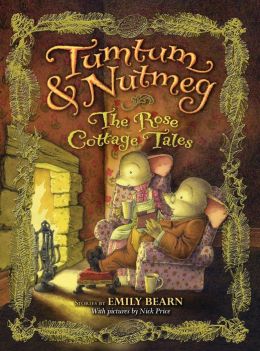
Tumtum & Nutmeg: The Rose Cottage Tales. Emily Bearn. 2010. Little Brown. 416 pages. [Source: Library]

Tumtum & Nutmeg: The Rose Cottage Tales features three stories starring some of my favorite mice: A Christmas Adventure, A Seaside Surprise, and A Circus Adventure.

In A Christmas Adventure, Tumtum and Nutmeg worry that the Mildew children (Arthur and Lucy) won't have Christmas this year unless they intervene. The mice read their letters to Santa. Arthur wants a toy car. Lucy wants a box of magic tricks. Can two mice give the children a Christmas to remember? Of course! Can two mice make an adventure of Christmas? Yes! Tumtum and Nutmeg seek to find the children presents locally. Baron Toymouse reigns over a nursery at a nearby house. (The children have long since grown up. He rules the former play room.) Baron Toymouse HAS a horrid reputation. But Tumtum and Nutmeg would risk just about anything to help the two children they've come to love so much. (They are more involved in Arthur and Lucy's upbringing then Mr. Mildew.)

In A Seaside Surprise, Tumtum and Nutmeg vacation with Arthur and Lucy (again). General Marchmouse also tags along. The two children are spending their holiday with their uncle or great-uncle. I enjoyed this adventure more than earlier ones, I believe. Or else I've come to appreciate the nonsensical General Marchmouse!

In A Circus Adventure, birthdays are celebrated. General Marchmouse has been invited to dine with Tumtum and Nutmeg. Unfortunately, he doesn't show up at his own party. Why? Well, he spies a present. It was Arthur's birthday as well. His uncle has sent a lovely present. A circus. A circus with a bus. General Marchmouse gives into temptation, he steals the bus and the ringmaster's clothes. He takes the bus for a trip outside and happens upon a circus in the meadow. A mouse circus of sorts. The book presents General Marchmouse at his best and worst. Can Tumtum and Nutmeg intervene and save all concerned?!

I was surprised that I liked/really liked ALL three stories. I was expecting to like one or maybe even two. But I really enjoyed all three stories. I was expecting to like A Circus Adventure the least, and, it may just be my favorite!!!

I would definitely recommend the six books I've read so far.
© 2014 SukaYuka.com of SukaYuka's Book Reviews

Wednesday, December 24, 2014

When Santa Fell to Earth

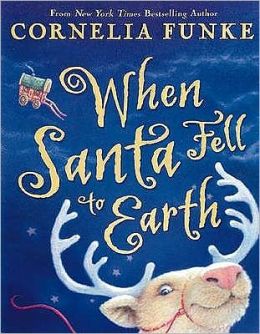
When Santa Fell To Earth. Cornelia Funke. Translated by Oliver Latsch. 1994/2006. Scholastic. 167 pages. [Source: Library]

I don't know what I was expecting exactly with Cornelia Funke's When Santa Fell to Earth. Was I disappointed with the reading experience? Not really. Funke's "Santa" may not have matched my expectations, but, once I got used to her take on "Santa" and his "elves," it worked fine for me. This book is certainly creative. It offers readers a) invisible reindeer, b) cursing elves, c) evil Nutcracker goons and d) chocolate santas. It is a very odd book in a way. Almost a Twilight Zone take on Christmas. (Especially about the BOOTS.)

The book begins with a failed escape of sorts. Niklas Goodfellow is a Santa on-the-run. He's been put on trial and unfairly sentenced. He isn't all on his own. There are a few elves and angels on his side in his caravan, a few who still "get" what Christmas is all about. But it's a dangerous time for them all. They may have initially escaped, but, they have crashed. They landed in small neighborhood. They may eventually get away BEFORE they're discovered, but, every day they remain, every day it takes to repair things increases the risk.

Charlotte and Ben are the kid heroes of When Santa Fell To Earth. They are the two that interact with Niklas Goodfellow and his angels and elves. They are the two that find the naughty reindeer, Twinklestar. They are the two that fight alongside Santa and his elves against the oh-so-evil Gerold Geronimus Goblynch.

The book is certainly interesting and entertaining. But it's also ODD.
© 2014 SukaYuka.com of SukaYuka's Book Reviews

Monday, December 22, 2014

Wars of the Roses (2014)

The Wars of the Roses: The Fall of the Plantagenets and the Rise of the Tudors. Dan Jones. 2014. Viking Adult. 416 pages. [Source: Library]

I wouldn't say I'd read just any book on this subject. But I would say I'd read almost any book on this subject. I've read plenty nonfiction and fiction covering these decades of English history. I find it fascinating yet brutal.

The Wars of the Roses: The Fall of the Plantagenets and the Rise of the Tudors was originally published as The Hollow Crown in the UK. It focuses on the lives of Henry V, Henry VI, Edward IV, Richard III, Henry VII, and Henry VIII. Others come into it as well: men and women who had a role to play in the "Wars of the Roses." I can imagine that if you're completely new to the subject, there would be a lot of names to keep up with, a lot of connections to remember. I didn't find that to be the case, however. I found the story was clearly told, with plenty of detail. It is an engaging read. It can lead you to plenty of "what ifs..." Because the story of how Henry VII came to the throne is just like that. He wasn't a likely candidate, in other words. If there hadn't been decades of distrust and betrayals and executions and battles, he'd never have stood a chance.

The book has plenty of drama, and I'd say it does a good job bringing the subjects to life or revealing their character or personality. I think the book makes an effort to quote what contemporary records had to say about any given king, what reputation they had during their reign and directly afterwards.

I would say that both The Plantagenets and The Wars of the Roses are great at illustrating that all the kings had weaknesses. There was never one completely perfect king. Some kings had more strengths than weaknesses. Some kings had more weaknesses than strengths. Some kings came to reign at exactly the right time when their country needed their strengths and could overlook their weaknesses. Some kings came to reign and didn't have what the country needed--at least not at that time. The books are also a great reminder of how DIFFERENT things were in the past, of how BLOODY and CRUEL politics could be. It wasn't just one king here and there that proved execution-happy or power-hungry, and, it wasn't just English kings either. If you put the times into context, you'll see that's just how things were all over Europe, and probably even broader than that.

For some potential readers, there's only ONE question: Does Dan Jones say that Richard III killed his nephews?! This is what the book says exactly, "All we can be sure of is that the boys were first disinherited, then deprived of their liberty and servants, and that they then disappeared, presumed dead by contemporaries across Europe. And the person who benefited most from their disappearance was Richard III" (278). That is all the book says about WHO might have done it. It does not suggest others who may have had motive and opportunity. But he doesn't spend time elaborating--speculating--on how, when, where, and why Richard did it. That was a big relief to me. Yes, I would have preferred for him to mention OTHER possible murderers, to be completely fair. BUT at least he didn't spend pages and pages building up a case against Richard murdering his nephews in the tower. Those two sentences are it. That is all the time he spends on the subject. So I think it would be overreacting to reject the whole book based on two sentences. The book covers decades of material. It covers the reigns of SIX kings. You can doubt his conclusion, and still benefit from the book as a whole.

© 2014 SukaYuka.com of SukaYuka's Book Reviews

Sunday, December 21, 2014

Eight More Christmas Books

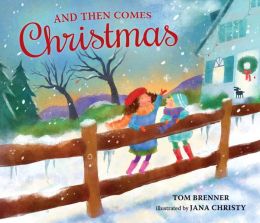
And Then Comes Christmas. Tom Brenner. Illustrated by Jana Christy. 2014. Candlewick Press. 32 pages. [Source: Review copy]

With some picture books, you almost have to read them a few times before you decide if you like them or not. Such is the case with Tom Brenner's And Then Comes Christmas.

And Then Comes Christmas is all about establishing atmosphere and celebrating traditions. Atmosphere is established by description and detail. Phrases like "bare branches rake across the sky" and "romp in snow as smooth as bedcovers." Traditions are celebrated: choosing a tree, decorating a tree, making cookies, wrapping presents, reading stories, attending programs, making crafts, seeing Santa at the mall, etc. Some traditions will likely be familiar. Some may not be. Not every child gets to play in the snow before Christmas--or after Christmas, for that matter! But all children could choose to make paper snowflakes to decorate their windows.

It is a book that slowly and gently counts down to Christmas. (Though not with actual numbers.) There is a certain pattern to it...multiple when/then passages.

I think my favorite when/then passage is:
When elves and reindeer appear in stores, and small trains race through toy villages, and piles of presents nestle in cotton drifts...Then hop from foot to foot, waiting to sit on Santa's knee."
I like this one well enough. But I would hate to have to diagram any of these sentences!

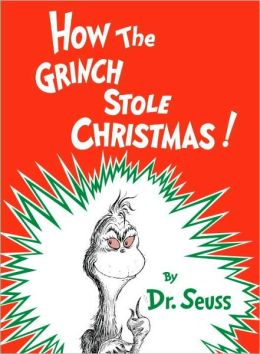
How the Grinch Stole Christmas. Dr. Seuss. 1957. Random House. 64 pages. [Source: Review copy]

I love it. Of course I love it. How could I not? Now, I will admit that I didn't read the actual book until I was an adult. It wasn't one of the Seuss books that I owned growing up. But the christmas special--the cartoon--is one I've seen dozens and dozens of times. The book itself is lovely. If you love one, you'll love the other.

So in case you're unfamiliar with the book or special, The Grinch hates Christmas. His neighbors, the Whos in Who-ville, love Christmas. He is super-cranky this year, and, he decides to steal it. He thinks Christmas is all about the stuff. Take the stuff, do away with it altogether, right? Wrong. The Whos in Who-ville teach the Grinch a lesson about joy.

One of my favorite things about it is it's just SO quotable. Here are a few of my favorite lines:
Every who down in Who-ville liked Christmas a lot...But the Grinch, who lived just north of Who-ville, did NOT!
And THEN they'd do something he liked least of all! Every who down in Who-ville, the tall and the small, would stand close together, with Christmas bells ringing. They'd stand hand-in-hand. And the Whos would start singing. They'd sing! And they'd sing! AND they'd SING! SING! SING!
Then he slid down the chimney. A rather tight pinch. But, if Santa could do it, then so could the Grinch.
Then the last thing he took was the log for their fire! Then he went up the chimney, himself, the old liar.
It came without ribbons! It came without tags! It came without packages, boxes, or bags!"

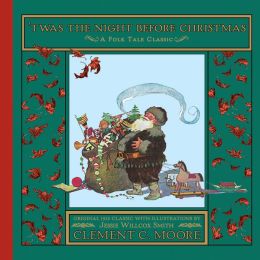
'Twas the Night Before Christmas. Clement C. Moore. Illustrated by Jessie Willcox Smith. 1823/1912. HMH. 32 pages. [Source: Review copy]

I've read 'Twas the Night Before Christmas plenty of times before. But this is the first time I've read the edition of the poem published as a picture book in 1912 with illustrations by Jessie Willcox Smith.

The poem itself is as delightful as it ever is. I think this is a poem that feels familiar no matter what. You don't have to seek it out year after year. It just finds you and sticks. It's just part of the Christmas culture. (I love the Sesame Street play starring Bert and Ernie as featured in Muppet Family Christmas.)

It was interesting to see the illustrations from this time period. (You may see the illustrations at project gutenberg.) Did I love the illustrations? Not particularly.

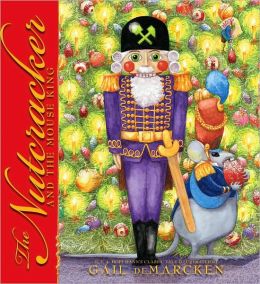
The Nutcracker and the Mouse King. E.T.A. Hoffmann. Adapted by Wren Maysen. Illustrated by Gail de Marcken. 2009. 56 pages. [Source: Review copy]

I am not as familiar with the original story (1816) as I am the story of the ballet. (The two are different.) It's an odd book. I'll be honest. It is just as strange as Alice in Wonderland. (Though, of course, The Nutcracker and the Mouse King came decades before Alice.)

Marie Stahlbaum is the heroine of The Nutcracker and the Mouse King. The book opens with Marie and her brother, Fritz, playing together and waiting, waiting, waiting for all the delights of Christmas. They are waiting to enter the large drawing room where the tree is, and where the presents are. Their mother and father are there as well. As is Godfather Drosselmeier. There is a new doll, Clara, for Marie. There are new toy soldiers for Fritz. And there is a lovely toy castle, Marzipan Castle, for them both. The Nutcracker is a gift for the whole family. Marie does take special interest in it, this interest remains despite the fact that Fritz breaks the Nutcracker when he's showing off.

Marie stays up past her bedtime in the drawing room. This is when things get strange: seeing Godfather Drosselmeier on top of the clock, seeing all the mice attack, seeing the Mouse King, etc. She witnesses a battle. Towards the close of that battle, she throws a slipper at the wicked Mouse King.

Marie awakens in bed the next day. Her mother had found her bleeding on the floor near the tree and toy cupboard. She spends the next few days at least in bed. Spending so much time in bed might seem horrible, and, perhaps Marie found it to be so part of the time at least. But her Godfather tells her strange stories which she believes of course.

Plenty of The Nutcracker and the Mouse King is the Godfather's strange, strange story. This story is about "a king, a queen, some mice, and a young princess named Pirlipat." The story is rich in detail:
Princess Pirlipat was very lovely. She had flawless white skin, with bright blue eyes and flowing locks of golden hair. The generals, noblemen, and ministers of the state all told the king and queen that they had never seen a baby like the princess. Not only was the princess beautiful, but she was also born with two perfect rows of teeth!
The queen insisted that Princess Pirlipat's cradle always be guarded. The royal guards were placed at Pirlipat's door, and directly beside her cradle sat six nurses...and with these six nurses sat six big cats. The nurses had strict orders from the queen to keep one cat in each of their laps and pet them all day and all night so that they would never stop purring. This was indeed strange. No one knew why the queen went to such lengths to protect her princess, but still, every night, the sound of purring cats echoed throughout the castle. But the queen had a very good reason to be on guard, for a curse had been placed on her family.
Readers learn of the family curse, of course. And it's something. The story becomes more and more bizarre as it unfolds. But to Marie, it is completely captivating.

Meanwhile, we have not seen the last of the mice or their dreadful King. Marie knows that sooner or later the final battle will come....

There does come a time when the Nutcracker takes Marie to his magical, fantastic home in Toyland.

So readers see Marie awaken again from yet another dream. Will Marie's ultimate dream come true?

This story is so strange and bizarre and rich in detail--pure fantasy.

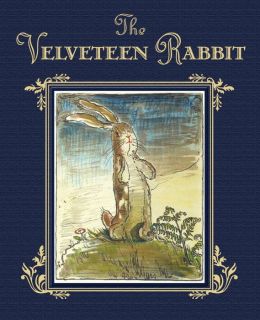
The Velveteen Rabbit. Margery Williams. Illustrated by William Nicholson. 1922/2014. Random House. 48 pages. [Source: Review copy]

Do you know what it is to be real? One little Christmas bunny will learn this and plenty of other life lessons in Margery Williams' classic tale The Velveteen Rabbit.

The Velveteen Rabbit opens with a young boy receiving a rabbit for a Christmas present. All is lovely for the rabbit that first day. But the toy is quickly forgotten. He becomes one toy of many, many, many toys. He's not exactly special to the boy or the other toys. In fact, I'd say the other toys bully him a bit. All except for the Skin Horse, the oldest toy in the nursery. It is this horse that tells the Rabbit all about being real, what it takes to be real, what it feels like, how it changes you, etc.
"Real isn't how you are made," said the Skin Horse. "It's a thing that happens to you. When a child loves you for a long, long time, not just to play with, but REALLY loves you, then you become Real." "Does it hurt?" asked the Rabbit. "Sometimes," said the Skin Horse, for he was always truthful. "When you are Real you don't mind being hurt." "Does it happen all at once, like being wound up," he asked, "or bit by bit?" "It doesn't happen all at once," said the Skin Horse. "You become. It takes a long time. That's why it doesn't often happen to people who break easily, or have sharp edges, or who have to be carefully kept. Generally, by the time you are Real, most of your hair has been loved off, and your eyes drop out and you get loose in the joints and very shabby. But these things don't matter at all, because once you are Real you can't be ugly, except to people who don't understand." "I suppose you are real?" said the Rabbit. And then he wished he had not said it, for he thought the Skin Horse might be sensitive. But the Skin Horse only smiled. "The Boy's Uncle made me Real," he said. "That was a great many years ago; but once you are Real you can't become unreal again. It lasts for always." (5-8)
The Velveteen Rabbit is one of my favorite Christmas books. I love the nursery magic. I love the ending. It was originally published in 1922. The story and illustrations in this edition are original. This is a beautiful edition of the book. One of the best I've seen.

The Velveteen Rabbit was published several years before A.A. Milne's Winnie the Pooh and House at Pooh Corner. Chances are if you enjoy one, you'll enjoy the other.

Do you have a favorite toy-come-to-life fantasy?

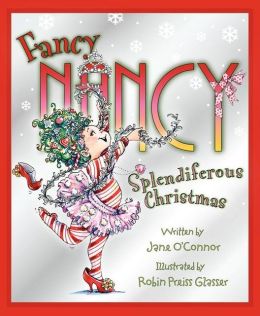
Fancy Nancy: Splendiferous Christmas. Jane O'Connor. Illustrated by Robin Preiss Glasser. 2009. HarperCollins. 32 pages. [Source: Library]

I enjoyed reading Fancy Nancy Splendiferous Christmas. This is actually the first Fancy Nancy book I've read, so it served as a good introduction to the series as well. I liked it very much. I love the illustrations. They were a bit busy, perhaps, but that is part of their charm, I think. I love the amount of detail. Every time I read it, I notice something I hadn't noticed before. There is something almost precious about this book--perhaps because of the illustrations, or even the text. But I don't mind that in a picture book now and then.

In this one, Fancy Nancy and her family are decorating the house for Christmas. They are doing plenty of christmas-y things all together as a family. One of things they are doing is waiting. Waiting is a big part of the holiday, in my opinion. They are waiting for the Grandpa to arrive. When he arrives, they can begin to decorate the tree. They always wait for him. And I imagine every year, she gets a bit impatient because she is oh-so-excited. This year, however, her parents allow her to put on the brand-new tree-topper, something that she picked out and bought with her own money--in the summer...I won't spoil this one. But I ended up liking it very much!
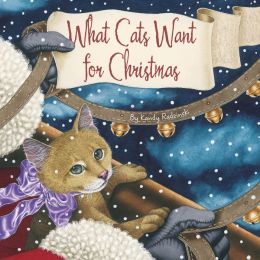
What Cats Want for Christmas. Kandy Radzinski. 2007. Sleeping Bear Press. 32 pages. [Source: Library]

For cat-lovers, this is a charming-enough book to read at Christmas time. The premise is simple: if cats could write letters to Santa, what would they ask for. Each spread shows a cat and his/her letter to Santa. The letters are all written in rhyme. The letters are predictable enough, but, the idea I think is original. I do wish there was more variety in what the letters requested, however. And some letters seem a bit dark and twisted.

I really liked the illustrations. I think I liked looking at the various cats better than reading the letters.

 It's Not About You Mr. Santa Claus. Soraya Diase Coffelt. 2014. Morgan James Publishing. 34 pages. [Source: Review copy]

There are plenty of children who write letters to Santa each year. But how many letters to Santa include the gospel message? In this picture book a young boy does just that.
Dear Mr. Santa Claus,
It's me again--a kid. I know I've written lots of letters to you before with long lists of gifts I wanted for Christmas. Well, not this year. This letter is different. I discovered the real meaning of Christmas has nothing to do with you at all. It is about a very special gift. I want to tell you about this gift. By the way, how are you and Mrs. Santa Claus doing? Have you lost any weight? Did your helpers, the elves, grow any taller? Do you still like cookies and milk? Are you still wearing that red, furry outfit? I've always wondered, what do you wear in the summer time?
It's a simple book with a timeless message. Which timeless message? Well, I suppose I could pick one or two that stand out. First, that Christmas is not about Santa and presents and shopping. It is actually about celebrating Jesus. Second, that the gospel is too good to keep to yourself. The gospel is for sharing.
The real Christmas story began a long time ago, when a Roman emperor named Caesar Augustus ordered that a census be taken. A census is when all the people had to be counted. At that time, A man named Joseph and his wife, Mary had to take a long journey to the city of David, known as Bethlehem, for the census. It wasn't an easy journey as Mary was going to have a baby soon.
The focus of this book is on retelling the Christmas story and communicating the gospel message. Probably leanings toward more retelling.

I was pleasantly surprised by the illustrations. I thought they were very nicely done.

Will this book please every single reader? Probably not. It may not be a perfect fit for every family this holiday season. But I think for some it will be a great find.


© 2014 SukaYuka.com of SukaYuka's Book Reviews
Tuesday, December 16, 2014

A Quilt for Christmas (2014)

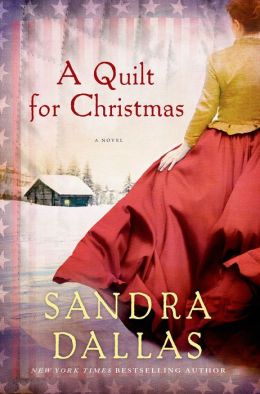
A Quilt for Christmas. Sandra Dallas. 2014. St. Martin's Press. 256 pages. [Source: Library]

For readers who love to read about quilters or quilts, this one may prove satisfying. Also, this one would be a good match for those who like to read about the Civil War. This one is set in Kansas during the last year of the Civil War. I liked Sandra Dallas' A Quilt for Christmas even though I don't consider myself fitting into the ideal audience. (I don't particularly seek out books about quilts. I don't seek out historical fiction set during the Civil War.)

Eliza Spooner is the heroine. She loves, loves, loves to quilt. She loves to get together with other women in the community. The war has had an effect on the community. Many husbands (and brothers, fathers, sons, etc.) are gone, away fighting for one side or the other. Eliza's husband, Will, is fighting for the Union. The novel opens with Eliza finishing a quilt she's made for her husband. She'll be sending the quilt along with a soldier who is returning to her husband's unit from leave. Her love for her husband is obvious, and, not just because she's spent all this time making a quilt. There are dozens of flashbacks. These flashbacks give readers a chance to get to know the couple. However, I must admit that these flashbacks are confusing at times. They are not really set apart in the text, and the transition from present-day to the past can be sloppy at times.

Readers meet Eliza and her son and daughter. Readers meet men and women of the small community as well. Mainly, readers get to know Missouri Ann and her daughter. When Missouri Ann's husband dies, she takes the opportunity to flee from her abusive in-laws. Eliza opens her home to the pair, and this isn't without some risk. Missouri Ann's in-laws are probably without a doubt the meanest and cruelest in the county--if not the state. But not everyone in the community is as immediately open to including Missouri Ann in their group. Her in-laws have tainted her, a bit, no one wants to get close to someone who would marry into that family.

At one point, at a quilting party of sorts, the discussion of slavery and runaway slaves comes up. Opinions are mixed. Prejudices are voiced. Even though most of the women are for the Union--for the Yankees--most if not all have very strong views about blacks.

Eliza's own views will be tested when she's asked to hide a runaway slave: a woman who murdered her mistress. Will she welcome her home to this slave and put her own life and the lives of her children at risk?

A Quilt for Christmas is an odd book at times. It seems to have a handful of plots and stories, any one could be the MAIN one, but really not one seems to stand out as being the one it's all about. It's definitely NOT a plot-driven book. It's mainly about the lives of women in a particular community during the fall of 1864 and throughout 1865.

© 2014 SukaYuka.com of SukaYuka's Book Reviews

Monday, December 15, 2014

Brown Girl Dreaming (2014)

Brown Girl Dreaming. Jacqueline Woodson. 2014. Nancy Paulsen Books.  336 pages. [Source: Library]

Brown Girl Dreaming is a lovely, often fascinating, memoir written in verse. "Verse novels" can be tricky for me. Sometimes I love them, sometimes I really don't. But in this case, it works well. The writing is just lovely, for the most part. The book is rich in detail capturing what it was like to grow up in Ohio, South Carolina, and New York in the 1960s and 1970s. The people. The places. The sights, sounds, and tastes. The feelings. It's a book that feels personal: an intimate look at family and friends. I very much enjoyed reading it.

Brown Girl Dreaming is a memoir of an author. So it's no big surprise that the focus of this one is on words and stories and reading and writing, of using words and stories to make sense of the world, or, to make a whole new world. But in addition to being about an author's journey, it is a novel about identity as well: who am I, why am I here, what am I supposed to do, etc.
How can I explain to anyone that stories
are like air to me,
I breathe them in and let them out
over and over again. (247)
© 2014 SukaYuka.com of SukaYuka's Book Reviews

Sunday, December 14, 2014

Eight Christmas Books

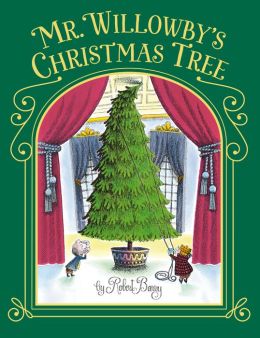
Mr. Willowby's Christmas Tree. Robert E. Barry. 1963. Random House. 32 pages. [Source: Library]

Mr. Willowby's Christmas tree came by special delivery. Full and fresh and glistening green--the biggest tree he had ever seen. He dashed downstairs to open the door--This was the moment he'd waited for.

I loved, loved, loved Mr. Willowby's Christmas Tree. It celebrates giving in a fun and playful way. Mr. Willowby starts off a long chain of giving when he chops off the top of his too-tall Christmas tree. A tree that is splendid in every other way. He gives the tree-top to the upstairs maid. She's delighted. Very delighted. How thoughtful! How cheery! But the tree is too-tall for her small room. The top must go! Chances are you can predict at this point how the story will go. But that doesn't mean it is in any way less delightful. This little tree-top gets passed down and re-trimmed again and again and again and again and again. And it's just WONDERFUL to see how much happiness and cheer it brings to others.

I loved the premise. I loved the writing. The rhyming was delightful. It worked very well for me! I think this one would make a great read-aloud. I also loved how uplifting it is. (After reading Baboushka and the Three Kings, I needed a cheery story!)

Why didn't someone tell me about this wonderful and charming picture book?! Why?! Well, I am glad to have discovered it now!

Which Christmas books would you consider classic? Which would you recommend?

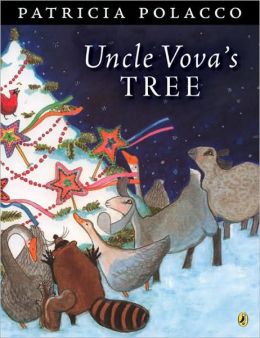
Uncle Vova's Tree. Patricia Polacco. 1989. Penguin. 32 pages. [Source: Library]

Uncle Vova's Tree is rich in detail and tradition. The author, Patricia Polacco, is drawing from her past and recalling some of her childhood Christmases. She writes, "As a child I celebrated Christmas as most American children did, but at Epiphany in January, my brother, my two cousins, my grandparents and I would go to the farm of my Great Uncle Vladimir and Aunt Svetlana to celebrate in the Russian tradition." The book recalls two family gatherings specifically. The first is Uncle Vova's last Christmas. Though of course, most everyone did not *know* it would be his last Christmas. The second is that first Christmas without him. The book definitely has tones of sadness, but, it is ultimately hopeful. Memories, good, strong happy memories, remain.

The book is rich in detail and tradition. It is informative in many ways. Did you know about the tradition of putting hay underneath the tablecloth to remember and honor the stable in Bethlehem where Jesus was born? But in addition to honoring tradition--in this case, Russian tradition--it also celebrates families. Readers meet a family that is close and loving and supportive. Little details make this one work well.

Too Many Tamales. Gary Soto. Illustrated by Ed Martinez. 1993. Penguin. 32 pages. [Source: Library]

Snow drifted through the streets and now that it was dusk, Christmas trees glittered in the windows.

Too Many Tamales is a great family-oriented Christmas story. Maria, our heroine, is helping her mom make tamales. She loves helping her mom, loves being grown-up in the kitchen. But things don't go smoothly with this first batch of tamales. And it is her fault. Mostly. Maria really, really, really wanted to try on her mom's ring. Unfortunately, this-too-big ring falls right into the masa mixture. Hours later, she realizes that she never took the ring off. She doesn't know for sure where the ring is. But she has a strong suspicion that it may very well be in one of the twenty-four tamales. With a little help from her cousins, Maria is in a race to find the ring before her mom--and all the other relatives--realize what has happened. Will she find the ring? Will her mom find out? Will her cousins ever want to eat another tamale?!

I liked this one very much.

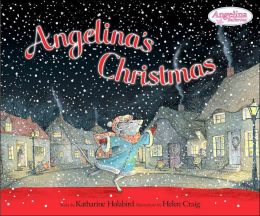
Angelina's Christmas. Katharine Holabird. Illustrated by Helen Craig. 1986. Penguin. 32 pages. [Source: Library]

Christmas was coming, and everyone at Angelina's school was working hard to prepare for the Christmas show.

I enjoyed reading Angelina's Christmas. I enjoyed meeting Angelina and her family. I loved how thoughtful and empathetic Angelina was. She realizes that there is one house in the village that is not decorated. She notices that there is one "old man huddled by a tiny fire." She learns from her parents that this old man is Mr. Bell, a retired postman. She decides that she will do something special for him so he won't be all alone at Christmas time. (And Angelina isn't the only one joining in to help make this Christmas memorable for Mr. Bell.) She makes him cookies, her mom sends along mince pies and fruit, her dad cuts him a Christmas tree. They visit him, Henry, Angelina's brother comes along too. But perhaps even more importantly than showing him kindness through things, they take the time to listen to him, to include him. This one is a lovely book.

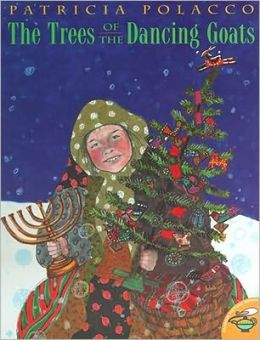
The Trees of the Dancing Goats. Patricia Polacco. 2000. Simon & Schuster. 32 pages. [Source: Library]

At our farm just outside Union City, Michigan, we didn't celebrate the same holidays as most of our neighbors...but we shared their delight and anticipation of them just the same.

I enjoyed reading The Trees of the Dancing Goats by Patricia Polacco. She is sharing yet another holiday memory with young readers in this picture book.

The story focuses on one holiday season when the town is hit by an epidemic, scarlet fever, I believe. The heroine's family is not sick, but, most of their neighbors are. As they are preparing to celebrate Hanukkah, they realize that most of their neighbors are too sick to prepare for and celebrate Christmas. They love their neighbors. They want to do something for them. Working together as a family, they decide to bring Christmas to their neighbors: food, a tree, decorations. Since they don't own any Christmas ornaments, they use animals carved out of wood. One of the animals, as you might have guessed, is a goat. When hung on the tree, it appears to be a dancing goat. Can one family bring Christmas cheer to a community?

I liked this one. I liked the family scenes very much. It is a thoughtful book. I'm glad I finally discovered it!

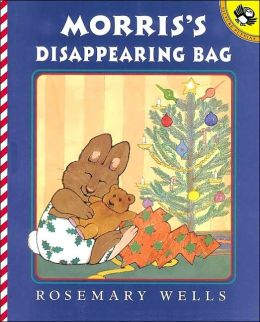
Morris' Disappearing Bag. Rosemary Wells. 1975. Penguin. 40 pages. [Source: Library]

It was Christmas morning. "Wow!" said Morris.

Morris' Disappearing Bag probably isn't my favorite Rosemary Wells, but, this one is enjoyable enough that it's worth reading at least once or twice. Morris stars in this one. He has three older siblings: one big brother, Victor, and two older sisters, Rose and Betty. It is a Christmas book, of course. After all the presents are opened, the three older siblings play with their presents and play with each others presents. Victor got hockey stuff. Betty got a chemistry set. Rose got a beauty kit. They take turns sharing. Much fun is had. But not by all. For Morris has only his present (a teddy bear) to play with. He doesn't get a turn with his siblings' presents. But that changes when Morris discovers a fantastic present under the tree. A bag. A disappearing bag. Whatever is in the bag disappears. His siblings all want a turn, and, he lets them in the bag. While his siblings have disappeared for the day, Morris plays with their stuff before settling into bed with his bear.

Max's Christmas. Rosemary Wells. 1986. Penguin. 32 pages. [Source: Library]

I love watching Max and Ruby. I've seen the adaptation of Max's Christmas plenty of times before I read the book. If you like the show, chances are you'll enjoy reading this book. It is very similar. For those new to these lovable siblings, Ruby is the older sibling. She seems to be raising Max all on her own. (Ruby and Max don't have parents. They have a Grandma, but, she does not live with Max and Ruby.) Max is the younger sibling. He is many things: cute, clever, curious. Yes, he can be mischievous, but, he is also super-observant. I love, love, love them both. I might like Max a tiny bit better than Ruby. But still. I love them both.

In this book, readers join Ruby and Max on Christmas Eve night. Ruby is trying her best to get Max to get ready for bed, to go to sleep. Max is excited, of course. Once he knows that Santa is coming to his house tonight, he wants to see it for himself. So he goes downstairs to wait for Santa....

I liked this one very much.

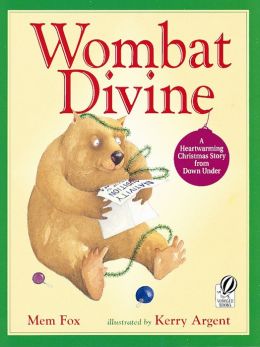
Wombat Divine. Mem Fox. Illustrated by Kerry Argent. 1995/1999. HMH. 32 pages. [Source: Library]

I found Mem Fox's Wombat Divine to be charming. I loved Wombat. He loves, loves, loves Christmas. More than anything, he wants a part in the nativity play. At the auditions, he tries his best. But there are so many parts that he's just not right for. I love the refrain, "Don't lose heart. Why not try for a different part?" which is used throughout the whole auditioning process. He auditions for Archangel Gabriel, Mary, a wise king, Joseph, an innkeeper, and a shepherd. But there's one role that he'd be just perfect playing. Can you guess it?

I liked this one. I thought it was cute and sweet. I liked the writing. I found it unique and oh-so-right.

© 2014 SukaYuka.com of SukaYuka's Book Reviews
My Year with Jane: A Darcy Christmas

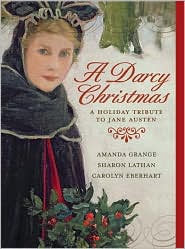
A Darcy Christmas: A Holiday Tribute to Jane Austen. By Amanda Grange, Carolyn Eberhart, and Sharon Lathan. 2010. Sourcebooks. 304 pages. [Source: Library]

I reread two of the three novellas in A Darcy Christmas. I reread Amanda Grange's Christmas Present and Carolyn Eberhart's Mr. Darcy's Christmas Carol. I chose not to reread Sharon Lathan's A Darcy Christmas. Each novella was around a hundred pages. A perfect length, in my opinion, for both stories.

Mr. Darcy's Christmas Carol is an interesting and often entertaining read starring Austen's characters and borrowing much from Charles Dickens. The premise is simple yet not completely predictable. Mr. Darcy is oh-so-happy that Bingley and Jane have married. But. He's still alone this holiday season. Unlike the original, he did not propose marriage to Elizabeth soon after Bingley and Jane's happy announcement. Georgiana, his sister, wants a new sister, a new particular sister for Christmas. His cousin has made a similar request, a particular new cousin. It isn't that Darcy doesn't still love her, want her, need her. But he's a bit proud and stubborn. So on the Christmas Eve in question, Darcy is visited by the ghost of his father who warns him of his faults and promises the visits of three spirits in the night. He adds that they will come with familiar faces. (Can you guess which "familiar face" is the ghost of Christmas future?)

I have conflicting thoughts on Mr. Darcy's Christmas Carol. On the one hand, there would be scenes and passages where I'm: it works, it really works, I can't believe this is working!!! And then perhaps just a page later, I'm: I take it back, this doesn't work at all, how am I suppose to believe this?! So there were plenty of scenes I liked. I liked how she fit it all together and made it work at least some of the time. It would be hard to fit all the great bits of Pride and Prejudice with all the great bits of A Christmas Carol. So I'm surprised it worked as well as it did actually. I like how one of my favorite scenes of A Christmas Carol is reworked from the beginning to the near-ending. That was something! I don't LOVE this one necessarily. As I mentioned, there are places where it is an almost-but-not-quite. It was a fun idea, perhaps, but not absolutely flawless. I alternated between wanting to shout at the book, and cheering. Still, it's worth reading at least once.

What did I think of Amanda Grange's Christmas Present? I liked it very much!!! I tend to like or love Amanda Grange's Austen adaptations. I think she does a great job with keeping Austen's characters as we know them and love them. She is able to capture the essence of each character. In this novella, readers get a glimpse of their second Christmases. (I believe, the two couples married in November or possibly early December?) Bingley and Jane have a baby. Elizabeth and Darcy are oh-so-close to having a baby as well. But have-her-own-way Elizabeth is insistent that even though she is due to have a baby any day, she is perfectly capable of traveling a few hours by carriage so she can spend the holidays with her family. Darcy gives in, of course. So what does a family Christmas look like? Well, this family Christmas borders on insane! Through half-a-dozen coincidences it seems, that most of the family (minus Georgiana) are brought together to share these few days. Including some you might not be expecting to see: Lady Catherine. Mr. Collins. The novella is comical. It's just a satisfying way to spend an afternoon. Sometimes a good, quick read that is light-hearted fun is just what you need.

This is my final post for "My Year With Jane." Here's a look at all the posts about Jane Austen:
© 2014 SukaYuka.com of SukaYuka's Book Reviews
Tuesday, December 9, 2014

Palace of Spies (2013)

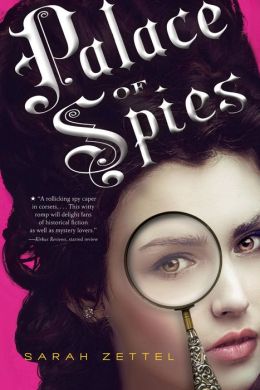
Palace of Spies. Sarah Zettel. 2013. Houghton Mifflin Harcourt. 368 pages. [Source: Library]

Peggy Fitzroy lives with her aunt, uncle, and cousin. She knows she's not wanted, her aunt and uncle have made that clear. But she gets along quite well with her cousin, Olivia. The novel opens with Peggy in a difficult position. Her uncle has arranged a marriage for her. She's not thrilled instead more than a little hesitant. Her hesitation only increases AFTER she meets him at a ball. Her intended isn't the only person she meets there, however. One other mystery man makes her acquaintance. He offers her a way out. He tells her that he knew her mother. He wants to make a deal with her, of sorts. He wants her to spy for him, to impersonate one of the Queen's maids. (Ladies-in-waiting?) He leaves her with his card. She's curious but just as hesitant about that option as well. If only she could have some control over her own future...

With a title like Palace of Spies, it's obvious what her choice was. She will become Lady Francesca Wallingham. Can she learn enough from Mr. Tinderflint and Mr. Peele? Do they know enough about her to tell her everything she needs to know to pass as this lady? Is either man trustworthy? What are their intentions? What will they do with the information she provides? Who can she trust at court? Did Lady Francesca have enemies? How will she be able to discern who her friends were and who her enemies were? Will she fool anyone? Will she fool everyone? Will she ever get a minute to call her own? How long will this deception last?

I enjoyed this one. I think I enjoyed it even more having read Lucy Worsley's The Courtiers: Splendor and Intrigue in the Georgian Court at Kensington Palace earlier this year. I was familiar with several of the characters. It was quite entertaining with a nice balance of danger and romance.

© 2014 SukaYuka.com of SukaYuka's Book Reviews
Monday, December 8, 2014

The Plantagenets

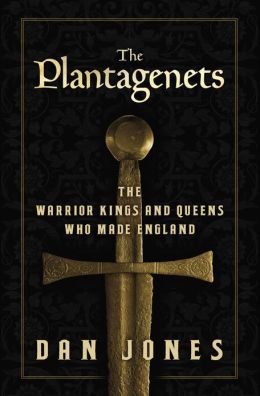
The Plantagenets. Dan Jones. 2013. Viking. 560 pages. [Source: Library]

I enjoyed reading this overview of British history. The book examines the reigns of a handful of Plantagenet kings: Henry II, Richard I, John, Henry III, Edward I, Edward II, Edward III, and Richard II. It spans several centuries: 1120-1399. It also overlaps a bit with French history.

The book opens with "The White Ship." It's a dramatic way to start a book. Henry I, the son of William the Conqueror, loses his son and heir in a shipwreck. Henry I has two dozen illegitimate children--give or take one or two. But his only legitimate child is a daughter, Matilda. He remarries hoping presumably to have another child--a son, a new heir. But that is not to be. He marries the widowed Matilda off--it was anything but a love match--and she starts having children of her own, many of them sons. He leaves his kingdom to his daughter, supposedly everyone has sworn their allegiance to her, but, in reality, she's never in a position to reign as queen. Her cousin, Stephen, reigns instead. War follows, naturally. It is not a short war, a quick and decisive war. It is a here and there, on-and-off again war where the people suffer for the family squabble most. Eventually, an agreement of sorts is reached, Stephen will pass the crown to Matilda's son, Henry II. He is the first Plantagenet king. Henry II, if you remember, is married to Eleanor of Aquitaine, the former French queen as well. They have many children together...

The book follows the reigns of each king. It goes into detail with politics and economics. It goes into detail with the struggles of each king. Their strengths and weaknesses, their battles. Sometimes these battles are with the church; sometimes these battles are with the French; sometimes these battles are with the Irish or the Welsh or the Scottish; sometimes these battles are with their own flesh and blood, their family; sometimes these battles are with their own countrymen, the barons, the nobility, or even the peasants. No one king has it all. No one king has a perfect, problem-free reign. It wouldn't necessarily be fair or right to sort the kings into two groups of "good" and "bad." Some kings had a reputation of being horrible, and yet they didn't do anything over and above what other kings before them or after them did. Writers of all centuries can label kings this or that, but, that is because historians can be biased. (Some are openly biased. Some not so much.)

As for the details about each king, what can I say? It's an overview, a detailed overview, to be sure. Some readers may be more of an expert and find fault with statements here and there throughout the book. They may spot myths presented as fact. But I certainly can't be among them. I don't know enough about each and every king.

I found the book to be interesting. Some chapters were more fascinating than others. Some chapters even seemed a bit confusing. But I kept reading.

© 2014 SukaYuka.com of SukaYuka's Book Reviews