Showing posts with label HarperCollins. Show all posts

Tuesday, January 13, 2015

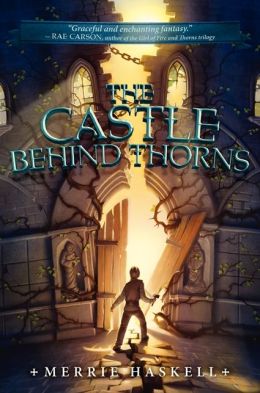
The Castle Behind Thorns (2014)

The Castle Behind Thorns. Merrie Haskell. 2014. HarperCollins. 336 pages. [Source: Library]

Sand woke, curled in the ashes of a great fireplace. Surprised to find himself waking at all, for he had no memory of falling asleep, Sand scrambled to his feet. Soot billowed from him in a cloud and sneaked up his nose. He sneezed four great sneezes that came back in lonely echoes from the vast room beyond the fireplace. Sand had never slept in a fireplace before. He never wanted to again. But he hesitated inside the fireplace, one foot suspended in midair, afraid to leave. In the room beyond, everything was broken. Every single thing.

I loved, loved, loved The Castle Behind Thorns. It is a retelling of Sleeping Beauty, I suppose. It puts a definite spin on it that is completely different from the original, but that is completely fascinating. Sand, the hero, wakes up in a fireplace in a castle that he's only heard stories about. The castle being abandoned quite suddenly when his own father was not yet grown. He finds himself very alone; he's the only living thing in the castle. (No growing plants, no bugs or insects, no birds, no mice, nothing). He keeps the panic to a minimum, in my opinion. Especially considering the situation! He's in an abandoned castle surrounded by hostile, vicious thorns. He explores. He plans. He mends. He learns and adapts. He's hungry and thirsty and tired. He finds a way to survive. In his exploring, he finds the family's crypt. He restores a body that had fallen, placing the young girl's body back gently and carefully.  Several days later, or some time later, readers meet the heroine Perrotte...

The Castle Behind Thorns is a beautiful story with memorable, well-developed characters. I enjoyed every minute of this one! The mystery is quite good! I would definitely recommend this one!

Read the Castle Behind Thorns
  • If you enjoy fairy tale retellings
  • If you enjoy good/great storytelling
  • If you like fantasy novels with a touch of magic
  • If you like mysteries 
  • If you like survival stories

© 2015 SukaYuka.com of SukaYuka's Book Reviews

Thursday, August 28, 2014

The Ostrich Conspiracy (2014)

Platypus Police Squad: The Ostrich Conspiracy. Jarrett J. Krosoczka. 2014. HarperCollins. 240 pages. [Source: Library]

I still like the premise of this mystery-detective series. But I think I liked the first book more than the second. Or else I was just really in the right mood to love the novelty of it, the humor of it. Mood does play a significant part sometimes. That being said, I did like this one. I liked our platypus heroes. I liked Zengo and his partner O'Malley. The book opens with a crime or potential crime. Something goes horribly wrong on the opening night of the new indoor/outdoor amusement park. As horribly wrong as you'd expect a juvenile mystery to get perhaps. Someone tampered with the power, people were stuck on rides for hours, the fireworks went off early and before the roof could be opened up, and the fireworks caused some fires. So not a great opening day but certainly memorable for all the wrong reasons. Zengo and O'Malley decide to take the case and see if it was all deliberate. They have a feeling it was, but, no proof at the beginning. They have strong feelings about some of the people--or should that be ANIMALS--involved. But they have to look for evidence and proof to build a case. Some characters readers met in the first book, but, plenty are new to the second book.

I liked this one. There are a handful of action sequences in it. Those who are looking for ACTION may like it more than the first one.

© 2014 SukaYuka.com of SukaYuka's Book Reviews

Wednesday, August 6, 2014

The One (2014)

The One. Kiera Cass. 2014. HarperCollins. 323 pages. [Source: Library]

One thing I can definitely say about all three books in this series is that they are all super-quick reads. Once I start reading, I don't want to stop. That being said, I can't say that I actually think about the books or the characters or the story after I'm done. I don't forget the story or the characters mind you. I've always liked that I can pick up the next book without any worries or confusion. That could be because the books aren't all that complex though.

In the third book, readers spend time with Prince Maxon and America Singer. She's one of four young ladies still in the running to be the next princess. The others are Celeste, Kriss, and Elise. Prince Maxon and America have always, always argued with one another. He brings out the fight in her. And he can't get enough of her honestly. Perhaps because she is so very different than his mother?

America (finally) admits to herself that she is really, truly not-kidding-around in LOVE with Maxon. Does she tell him? Are you kidding? She wouldn't dream of actually communicating with him. She'd rather nag, nag, nag him for keeping the other girls around. His excuse? You never, ever show me how you feel about me, you just yell at me. He has a point. But I suppose she does as well.

Communication is something that America fails at, I have to say. Even though America knows that she doesn't love Aspen anymore in that way, she is not telling him that. And she's not telling Maxon that she loves him. And then she realizes that sooner or later, Maxon may need to be told that at one point in her past, Aspen was a love interest.

The trilogy is definitely predictable and a bit silly. But it's almost an irresistible silly.

© 2014 SukaYuka.com of SukaYuka's Book Reviews

Monday, July 21, 2014

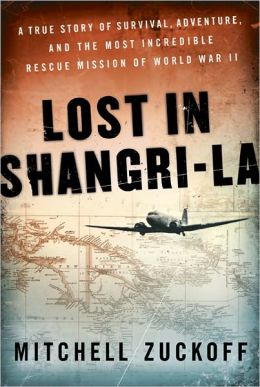
Lost in Shangri-La

Lost in Shangri-La. Mitchell Zuckoff. 2011. HarperCollins. 384 pages. [Source: Library]

After reading Frozen in Time, I knew I wanted to read another by Mitchell Zuckoff. Lost In Shangri-La: A True Story of Survival, Adventure, and the Most Incredible Rescue Mission of World War II did not disappoint. The two books are similar in that both books are about plane crashes, survivors, and rescue attempts. Also, obviously, both books are set during World War II.

Lost In Shangri-La tells the story of Margaret Hastings, John McCollom, and Kenneth Decker. These three were the survivors of the plane crash. All three were stationed in Dutch New Guinea, all three were taking part in a little sight-seeing holiday. All hoped to see "Shangri-La" safely from above. Twenty-four were on the plane, but after the crash, after the first twenty-four hours, only three remained alive. The three are able to leave the crash site and make their way to a better place, they are hoping to get to where a passing plane, a search plane, can see them.

The book goes on to tell of the men involved in the rescuing. Hastings and Decker were suffering severe injuries and in need of immediate medical attention. A rescue could not be accomplished quickly, in just a day or two. No, it would take time and careful planning...

Survivors. Rescuers. Natives. The book is very interesting. I definitely recommend it!

© 2014 SukaYuka.com of SukaYuka's Book Reviews
Monday, July 7, 2014

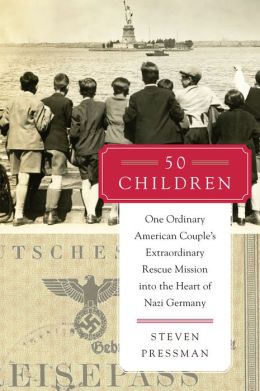
50 Children (2014)

50 Children: One Ordinary American Couple's Extraordinary Rescue Mission Into the Heart of Nazi Germany. Steven Pressman. 2014. HarperCollins. 320 pages. [Source: Library]

50 Children: One Ordinary American Couple's Extraordinary Rescue Mission Into the Heart of Nazi Germany is a must-read. It is incredibly compelling and, in my opinion, unforgettable. It tells the true story of an American Jewish couple, Gilbert and Eleanor Kraus, and how they diligently worked to save 50 Jewish children from Nazi Germany in 1939. Why 50? Well. They faced obstacles. You might think the biggest obstacles they faced were in Nazi Germany, working with the Nazi regime/government. And no doubt the obstacles they faced when they actually traveled there themselves to do the paperwork and bring over the children were many. But. What might surprise you is how BIG the obstacles were in the United States that they faced. The truth: the United States knew about the ever-increasing risks and dangers facing Jews, they knew that it was a matter of life-and-death, but they did not care. They simply did not care. They did not want Jewish immigrants. Plain and simple. There were laws in place, and those laws were kept strictly, limiting the number of immigrants, of Jewish immigrants. And loopholes had to be found, in a way, to get even those fifty into the United States. Want to know another sad truth? The couple faced opposition from Jewish Americans, from Jewish organizations in America! The book tells how some Jews worried that by bringing MORE Jews into the country, it would increase prejudice and hatred towards them.

The book tells the remarkable story of the men and women involved in this rescue mission. It tells of their determination and stubbornness, their perseverance, how they would not stop until it was accomplished, how they would not quit and say well, we tried, but, there's nothing more we can do. No, they could not turn away from what they knew to be right and good. It's an inspiring, courageous story.

I definitely recommend this one!

© 2014 SukaYuka.com of SukaYuka's Book Reviews
Friday, July 4, 2014

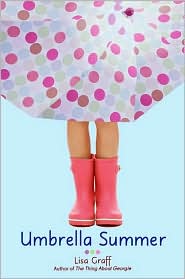
Reread #27 Umbrella Summer

Umbrella Summer. Lisa Graff. 2009. HarperCollins. 240 pages. [Source: Library]

 I have been wanting to reread Umbrella Summer for several years now. I first reviewed it in October 2009. I remember having a good, strong connection with Annie, the heroine. Every single person in the Richards family is struggling with grief--with the loss of Jared, Annie's older brother. But it is Annie whom we come to know and love throughout the book. We see the parents handling of grief, of moving on or not moving on as the case may be. We see how they parent, if they parent, Annie. All this is seen through Annie's perspective. Annie's perspective is seen through a complex range of emotions: fear, anxiety, sadness, and anger. For example, Annie has a hard time sympathizing with her friend, Rebecca, who has lost her pet hamster. Her response to Rebecca's strong grief is understandable, but, problematic for the friendship. He was just a hamster. It's not like you lost your brother. While the book is very much about grief, it is also a very good book about friendship, about what it means to be a friend, about building new friendships and restoring broken ones.

One of my favorite friendships in Umbrella Summer is Annie's friendship with their new neighbor, Mrs. Finch. Mrs. Finch is no stranger to loss, she has also lost someone close to her, her husband. Mrs. Finch and Annie both feel their losses strongly, yet, by coming together, by being honest with one another, by sharing the best memories, the best qualities about those they have loved and lost, they realize that they are beginning to heal a little, and that is a very good thing.

I also thought it was sweet that Annie and Jared's best friend have a special connection and come together as friends to truly celebrate Jared.

© 2014 SukaYuka.com of SukaYuka's Book Reviews
Thursday, July 3, 2014

Free To Fall (2014)

Free to Fall. Lauren Miller. 2014. HarperCollins. 480 pages. [Source: Library]

I loved Lauren Miller's Free to Fall. I enjoyed the mystery and conspiracy. I enjoyed the romance. I enjoyed the premise most of all. Is the book absolutely perfect? I wouldn't go that far. I'm not sure enough characters are fully developed to be near perfect. But in my opinion, the premise worked from start to finish. (I'd definitely say this is a plot-driven read.) I also enjoyed the themes and symbols of this one. (Hint: Paradise Lost)

Free to Fall is set circa 2030. Rory Vaughn, our heroine, is super excited to learn that she has been accepted to the oh-so-exclusive Theden Academy. It is only after she's been accepted that her father tells her that her mother also attended Theden Academy. (Theden Academy is a highschool, not a college). Before her mom died, she left something for her daughter. A note and a necklace. (It was conditional upon her going to Theden Academy.) Another girl from Rory's former school has been accepted as well. They will room together for better or worse. Her name is Hershey Clements.

Perhaps the less you know, the better. Since this one is plot-and-premise driven. Since this one is so focused on uncovering a BIG, BIG mystery. But. There is romance. And not the kind of "romance" that involves a love triangle! The hero's name is North, and, I definitely liked him! 

I would definitely recommend this one!

© 2014 SukaYuka.com of SukaYuka's Book Reviews

Tuesday, June 24, 2014

Behave Yourself, Bethany Brant (1986)

Behave Yourself, Bethany Brant. Patricia Beatty. 1986. HarperCollins. 160 pages. [Source: Bought.] 

I acquired Behave Yourself, Bethany Brant from the library book sale a few years ago. Bethany Brant, the heroine, is a preacher's kid. The book is set near the turn of the twentieth century. And it's set in Texas. It felt like it could be a very good fit for me. Unfortunately, it wasn't quite what I expected it to be.

The book opens with Bethany Brant visiting a fortune teller at a fair or carnival. Her parents are busy listening to live music; her brother, Abel, is off on his own. Bethany knows her parents wouldn't approve of her visiting a fortune teller, of her wasting her money on such a thing, of her giving so much of her time and thought to what the fortune teller says. But. Bethany Brant does, at least on this occasion, exactly what she wants.

The entire book is centered around what the fortune teller said. She was told at least three specific things: something bad was going to happen, there were elephants in her future, and that a one-eyed man would befriend her in her greatest need.

The book chronicles Bethany through all three "prophecies" (for lack of a better word.) It follows her for almost two years. A lot does happen to turn Bethany's world upside down. And in many ways, the book is just your average coming-of-age story.

I liked this one. But I certainly didn't love it.

© 2014 SukaYuka.com of SukaYuka's Book Reviews

Tuesday, June 10, 2014

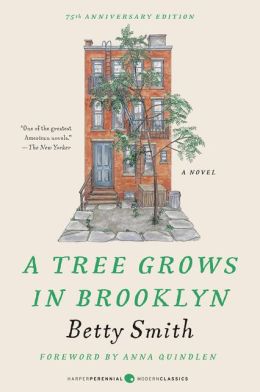
A Tree Grows In Brooklyn (1943)

A Tree Grows in Brooklyn. Betty Smith. 1943/2006. HarperCollins. 496 pages. [Source: Bought]

Oh how I loved Betty Smith's A Tree Grows in Brooklyn. Readers get the chance to get to know Francie, the heroine, her brother, Neeley, her mother, Katie, her father, Johnny, her aunts, Sissy and Evy, and her grandmother, Mary Rommely. A Tree Grows in Brooklyn is set circa 1910-1918 in Brooklyn, New York; it is very much a coming-of-age novel focusing on Francie, yet expanding to include several generations of her family. The book has a good number of flashbacks letting readers get to know all the members of the family before getting good and settled in Francie's life. It is a book that embraces ALL of life: the big things, the little things: no matter how ugly or beautiful. Truth does not equal beauty as Francie learns. I loved Francie's passion for living. I loved her observations.

A Tree Grows In Brooklyn is rich in detail AND rich in characterization. It is not a fast-paced action, adventure novel. It is a character-driven, family-focused historical novel. It doesn't try to make people better than they are. It is realistic and honest. The characters are very human, very fallible. One of the themes is in fact being true and honest. Francie has a confrontation with an English teacher. The teacher is trying to shame Francie into writing only about the beautiful, precious things of life. Sunsets. Stars. Flowers. She has been writing about her life, about her father, about her childhood. Her teacher tells her to go home and burn these writings and say "this is ugliness, this is ugliness, this is ugliness." Francie finally submits enough to be able to end the conversation and leave the room, but she's holding strong to who she is and where she comes from.

It is a beautifully written novel. It is very quotable.
The one tree in Francie’s yard was neither a pine nor a hemlock. It had pointed leaves which grew along green switches which radiated from the bough and made a tree which looked like a lot of opened green umbrellas. Some people called it the Tree of Heaven. No matter where its seed fell, it made a tree which struggled to reach the sky. It grew in boarded-up lots and out of neglected rubbish heaps and it was the only tree that grew out of cement. It grew lushly, but only in the tenements districts.
An eleven-year-old girl sitting on this fire escape could imagine that she was living in a tree. That’s what Francie imagined every Saturday afternoon in summer.
THE LIBRARY WAS A LITTLE OLD SHABBY PLACE. FRANCIE THOUGHT it was beautiful. The feeling she had about it was as good as the feeling she had about church. She pushed open the door and went in. She liked the combined smell of worn leather bindings, library paste and freshly inked stamping pads better than she liked the smell of burning incense at high mass.
Francie thought that all the books in the world were in that library and she had a plan about reading all the books in the world. She was reading a book a day in alphabetical order and not skipping the dry ones.
“Mother, I am young. Mother, I am just eighteen. I am strong. I will work hard, Mother. But I do not want this child to grow up just to work hard. What must I do, Mother, what must I do to make a different world for her? How do I start?” “The secret lies in the reading and the writing. You are able to read. Every day you must read one page from some good book to your child. Every day this must be until the child learns to read. Then she must read every day, I know this is the secret.”
“I will read,” promised Katie. “What is a good book?” “There are two great books. Shakespeare is a great book. I have heard tell that all the wonder of life is in that book; all that man has learned of beauty, all that he may know of wisdom and living are on those pages. It is said that these stories are plays to be acted out on the stage. I have never spoken to anyone who has seen this great thing. But I heard the lord of our land back in Austria say that some of the pages sing themselves like songs.”
“And what is the other great book?” “It is the Bible that the Protestant people read.” “We have our own Bible, the Catholic one.” Mary looked around the room furtively. “It is not fitting for a good Catholic to say so but I believe that the Protestant Bible contains more of the loveliness of the greatest story on this earth and beyond it. A much-loved Protestant friend once read some of her Bible to me and I found it as I have said.
“That is the book, then, and the book of Shakespeare. And every day you must read a page of each to your child—even though you yourself do not understand what is written down and cannot sound the words properly. You must do this that the child will grow up knowing of what is great—knowing that these tenements of Williamsburg are not the whole world.”
Everything struggles to live. Look at that tree growing up there out of that grating. It gets no sun, and water only when it rains. It’s growing out of sour earth. And it’s strong because its hard struggle to live is making it strong. My children will be strong that way.”
Well, everybody’s something. We all got a tag of some kind.
She found to her agony, that the doctor was still there, poised needle and all. He was staring at her arm in distaste. Francie looked too. She saw a small white area on a dirty dark-brown arm. She heard the doctor talking to the nurse. “Filth, filth, filth, from morning to night. I know they’re poor but they could wash. Water is free and soap is cheap. Just look at that arm, nurse.” The nurse looked and clucked in horror. Francie stood there with the hot flamepoints of shame burning her face.
After the doctor’s outburst, Francie stood hanging her head. She was a dirty girl. That’s what the doctor meant. He was talking more quietly now asking the nurse how that kind of people could survive; that it would be a better world if they were all sterilized and couldn’t breed anymore. Did that mean he wanted her to die? Would he do something to make her die because her hands and arms were dirty from the mud pies?
“My brother is next. His arm is just as dirty as mine so don’t be surprised. And you don’t have to tell him. You told me.” They stared at this bit of humanity who had become so strangely articulate. Francie’s voice went ragged with a sob. “You don’t have to tell him. Besides it won’t do no good. He’s a boy and he don’t care if he is dirty.”
She put her arm around her and held her close to her own life warmth. “Francie, baby, you’re trembling like a leaf.” Francie had never heard that expression and it made her thoughtful. She looked at the little tree growing out of the concrete at the side of the house. There were still a few dried leaves clinging to it. One of them rustled dryly in the wind. Trembling like a leaf. She stored the phrase away in her mind.
“Forgiveness,” said Mary Rommely, “is a gift of high value. Yet its cost is nothing.”
OH, MAGIC HOUR WHEN A CHILD FIRST KNOWS IT CAN READ PRINTED WORDS!
For quite a while, Francie had been spelling out letters, sounding them and then putting the sounds together to mean a word. But one day, she looked at a page and the word “mouse” had instantaneous meaning. She looked at the word, and the picture of a gray mouse scampered through her mind. She looked further and when she saw “horse,” she heard him pawing the ground and saw the sun glint on his glossy coat. The word “running” hit her suddenly and she breathed hard as though running herself. The barrier between the individual sound of each letter and the whole meaning of the word was removed and the printed word meant a thing at one quick glance. She read a few pages rapidly and almost became ill with excitement. She wanted to shout it out. She could read! She could read! From that time on, the world was hers for the reading. She would never be lonely again, never miss the lack of intimate friends. Books became her friends and there was one for every mood. There was poetry for quiet companionship. There was adventure when she tired of quiet hours. There would be love stories when she came into adolescence and when she wanted to feel a closeness to someone she could read a biography. On that day when she first knew she could read, she made a vow to read one book a day as long as she lived.
She liked numbers and sums. She devised a game in which each number was a family member and the “answer” made a family grouping with a story to it. Naught was a babe in arms. He gave no trouble. Whenever he appeared you just “carried” him. The figure 1 was a pretty baby girl just learning to walk, and easy to handle; 2 was a baby boy who could walk and talk a little. He went into family life (into sums, etc.) with very little trouble. And 3 was an older boy in kindergarten, who had to be watched a little. Then there was 4, a girl of Francie’s age. She was almost as easy to “mind” as 2. The mother was 5, gentle and kind. In large sums, she came along and made everything easy the way a mother should. The father, 6, was harder than the others but very just. But 7 was mean. He was a crotchety old grandfather and not at all accountable for how he came out. The grandmother, 8, was hard too, but easier to understand than 7. Hardest of all was 9. He was company and what a hard time fitting him into family life! When Francie added a sum, she would fix a little story to go with the result. If the answer was 924, it meant that the little boy and girl were being minded by company while the rest of the family went out. When a number such as 1024 appeared, it meant that all the little children were playing together in the yard. The number 62 meant that papa was taking the little boy for a walk; 50 meant that mama had the baby out in the buggy for an airing and 78 meant grandfather and grandmother sitting home by the fire of a winter’s evening. Each single combination of numbers was a new set-up for the family and no two stories were ever the same.
Francie was ten years old when she first found an outlet in writing. What she wrote was of little consequence. What was important was that the attempt to write stories kept her straight on the dividing line between truth and fiction.
“TODAY, I AM A WOMAN,” WROTE FRANCIE IN HER DIARY IN THE summer when she was thirteen. She looked at the sentence and absently scratched a mosquito bite on her bare leg. She looked down on her long thin and as yet formless legs. She crossed out the sentence and started over. “Soon, I shall become a woman.” She looked down on her chest which was as flat as a washboard and ripped the page out of the book. She started fresh on a new page.
“But poverty, starvation and drunkenness are ugly subjects to choose. We all admit these things exist. But one doesn’t write about them.” “What does one write about?” Unconsciously, Francie picked up the teacher’s phraseology. “One delves into the imagination and finds beauty there. The writer, like the artist, must strive for beauty always.” “What is beauty?” asked the child. “I can think of no better definition than Keats’: ‘Beauty is truth, truth beauty.’”
Francie took her courage into her two hands and said, “Those stories are the truth.”
“Nonsense!” exploded Miss Garnder. Then, softening her tone, she continued: “By truth, we mean things like the stars always being there and the sun always rising and the true nobility of man and mother-love and love for one’s country,” she ended anti-climactically. “I see,” said Francie. As Miss Garnder continued talking, Francie answered her bitterly in her mind. “Drunkenness is neither truth nor beauty. It’s a vice. Drunkards belong in jail, not in stories. And poverty. There is no excuse for that. There’s work enough for all who want it. People are poor because they’re too lazy to work. There’s nothing beautiful about laziness. (Imagine Mama lazy!) “Hunger is not beautiful. It is also unnecessary. We have well-organized charities. No one need go hungry.” Francie ground her teeth. Her mother hated the word “charity” above any word in the language and she had brought up her children to hate it too. “Now, I’m not a snob,” stated Miss Garnder. “I do not come from a wealthy family. My father was a minister with a very small salary.” (But it was a salary, Miss Garnder.)
“And the only help my mother had was a succession of untrained maids, mostly girls from the country.” (I see. You were poor, Miss Garnder, poor with a maid.) “Many times we were without a maid and my mother had to do all the housework herself.” (And my mother, Miss Garnder, has to do all her own housework, and yes, ten times more cleaning than that.) “I wanted to go to the state university but we couldn’t afford it. My father had to send me to a small denominational college.” (But admit you had no trouble going to college.) “And believe me, you’re poor when you go to such a college. I know what hunger is, too. Time and time again my father’s salary was held up and there was no money for food. Once we had to live on tea and toast for three days.” (So you know what it is to be hungry, too.) “But I’d be a dull person if I wrote about nothing but being poor and hungry, wouldn’t I?” Francie didn’t answer. “Wouldn’t I?” repeated Miss Garnder emphatically. “Yes ma’am.”
“I’ve taken all this time with you because I honestly believe that you have promise. Now that we’ve talked things out, I’m sure you’ll stop writing those sordid little stories.” Sordid. Francie turned the word over. It was not in her vocabulary. “What does that mean—sordid?”
Sordid: Filthy. Filthy? She thought of her father wearing a fresh dicky and collar every day of his life and shining his worn shoes as often as twice a day. Dirty. Papa had his own mug at the barber shop. Base. Francie passed that up not knowing exactly what it meant. Gross. Never! Papa was a dancer. He was slender and quick. His body wasn’t gross. Also mean and low. She remembered a hundred and one little tendernesses and acts of thoughtfulness on the part of her father. She remembered how everyone had loved him so. Her face got hot. She couldn’t see the next words because the page turned red under her eyes. She turned on Miss Garnder, her face twisted with fury. “Don’t you ever dare use that word about us!” “Us?” asked Miss Garnder blankly. “We were talking about your compositions. Why, Frances!” Her voice was shocked. “I’m surprised! A well-behaved girl like you. What would your mother say if she knew you had been impertinent to your teacher?” Francie was frightened. Impertinence to a teacher was almost a reformatory offense in Brooklyn. “Please excuse me. Please excuse me,” she repeated abjectly. “I didn’t mean it.” “I understand,” said Miss Garnder gently. She put her arm around Francie and led her to the door. “Our little talk has made an impression on you, I see. Sordid is an ugly word and I’m glad you resented my using it. It shows that you understand. Probably you don’t like me any more, but please believe that I spoke for your own good.
 Yes, the world was changing rapidly and this time she knew it was the world and not herself.
“Dear God,” she prayed, “let me be something every minute of every hour of my life. Let me be gay; let me be sad. Let me be cold; let me be warm. Let me be hungry…have too much to eat. Let me be ragged or well dressed. Let me be sincere—be deceitful. Let me be truthful; let me be a liar. Let me be honorable and let me sin. Only let me be something every blessed minute. And when I sleep, let me dream all the time so that not one little piece of living is ever lost.”
The last time of anything has the poignancy of death itself. This that I see now, she thought, to see no more this way. Oh, the last time how clearly you see everything; as though a magnifying light had been turned on it. And you grieve because you hadn’t held it tighter when you had it every day. What had Granma Mary Rommely said? “To look at everything always as though you were seeing it either for the first or last time: Thus is your time on earth filled with glory.”

© 2014 SukaYuka.com of SukaYuka's Book Reviews
Tuesday, March 4, 2014

P.S. Be Eleven (2013)

P.S. Be Eleven. Rita Williams-Garcia. 2013. HarperCollins. 274 pages. [Source: Library]

In One Crazy Summer, readers met three sisters: Delphine, Vonetta, and Fern. P.S. Be Eleven is the sequel to the award-winning One Crazy Summer. The novel opens with the three girls on their way home from their summer trip. Yes, the events pick up just where the last book left off.

P.S. Be Eleven captures their adventures and misadventures in New York as the girls settle back down for another school year. It won't exactly be a calm year either. Their uncle is coming back home from Vietnam, for example, and their own father is getting married. By the end of the book, even more has changed for these young girls. (But I won't spoil it!) But perhaps the one oh-so-pleasant happening of the novel is the girls introduction to the Jackson Five. These sisters hear from a friend that they just HAVE to watch this new oh-so-awesome group perform on a TV show. They risk the wrath of their grandmother to turn on the TV after their bedtime--she's asleep too. But. I'm guessing each would tell you it was worth it. These three become obsessed with the Jackson Five, and they dream of seeing them in concert. An opportunity arises, something that adds a bit of structure to these adventures, but will they get their happily ever after?

I never knew how much a sequel was needed until I read P.S. Be Eleven. I was perfectly content with One Crazy Summer, and yet, after spending more time with these three sisters, well, it was just right, just perfect to go back and revisit them in their comfort zone. The book has a great feel to it.

P.S. Be Eleven was a great experience. I definitely connected with the characters. I knew this to be true when I found myself getting angry--in some cases really angry--with certain situations and events. I found that I really cared deeply about these sisters. I thought the setting was enjoyable, and their obsession with the Jackson Five was great! It was a thoughtful read, as well.

© 2014 SukaYuka.com of SukaYuka's Book Reviews

Tuesday, February 18, 2014

Hideous Love (2013)

Hideous Love: The Story of The Girl Who Wrote Frankenstein. Stephanie Hemphill. 2013. HarperCollins. 320 pages. [Source: Library]

I am familiar with the story of Mary Shelley. I am probably more familiar than the target audience would be of Mary Shelley, her sister, Claire, her lover-husband, Percy Shelley, Lord Byron, etc. I took a whole semester focusing primarily on these Romantic authors. (Claire was an extra bonus. You can't cover the lives of Mary, Percy, without mentioning Claire and her lovechild.) I was curious how the story would be presented. I am not usually a big fan of verse novels. I think some work really, really, really well. And I think others are absolutely awful. This falls into the "why is this a verse novel?" category. I think the story could have been told just as well, if not better, in prose format, in journal format in particular. We do know that Mary Shelley kept a journal, of sorts.

That being said, I do think the book did a fairly good job at capturing the ANGST that is Mary Shelley's private life. Her life was a BIG, BIG MESS. Oh, what she had to put up with! Oh, what she had to endure! Oh, the consequences of leaping into love without being ready for it! As a teenager, she runs away from home with a married man, a poet or would-be poet. She takes her sister. Because she took her sister, well, her STEP sister, with her, she'll be stuck with the sister for what seems like forever. With her husband's notion of free-love this and free-love-that, the LAST thing Mary needs is another woman in their lives who is constantly there and wanting/needing attention. Mary also suffered so very many losses. So many of her children died, died in their infancy or toddler years. And some of that was just the times they lived, and some of that was due to her husband's stupidity and stubbornness. Anyway, it is an emotionally demanding story. Far from boring. Because her husband was a poet, because she spent so much time with poets, it would be nice if this format of verse novel worked in telling her own story. However, I did not feel the verse format was one of the book's strengths. If the book works, which I think it does in a way, it is because of the emotion behind the words, not the words themselves. The writing didn't seem especially lyrical or lovely or poetic.
© 2014 SukaYuka.com of SukaYuka's Book Reviews