Showing posts with label classics. Show all posts

Friday, December 26, 2014

Reread #52 Jane Eyre

Jane Eyre. Charlotte Bronte. 1847.  300 pages. [Source: Own]

There was no possibility of taking a walk that day.

Can a plain, orphan governess find true love and a happily ever after? Yes, if she's willing to speak her own mind, stay true to herself, and fight for the one she loves. Jane's journey to her happily ever after certainly wasn't easy or typical. 

I have many, many posts about Jane Eyre. But surprisingly, only two book reviews! I first reviewed it--for the blog--in September 2008. My second review is from December 2011. In 2012, I reviewed ten film adaptations of Jane Eyre. Each film got its own review, but I then wrote up a post analyzing them all.

It had been a few years since I'd last read Jane Eyre. After watching it so many times, I needed to take a break. But I knew that I would want to include the book in my year of rereading. It is just wonderful to revisit Jane Eyre again and again and again.

Do you love Jane Eyre too? Do you have a favorite scene? a least favorite scene? What is your favorite adaptation? What scenes do you find essential in an adaptation?

Some of my favorite quotes:
He had been looking two minutes at the fire, and I had been looking the same length of time at him, when, turning suddenly, he caught my gaze fastened on his physiognomy. “You examine me, Miss Eyre,” said he: “do you think me handsome?” I should, if I had deliberated, have replied to this question by something conventionally vague and polite; but the answer somehow slipped from my tongue before I was aware—“No, sir.” “Ah! By my word! there is something singular about you,” said he: “you have the air of a little nonnette; quaint, quiet, grave, and simple, as you sit with your hands before you, and your eyes generally bent on the carpet (except, by-the-bye, when they are directed piercingly to my face; as just now, for instance); and when one asks you a question, or makes a remark to which you are obliged to reply, you rap out a round rejoinder, which, if not blunt, is at least brusque. What do you mean by it?” “Sir, I was too plain; I beg your pardon. I ought to have replied that it was not easy to give an impromptu answer to a question about appearances; that tastes mostly differ; and that beauty is of little consequence, or something of that sort.” “You ought to have replied no such thing. Beauty of little consequence, indeed! And so, under pretence of softening the previous outrage, of stroking and soothing me into placidity, you stick a sly penknife under my ear! Go on: what fault do you find with me, pray? I suppose I have all my limbs and all my features like any other man?” “Mr. Rochester, allow me to disown my first answer: I intended no pointed repartee: it was only a blunder.” “Just so: I think so: and you shall be answerable for it. Criticise me: does my forehead not please you?” He lifted up the sable waves of hair which lay horizontally over his brow, and showed a solid enough mass of intellectual organs, but an abrupt deficiency where the suave sign of benevolence should have risen. “Now, ma’am, am I a fool?” “Far from it, sir. You would, perhaps, think me rude if I inquired in return whether you are a philanthropist?”
“You looked very much puzzled, Miss Eyre; and though you are not pretty any more than I am handsome, yet a puzzled air becomes you; besides, it is convenient, for it keeps those searching eyes of yours away from my physiognomy, and busies them with the worsted flowers of the rug; so puzzle on. Young lady, I am disposed to be gregarious and communicative to-night.” With this announcement he rose from his chair, and stood, leaning his arm on the marble mantelpiece: in that attitude his shape was seen plainly as well as his face; his unusual breadth of chest, disproportionate almost to his length of limb. I am sure most people would have thought him an ugly man; yet there was so much unconscious pride in his port; so much ease in his demeanour; such a look of complete indifference to his own external appearance; so haughty a reliance on the power of other qualities, intrinsic or adventitious, to atone for the lack of mere personal attractiveness, that, in looking at him, one inevitably shared the indifference, and, even in a blind, imperfect sense, put faith in the confidence. “I am disposed to be gregarious and communicative to-night,” he repeated, “and that is why I sent for you: the fire and the chandelier were not sufficient company for me; nor would Pilot have been, for none of these can talk. Adèle is a degree better, but still far below the mark; Mrs. Fairfax ditto; you, I am persuaded, can suit me if you will: you puzzled me the first evening I invited you down here. I have almost forgotten you since: other ideas have driven yours from my head; but to-night I am resolved to be at ease; to dismiss what importunes, and recall what pleases. It would please me now to draw you out—to learn more of you—therefore speak.” Instead of speaking, I smiled; and not a very complacent or submissive smile either. “Speak,” he urged. “What about, sir?” “Whatever you like. I leave both the choice of subject and the manner of treating it entirely to yourself.” Accordingly I sat and said nothing: “If he expects me to talk for the mere sake of talking and showing off, he will find he has addressed himself to the wrong person,” I thought. “You are dumb, Miss Eyre.” I was dumb still. He bent his head a little towards me, and with a single hasty glance seemed to dive into my eyes. “Stubborn?” he said, “and annoyed. Ah! it is consistent. I put my request in an absurd, almost insolent form. Miss Eyre, I beg your pardon. The fact is, once for all, I don’t wish to treat you like an inferior: that is” (correcting himself), “I claim only such superiority as must result from twenty years’ difference in age and a century’s advance in experience. This is legitimate, et j’y tiens, as Adèle would say; and it is by virtue of this superiority, and this alone, that I desire you to have the goodness to talk to me a little now, and divert my thoughts, which are galled with dwelling on one point—cankering as a rusty nail.” He had deigned an explanation, almost an apology, and I did not feel insensible to his condescension, and would not seem so. “I am willing to amuse you, if I can, sir—quite willing; but I cannot introduce a topic, because how do I know what will interest you? Ask me questions, and I will do my best to answer them.”  
Besides, I know what sort of a mind I have placed in communication with my own: I know it is one not liable to take infection: it is a peculiar mind: it is a unique one. Happily I do not mean to harm it: but, if I did, it would not take harm from me. The more you and I converse, the better; for while I cannot blight you, you may refresh me.”
The ease of his manner freed me from painful restraint: the friendly frankness, as correct as cordial, with which he treated me, drew me to him. I felt at times as if he were my relation rather than my master: yet he was imperious sometimes still; but I did not mind that; I saw it was his way. So happy, so gratified did I become with this new interest added to life, that I ceased to pine after kindred: my thin crescent-destiny seemed to enlarge; the blanks of existence were filled up; my bodily health improved; I gathered flesh and strength. And was Mr. Rochester now ugly in my eyes? No, reader: gratitude, and many associations, all pleasurable and genial, made his face the object I best liked to see; his presence in a room was more cheering than the brightest fire. Yet I had not forgotten his faults; indeed, I could not, for he brought them frequently before me. He was proud, sardonic, harsh to inferiority of every description: in my secret soul I knew that his great kindness to me was balanced by unjust severity to many others. He was moody, too; unaccountably so; I more than once, when sent for to read to him, found him sitting in his library alone, with his head bent on his folded arms; and, when he looked up, a morose, almost a malignant, scowl blackened his features. But I believed that his moodiness, his harshness, and his former faults of morality (I say former, for now he seemed corrected of them) had their source in some cruel cross of fate. I believed he was naturally a man of better tendencies, higher principles, and purer tastes than such as circumstances had developed, education instilled, or destiny encouraged. I thought there were excellent materials in him; though for the present they hung together somewhat spoiled and tangled. I cannot deny that I grieved for his grief, whatever that was, and would have given much to assuage it. Though I had now extinguished my candle and was laid down in bed, I could not sleep for thinking of his look when he paused in the avenue, and told how his destiny had risen up before him, and dared him to be happy at Thornfield. 
I had not intended to love him; the reader knows I had wrought hard to extirpate from my soul the germs of love there detected; and now, at the first renewed view of him, they spontaneously arrived, green and strong! He made me love him without looking at me.
“He is not to them what he is to me,” I thought: “he is not of their kind. I believe he is of mine;—I am sure he is—I feel akin to him—I understand the language of his countenance and movements: though rank and wealth sever us widely, I have something in my brain and heart, in my blood and nerves, that assimilates me mentally to him. Did I say, a few days since, that I had nothing to do with him but to receive my salary at his hands? Did I forbid myself to think of him in any other light than as a paymaster? Blasphemy against nature! Every good, true, vigorous feeling I have gathers impulsively round him. I know I must conceal my sentiments: I must smother hope; I must remember that he cannot care much for me. For when I say that I am of his kind, I do not mean that I have his force to influence, and his spell to attract; I mean only that I have certain tastes and feelings in common with him.

© 2014 SukaYuka.com of SukaYuka's Book Reviews

Sunday, December 21, 2014

Lark Rise to Candleford (1943)

Lark Rise to Candleford. Flora Thompson. 1943. 537 pages. [Source: Bought]

Did I enjoy reading Flora Thompson's Lark Rise to Candleford? Yes. Did I enjoy all three books equally? Probably not. Did I enjoy any one book as much as I loved the TV adaptation? Probably not. Lark Rise to Candleford is an omnibus edition of a trilogy: Lark Rise, Over to Candleford, and Candleford Green.

The first book in the series is Lark Rise. What I liked about Lark Rise was the fact that it had a cozy yet realistic feel to it. The chapters capture what life was like in a specific time and place, a particular part of the country in the 1880s. Rural vignettes. The book is rich in detail and description. Nothing happens but description. A sampling of chapter titles: "A Hamlet Childhood," "Men Afield," "At the 'Wagon and Horses'," "Callers," "Country Playtime," "School," "May Day," "To Church on Sunday."

The second book in the series is Over to Candleford. This book is definitely more personal in nature. For the most part, it focuses on one young girl, Laura. Readers see Laura at home, at school, at play, at church, visiting cousins, aunts, and uncles, etc. It is still rich in description and detail. Even though it is a more personal look at life in the country in the 1880s and 90s, it is still heavier on the descriptions than the action. This isn't a book that focuses on stories and storytelling. The book ends with a young Laura--perhaps twelve or thirteen--getting an apprentice job in Candleford Green with the postmistress Miss Dorcas Lane.

The third book in the series is Candleford Green. The book opens with Laura leaving home. She's excited and timid. The book will see her established in this new life. She'll be meeting new people, living in a new place, experiencing new things, growing up into a young woman. I was disappointed with this book. I haven't decided if I'm disappointed because it lacks characterization and plot in general OR if I'm disappointed because it lacks the characterization and plot that the television adaptation brought to it. The book's strength is in description and vignettes. The book's weakness is that there are not really any connecting stories or plot sequences. People are mentioned by name, perhaps, but in a very superficial just a few paragraphs way. The characters lack depth. A sentence or two here and there does not make good characterization. If the heroine, Laura, was fully developed and the chapters worked as a personal narrative capturing her experiences, thoughts, and struggles, then I think it might have worked better for me. But there was no person to connect to, no connecting-story to follow. It was just one description after another. There were passages I enjoyed reading. Laura does like to read! But nothing about it that made me LOVE it. I liked it well enough.

© 2014 SukaYuka.com of SukaYuka's Book Reviews
Friday, December 12, 2014

Reread #50 Les Miserables

Les Miserables. Victor Hugo. Translated by Isabel Florence Hapgood. 1862/1887. 1232 pages.
This book is a drama, whose leading personage is the Infinite. Man is the second.
I have now read Les Miserables three times. This will be my second review of Les Miserables on my blog. My first review was in April 2013. I love Les Miserables. I do. I think I love it more each time I read it. The book has depth. The story it tells is memorable and emotional. It is a book you EXPERIENCE. I love so many things about it: the depth and quality of the writing, the characterization, the narration, the themes.

There are many words that could be used to describe Les Miserables: compelling, political, spiritual, philosophical, dramatic, romantic. It is just as concerned about politics and social justice as it is romance and family. It touches on the subjects of education, crime, poverty, and injustice. It's a novel where ideas matter just as much as characters.

It's also a novel heavy on details. When it's good, it's REALLY good. But at times some of the details are too taste-specific. In other words, some of the details weigh the story down. At times Les Miserables is boring. It's worth reading. It is. It's worth pushing through to the end. It's okay to skim certain sections, in my opinion, because it is one of the most satisfying reading experiences overall. Not that I LOVE the ending, though I think I may have made peace with it this time around.

Who are some of the characters? Bishop Myriel, Jean Valjean, Fantine, Inspector Javert, Cosette, Marius, Eponine, Enjolras, Monsieur and Madame Thenardier, Mabeuf, Monsieur Gillenormand, and Gavroche--just to name a few.  I don't know if I can say I have a favorite. I know which characters I don't like. But I really just like all of them--no matter their strengths and weaknesses.

Do you have a favorite character? a favorite scene?

One of my favorite scenes is early in the novel when Jean Valjean meets Bishop Myriel (Bienvenu). He is an ex-convict who has just been released. He's seeking a place to stay for the night. It is not going well.
"I have knocked at all doors."
"Well?"
"I have been driven away everywhere."
The "good woman" touched the man's arm, and pointed out to him on the other side of the street a small, low house, which stood beside the Bishop's palace.
"You have knocked at all doors?"
"Yes."
"Have you knocked at that one?"
"No."
"Knock there."
It opened wide with a rapid movement, as though some one had given it an energetic and resolute push.
A man entered.
We already know the man. It was the wayfarer whom we have seen wandering about in search of shelter.
He entered, advanced a step, and halted, leaving the door open behind him. He had his knapsack on his shoulders, his cudgel in his hand, a rough, audacious, weary, and violent expression in his eyes. The fire on the hearth lighted him up. He was hideous. It was a sinister apparition.
Madame Magloire had not even the strength to utter a cry. She trembled, and stood with her mouth wide open.
Mademoiselle Baptistine turned round, beheld the man entering, and half started up in terror; then, turning her head by degrees towards the fireplace again, she began to observe her brother, and her face became once more profoundly calm and serene.
The Bishop fixed a tranquil eye on the man.
As he opened his mouth, doubtless to ask the new-comer what he desired, the man rested both hands on his staff, directed his gaze at the old man and the two women, and without waiting for the Bishop to speak, he said, in a loud voice:—
"See here. My name is Jean Valjean. I am a convict from the galleys. I have passed nineteen years in the galleys. I was liberated four days ago, and am on my way to Pontarlier, which is my destination. I have been walking for four days since I left Toulon. I have travelled a dozen leagues to-day on foot. This evening, when I arrived in these parts, I went to an inn, and they turned me out, because of my yellow passport, which I had shown at the town-hall. I had to do it. I went to an inn. They said to me, 'Be off,' at both places. No one would take me. I went to the prison; the jailer would not admit me. I went into a dog's kennel; the dog bit me and chased me off, as though he had been a man. One would have said that he knew who I was. I went into the fields, intending to sleep in the open air, beneath the stars. There were no stars. I thought it was going to rain, and I re-entered the town, to seek the recess of a doorway. Yonder, in the square, I meant to sleep on a stone bench. A good woman pointed out your house to me, and said to me, 'Knock there!' I have knocked. What is this place? Do you keep an inn? I have money—savings. One hundred and nine francs fifteen sous, which I earned in the galleys by my labor, in the course of nineteen years. I will pay. What is that to me? I have money. I am very weary; twelve leagues on foot; I am very hungry. Are you willing that I should remain?"
"Madame Magloire," said the Bishop, "you will set another place."
The man advanced three paces, and approached the lamp which was on the table. "Stop," he resumed, as though he had not quite understood; "that's not it. Did you hear? I am a galley-slave; a convict. I come from the galleys." He drew from his pocket a large sheet of yellow paper, which he unfolded. "Here's my passport. Yellow, as you see. This serves to expel me from every place where I go. Will you read it? I know how to read. I learned in the galleys. There is a school there for those who choose to learn. Hold, this is what they put on this passport: 'Jean Valjean, discharged convict, native of'—that is nothing to you—'has been nineteen years in the galleys: five years for house-breaking and burglary; fourteen years for having attempted to escape on four occasions. He is a very dangerous man.' There! Every one has cast me out. Are you willing to receive me? Is this an inn? Will you give me something to eat and a bed? Have you a stable?"
"Madame Magloire," said the Bishop, "you will put white sheets on the bed in the alcove." We have already explained the character of the two women's obedience.
Madame Magloire retired to execute these orders.
The Bishop turned to the man.
"Sit down, sir, and warm yourself. We are going to sup in a few moments, and your bed will be prepared while you are supping."
At this point the man suddenly comprehended. The expression of his face, up to that time sombre and harsh, bore the imprint of stupefaction, of doubt, of joy, and became extraordinary. He began stammering like a crazy man:—
"Really? What! You will keep me? You do not drive me forth? A convict! You call me sir! You do not address me as thou? 'Get out of here, you dog!' is what people always say to me. I felt sure that you would expel me, so I told you at once who I am. Oh, what a good woman that was who directed me hither! I am going to sup! A bed with a mattress and sheets, like the rest of the world! a bed! It is nineteen years since I have slept in a bed! You actually do not want me to go! You are good people. Besides, I have money. I will pay well. Pardon me, monsieur the inn-keeper, but what is your name? I will pay anything you ask. You are a fine man. You are an inn-keeper, are you not?"
"I am," replied the Bishop, "a priest who lives here."
"A priest!" said the man. "Oh, what a fine priest! Then you are not going to demand any money of me? You are the cure, are you not? the cure of this big church? Well! I am a fool, truly! I had not perceived your skull-cap."
As he spoke, he deposited his knapsack and his cudgel in a corner, replaced his passport in his pocket, and seated himself. Mademoiselle Baptistine gazed mildly at him. He continued:
"You are humane, Monsieur le Curé; you have not scorned me. A good priest is a very good thing. Then you do not require me to pay?"
"No," said the Bishop; "keep your money. How much have you? Did you not tell me one hundred and nine francs?"
"And fifteen sous," added the man.
"One hundred and nine francs fifteen sous. And how long did it take you to earn that?"
"Nineteen years."
"Nineteen years!"
The Bishop sighed deeply.
The man continued: "I have still the whole of my money. In four days I have spent only twenty-five sous, which I earned by helping unload some wagons at Grasse. Since you are an abbe, I will tell you that we had a chaplain in the galleys. And one day I saw a bishop there. Monseigneur is what they call him. He was the Bishop of Majore at Marseilles. He is the cure who rules over the other cures, you understand. Pardon me, I say that very badly; but it is such a far-off thing to me! You understand what we are! He said mass in the middle of the galleys, on an altar. He had a pointed thing, made of gold, on his head; it glittered in the bright light of midday. We were all ranged in lines on the three sides, with cannons with lighted matches facing us. We could not see very well. He spoke; but he was too far off, and we did not hear. That is what a bishop is like."
While he was speaking, the Bishop had gone and shut the door, which had remained wide open.
Madame Magloire returned. She brought a silver fork and spoon, which she placed on the table.
"Madame Magloire," said the Bishop, "place those things as near the fire as possible." And turning to his guest: "The night wind is harsh on the Alps. You must be cold, sir."
Each time that he uttered the word sir, in his voice which was so gently grave and polished, the man's face lighted up. Monsieur to a convict is like a glass of water to one of the shipwrecked of the Medusa. Ignominy thirsts for consideration.
"This lamp gives a very bad light," said the Bishop.
Madame Magloire understood him, and went to get the two silver candlesticks from the chimney-piece in Monseigneur's bed-chamber, and placed them, lighted, on the table.
"Monsieur le Curé," said the man, "you are good; you do not despise me. You receive me into your house. You light your candles for me. Yet I have not concealed from you whence I come and that I am an unfortunate man."
The Bishop, who was sitting close to him, gently touched his hand. "You could not help telling me who you were. This is not my house; it is the house of Jesus Christ. This door does not demand of him who enters whether he has a name, but whether he has a grief. You suffer, you are hungry and thirsty; you are welcome. And do not thank me; do not say that I receive you in my house. No one is at home here, except the man who needs a refuge. I say to you, who are passing by, that you are much more at home here than I am myself. Everything here is yours. What need have I to know your name? Besides, before you told me you had one which I knew."
The man opened his eyes in astonishment.
"Really? You knew what I was called?"
"Yes," replied the Bishop, "you are called my brother."
"Stop, Monsieur le Curé," exclaimed the man. "I was very hungry when I entered here; but you are so good, that I no longer know what has happened to me."
The Bishop looked at him, and said,—
"You have suffered much?"
"Oh, the red coat, the ball on the ankle, a plank to sleep on, heat, cold, toil, the convicts, the thrashings, the double chain for nothing, the cell for one word; even sick and in bed, still the chain! Dogs, dogs are happier! Nineteen years! I am forty-six. Now there is the yellow passport. That is what it is like."
"Yes," resumed the Bishop, "you have come from a very sad place. Listen. There will be more joy in heaven over the tear-bathed face of a repentant sinner than over the white robes of a hundred just men. If you emerge from that sad place with thoughts of hatred and of wrath against mankind, you are deserving of pity; if you emerge with thoughts of good-will and of peace, you are more worthy than any one of us."
This meeting will change his life. The impact of the Bishop on Jean Valjean is huge. And this scene is just the beginning.

In writing this review, I discovered two books releasing in 2015, that I really, really WANT to review--NEED to review. Both are February releases. Candlewick Press is releasing Marcia Williams' retelling of Les Miserables.  Penguin is releasing a NEW translation of Les Miserables by Christine Donougher.

I could not possibly share every quote I loved from the book. There are hundreds. But I will share some with you.

Favorite quotes:

True or false, that which is said of men often occupies as important a place in their lives, and above all in their destinies, as that which they do.
"Jean Valjean, my brother, you no longer belong to evil, but to good. It is your soul that I buy from you; I withdraw it from black thoughts and the spirit of perdition, and I give it to God." 
Teach those who are ignorant as many things as possible; society is culpable, in that it does not afford instruction gratis; it is responsible for the night which it produces. This soul is full of shadow; sin is therein committed. The guilty one is not the person who has committed the sin, but the person who has created the shadow.
The supreme happiness of life consists in the conviction that one is loved; loved for one's own sake—let us say rather, loved in spite of one's self.
To make the poem of the human conscience, were it only with reference to a single man, were it only in connection with the basest of men, would be to blend all epics into one superior and definitive epic.
Diamonds are found only in the dark places of the earth; truths are found only in the depths of thought. It seemed to him, that, after having descended into these depths, after having long groped among the darkest of these shadows, he had at last found one of these diamonds, one of these truths, and that he now held it in his hand, and he was dazzled as he gazed upon it. 
If you wish to gain an idea of what revolution is, call it Progress; and if you wish to acquire an idea of the nature of progress, call it To-morrow. To-morrow fulfils its work irresistibly, and it is already fulfilling it to-day. It always reaches its goal strangely.
Man lives by affirmation even more than by bread.
Peace is happiness digesting.
The bourgeoisie is simply the contented portion of the people. The bourgeois is the man who now has time to sit down. A chair is not a caste.
True history being a mixture of all things, the true historian mingles in everything.
Of all the things that God has made, the human heart is the one which sheds the most light, alas! and the most darkness.
A compliment is something like a kiss through a veil.
Civil war—what does that mean? Is there a foreign war? Is not all war between men, war between brothers? War is qualified only by its object. There is no such thing as foreign or civil war; there is only just and unjust war.
The right to the alphabet, that is where the beginning must be made. The primary school imposed on all, the secondary school offered to all, that is the law. From an identical school, an identical society will spring. Yes, instruction! light! light! everything comes from light, and to it everything returns. Citizens, the nineteenth century is great, but the twentieth century will be happy.
Everything can be parodied, even parody.
He sleeps. Although his fate was very strange, he lived. He died when he had no longer his angel. The thing came to pass simply, of itself, as the night comes when day is gone.
© 2014 SukaYuka.com of SukaYuka's Book Reviews

Sunday, November 30, 2014

Miracle on 34th Street (1947)

Miracle on 34th Street. Valentine Davies. Illustrated by Tomie de Paola. 1947/2001. HMH. 136 pages. [Source: Library]

I have almost always loved the movie. I can now say that I love the book. If you love the movie, and, if you love to read, then, you should consider reading Miracle on 34th Street. True, it is not substantially different from the movie. But there are subtle differences, I found. I liked these differences small as they may be. The book is sweet and charming in all the right ways. I liked spending time with Kris Kringle, Doris and Susan Walker, and Fred Gayley. The book moves quickly, from scene to scene to scene. The book may not be as detailed and descriptive as a typical novel; it still has a movie-feel to it: going from scene to scene without pausing to ponder or describe. If I read the book first, would I get a sense, true sense, of the characters? I'm not sure. I'd like to think so. But it's hard to come to this story new. I know this story. I love this story.

© 2014 SukaYuka.com of SukaYuka's Book Reviews

Friday, November 28, 2014

Reread #48 A Christmas Carol

A Christmas Carol. Charles Dickens. 1843. 96 pages. [Source: Bought]

MARLEY WAS DEAD, to begin with. There is no doubt whatever about that.

 I have watched A Christmas Carol more times than I've read it, and I've read it two or three times at least. The story is oh-so-familiar; the phrasing is oh-so-familiar. It's a book that has an old-friend feel even if you haven't read it dozens of times. There are scenes and descriptions that just feel incredibly right and familiar. For example,
Oh! but he was a tight-fisted hand at the grindstone, Scrooge! a squeezing, wrenching, grasping, scraping, clutching, covetous old sinner! Hard and sharp as flint, from which no steel had ever struck out generous fire, secret, and self-contained, and solitary as an oyster. The cold within him froze his old features, nipped his pointed nose, shriveled his cheek, stiffened his gait, made his eyes red, his thin lips blue, and spoke out shrewdly in his grating voice. A frosty rime was on his head, and on his eyebrows, and his wiry chin. He carried his own low temperature always about with him; he iced his office in the dog-days; and didn’t thaw it one degree at Christmas.
and
“A merry Christmas, uncle! God save you!” cried a cheerful voice. It was the voice of Scrooge’s nephew, who came upon him so quickly that this was the first intimation he had of his approach. “Bah!” said Scrooge. “Humbug!” He had so heated himself with rapid walking in the fog and frost, this nephew of Scrooge’s, that he was all in a glow; his face was ruddy handsome; his eyes sparkled, and his breath smoked again.
“Christmas a humbug, uncle!” said Scrooge’s nephew. “You don’t mean that, I am sure?” “I do,” said Scrooge. “Merry Christmas! What right have you to be merry? What reason have you to be merry? You’re poor enough.”
“Come, then,” returned the nephew gaily. “What right have you to be dismal? What reason have you to be morose? You’re rich enough.” Scrooge, having no better answer ready on the spur of the moment, said “Bah!” again; and followed it up with “Humbug!”
“Nephew!” returned the uncle sternly, “keep Christmas in your own way, and let me keep it in mine.” “Keep it!” repeated Scrooge’s nephew. “But you don’t keep it.” “Let me leave it alone, then,” said Scrooge. “Much good may it do you! Much good it has ever done you!” “There are many things from which I might have derived good by which I have not profited, I dare say,” returned the nephew, “Christmas among the rest. But I am sure I have always thought of Christmas-time, when it has come round—apart from the veneration due to its sacred name and origin, if anything belonging to it can be apart from that—as a good time; a kind, forgiving, charitable, pleasant time; the only time I know of, in the long calendar of the year, when men and women seem by one consent to open their shut-up hearts freely, and to think of people below them as if they really were fellow-passengers to the grave, and not another race of creatures bound on other journeys. And therefore, uncle, though it has never put a scrap of gold or silver in my pocket, I believe that it has done me good, and will do me good; and I say, God bless it!”
Other details, I've found, are less memorable perhaps.
“Forgive me if I am not justified in what I ask,” said Scrooge, looking intently at the Spirit’s robe, “but I see something strange, and not belonging to yourself, protruding from your skirts. Is it a foot or a claw?” “It might be a claw, for the flesh there is upon it,” was the Spirit’s sorrowful reply. “Look here.” From the foldings of its robe, it brought two children, wretched, abject, frightful, hideous, miserable. They knelt down at its feet, and clung upon the outside of its garment. “O Man! look here! Look, look, down here!” exclaimed the Ghost. They were a boy and girl. Yellow, meager, ragged, scowling, wolfish; but prostrate, too, in their humility. Where graceful youth should have filled their features out, and touched them with its freshest tints, a stale and shriveled hand, like that of age, had pinched and twisted them, and pulled them into shreds. Where angels might have sat enthroned, devils lurked, and glared out menacing. No change, no degradation, no perversion of humanity, in any grade, through all the mysteries of wonderful creation, has monsters half so horrible and dread. Scrooge started back, appalled. Having them shown to him in this way, he tried to say they were fine children, but the words choked themselves, rather than be parties to a lie of such enormous magnitude. “Spirit! are they yours?” Scrooge could say no more. “They are Man’s,” said the Spirit, looking down upon them. “And they cling to me, appealing from their fathers. This boy is Ignorance. This girl is Want. Beware of them both, and all of their degree, but most of all beware this boy, for on his brow I see that written which is Doom, unless the writing be erased. Deny it!” cried the Spirit, stretching out its hand toward the City. “Slander those who tell it ye! Admit it for your factious purposes, and make it worse! And bide the end!” “Have they no refuge or resource?” cried Scrooge. “Are there no prisons?” said the Spirit, turning on him for the last time with his own words. “Are there no workhouses?” The bell struck Twelve.
I don't recall thinking much of the two children Ignorance and Want, of thinking about what message Dickens was sending. But when I was reading The Man Who Invented Christmas, Standiford stressed their significance. (Standiford called A Christmas Carol, "a bald-faced parable that underscores Dickens's enduring themes: the deleterious effects of ignorance and want.") Why had I not noticed them before? I can only suppose that I've been rushing through the text looking for what was familiar and beloved, not really considering the book as a whole.

I like A Christmas Carol. I don't love, love, love it. I have found it to be a Christ-less Christmas story. A book that doesn't really focus on the Savior--newborn babe or risen Savior--so much as it focuses on humanity improving and changing and saving themselves. The message to Scrooge isn't, you're a bad man; you need a Savior; consider your eternal soul. The message is whether that even Scrooge, as horrible as he was, can change; he can change the way he lives; he can become a good man, a great man. He can avoid after-life horrors by changing his behavior. That isn't a Christian message.

© 2014 SukaYuka.com of SukaYuka's Book Reviews

Sunday, November 16, 2014

Is He Popenjoy? (1878)

Is He Popenjoy? Anthony Trollope. 1878/1993. Penguin. 632 pages. [Source: Bought]

Like so many of Anthony Trollope's novels, Is He Popenjoy? is a novel essentially about marriage and relationships. Just because it's about marriage and relationships doesn't mean it is about love and romance and happily ever after.

Lord George and Mary Germain are newly married. Mary Lovelace was not exactly his first choice for a bride. (His first choice was in fact a woman named Adelaide. She too is recently married. She is Mrs. Houghton now.) The two are in the getting-to-know each other stage. Yes, they are married. But they weren't madly in love with each other before they married. Only time will tell if they will fall in love with each other afterwards. She is thoughtfully examining herself for signs of love, and she's looking closely at her husband as well. Do I love him yet? How about now?

The couple lives with his family, with his mother, with two of his older sisters. George is content with the arrangement. After all, most of the adjustment falls to Mary as it now stands. Mary is the one who has to come into a house with three older, opinionated, slightly critical women. Mary is the one under examination, under trial, not George.

But. One of the conditions for marrying Mary was arranged by her father. George must be willing to get a house in London and they must reside there several months each year. This puts George very much out of his comfort zone. It thrills Mary, of course, as her father knew it would. In London, Mary has the freedom to relax and be herself.

Complications. Mary is introduced to Adelaide Houghton's cousin, Jack de Baron. Adelaide is hoping that Jack will flirt with Mary. That Mary will flirt right back. Mary and Jack do become friends, good friends. But it is friendship, nothing more, nothing less. Adelaide. What can I really say about her?! She infuriated me. She throws herself at Lord George time and time and time and time again. She is desperately in love with him now and not a bit discreet about it. She must tell him explicitly how much she NEEDS him and how he was always, always the one she wanted most of all. It's a pitiful sight when all is said and done. George. Well. George listens again and again and again and again. He's always open to hearing her declarations. Even if he's embarrassed and ashamed afterwards. As he walks away from and her and heads back to his wife, he's left feeling icky. Yet. For some reason, he sees it as his job as a gentlemen to remain friends with Mrs. Houghton, that he is being kind when he visits her at her request. He doesn't want to be RUDE to her after all.

More complications. George's family is completely dysfunctional. His older brother is a twisted mess. He's got no manners, no heart, no conscience. He's spent almost all his adult life living abroad in Italy. After learning of his younger brother's marriage, he writes to let his family know that they have to leave HIS house, and that under no terms are they to remain in the neighborhood or community because he doesn't want to see them. He has decided to come back. He is bringing a wife. A wife and a son, an heir. Never mind that he never communicated to his family or his lawyers that he married or had a son. True, he is the heir and the house is technically his to do with as he sees fit. But who throws their own family out without at least making some assistance towards finding them another place? The family manage to stay in the neighborhood against his wishes. And their brief encounters together are super awkward and humiliating. He wants nothing to do with anybody. Not his family. Not his former friends. Not his neighbors. Not the clergy in the area. NO person is welcome in his house. Mary's father advocates that something is obviously wrong here. Perhaps his brother has some secrets he wants to keep hidden. Perhaps his brother's son is not legitimate? Perhaps his wife is not really his wife?

Taking sides. Relationships get ugly and messy and twisted in this one. Accusations for just about everything abound. Ultimatums are given. All relationships will be tested. Can love bloom between two stressed individuals in these horrible conditions?

I didn't love this one. I didn't hate it, mind you. I didn't even dislike it exactly. It's just that there were more characters that I hated than characters that I liked in this one.

© 2014 SukaYuka.com of SukaYuka's Book Reviews
Sunday, November 9, 2014

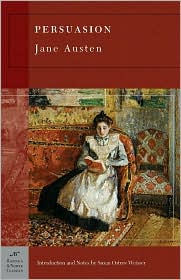
Sundays with Jane: Persuasion (1818)

Persuasion. Jane Austen 1818/1992. Knopf Doubleday. 304 pages. [Source: Bought]

Persuasion is my favorite Jane Austen novel. It just is. I believe this is the third time I've reviewed it. April 2011. January 2008. Out of all of Austen's opening lines, I have to admit that Persuasion's first sentence is my least favorite. Wouldn't you agree?

Opening to Sense and Sensibility: The family of Dashwood had long been settled in Sussex.

Opening to Pride and Prejudice: It is a truth universally acknowledged, that a single man in possession of a good fortune, must be in want of a wife.

Opening to Mansfield ParkAbout thirty years ago Miss Maria Ward, of Huntingdon, with only seven thousand pounds, had the good luck to captivate Sir Thomas Bertram, of Mansfield Park, in the county of Northampton, and to be thereby raised to the rank of a baronet's lady, with all the comforts and consequences of an handsome house and large income.

Opening to EmmaEmma Woodhouse, handsome, clever, and rich, with a comfortable home and happy disposition, seemed to unite some of the best blessings of existence; and had lived nearly twenty-one years in the world with very little to distress or vex her. 

Opening to Northanger AbbeyNo one who had ever seen Catherine Morland in her infancy would have supposed her born to be an heroine. Her situation in life, the character of her father and mother, her own person and disposition, were all equally against her. 

Opening to Persuasion: Sir Walter Elliot, of Kellynch Hall, in Somersetshire, was a man who, for his own amusement, never took up any book but the Baronetage; there he found occupation for an idle hour, and consolation in a distressed one; there his faculties were roused into admiration and respect, by contemplating the limited remnant of the earliest patents; there any unwelcome sensations, arising from domestic affairs changed naturally into pity and contempt as he turned over the almost endless creations of the last century; and there, if every other leaf were powerless, he could read his own history with an interest which never failed.

I've already summarized the plot twice before, and, the problem with reread posts is that I have to always (try to) find new ways to say what I've already said.

Anne Elliot is the heroine of Persuasion. If you haven't read Persuasion before let me add this, please, don't expect Anne to be Elizabeth Bennet. Just don't. You'll be happier for letting Anne be Anne and not comparing her to Elizabeth, Emma, Elinor, Marianne, Catherine, or Fanny. Plenty of people misunderstand Anne--the top offenders being her very own family--I don't want you to be one of them. Don't let her family persuade you that Anne is someone to easily dismiss, a nobody.

As I was saying, Anne is the heroine of Persuasion. Eight years before the novel opens, Anne fell in love. It was a forever-love. She wanted to marry Frederick Wentworth. He wanted to marry her too. They loved each other very much. But he had no way to support her. It wasn't just that he couldn't support her in style. Her family disapproved. Her friends disapproved. Long story short, the engagement was broken off. Persuasion is all about her second chance. When Anne and Captain Wentworth meet again, eight years later, can these two come together and make it work, can they have their happily ever after? That is the very simplified version, I suppose! Austen being Austen, there are plenty of characters and stories introduced in Persuasion. It is a very enjoyable read. In places, it is quite giddy-making.

Do you have a favorite Austen hero? Captain Wentworth is perhaps one of the strongest Austen heroes. Of course, everyone is familiar with Darcy. But Wentworth has his fans as well! Perhaps in large part due to his letter to Anne:
I can listen no longer in silence. I must speak to you by such means as are within my reach. You pierce my soul. I am half agony, half hope. Tell me not that I am too late, that such precious feelings are gone forever. I offer myself to you again with a heart even more your own than when you almost broke it eight years and a half ago. Dare not say that a man forgets sooner than woman, that his love has an earlier death. I have loved none but you. Unjust I may have been, weak and resentful I have been, but never inconstant. You alone have brought me to Bath. For you alone I think and plan. (234)
Personally, I love Henry Tilney, Mr. Knightley, and Captain Wentworth.

Favorite quotes:
Excepting one short period of her life, she had never, since the age of fourteen, never since the loss of her dear mother, known the happiness of being listened to, or encouraged by any just appreciation or real taste.
No, it was not regret which made Anne’s heart beat in spite of herself, and brought the colour into her cheeks when she thought of Captain Wentworth unshackled and free. She had some feelings which she was ashamed to investigate. They were too much like joy, senseless joy!
She hoped to be wise and reasonable in time; but alas! alas! she must confess to herself that she was not wise yet.

© 2014 SukaYuka.com of SukaYuka's Book Reviews

Friday, October 31, 2014

Reread #44 Frankenstein

Frankenstein. Mary Shelley. 1818/1831. Oxford World's Classics. 250 pages. [Source: Bought]

Almost every time I read it, I focus on something new, something that I might have missed, something that I hadn't considered before. I thought I would share my observations with you instead of a traditional review.

Stories. Frankenstein is a story within a story. But it's more than that. It's a text that utilizes stories and storytelling even within that framework. The first story, of course, is the one Robert Walton is communicating to his sister, Margaret, through letters. After the first few letters, Walton stops being so introspective and focuses on telling someone else's story. Victor Frankenstein's story. This is written in the letters in first person, as if Victor himself were telling the story--sharing it. Within that big story, are dozens of little stories. The story of how his parents met. The story of his birth and childhood. The story of how Elizabeth was adopted. The story of how he became interested in science. The story of his mother's death. The story of his going away to university. The story of his madness--his obsession--and how he came to create life. The story of his sickness and recovery. The story of his learning about his brother's death/murder. The story of Justine. You get the idea. Each story is crafted and shaped. These stories are how he sees himself and the world, his place in it. Some of the stories are personal and a vital part of the plot. Other stories are more like asides. But this isn't Victor's story alone. Midway through the book, readers learn the creature's story. Even though this is written in first person though the eyes of the creature--the monster--the words are for better or worse being filtered through Victor Frankenstein's memory. He's telling what the monster said. He's telling what the monster heard. And Robert Walton is then passing along Frankenstein's story of the events and conversations. The creature is a storyteller as well. He recalls his life, his memories, his desires and needs. But he also focuses in particular on one family, one French family living in exile. This section has multiple stories. Including one focusing on a young woman. Though it may seem like an aside to readers, the stories matter very much to the narrator, the creature. The stories are providing for him a framework of the world, of how it works, of what life and love are all about. The stories resonate with the creature. He has seen love. He has seen family. He has seen fellowship and community. Because he has seen this, he feels the lack of it in his own life. But it isn't just the unfolding story that he personally witnesses. He is also shaped by the stories--the words--in the books he oh-so-conveniently is able to read. Words and stories matter. The stories we tell ourselves about ourselves, the stories we share with others, they all matter. For example, I think the story the creature told himself over and over and over again was it is all Victor's fault. He made me. He gave me life. He made me this ugly, this revolting. He made me this large and strong. He left me--he abandoned me. He didn't love me. He never loved me. He rejected me. He made it so everyone would reject me. Why does everyone reject me? It's his fault. It's all his fault. He made me have killing-hands. He made me have killing-thoughts. He didn't show me a better way. He didn't teach me. He didn't raise me. I had to learn everything all by myself. It is his fault. I'm not responsible. Why would I be? It is his fault! If it wasn't for him, I wouldn't be so miserable, so alone, so full of angst. I wouldn't feel pain or hunger or thirst. I wouldn't feel at all. The monster has his Job moments. One last thing, Victor Frankenstein speaks of the power of words, of persuasion. He warns that the creature has a way with words, that he can manipulate people by his persuasiveness. He warns Walton not to let himself be manipulated by the creature's story--his words and pleas. Is there any truth to this? Is the creature trying to masquerade himself as an angel of light? His actions say one thing: he's a killer, a murderer, he premeditates at least some of his crimes. His words say another: no one loves me, everyone runs from me, it's all HIS fault.

Questions. It's hard to read Frankenstein without questions. Who is the real monster? Who should be held responsible? Is there anyone who shouldn't be held responsible? Why is human life valued so little by ego-obsessed people? Why does Walton idolize Frankenstein?

Victor Frankenstein, Robert Walton, and the creature share a few things in common. They are introspective, moody, obsessed, and lonely. True, there are differences in their obsessions. Robert Walton is obsessed with glory, with adventure, with discovering the Northwest Passage. Walton has spent years if not decades obsessed with the North Pole, with the arctic regions. This started as a boy with books, with stories and words. His dream shifted slightly for a brief period of time when he wanted to be a poet, but, ultimately he came back to his first love. He didn't give up his poetic personality/nature however. Victor Frankenstein is first obsessed with science, with electricity, with creating life. This playing God leads to no good--it leads to madness and murder. I believe the madness started long before he was successful. I have never understood how he could piece together this creature--this eight-foot creature--and it is only when he is alive that he realizes that it is monstrous and ugly and unnatural and threatening. Why make it eight-feet? Why make it so unhuman? Regardless, having created life, he then becomes obsessed with destroying it--with murdering his demon-creation, his monster. His only reason to live is to track down and kill the monster. The monster's obsession? Well, he's driven by anger and pain. He wants to HURT Frankenstein. He is acting out, having murderous temper-tantrums all to get the attention of the one who gave him life, his father, his creator. He wants what he can't have. He wants love and acceptance. He wants to belong. He wants companionship and family. He wants to be happy. He wants to be treated fairly and humanely. He doesn't want to be judged based on appearances. He taunts and haunts his creator. He wants Frankenstein to be just as miserable and desperate as he is.

Quotes:

Robert Walton meets Victor Frankenstein:
In the morning, however, as soon as it was light, I went upon deck and found all the sailors busy on one side of the vessel, apparently talking to someone in the sea. It was, in fact, a sledge, like that we had seen before, which had drifted towards us in the night on a large fragment of ice. Only one dog remained alive; but there was a human being within it whom the sailors were persuading to enter the vessel. He was not, as the other traveller seemed to be, a savage inhabitant of some undiscovered island, but a European. When I appeared on deck the master said, "Here is our captain, and he will not allow you to perish on the open sea." On perceiving me, the stranger addressed me in English, although with a foreign accent. "Before I come on board your vessel," said he, "will you have the kindness to inform me whither you are bound?" You may conceive my astonishment on hearing such a question addressed to me from a man on the brink of destruction and to whom I should have supposed that my vessel would have been a resource which he would not have exchanged for the most precious wealth the earth can afford. I replied, however, that we were on a voyage of discovery towards the northern pole. Upon hearing this he appeared satisfied and consented to come on board. Good God! Margaret, if you had seen the man who thus capitulated for his safety, your surprise would have been boundless. His limbs were nearly frozen, and his body dreadfully emaciated by fatigue and suffering. I never saw a man in so wretched a condition. We attempted to carry him into the cabin, but as soon as he had quitted the fresh air he fainted. We accordingly brought him back to the deck and restored him to animation by rubbing him with brandy and forcing him to swallow a small quantity. As soon as he showed signs of life we wrapped him up in blankets and placed him near the chimney of the kitchen stove. By slow degrees he recovered and ate a little soup, which restored him wonderfully. Two days passed in this manner before he was able to speak, and I often feared that his sufferings had deprived him of understanding. When he had in some measure recovered, I removed him to my own cabin and attended on him as much as my duty would permit. I never saw a more interesting creature: his eyes have generally an expression of wildness, and even madness, but there are moments when, if anyone performs an act of kindness towards him or does him any the most trifling service, his whole countenance is lighted up, as it were, with a beam of benevolence and sweetness that I never saw equalled. But he is generally melancholy and despairing, and sometimes he gnashes his teeth, as if impatient of the weight of woes that oppresses him.
 Robert shares his big, big dream with Victor:
I was easily led by the sympathy which he evinced to use the language of my heart, to give utterance to the burning ardour of my soul and to say, with all the fervour that warmed me, how gladly I would sacrifice my fortune, my existence, my every hope, to the furtherance of my enterprise. One man's life or death were but a small price to pay for the acquirement of the knowledge which I sought, for the dominion I should acquire and transmit over the elemental foes of our race. At first I perceived that he tried to suppress his emotion; he placed his hands before his eyes, and my voice quivered and failed me as I beheld tears trickle fast from between his fingers; a groan burst from his heaving breast. I paused; at length he spoke, in broken accents: "Unhappy man! Do you share my madness? Have you drunk also of the intoxicating draught? Hear me; let me reveal my tale, and you will dash the cup from your lips!"

And so it begins...
Yesterday the stranger said to me, "You may easily perceive, Captain Walton, that I have suffered great and unparalleled misfortunes. I had determined at one time that the memory of these evils should die with me, but you have won me to alter my determination. You seek for knowledge and wisdom, as I once did; and I ardently hope that the gratification of your wishes may not be a serpent to sting you, as mine has been. I do not know that the relation of my disasters will be useful to you; yet, when I reflect that you are pursuing the same course, exposing yourself to the same dangers which have rendered me what I am, I imagine that you may deduce an apt moral from my tale, one that may direct you if you succeed in your undertaking and console you in case of failure. He then told me that he would commence his narrative the next day when I should be at leisure. This promise drew from me the warmest thanks. I have resolved every night, when I am not imperatively occupied by my duties, to record, as nearly as possible in his own words, what he has related during the day. If I should be engaged, I will at least make notes. This manuscript will doubtless afford you the greatest pleasure; but to me, who know him, and who hear it from his own lips—with what interest and sympathy shall I read it in some future day! Even now, as I commence my task, his full-toned voice swells in my ears; his lustrous eyes dwell on me with all their melancholy sweetness; I see his thin hand raised in animation, while the lineaments of his face are irradiated by the soul within. Strange and harrowing must be his story, frightful the storm which embraced the gallant vessel on its course and wrecked it—thus!
I've reviewed Frankenstein several times in the past. 2007. 2009. 2010. 2011

© 2014 SukaYuka.com of SukaYuka's Book Reviews
Sunday, October 26, 2014

Dancers in Mourning (1937)

Dancers in Mourning. Margery Allingham. 1937. 337 pages. [Source: Bought]
 When Mr. William Faraday sat down to write his memoirs after fifty-eight years of blameless inactivity he found the work of inscribing the history of his life almost as tedious as living it had been and so, possessing a natural invention coupled with a gift for locating the easier path, he began to prevaricate a little upon the second page, working up to downright lying on the sixth and subsequent folios.
The book appeared at eighteen-and-sixpence, with frontispiece, in nineteen thirty-four and would have passed into the limbo of the remainder lists with thousands of its prototypes had not the quality of one of the wilder anecdotes in the chapters dealing with an India the author had never seen earned it a place in the news columns of a Sunday paper.
This paragraph called the memoirs to the attention of a critic who had not permitted his eminence to impair his appreciation of the absurd, and in the review which he afterwards wrote he pointed out that the work was pure fiction, not to say fantasy, and was incidentally one of the funniest books of the decade.
The public agreed with the critic and at the age of sixty-one William Faraday, author of Memoirs of an Old Buffer (republished at seven-and-six, seventy-fourth thousand), found himself a literary figure.
I was disappointed with this vintage mystery. While I absolutely loved the opening pages, by the end I found the whole book to be a mess. I admit it could be a mood thing. As much as I wanted to like it, even love it, perhaps I didn't have the patience to remember the large cast of suspects. Or perhaps the problem is that the characters aren't well drawn enough, aren't unique enough, to distinguish between. There were three or four characters that I could remember. But for the others, it was who is she again? who is he again? how does he fit into the group again? where did she come from?

Albert Campion has been invited into the inner circle of Jimmy Sutane and his friends. Sutane is in show business--the theater. Uncle William is, I believe, a mutual friend? Regardless, Uncle William is one of Campion's closest friends in the book. Anyway, Sutane invites Campion to his country house. There are many, many people there. Mostly his guests are in show business too--in the same currently running production. But a few are in his employ or in his family. By the end of the day, tragedy will strike and one of the guests will be dead.

The main reason I found this book to be a complete mess is Albert Campion. He is a horrible detective in this one. Why? Because at the party, he falls madly, deeply in LOVE with Jimmy Sutane's wife. He believes that they share a meaningful moment. In fact, he gets so swept up in the moment...he finds himself almost rushing across the room and taking her in his arms. At least he doesn't do that. But. Regardless. His inappropriate interest in Linda--Jimmy's wife--keeps him from using his brain for hundreds of pages. He doesn't want the murder to be solved just in case the murderer is someone that she cares about, just in case bringing the murderer to justice would make her feel bad. It's RIDICULOUS.


© 2014 SukaYuka.com of SukaYuka's Book Reviews

Sunday, October 19, 2014

A Tale of Two Cities (1854)

A Tale of Two Cities. Charles Dickens. 1854/2003. Bantam Classics. 382 pages. [Source: Bought]

I didn't love A Tale of Two Cities. Or should I say I didn't love it as much as I hoped I would OR even thought I would. A Tale of Two Cities is definitely a subject-driven novel. The focus, I would even say sole focus, is on the French Revolution. We meet individual characters within that setting, to make the French Revolution more personal, perhaps, but, in my opinion, Dickens characterization is not as strong in A Tale of Two Cities as it is in some of his other novels. That doesn't mean his characters are not memorable. In fact, I imagine that there are at least two or three characters in this one that are very memorable indeed. A Tale of Two Cities is also a very heavy novel thematically. It's just dark and oppressive. Dickens won't be bringing any smiles to readers in this one. Personally, I love it when Dickens makes me laugh!

The novel begins with a reunion. A daughter, Lucie Manette, learns that the father she has long presumed to be dead is, in fact, alive. His existence seems to be news to quite a few people. Lucie Manette and Mr. Jarvis Lorry travel to France from England to meet him and bring him back. The name of this section is "Recalled to Life." And it's a very fitting title, in my opinion. Lorry and Lucie never really learn the whole story, all the ugly details of the past. Seeing Lucie with her father reminded me--in a good way--of the relationship between Jean Valjean and Cosette.

The second book, "The Golden Thread," introduces readers to Charles Darnay and Sydney Carton. These two men become very well known to Dr. Manette and his daughter. Both men love and admire her, as you would expect. But she can only love one of them, and, her heart belongs to Charles. Of course, this is a very simple summary!

The third book is "The Track of A Storm." Let's just say, Dickens can do bleakity-bleak. This book follows Charles Darnay into France during the early days of the French Revolution. I had a hard time reading this section, because I didn't want to experience it. Darnay is NOT alone in France. And he's far from forgotten. Dr. Manette and his daughter and granddaughter are there, for one, and so is Sydney Carton. Of course, there are others as well to round out the plot.

Throughout all three sections, readers have also followed a few people from France, mainly Monsieur Defarge and his not-so-lovely wife, Madame Defarge. I'm not sure I've ever hated a character more. I am sure that I have. Probably. Still, this book made me so very angry in places!!!

I won't talk about the ending. I won't. I don't want to. I probably don't even need to. A Tale of Two Cities left me needing a comfort read as a follow-up.

© 2014 SukaYuka.com of SukaYuka's Book Reviews

Sunday, October 12, 2014

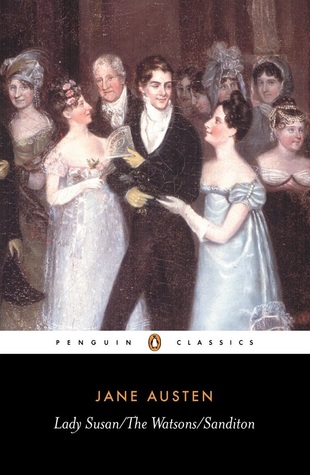
My Year with Jane: Lady Susan, Watsons, Sandition

Lady Susan, The Watsons, Sandition. Jane Austen. 1975. Penguin. 211 pages. [Source: Bought]

Lady Susan. I've read Lady Susan several times now. This is a quick, enjoyable read. I always forget how playful it is until I'm rereading it. I do have a tendency to dismiss it. The story, the drama, is told almost exclusively through letters. The epilogue being the exception. While I'm glad that readers do learn what happens next, how happily ever after is achieved for certain characters, it doesn't quite feel like it belongs either.

In the novel, readers meet Lady Susan and her daughter. She has invited herself to stay with a brother-in-law, I believe, and his family. Catherine is one of the main characters. She HATES Lady Susan and wishes she could politely throw her out of her home. She LOVES Lady Susan's daughter, however. One of Lady Susan's biggest fans is Reginald, Catherine's brother. Lady Susan can do no wrong in his eyes. His journey to the truth is interesting but frustrating.

The characters in this one are certainly different. Lady Susan reminds me of Mary Crawford in a way, with Mary Crawford being the tamer. Lady Susan is SOMETHING. She belongs on a soap opera perhaps.
Where there is a disposition to dislike, a motive will never be wanting.
In short, when a person is always to deceive, it is impossible to be consistent.
Facts are such horrid things!
The Watsons. This was my first time to read this incomplete novel. I would have loved it if Austen had finished it, I'm sure. It has so much potential. It had me from hello. Unfortunately, it is too brief to be truly satisfying. But in just a few short chapters, I found everything I love about Austen to be present.   
Miss Emma Watson, who was very recently returned to her family from the care of an aunt who had brought her up, was to make her first public appearance in the neighbourhood, and her eldest sister, whose delight in a ball was not lessened by a ten years’ enjoyment, had some merit in cheerfully undertaking to drive her and all her finery in the old chair to D. on the important morning.
Sandition. This was also my first time to read this incomplete novel. I think I liked the beginning of The Watsons more than I liked Sandition. (Even though Sandition is longer. Even though I found Sandition more quotable.) I am glad I read it...once. It was certainly enjoyable enough for what it was.
Sanditon was a second wife and four children to him, hardly less dear, and certainly more engrossing. He could talk of it forever. lt had indeed the highest claims; not only those of birthplace, property and home; it was his mine, his lottery, his speculation and his hobby horse; his occupation, his hope and his futurity.
EVERY NEIGHBOURHOOD should have a great lady. The great lady of Sanditon was Lady Denham; and in their journey from Willingden to the coast, Mr. Parker gave Charlotte a more detailed account of her than had been called for before. She had been necessarily often mentioned at Willingden -- for being his colleague in speculation, Sanditon itself could not be talked of long without the introduction of Lady Denham. That she was a very rich old lady, who had buried two husbands, who knew the value of money, and was very much looked up to and had a poor cousin living with her, were facts already known; but some further particulars of her history and her character served to lighten the tediousness of a long hill, or a heavy bit of road, and to give the visiting young lady a suitable knowledge of the person with whom she might now expect to be daily associating.
She took up a book; it happened to be a volume of Camilla. She had not Camilla’s youth, and had no intention of having her distress; so she turned from the drawers of rings and brooches, repressed further solicitation and paid for what she had bought.
 
© 2014 SukaYuka.com of SukaYuka's Book Reviews

Monday, September 29, 2014

In Search of England

In Search of England. H.V. Morton. 1927/2007. Da Capo Press. 304 pages. [Source: Bought]

I enjoyed reading H.V. Morton's travel book In Search of England. If you enjoy reading leisurely, sometimes amusing, travel books with observations and stories you should consider reading it. I liked the casual, often-charming style of Morton's travel writing.

The premise of this book is simple: the author returns home to England from Palestine with one simple goal to go "in search of England." His homesickness has given him the desire to have an adventure, "I will see what lies off the beaten track. I will, as the mood takes me, go into famous towns and unknown hamlets. I will shake up the dust of kings and abbots; I will bring the knights and the cavaliers back to the roads, and once in a while, I will hear the thunder of old quarrels at earthwork and church door. If I become weary of dream and legend I will just sit and watch the ducks on a village pond, or take the horses to water: I will talk with lords and cottagers, tramps, gipsies, and dogs; I will, in fact, do anything that comes into my head as suddenly and light-heartedly as I will accept anything, and everything, that comes my way in rain or sun along the road."

In Search of England is best read with leisure and patience. Don't expect the book to be a thrilling fast-paced adventure. Expect to take your time, to read it in between other books you're reading. I enjoyed what I read. But I never enjoyed it so much that I felt the need to read the whole book in one sitting. It's not that kind of book. It's a book that you don't lose momentum on by taking a break.

(I've also read and reviewed H.V. Morton's In the Steps of the Master.)

Favorite quotes:
How often in London rain weighs on the spirit and soaks itself into the very soul; but in the country it seldom saddens you - in fact, there is a kind of country rain that exhilarates and causes you to sing aloud.
Whenever I see a small boy sail a boat I long to join in. I can never see him without wondering whether boys still have the heavenly time with boats that I have had.
I once heard a bright young man say at a party that living in Bath was rather like sitting in the lap of a dear old lady. Nobody laughed, because it is true. Bath is the dear old lady of Somerset: grey-haired, mittened, smelling faintly of lavender; one of those old ladies who have outlived a much-discussed past, and are now as obviously respectable as only old ladies with crowded pasts can be. She nurses you with a shrewd twinkle in which you detect experience mellowed by age. You look at her lovingly, wondering how she could ever have been wicked; wishing that she could grow young again for one wild evening and show you! That might wake you up!
I have been reading with avidity the medical pamphlets provided free in Bath, and I feel that my arteries become harder and harder every minute. I wonder whether the ache in my left eye is paraplegia. I have no idea what this is, but when I whisper the word something ominous seems in mid-air with bared claws. It is hardly possible that I shall escape from oxularia. (Obesity does not worry me.) Intestinal stasis? Well, perhaps! Chronic vesical catarrh? I wonder? As I glance down the long list of diseases cured at Bath - feeling a sharp twinge of fibrocitis, a swift jab of lithiasis, and an alarming touch of rhinitis - it is perfectly clear to me that the average human being's chance of seeing Bath more than once is about a hundred to one.
This story has no right in this book, and I apologize for writing it. It happened like this. I was finding my way out of Carlisle with the intention of crossing the Roman Wall that runs across England from Solway Firth to the Tyne, when I saw a signpost: `To Gretna Green io miles.' I pulled up sharply: `This,' I said, `is where I go right off the rails. I must see Gretna Green! I'll take a holiday and - go to Scotland!' How could I neglect to visit the scene of so much folly? In a few minutes I had left England behind me and was spinning along in a country which looked exactly like it, but was not. I had crossed the Border! Scotland does not begin to get `bonny' just here, but it was stimulating to realize that we were in the land of red whiskers and freckled maids, of brown trout streams, of purple moors, of great mountains, which, even in fair weather, wear white caps of cloud. At the cottage doors clustered brawny sandy-haired boys (who some day, of course, go south) and little girls who will grow up and speak the most delicious English in the world. The road runs straight from Carlisle to Gretna, as if anxious to cut off all the corners and give a sporting finish to the race. At the end of this road - and in the heart of a great crowd - I found Gretna Green. 
How much romance, beauty and drama can be skipped over by a guide-book! As I was standing behind the high altar of Durham Cathedral earlier in the day I saw a large platform with one word carved in the stone: `Cuthbertus.' The guide-book says: `In the place of honour behind the high altar is the tomb of St Cuthbert, who died A.D. 687. The body still rests below....' Now as I read this bald truth my imagination went on a long journey. At the end of a tunnel of time, 1,239 years long, I saw a strange England, and I saw the hill of Durham before its great Norman church was built, before the stone Saxon church was built, before the first little reed chapel was built: just a woody hill of red sandstone, with perhaps a speckled.fawn standing in the fern. The roots of Durham go back into an England difficult to see: an England wild, bloody, savage; an England which prayed to Wotan and Thor in the ruins of Roman temples; an England beautiful at this time beyond words, because, caring nothing for the clash of kingdom on kingdom, the sound of swords and the trail of fire, Christ was walking through English meadows humbly as He walked through Galilee. The legions of Rome had returned with shaven heads bearing not a sword, but a message. Men have done deeds in the name of God which would have made Christ weep, but the story of the conversion of England to Christianity, with which Durham is so marvellously linked, is, I believe, one of the loveliest stories since the New Testament.
York is the lovely queen - as London is the powerful king - of English cities.
Men didn't just arrive with cartloads of stones and start to build a church. There is a story of faith and struggle behind every English cathedral.
I am the only person I have ever known who has been to Rutland. I admit that I have known men who have passed through Rutland in search of a fox, but I have never met a man who has deliberately set out to go to Rutland; and I do not suppose you have. Rutland - which I believe most people think is in Wales - is the smallest county in England, and the most remarkable. It is only seventeen miles long and seventeen miles wide, and it contains only two towns, Oakham and Uppingham, neither large enough to be a municipal borough. The county of Rutland, nestling like a baby in arms between Lincolnshire, Leicestershire, and Northamptonshire, is included in `The Shires'. Rutland is the only shire carved out of old Saxon Mercia not named after its county town, otherwise we would know it as Oakhamshire. On the other hand, no one would dream of calling it Rutlandshire! Tiny Rutland is the only example of an ancient Mercian division which has survived the West Saxon shire-ing of the district.
Norfolk is the most suspicious county in England. In Devon and Somerset men hit you on the back cordially; in Norfolk they look as though they would like to hit you over the head - till they size you up. You see, for centuries the north folk of East Anglia were accustomed to meet stray Vikings on lonely roads who had just waded ashore from the long boats...`Good morning, 'bor!' said the Vikings. `Which is the way to the church?' `What d'ye want to know for?' was the Norfolk retort. `Well, we thought about setting fire to it!' You will gather that Norfolk's suspicion of strangers, which is an ancient complex bitten into the East Anglian through centuries of bitter experience, is well grounded, and should never annoy the traveller... They mean well. Once they bring themselves to call you "bor' (which, I conclude, is the short for `neighbour' or, perhaps, `boy'), you can consider yourself highly complimented. In East Anglia men are either neighbours or Vikings.

© 2014 SukaYuka.com of SukaYuka's Book Reviews
Sunday, September 21, 2014

No Name (1862)

No Name. Wilkie Collins. 1862/1998. Oxford University Press. 748 pages.

No Name is my third Wilkie Collins novel to read this year. I've also read A Rogue's Life and The Law and the Lady. I don't know if I'll have time to squeeze in another before the year is over or not. But it's looking like No Name will definitely be my favorite. This novel reminded me of why I enjoy reading Wilkie Collins! And sometimes I do need reminding. I have been disappointed before. But when he's good, he tends to be really, really good. No Name is definitely Collins at his best! I enjoyed No Name best when I stopped trying to categorize it.

Magdalen Vanstone is the heroine of No Name. After her parents die within weeks of each other, she learns some startling news that changes everything for herself and her sister. Her father was not legally married to her mother; that is he was not legally married to her until a few months ago. His honorable intentions, unfortunately, have ruined their lives. For his marriage discredits his previous will. If he had NOT gotten married, then the girls would have been in his will and they would have inherited everything. Now his everything goes to an estranged older brother that is mean and cruel. (Collins would like you to boo, hiss now)

Norah, the good sister, the good older sister, accepts this news with grace and courage. She will follow Miss Garth's advice closely. She will become a governess. She will be far from wealthy, but, she'll hold onto as much dignity as she can cling to under the circumstances.

Magdalen, the younger sister, refuses to accept it at all. And she's just as clever and crafty as she is stubborn. Magdalen teams up with a relation of a relation, a con man named Captain Wragge. Both are clever and willing to be a bit immoral in pursuit of what they want most, of what they feel they deserve. Captain Wragge may sound like a villain, but, there's just something about him that I can't help liking. He certainly makes NO NAME an interesting read!!!

Magdalen has a plan, a scheme, for recovering the money that is rightfully hers. She will stop at nothing to get it. What is her plan? Well, it involves her (mean) uncle, Michael Vanstone, and his heir, Noel.

The scheme does not go unnoticed, however. Mrs. Lecount is a servant in the Vanstone household, and she is very controlling and extremely observant. She is always on the lookout for people who might be tempted to take advantage of the family since they are old and/or weak and/or very stupid!

It is a plot-driven novel with plenty of twists and turns. I enjoyed every single one. The book may be over 700 pages, but it's a quick 700 pages!!! It's a surprisingly quick read. Once you become hooked on the story, on learning what happens next, once you start to CARE about the characters, you just have to read on and on!!!

Will Magdalen's scheme succeed?
Will she get her hands on the money?
Will she share the money with Captain Wragge?
Will he find a way of getting his share? Is he really on her side no matter what? Or will he turn traitor?
Will either sister get married? Will either sister live happily ever after?

© 2014 SukaYuka.com of SukaYuka's Book Reviews

Friday, September 19, 2014

Reread #38 The Hobbit

The Hobbit. J.R.R. Tolkien. 1937.  320 pages. [Source: Bought]

In a hole in the ground there lived a hobbit. Not a nasty, dirty, wet hole, filled with the ends of worms and an oozy smell, nor yet a dry, bare, sandy hole with nothing in it to sit down on or to eat: it was a hobbit-hole, and that means comfort. 

I love The Hobbit. I do. This is my fourth time to review it. I first read it in May 2008. I also reviewed it in 2012 and 2013. (The 2013 review being of The Annotated Hobbit!)

The Hobbit is an adventure story starring Bilbo Baggins (the hobbit) and thirteen dwarves (led by Thorin). Gandalf introduces the dwarfs to Bilbo, he introduces him as a great burglar. Is he a great burglar? Not really. He's never done anything of the sort before. He's never even thought of doing any such thing. Bilbo have an adventure? Bilbo go on a long journey? The idea that he, a comfort-loving hobbit would leave the safety of his shire to GO and steal from a dragon is ridiculous. Yet. Bilbo finds himself on such a journey. And Bilbo discovers that there is more to him. It's not that he suddenly becomes brave and strong and wise. He doesn't. But he's shaped by the experiences of the journey.

Quotes:
“Good Morning!” said Bilbo, and he meant it. The sun was shining, and the grass was very green. But Gandalf looked at him from under long bushy eyebrows that stuck out further than the brim of his shady hat. “What do you mean?” he said. “Do you wish me a good morning, or mean that it is a good morning whether I want it or not; or that you feel good this morning; or that it is a morning to be good on?” “All of them at once,” said Bilbo.
“What a lot of things you do use Good morning for!” said Gandalf. “Now you mean that you want to get rid of me, and that it won’t be good till I move off.”
He liked visitors, but he liked to know them before they arrived, and he preferred to ask them himself. He had a horrible thought that the cakes might run short, and then he—as the host: he knew his duty and stuck to it however painful—he might have to go without.
“Go back?” he thought. “No good at all! Go sideways? Impossible! Go forward? Only thing to do! On we go!”
He was altogether alone. Soon he thought it was beginning to feel warm. “Is that a kind of a glow I seem to see coming right ahead down there?” he thought. It was. As he went forward it grew and grew, till there was no doubt about it. It was a red light steadily getting redder and redder. Also it was now undoubtedly hot in the tunnel. Wisps of vapour floated up and past him and he began to sweat. A sound, too, began to throb in his ears, a sort of bubbling like the noise of a large pot galloping on the fire, mixed with a rumble as of a gigantic tom-cat purring. This grew to the unmistakable gurgling noise of some vast animal snoring in its sleep down there in the red glow in front of him. It was at this point that Bilbo stopped. Going on from there was the bravest thing he ever did. The tremendous things that happened afterwards were as nothing compared to it. He fought the real battle in the tunnel alone, before he ever saw the vast danger that lay in wait.
“You have nice manners for a thief and a liar,” said the dragon. “You seem familiar with my name, but I don’t seem to remember smelling you before. Who are you and where do you come from, may I ask?” “You may indeed! I come from under the hill, and under the hills and over the hills my paths led. And through the air. I am he that walks unseen.” “So I can well believe,” said Smaug, “but that is hardly your usual name.” “I am the clue-finder, the web-cutter, the stinging fly. I was chosen for the lucky number.” “Lovely titles!” sneered the dragon. “But lucky numbers don’t always come off.” “I am he that buries his friends alive and drowns them and draws them alive again from the water. I came from the end of a bag, but no bag went over me.” “These don’t sound so creditable,” scoffed Smaug. “I am the friend of bears and the guest of eagles. I am Ringwinner and Luckwearer; and I am Barrel-rider,” went on Bilbo beginning to be pleased with his riddling. “That’s better!” said Smaug. “But don’t let your imagination run away with you!”
If more of us valued food and cheer and song above hoarded gold, it would be a merrier world.
© 2014 SukaYuka.com of SukaYuka's Book Reviews

Thursday, September 18, 2014

My Cousin Rachel (1951)

My Cousin Rachel. Daphne du Maurier. 1951. 374 pages. [Source: Library]

Years ago I read and enjoyed Rebecca by Daphne du Maurier. I've been meaning to read more of her books ever since. My Cousin Rachel is the second of hers that I've read. I enjoyed it. I'm not sure I enjoyed it more than Rebecca. But I think it is safe to say that if you enjoyed Rebecca you will also (most likely) enjoy My Cousin Rachel.

My Cousin Rachel is narrated by Philip Ashley. He is the heir to his cousin Ambrose's estate. Ambrose took him in and raised him essentially. These two are close as can be. Daphne du Maurier knows how to do foreshadowing. In both Rebecca and My Cousin Rachel, she uses it generously giving readers time to prepare for tough times ahead. In this case, the foreshadowing is about Ambrose's trip abroad and his surprise wedding to a young woman, coincidentally a distant cousin, named Rachel. Rachel is a widow he meets in Italy. Instead of returning home to England, these two settle down in Italy--Florence, I believe. Philip is angsty to say the least. How dare my cousin do this to me! How dare he marry someone he barely knows! Philip spends months imagining Rachel's character and personality. She has to have an agenda! She has to be manipulative and scheming. She has to be TROUBLE. Now Philip doesn't voice his concerns to everyone he meets. He is more guarded, almost aware that it's silly of him to have this strong a reaction to someone he's never met. But Ambrose's happily ever after is short-lived. And not just because he dies. Ambrose wrote mysterious letters to Philip over several months. In these letters, Philip sees that all is not well. That there is something to his prejudice against Rachel. It seems that Ambrose has regrets, big regrets, about Rachel. The moodiest of all these letters reaches Philip after Ambrose's death.

So. What will Philip think of Rachel once he actually meets her? What will she think of him? Will they be friends or enemies? Will they trust one another? Should they trust one another? Whose story is based in reality? Is Rachel's accounting of Ambrose's last months true? Or was Ambrose right to mistrust Rachel? Will Philip be wise enough and objective enough to know what is going on?

The author certainly gives readers plenty to think about. Readers get almost all their information filtered through Philip's perspective. But I suppose the dialogue in the book might provide more. If one can trust Philip's recollection of it.

I think My Cousin Rachel is a character-driven gothic novel. It is certainly creepy and weird.

© 2014 SukaYuka.com of SukaYuka's Book Reviews

Sunday, September 14, 2014

My Year with Jane: Northanger Abbey

Northanger Abbey. Jane Austen. 1817/1992. Everyman's Library. 288 pages. [Source: Library]

No one who had ever seen Catherine Morland in her infancy, would have supposed her born to be an heroine. Her situation in life, the character of her father and mother, her own person and disposition, were all equally against her. 

I know I say this with every Austen review, but, it's true: I love her novels more each time I read them. Now that I've read Northanger Abbey three or four times, I have to admit that I really do love it. Perhaps not as much as I love, love, love Persuasion. But I really am very fond of it. I am especially fond of Henry Tilney. He may just be my favorite, favorite, favorite Austen hero.

My latest review of the novel is from 2011. I am going to challenge myself to keep the summary as brief as possible:

Catherine Morland, our heroine, loves to read; she especially loves to read gothic novels. When she travels to Bath with her neighbors, she meets a new best friend, Isabella Thorpe, and a potential soul mate, Henry Tilney. While Miss Thorpe ends up disappointing her, Catherine's journey is not in vain for her crush, Henry, has a saint for a sister. When invited to visit the Tilney household, Catherine is beyond excited to accept. Her time at Northanger Abbey, the Tilney's home, proves shocking, but not at all in the way she expected.

I love the newest movie adaptation. I would definitely recommend it.

My favorite quotes:
She had reached the age of seventeen, without having seen one amiable youth who could call forth her sensibility, without having inspired one real passion, and without having excited even any admiration but what was very moderate and very transient. This was strange indeed! But strange things may be generally accounted for if their cause be fairly searched out. There was not one lord in the neighbourhood; no — not even a baronet. There was not one family among their acquaintance who had reared and supported a boy accidentally found at their door — not one young man whose origin was unknown. Her father had no ward, and the squire of the parish no children. But when a young lady is to be a heroine, the perverseness of forty surrounding families cannot prevent her. Something must and will happen to throw a hero in her way.
The master of the ceremonies introduced to her a very gentlemanlike young man as a partner; his name was Tilney. He seemed to be about four or five and twenty, was rather tall, had a pleasing countenance, a very intelligent and lively eye, and, if not quite handsome, was very near it. His address was good, and Catherine felt herself in high luck. There was little leisure for speaking while they danced; but when they were seated at tea, she found him as agreeable as she had already given him credit for being. He talked with fluency and spirit — and there was an archness and pleasantry in his manner which interested, though it was hardly understood by her. After chatting some time on such matters as naturally arose from the objects around them, he suddenly addressed her with — ”I have hitherto been very remiss, madam, in the proper attentions of a partner here; I have not yet asked you how long you have been in Bath; whether you were ever here before; whether you have been at the Upper Rooms, the theatre, and the concert; and how you like the place altogether. I have been very negligent — but are you now at leisure to satisfy me in these particulars? If you are I will begin directly.” “You need not give yourself that trouble, sir.” “No trouble, I assure you, madam.” Then forming his features into a set smile, and affectedly softening his voice, he added, with a simpering air, “Have you been long in Bath, madam?” “About a week, sir,” replied Catherine, trying not to laugh. “Really!” with affected astonishment. “Why should you be surprised, sir?” “Why, indeed!” said he, in his natural tone. “But some emotion must appear to be raised by your reply, and surprise is more easily assumed, and not less reasonable than any other. Now let us go on. Were you never here before, madam?” “Never, sir.” “Indeed! Have you yet honoured the Upper Rooms?” “Yes, sir, I was there last Monday.” “Have you been to the theatre?” “Yes, sir, I was at the play on Tuesday.” “To the concert?” “Yes, sir, on Wednesday.” “And are you altogether pleased with Bath?” “Yes — I like it very well.” “Now I must give one smirk, and then we may be rational again.” Catherine turned away her head, not knowing whether she might venture to laugh. “I see what you think of me,” said he gravely — ”I shall make but a poor figure in your journal tomorrow.”
“My journal!” “Yes, I know exactly what you will say: Friday, went to the Lower Rooms; wore my sprigged muslin robe with blue trimmings — plain black shoes — appeared to much advantage; but was strangely harassed by a queer, half-witted man, who would make me dance with him, and distressed me by his nonsense.” “Indeed I shall say no such thing.” “Shall I tell you what you ought to say?” “If you please.” “I danced with a very agreeable young man, introduced by Mr. King; had a great deal of conversation with him — seems a most extraordinary genius — hope I may know more of him. That, madam, is what I wish you to say.” “But, perhaps, I keep no journal.” “Perhaps you are not sitting in this room, and I am not sitting by you. These are points in which a doubt is equally possible. Not keep a journal! How are your absent cousins to understand the tenour of your life in Bath without one?
My dear madam, I am not so ignorant of young ladies’ ways as you wish to believe me; it is this delightful habit of journaling which largely contributes to form the easy style of writing for which ladies are so generally celebrated. Everybody allows that the talent of writing agreeable letters is peculiarly female. Nature may have done something, but I am sure it must be essentially assisted by the practice of keeping a journal.”
“What are you thinking of so earnestly?” said he, as they walked back to the ballroom; “not of your partner, I hope, for, by that shake of the head, your meditations are not satisfactory.” Catherine coloured, and said, “I was not thinking of anything.” “That is artful and deep, to be sure; but I had rather be told at once that you will not tell me.” “Well then, I will not.” “Thank you; for now we shall soon be acquainted, as I am authorized to tease you on this subject whenever we meet, and nothing in the world advances intimacy so much.”
I have no notion of loving people by halves; it is not my nature. My attachments are always excessively strong.
I consider a country-dance as an emblem of marriage. Fidelity and complaisance are the principal duties of both; and those men who do not choose to dance or marry themselves, have no business with the partners or wives of their neighbours.” “But they are such very different things!” “ — That you think they cannot be compared together.” “To be sure not. People that marry can never part, but must go and keep house together. People that dance only stand opposite each other in a long room for half an hour.” “And such is your definition of matrimony and dancing. Taken in that light certainly, their resemblance is not striking; but I think I could place them in such a view. You will allow, that in both, man has the advantage of choice, woman only the power of refusal; that in both, it is an engagement between man and woman, formed for the advantage of each; and that when once entered into, they belong exclusively to each other till the moment of its dissolution; that it is their duty, each to endeavour to give the other no cause for wishing that he or she had bestowed themselves elsewhere, and their best interest to keep their own imaginations from wandering towards the perfections of their neighbours, or fancying that they should have been better off with anyone else. You will allow all this?” “Yes, to be sure, as you state it, all this sounds very well; but still they are so very different. I cannot look upon them at all in the same light, nor think the same duties belong to them.” “In one respect, there certainly is a difference. In marriage, the man is supposed to provide for the support of the woman, the woman to make the home agreeable to the man; he is to purvey, and she is to smile. But in dancing, their duties are exactly changed; the agreeableness, the compliance are expected from him, while she furnishes the fan and the lavender water. That, I suppose, was the difference of duties which struck you, as rendering the conditions incapable of comparison.”
“The person, be it gentleman or lady, who has not pleasure in a good novel, must be intolerably stupid. I have read all Mrs. Radcliffe’s works, and most of them with great pleasure. The Mysteries of Udolpho, when I had once begun it, I could not lay down again; I remember finishing it in two days — my hair standing on end the whole time.” “Yes,” added Miss Tilney, “and I remember that you undertook to read it aloud to me, and that when I was called away for only five minutes to answer a note, instead of waiting for me, you took the volume into the Hermitage Walk, and I was obliged to stay till you had finished it.” “Thank you, Eleanor — a most honourable testimony. You see, Miss Morland, the injustice of your suspicions. Here was I, in my eagerness to get on, refusing to wait only five minutes for my sister, breaking the promise I had made of reading it aloud, and keeping her in suspense at a most interesting part, by running away with the volume, which, you are to observe, was her own, particularly her own. I am proud when I reflect on it, and I think it must establish me in your good opinion.”
“I am very glad to hear it indeed, and now I shall never be ashamed of liking Udolpho myself. But I really thought before, young men despised novels amazingly.” “It is amazingly; it may well suggest amazement if they do — for they read nearly as many as women. I myself have read hundreds and hundreds. Do not imagine that you can cope with me in a knowledge of Julias and Louisas. If we proceed to particulars, and engage in the never-ceasing inquiry of ‘Have you read this?’ and ‘Have you read that?’ I shall soon leave you as far behind me as — what shall I say? — I want an appropriate simile. — as far as your friend Emily herself left poor Valancourt when she went with her aunt into Italy. Consider how many years I have had the start of you. I had entered on my studies at Oxford, while you were a good little girl working your sampler at home!” “Not very good, I am afraid. But now really, do not you think Udolpho the nicest book in the world?”
The word ‘nicest,’ as you used it, did not suit him; and you had better change it as soon as you can, or we shall be overpowered with Johnson and Blair all the rest of the way.” “I am sure,” cried Catherine, “I did not mean to say anything wrong; but it is a nice book, and why should not I call it so?” “Very true,” said Henry, “and this is a very nice day, and we are taking a very nice walk, and you are two very nice young ladies. Oh! It is a very nice word indeed! It does for everything. Originally perhaps it was applied only to express neatness, propriety, delicacy, or refinement — people were nice in their dress, in their sentiments, or their choice. But now every commendation on every subject is comprised in that one word.” 
It was no effort to Catherine to believe that Henry Tilney could never be wrong. His manner might sometimes surprise, but his meaning must always be just: and what she did not understand, she was almost as ready to admire, as what she did.
The past, present, and future were all equally in gloom.
Wherever you are you should always be contented, but especially at home, because there you must spend the most of your time.
© 2014 SukaYuka.com of SukaYuka's Book Reviews