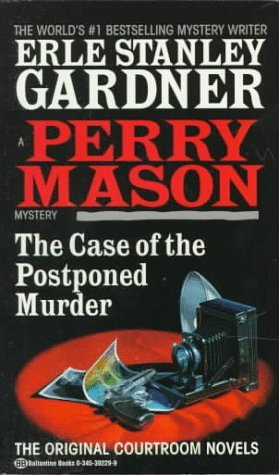
The Case of the Postponed Murder. Erle Stanley Gardner. 1973. 152 pages. [Source: Bought]
I enjoyed reading The Case of the Postponed Murder. Is it the best mystery ever? OF course not. I wouldn't even say it is the best Perry Mason mystery that I've ever read. But is it worth the quick time it takes? I think so. If you love the characters Perry Mason, Paul Drake, and Della Street, then you'll most likely enjoy reading this one enough.
The mystery begins with a woman visiting Mason's office. The would-be-client is concerned about her sister whom she claims is missing. Mason doesn't trust the woman, he thinks she's lying, or telling half-truths at least. He does direct her to hire Paul Drake as a private detective. Mason's hunch is that the sister story is flawed. His best guest is that "Sylvia Farr" the oh-so-concerned sister is in fact Mae Farr the so-called missing sister. His suspicions are confirmed a few days later, but, by then he's too involved in the case. It starts out a forgery case, an alleged check-forgery case. But, of course, you may have guessed it, ends in a murder case. (Though this one doesn't have a very satisfying murder-trial element to it.) The book is predictable enough, but, I don't have a problem with predictable and Perry Mason.
The book does feel a bit dated, even for 1973. The client, Mae Farr, is determined to be independent and strong-willed. She wants to make her way through life on her own, earn her own money, pay her own way, take care of her own problems. Yet, by the conclusion, she's decided that maybe she was wrong to think she could do it all on her own in the big city, that it would be best for her to marry the rancher who's spent years of his life loving her from afar. You definitely get the sense that she's been tamed. I guess my concern with that is that she's spent the entire book saying that she didn't love him at all, that she didn't care for him, that she'd never be happy with him, that she had no desire at all to get married and settle down. And then, within two pages a complete change of heart.
© 2014 SukaYuka.com of SukaYuka's Book Reviews
Showing posts with label mystery. Show all posts
Sunday, December 28, 2014
Sunday, October 26, 2014
Dancers in Mourning (1937)
Dancers in Mourning. Margery Allingham. 1937. 337 pages. [Source: Bought]
Albert Campion has been invited into the inner circle of Jimmy Sutane and his friends. Sutane is in show business--the theater. Uncle William is, I believe, a mutual friend? Regardless, Uncle William is one of Campion's closest friends in the book. Anyway, Sutane invites Campion to his country house. There are many, many people there. Mostly his guests are in show business too--in the same currently running production. But a few are in his employ or in his family. By the end of the day, tragedy will strike and one of the guests will be dead.
The main reason I found this book to be a complete mess is Albert Campion. He is a horrible detective in this one. Why? Because at the party, he falls madly, deeply in LOVE with Jimmy Sutane's wife. He believes that they share a meaningful moment. In fact, he gets so swept up in the moment...he finds himself almost rushing across the room and taking her in his arms. At least he doesn't do that. But. Regardless. His inappropriate interest in Linda--Jimmy's wife--keeps him from using his brain for hundreds of pages. He doesn't want the murder to be solved just in case the murderer is someone that she cares about, just in case bringing the murderer to justice would make her feel bad. It's RIDICULOUS.
© 2014 SukaYuka.com of SukaYuka's Book Reviews
When Mr. William Faraday sat down to write his memoirs after fifty-eight years of blameless inactivity he found the work of inscribing the history of his life almost as tedious as living it had been and so, possessing a natural invention coupled with a gift for locating the easier path, he began to prevaricate a little upon the second page, working up to downright lying on the sixth and subsequent folios.I was disappointed with this vintage mystery. While I absolutely loved the opening pages, by the end I found the whole book to be a mess. I admit it could be a mood thing. As much as I wanted to like it, even love it, perhaps I didn't have the patience to remember the large cast of suspects. Or perhaps the problem is that the characters aren't well drawn enough, aren't unique enough, to distinguish between. There were three or four characters that I could remember. But for the others, it was who is she again? who is he again? how does he fit into the group again? where did she come from?
The book appeared at eighteen-and-sixpence, with frontispiece, in nineteen thirty-four and would have passed into the limbo of the remainder lists with thousands of its prototypes had not the quality of one of the wilder anecdotes in the chapters dealing with an India the author had never seen earned it a place in the news columns of a Sunday paper.
This paragraph called the memoirs to the attention of a critic who had not permitted his eminence to impair his appreciation of the absurd, and in the review which he afterwards wrote he pointed out that the work was pure fiction, not to say fantasy, and was incidentally one of the funniest books of the decade.
The public agreed with the critic and at the age of sixty-one William Faraday, author of Memoirs of an Old Buffer (republished at seven-and-six, seventy-fourth thousand), found himself a literary figure.
Albert Campion has been invited into the inner circle of Jimmy Sutane and his friends. Sutane is in show business--the theater. Uncle William is, I believe, a mutual friend? Regardless, Uncle William is one of Campion's closest friends in the book. Anyway, Sutane invites Campion to his country house. There are many, many people there. Mostly his guests are in show business too--in the same currently running production. But a few are in his employ or in his family. By the end of the day, tragedy will strike and one of the guests will be dead.
The main reason I found this book to be a complete mess is Albert Campion. He is a horrible detective in this one. Why? Because at the party, he falls madly, deeply in LOVE with Jimmy Sutane's wife. He believes that they share a meaningful moment. In fact, he gets so swept up in the moment...he finds himself almost rushing across the room and taking her in his arms. At least he doesn't do that. But. Regardless. His inappropriate interest in Linda--Jimmy's wife--keeps him from using his brain for hundreds of pages. He doesn't want the murder to be solved just in case the murderer is someone that she cares about, just in case bringing the murderer to justice would make her feel bad. It's RIDICULOUS.
© 2014 SukaYuka.com of SukaYuka's Book Reviews
Sunday, September 28, 2014
The Singing Sands (1952)
The Singing Sands. Josephine Tey. 1952. 224 pages. [Source: Bought]
It was six o'clock of a March morning, and still dark. The long train came sidling through the scattered lights of the yard, clicking gently over the points.
Inspector Alan Grant is on holiday. He's had to take a personal holiday because of his mental health condition. He's had a nervous break, I suppose. Suddenly, he's weighed down by fear and anxiety, and shame. He doesn't want everyone to know what his mind is doing to him. Little things that he's always taken for granted now are tormenting him: riding in a train, sleeping in a sleeper car, riding in a car, riding in a plane. He's become claustrophobic.
As you have probably guessed, Grant is not going to do much relaxing on his vacation. Oh. He does try. But he keeps thinking about this case. A case that others at Scotland Yard have already closed. They've identified the body and the cause of death. End of story. But it's not enough for Grant. He thinks there is more to the story...and since this is his story, his FINAL story, I might add...he's right!
I liked this one. I am not sure I loved it. But I liked spending time with Grant.
© 2014 SukaYuka.com of SukaYuka's Book Reviews
It was six o'clock of a March morning, and still dark. The long train came sidling through the scattered lights of the yard, clicking gently over the points.
Inspector Alan Grant is on holiday. He's had to take a personal holiday because of his mental health condition. He's had a nervous break, I suppose. Suddenly, he's weighed down by fear and anxiety, and shame. He doesn't want everyone to know what his mind is doing to him. Little things that he's always taken for granted now are tormenting him: riding in a train, sleeping in a sleeper car, riding in a car, riding in a plane. He's become claustrophobic.
Well, at least he had managed not to open the door last night. But the triumph had been dearly bought. He was drained and empty, a walking nothingness. "Don't fight it," the doctor had said. "If you want to be in the open, go into the open." But to have opened the door last night would have meant a defeat so mortal that he felt there would be no recovery. It would have been an unconditional surrender to the forces of Unreason. So he had lain and sweated. And the door had stayed closed. (4)The morning after his sleepless night, Grant discovers a dead body. "Number B Seven" is found dead in his sleeper. Grant, who is not on duty, gets a very good look at him, and he accidentally picks up the dead man's newspaper. He takes it with him by chance. Later, when he's arrived at his cousin's house, I believe, he realizes what he did. He notices for the first time that the paper had been written on. It contains a few lines of poetry. Grant isn't sure if the man was writing an original poem, or, if he was writing down someone else's poem. But either way, those lines and that handwriting make an impact on him. He can't stop thinking about "Number B Seven." Even though he's supposed to be on vacation, resting and relaxing, and FISHING.
As you have probably guessed, Grant is not going to do much relaxing on his vacation. Oh. He does try. But he keeps thinking about this case. A case that others at Scotland Yard have already closed. They've identified the body and the cause of death. End of story. But it's not enough for Grant. He thinks there is more to the story...and since this is his story, his FINAL story, I might add...he's right!
I liked this one. I am not sure I loved it. But I liked spending time with Grant.
© 2014 SukaYuka.com of SukaYuka's Book Reviews
Tuesday, September 23, 2014
The Late Scholar (2014)
The Late Scholar. Jill Paton Walsh. 2014. St. Martin's Press. 368 pages. [Source: Library]
I enjoyed The Late Scholar enough while reading it, for the most part, but the more I think about it, the more disappointed I am. I have liked or enjoyed Jill Paton Walsh's sequels to Dorothy Sayer's Lord Peter mysteries. The Late Scholar is set in the 1950s. (I'm not sure if it's early, mid, or late 50s. But Queen Elizabeth is on the throne, I believe.) The novel opens with the Duke of Denver (aka Lord Peter Wimsey) learning that he is a Visitor at Oxford. He is being called upon to settle a dispute among the fellows. The person--ultimately one of many suspects, I suppose--who initially requested his interference comes to regret it. Lord Peter is thorough. He doesn't want to just cast a vote on a controversial topic without any thought. He wants to study the situation, learn both sides, draw his own conclusions about what is best. The dispute is about selling a medieval book to get the money to buy land next door that has come up for sell. Is land more valuable to the college than one book in the library? Or is the ancient book more valuable to the college than a piece of real estate? It wouldn't be a mystery book if it didn't turn to violence and murder. Lord Peter, Harriet Vane, and Bunter must follow all the clues to catch a murderer or two.
There were a few things that felt a bit off, that kept this one from feeling like a genuine, authentic Lord Peter/Harriet Vane mystery. I allow some change would be natural enough. Two decades would change a person, would change a couple. But the changes in a way have a very surface feel to them. I'm not sure the characters have the depth that they need, they are very much reliant on familiarity with the original.
I have not reread the whole (original) series, but, Lord Peter seems changed and not always for the better. I could not show you a passage where Lord Peter reveals a personal faith in God. But I have a feeling I would have remembered if Lord Peter revealed a cold mockery for Christianity and/or stated openly and unashamedly that he did NOT believe in God. There were a few uncomfortable scenes in Late Scholar where Peter's atheism comes to light, I suppose. It was done in an almost ha, ha, don't be silly, of course I don't believe in God kind of way. It just struck me as wrong. I'm not saying that I consider Lord Peter evangelical. But. I always got the impression that he believed there was a God, that at the very least he was agnostic. The reason this strikes me as wrong is that Dorothy Sayers was a Christian, she wrote Christian books. I've read some of her theological essays and they are quite good. I just don't see HER Lord Peter being one to make light of or mock Christianity or the Bible or the fundamental belief that there is a God. Of course times have changed. Decades have passed since his creation, so maybe modern readers assume that naturally Lord Peter is "smart enough" to have outgrown any idea of God.
© 2014 SukaYuka.com of SukaYuka's Book Reviews
I enjoyed The Late Scholar enough while reading it, for the most part, but the more I think about it, the more disappointed I am. I have liked or enjoyed Jill Paton Walsh's sequels to Dorothy Sayer's Lord Peter mysteries. The Late Scholar is set in the 1950s. (I'm not sure if it's early, mid, or late 50s. But Queen Elizabeth is on the throne, I believe.) The novel opens with the Duke of Denver (aka Lord Peter Wimsey) learning that he is a Visitor at Oxford. He is being called upon to settle a dispute among the fellows. The person--ultimately one of many suspects, I suppose--who initially requested his interference comes to regret it. Lord Peter is thorough. He doesn't want to just cast a vote on a controversial topic without any thought. He wants to study the situation, learn both sides, draw his own conclusions about what is best. The dispute is about selling a medieval book to get the money to buy land next door that has come up for sell. Is land more valuable to the college than one book in the library? Or is the ancient book more valuable to the college than a piece of real estate? It wouldn't be a mystery book if it didn't turn to violence and murder. Lord Peter, Harriet Vane, and Bunter must follow all the clues to catch a murderer or two.
There were a few things that felt a bit off, that kept this one from feeling like a genuine, authentic Lord Peter/Harriet Vane mystery. I allow some change would be natural enough. Two decades would change a person, would change a couple. But the changes in a way have a very surface feel to them. I'm not sure the characters have the depth that they need, they are very much reliant on familiarity with the original.
I have not reread the whole (original) series, but, Lord Peter seems changed and not always for the better. I could not show you a passage where Lord Peter reveals a personal faith in God. But I have a feeling I would have remembered if Lord Peter revealed a cold mockery for Christianity and/or stated openly and unashamedly that he did NOT believe in God. There were a few uncomfortable scenes in Late Scholar where Peter's atheism comes to light, I suppose. It was done in an almost ha, ha, don't be silly, of course I don't believe in God kind of way. It just struck me as wrong. I'm not saying that I consider Lord Peter evangelical. But. I always got the impression that he believed there was a God, that at the very least he was agnostic. The reason this strikes me as wrong is that Dorothy Sayers was a Christian, she wrote Christian books. I've read some of her theological essays and they are quite good. I just don't see HER Lord Peter being one to make light of or mock Christianity or the Bible or the fundamental belief that there is a God. Of course times have changed. Decades have passed since his creation, so maybe modern readers assume that naturally Lord Peter is "smart enough" to have outgrown any idea of God.
© 2014 SukaYuka.com of SukaYuka's Book Reviews
Friday, August 29, 2014
#35 Daughter of Time
The Daughter of Time. Josephine Tey. 1951/1995. Simon & Schuster. 208 pages. [Source: Bought]
Grant lay on his high white cot and stared at the ceiling. Stared at it with loathing. He knew by heart every last minute crack on its nice clean surface. He had made maps of the ceiling and gone exploring on them; rivers, islands, and continents. He had made guessing games of it and discovered hidden objects; faces, birds, and fishes. He had made mathematical calculations of it and rediscovered his childhood; theorems, angles, and triangles. There was practically nothing else he could do but look at it.
It's hard for me to imagine that just a little over four years ago I was not a mystery reader. While I was willing to try a new genre and a new author based on my best friend's recommendation, I didn't think I'd actually enjoy it, as in LOVE what I'm reading. In July 2010, I read two Josephine Tey books: The Man in the Queue, which I've read only once, and The Daughter of Time, which I've reread again and again. This is the fourth time I've read The Daughter of Time!
The Daughter Of Time isn't a typical mystery. The hero, Inspector Grant, is stuck in a hospital bed with a broken leg. He sees visitors. He sees doctors and nurses. He could spend his time reading. But. He isn't really satisfied with the fiction close at hand provided by his friends. What he really wants is to have a case to solve. That seems impossible until someone suggests he solve a case from the past. He seeks out a mystery from history. He chooses Richard III. The action in the novel comes from thinking, reading, researching, and brainstorming with his friends.
Since I've read it four times, you have to know that I LOVE, LOVE, LOVE this one. I love it even more each time I read it! And this SONG is a must!!!!
© 2014 SukaYuka.com of SukaYuka's Book Reviews
Grant lay on his high white cot and stared at the ceiling. Stared at it with loathing. He knew by heart every last minute crack on its nice clean surface. He had made maps of the ceiling and gone exploring on them; rivers, islands, and continents. He had made guessing games of it and discovered hidden objects; faces, birds, and fishes. He had made mathematical calculations of it and rediscovered his childhood; theorems, angles, and triangles. There was practically nothing else he could do but look at it.
It's hard for me to imagine that just a little over four years ago I was not a mystery reader. While I was willing to try a new genre and a new author based on my best friend's recommendation, I didn't think I'd actually enjoy it, as in LOVE what I'm reading. In July 2010, I read two Josephine Tey books: The Man in the Queue, which I've read only once, and The Daughter of Time, which I've reread again and again. This is the fourth time I've read The Daughter of Time!
The Daughter Of Time isn't a typical mystery. The hero, Inspector Grant, is stuck in a hospital bed with a broken leg. He sees visitors. He sees doctors and nurses. He could spend his time reading. But. He isn't really satisfied with the fiction close at hand provided by his friends. What he really wants is to have a case to solve. That seems impossible until someone suggests he solve a case from the past. He seeks out a mystery from history. He chooses Richard III. The action in the novel comes from thinking, reading, researching, and brainstorming with his friends.
Since I've read it four times, you have to know that I LOVE, LOVE, LOVE this one. I love it even more each time I read it! And this SONG is a must!!!!
It was brought home to him for the first time not only what a useless thing the murder of the boys would have been, but what a silly thing. And if there was anything that Richard of Gloucester was not, beyond a shadow of a doubt, it was silly. (137)
"Of course I'm only a policeman," Grant said. "Perhaps I never moved in the right circles. It may be that I've met only nice people. Where would one have to go to meet a woman who became matey with the murderer of her two boys?"
"Greece, I should think," Marta said. "Ancient Greece."
"I can't remember a sample even there."
"Or a lunatic asylum, perhaps. Was there any sign of idiocy about Elizabeth Woodville?"
"Not that anyone ever noticed. And she was Queen for twenty years or so."
...
"Yes of course. It's the height of absurdity. It belongs to Ruthless Rhymes, not to sober history. That is why historians surprise me. They seem to have no talent for the likeliness of any situation. They see history like a peepshow; with two-dimensional figures against a distant background."
"Perhaps when you are grubbing about with tattered records you haven't time to learn about people. I don't mean about the people in the records, but just about People. Flesh and blood. And how they react to circumstances." (151)
© 2014 SukaYuka.com of SukaYuka's Book Reviews
Sunday, June 22, 2014
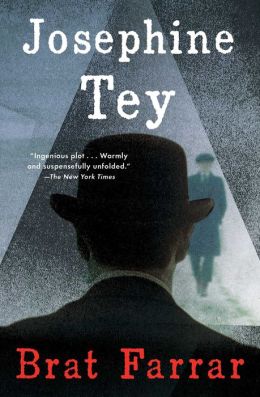
Brat Farrar (1949)
Brat Farrar. Josephine Tey. 1949/1997. 288 pages. [Source: Bought]
I definitely enjoyed reading Brat Farrar. Was it my favorite-favorite Tey novel? Probably not. But I enjoyed it so much more than Miss Pym Disposes and A Shilling for Candles.
In Brat Farrar, the reader is in on the secret. Brat Farrar is impersonating Patrick Ashby. Alec Loding "discovers" Brat Farrar's resemblance to the Ashby family. There were twin brothers Patrick and Simon. Patrick vanished when he was twelve or thirteen, and he was presumed dead. The note he conveniently left behind led everyone to believe it was suicide. Even though Patrick didn't seem the sort. Then again, Patrick would not have been the sort to run away for eight years either. Alec Loding is encouraging his new friend, Brat, to invent such a tale. BE Patrick. Inherit the family estate. He tempts him with horses. If there is one thing our hero can't resist, it's horses. His oh-so-special way with horses gives his life meaning. On the one hand, Brat is essentially a moral guy. He knows right from wrong. He is not the sort to be reckless and cruel for the fun of it. On the other hand, ALL THOSE HORSES. So he allows Loding to coach him, teach him, anything and everything he needs to know to BE PATRICK. (How does Alec know all these details? Sure, a family friend might know some stuff, but everything from the age of three or four on up?! Everything???)
So Patrick Ashby returns from the dead. He takes his place with his family. Everything seems to be off to a good start, but, Brat can't help wondering WHY Simon is so SMUG. Like Brat, readers pick up some clues...not firm, exact clues perhaps...but strong feelings that Simon is, well, the more evil twin.
I liked this one. It was a very quick read.
© 2014 SukaYuka.com of SukaYuka's Book Reviews
I definitely enjoyed reading Brat Farrar. Was it my favorite-favorite Tey novel? Probably not. But I enjoyed it so much more than Miss Pym Disposes and A Shilling for Candles.
In Brat Farrar, the reader is in on the secret. Brat Farrar is impersonating Patrick Ashby. Alec Loding "discovers" Brat Farrar's resemblance to the Ashby family. There were twin brothers Patrick and Simon. Patrick vanished when he was twelve or thirteen, and he was presumed dead. The note he conveniently left behind led everyone to believe it was suicide. Even though Patrick didn't seem the sort. Then again, Patrick would not have been the sort to run away for eight years either. Alec Loding is encouraging his new friend, Brat, to invent such a tale. BE Patrick. Inherit the family estate. He tempts him with horses. If there is one thing our hero can't resist, it's horses. His oh-so-special way with horses gives his life meaning. On the one hand, Brat is essentially a moral guy. He knows right from wrong. He is not the sort to be reckless and cruel for the fun of it. On the other hand, ALL THOSE HORSES. So he allows Loding to coach him, teach him, anything and everything he needs to know to BE PATRICK. (How does Alec know all these details? Sure, a family friend might know some stuff, but everything from the age of three or four on up?! Everything???)
So Patrick Ashby returns from the dead. He takes his place with his family. Everything seems to be off to a good start, but, Brat can't help wondering WHY Simon is so SMUG. Like Brat, readers pick up some clues...not firm, exact clues perhaps...but strong feelings that Simon is, well, the more evil twin.
I liked this one. It was a very quick read.
© 2014 SukaYuka.com of SukaYuka's Book Reviews
Sunday, May 25, 2014
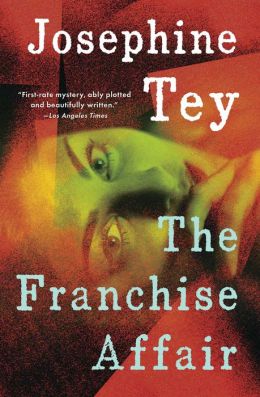
The Franchise Affair (1948)
The Franchise Affair. Josephine Tey. 1948. 304 pages. [Source: Book I bought]
Robert Blair is a lawyer. He lives a boring life; nothing terribly exciting or thrilling ever happens. And. He doesn't seem to mind that his life is mostly predictable. But then one day he receives a call from Marion Sharpe. She is in need of a lawyer; she needs one as soon as possible. Yes, she knows that his firm doesn't specialize in criminal law; yes, she knows he's never handled any case quite like hers before. Yes, she'd be willing to find another lawyer if necessary--if charges are brought against her and if the case were to go to trial. But can he come NOW! He agrees. He rushes to The Francise. He meets Marion and her mother. He meets Inspector Grant. He hears what these two ladies are being accused of. He meets the young woman, Betty Kane, accusing them. He's left a bit speechless. Kane's story: I was waiting for the bus, these two "old" ladies offered me a ride, I accepted, they took me to their home, wouldn't let me leave, locked me in the attic, denied me food unless I worked for them doing some mending, they beat me too! After four weeks I managed to escape! Grant and Blair are speechless as are the women. The story seems weird and unrealistic. Grant's instincts are telling him that the Kane girl is a crazy attention-seeker who is a liar through and through. Blair also thinks the Kane girl is a liar. He also thinks she's immoral. There HAS to be a man involved. Kane had to have met a guy over vacation and run off with him and made up this horrible story when that love affair fell apart. Both Blair and Grant are relying on instincts and making quick judgments. Grant, at the start of the novel, does not want to make a case of this. He does not believe there has been an actual crime.
But. The story will not go away. Kane will tell her story, keep her story alive in the papers. The community will turn against the Sharpe women at the Francise. Things will get uncomfortable and dangerous.
Blair is determined that the best defense is to prove that Betty Kane is a terrible, horrible mess of a girl. She's far from good and honest and respectable. He wants to expose this girl, show her that she can't go around accusing good, honest women like the Sharpes of horrible crimes. She shouldn't be allowed to get away with it.
Grant, Tey's detective, is barely in this one. He is in a few scenes, but, for the most part this is Robert Blair's story, his chance to have an exciting life, to play hero.
The Franchise Affair is not my favorite Tey novel, but, it was a pleasant read.
© 2014 SukaYuka.com of SukaYuka's Book Reviews
Robert Blair is a lawyer. He lives a boring life; nothing terribly exciting or thrilling ever happens. And. He doesn't seem to mind that his life is mostly predictable. But then one day he receives a call from Marion Sharpe. She is in need of a lawyer; she needs one as soon as possible. Yes, she knows that his firm doesn't specialize in criminal law; yes, she knows he's never handled any case quite like hers before. Yes, she'd be willing to find another lawyer if necessary--if charges are brought against her and if the case were to go to trial. But can he come NOW! He agrees. He rushes to The Francise. He meets Marion and her mother. He meets Inspector Grant. He hears what these two ladies are being accused of. He meets the young woman, Betty Kane, accusing them. He's left a bit speechless. Kane's story: I was waiting for the bus, these two "old" ladies offered me a ride, I accepted, they took me to their home, wouldn't let me leave, locked me in the attic, denied me food unless I worked for them doing some mending, they beat me too! After four weeks I managed to escape! Grant and Blair are speechless as are the women. The story seems weird and unrealistic. Grant's instincts are telling him that the Kane girl is a crazy attention-seeker who is a liar through and through. Blair also thinks the Kane girl is a liar. He also thinks she's immoral. There HAS to be a man involved. Kane had to have met a guy over vacation and run off with him and made up this horrible story when that love affair fell apart. Both Blair and Grant are relying on instincts and making quick judgments. Grant, at the start of the novel, does not want to make a case of this. He does not believe there has been an actual crime.
But. The story will not go away. Kane will tell her story, keep her story alive in the papers. The community will turn against the Sharpe women at the Francise. Things will get uncomfortable and dangerous.
Blair is determined that the best defense is to prove that Betty Kane is a terrible, horrible mess of a girl. She's far from good and honest and respectable. He wants to expose this girl, show her that she can't go around accusing good, honest women like the Sharpes of horrible crimes. She shouldn't be allowed to get away with it.
Grant, Tey's detective, is barely in this one. He is in a few scenes, but, for the most part this is Robert Blair's story, his chance to have an exciting life, to play hero.
The Franchise Affair is not my favorite Tey novel, but, it was a pleasant read.
© 2014 SukaYuka.com of SukaYuka's Book Reviews
Sunday, April 27, 2014
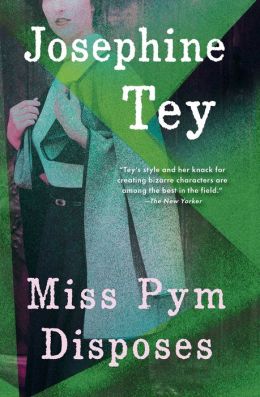
Miss Pym Disposes
Miss Pym Disposes. Josephine Tey. 1946. 238 pages. [Source: Book I Bought]
Miss Lucy Pym is visiting an 'old friend' who is now a principal at a physical training college. The occasion for her visit is her successful bestselling status as an author of a popular psychology book. Her book is the new "it" book of the moment, Miss Pym gives guest lectures. The students of this college, particularly the juniors and seniors, take a real liking to her. They beg and plead and urge her to stay. So she postpones leaving. (I'm not sure her old college friend is as enthusiastic about keeping her around for the last few weeks of the semester until graduation or not. I'm sure by the end she's thinking: why oh why did I think it would be a good idea to ask her to visit!) It's a super busy time for all. One class is preparing to graduate; there is stress and distress as they prepare for finals and critiques. Some students will be placed in a new job before graduation, others will have to make their own applications after graduation. A really ideal job opportunity arises, and, for some reason this causes great rumbles on the staff and among students. One student is chosen over another. Almost everyone disagrees with the decision. Even Miss Pym is argumentative and opinionated. As graduation approaches the inevitable happens. Inevitable ONLY because it's a mystery book and there is the expectation that at some point a crime, probably murder, but at the very least attempted murder, will occur. This happens extraordinarily late in the novel. One of the graduating seniors has an "accident" that ultimately leads to her death. Miss Pym knows the accident was no accident, and she has proof. But will her proof ever be turned over to the authorities?! Will Miss Pym play god and decided that she has no ethical obligation to turn in the murderer--the girl she's convinced is guilty?!
Miss Pym Disposes is a strange little mystery. I found the academic setting interesting, at least in the beginning. But overall, I was not impressed with this one.
© 2014 SukaYuka.com of SukaYuka's Book Reviews
Miss Lucy Pym is visiting an 'old friend' who is now a principal at a physical training college. The occasion for her visit is her successful bestselling status as an author of a popular psychology book. Her book is the new "it" book of the moment, Miss Pym gives guest lectures. The students of this college, particularly the juniors and seniors, take a real liking to her. They beg and plead and urge her to stay. So she postpones leaving. (I'm not sure her old college friend is as enthusiastic about keeping her around for the last few weeks of the semester until graduation or not. I'm sure by the end she's thinking: why oh why did I think it would be a good idea to ask her to visit!) It's a super busy time for all. One class is preparing to graduate; there is stress and distress as they prepare for finals and critiques. Some students will be placed in a new job before graduation, others will have to make their own applications after graduation. A really ideal job opportunity arises, and, for some reason this causes great rumbles on the staff and among students. One student is chosen over another. Almost everyone disagrees with the decision. Even Miss Pym is argumentative and opinionated. As graduation approaches the inevitable happens. Inevitable ONLY because it's a mystery book and there is the expectation that at some point a crime, probably murder, but at the very least attempted murder, will occur. This happens extraordinarily late in the novel. One of the graduating seniors has an "accident" that ultimately leads to her death. Miss Pym knows the accident was no accident, and she has proof. But will her proof ever be turned over to the authorities?! Will Miss Pym play god and decided that she has no ethical obligation to turn in the murderer--the girl she's convinced is guilty?!
Miss Pym Disposes is a strange little mystery. I found the academic setting interesting, at least in the beginning. But overall, I was not impressed with this one.
© 2014 SukaYuka.com of SukaYuka's Book Reviews
Sunday, March 23, 2014
In the Best Families (1950)
In the Best Families. (Nero Wolfe). Rex Stout. 1950. 272 pages. [Source: Book I Bought]
Wow! What a book, what a mystery! I absolutely loved, loved, loved Second Confession, but, I think I loved this one just as much. Three Nero Wolfe mysteries are closely linked together: And Be A Villain, Second Confession, and In the Best Families. Second Confession and In the Best Families especially fit together well. They introduce a character, Nero Wolfe likes to call "X" because he doesn't want to casually drop this bad guy's real name too often. X made threats in And Be A Villain and Second Confession, and in Second Confession X knew just how to make Nero suffer: by destroying his orchids. But nothing compares to the danger in In The Best Families.
It starts with a client, of course, all of his mysteries start with a client! Mrs. Rackham wants her husband investigated. She doesn't want to expose him, she's not out to publish any wrong-doings, she just wants to know herself what her husband has been up to. He used to ask her for money, now, he has his own resources, and she's doubtful that he's coming by them through honest hard work. They arrange for Archie Goodwin to come to her estate disguised as himself, he'll be "investigating" the poisoning of her cousin's dog. He'll be asking questions, lots of questions. Some are naturally suspicious. Who is paying for this investigation? The poor cousin (Leeds) or Mrs. Rackham herself? Since the dog survived and ultimately no harm was done, and since this all happened over a month ago, why pay Nero Wolfe prices for the answers?!
Goodwin was to spend the night at the cousin's small home (he's just a "quick" walk away from Mrs. Rackham's quite-large estate). But does Archie get a good night's sleep?! NO!!! When Archie calls Nero Wolfe with the details--Mrs. Rackham is dead--something unexpected happens. After much aggravation with the local police, still without any sleep, Archie returns home and discovers something shocking: NERO WOLFE IS GONE! Arrangements have been made for his orchids, for his cook, Fritz, and for Archie himself.
Archie all on his own?! Archie solving his own cases? Yes this book is quite unique!!!
I would love to tell more, because it's lovely through and through, but I won't. This book has so many great, great scenes!!!
© 2014 SukaYuka.com of SukaYuka's Book Reviews
Wow! What a book, what a mystery! I absolutely loved, loved, loved Second Confession, but, I think I loved this one just as much. Three Nero Wolfe mysteries are closely linked together: And Be A Villain, Second Confession, and In the Best Families. Second Confession and In the Best Families especially fit together well. They introduce a character, Nero Wolfe likes to call "X" because he doesn't want to casually drop this bad guy's real name too often. X made threats in And Be A Villain and Second Confession, and in Second Confession X knew just how to make Nero suffer: by destroying his orchids. But nothing compares to the danger in In The Best Families.
It starts with a client, of course, all of his mysteries start with a client! Mrs. Rackham wants her husband investigated. She doesn't want to expose him, she's not out to publish any wrong-doings, she just wants to know herself what her husband has been up to. He used to ask her for money, now, he has his own resources, and she's doubtful that he's coming by them through honest hard work. They arrange for Archie Goodwin to come to her estate disguised as himself, he'll be "investigating" the poisoning of her cousin's dog. He'll be asking questions, lots of questions. Some are naturally suspicious. Who is paying for this investigation? The poor cousin (Leeds) or Mrs. Rackham herself? Since the dog survived and ultimately no harm was done, and since this all happened over a month ago, why pay Nero Wolfe prices for the answers?!
Goodwin was to spend the night at the cousin's small home (he's just a "quick" walk away from Mrs. Rackham's quite-large estate). But does Archie get a good night's sleep?! NO!!! When Archie calls Nero Wolfe with the details--Mrs. Rackham is dead--something unexpected happens. After much aggravation with the local police, still without any sleep, Archie returns home and discovers something shocking: NERO WOLFE IS GONE! Arrangements have been made for his orchids, for his cook, Fritz, and for Archie himself.
Archie all on his own?! Archie solving his own cases? Yes this book is quite unique!!!
I would love to tell more, because it's lovely through and through, but I won't. This book has so many great, great scenes!!!
© 2014 SukaYuka.com of SukaYuka's Book Reviews
Sunday, February 23, 2014
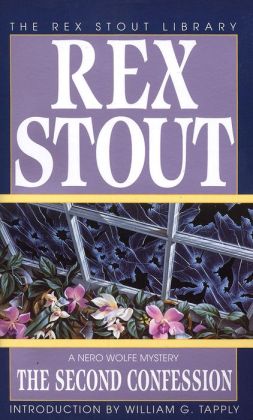
The Second Confession (1949)
The Second Confession (Nero Wolfe). Rex Stout. 1949. 256 pages. [Source: Book I Bought]
The Second Confession might just be my new favorite, favorite Nero Wolfe novel. I didn't think it was possible to love Wolfe and Goodwin more than I already did, but spending two days with this book proved that I had more love to give. I loved, loved, loved every minute of this mystery.
Mr. Sperling hires Wolfe as a private detective "to prove" that his daughter's boyfriend is a communist. Wolfe is reluctant to take on a case with those terms. He argues that what Sperling desires is not proof that this Louis Rony is a Communist, instead what he wants is his daughter to end things with him, period, Communist or not. Wolfe agrees to take the case on his own terms. He will help find proof that will convince this young woman that Rony's not the man for her; he'll even strongly encourage Archie to flirt with the daughter in question and distract her.
This case was very exciting and intense. I loved following it from beginning to end. It was a lot more exciting than most of Wolfe's cases. I love how full of personality it was. It was also very quotable!!!
© 2014 SukaYuka.com of SukaYuka's Book Reviews
The Second Confession might just be my new favorite, favorite Nero Wolfe novel. I didn't think it was possible to love Wolfe and Goodwin more than I already did, but spending two days with this book proved that I had more love to give. I loved, loved, loved every minute of this mystery.
Mr. Sperling hires Wolfe as a private detective "to prove" that his daughter's boyfriend is a communist. Wolfe is reluctant to take on a case with those terms. He argues that what Sperling desires is not proof that this Louis Rony is a Communist, instead what he wants is his daughter to end things with him, period, Communist or not. Wolfe agrees to take the case on his own terms. He will help find proof that will convince this young woman that Rony's not the man for her; he'll even strongly encourage Archie to flirt with the daughter in question and distract her.
"Get invited to his home, socially. Meet Mr. Rony and form an opinion of him. More important, form one of the daughter, as intimately and comprehensively as possible. Make appointments with her. Seize and hold her attention. You should be able to displace Mr. Rony in a week, a fortnight at the most--and that's the objective."But the case doesn't go exactly as planned. The relationship is ended. That part was a success. Then again, it's hard to have a relationship with a corpse. Yes, Rony ends up dead, apparently run over by a car in the Sperling driveway. Who murdered him? What was the motive?
"I'll be damned." I shook my head reproachfully. "You mean to make a pass at her."
"Your terms are yours, and I prefer mine. Mr. Sperling said his daughter is excessively curious. Transfer her curiosity from Mr. Rony to you."
"You mean break her heart."
"You can stop this side of tragedy."
"Yeah, and I can stop this side of starting." I looked righteous and outraged. "You've gone a little too far. I like being a detective, and I like being a man, with all that implies, but I refuse to degrade whatever glamour I may--"
"Archie!" He snapped it.
"Yes, sir."
"With how many young women whom you met originally through your association with my business have you established personal relationships?"
"Between five and six thousand. But that's not--" (9-10)
This case was very exciting and intense. I loved following it from beginning to end. It was a lot more exciting than most of Wolfe's cases. I love how full of personality it was. It was also very quotable!!!
© 2014 SukaYuka.com of SukaYuka's Book Reviews
Subscribe to:
Posts (Atom)
