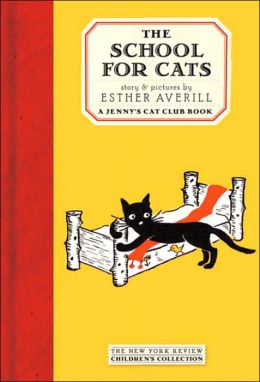
The School for Cats was originally published in 1947. It is part of a larger series of books starring the (black) cat Jenny Linsky and her friends. The School of Cats is not the first in the series, but, it is the first in the series that my library actually had. In this "Jenny's Cat Club" book, readers meet Jenny as she leaves her home in Greenwich Village to attend school in the country. She is very, very, very unsure about the whole school thing. But her master, Captain Tinker, wants her "to study cat lore in the country." There is definitely something of an adventure in this one when Jenny runs away from school. But it also contains a lesson on friendship and adapting to new situations.
I enjoyed this one. I look forward to reading others in the series.
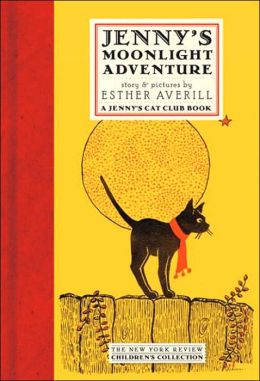
Jenny's Moonlight Adventure was originally published in 1949. It is part of a larger series of books starring Jenny and her friends. I did not like this book as well as The School for Cats. It is a Halloween adventure. Jenny must prove how brave she is both for herself and for her friends. She reluctantly accepts a job that only she can do. She is to carry a nose flute to a sick friend (another cat, of course). The job is "dangerous" because it requires her to be brave and clever enough to get past several unfriendly neighborhood dogs.
For readers who celebrate Halloween, this one might prove charming.

Of the Jenny Linsky books I've read so far, Jenny Goes to Sea is probably my favorite. In this chapter book originally published in 1957, Jenny Linsky and her two brothers, Edward and Checkers, travel the world with their owner, Captain Tinker. These three cats become very good friends with Jack Tar, the ship's cat. These three leave the ship in company with Jack Tar at many of the ports including Capetown, Zanzibar, Singapore, and Bangkok. Adventures come oh-so-naturally.
I definitely recommend this series to cat lovers of all ages.
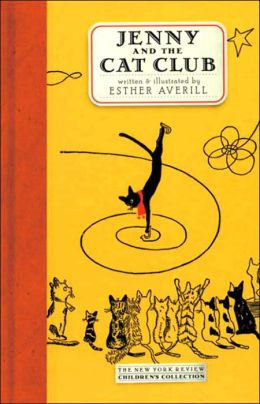
Jenny and the Cat Club features five stories by Esther Averill. These were originally published in 1944, 1948, 1951, 1952, and 1953. The stories are: "The Cat Club," "Jenny's First Party," "When Jenny Lost Her Scarf," "Jenny's Adopted Brothers," and "How the Brothers Joined the Cat Club."
The Cat Club introduces readers to Jenny Linsky, a "shy little black cat" from New York City. Readers meet Jenny and her owner Captain Tinker. In this adventure, Jenny receives her signature red scarf, a present from her owner who happens to knit. This red scarf helps Jenny gain enough confidence to talk to other cats in the neighborhood. In this one, readers learn about the neighborhood cat club, they are briefly introduced to the other cats, and they learn that members of the cat club must be special.
Jenny's First Party is a story focusing on Jenny and her friend Pickles (the fire cat) teaming up and strolling the neighborhood. Both are looking for fun, fun, fun. But neither have money. (What cat has money?!) They stumble upon a groovy party and a great time is had by all. Readers learn that Jenny can dance a happy little sailor's hornpipe dance.
"When Jenny Loses Her Scarf" is about when Jenny's beloved red scarf was stolen by a dog. The dog, Rob the Robber, refuses to give it back. Jenny seeks help from Pickles the fire cat. Pickles is just the one to help her, it turns out, for justice is dealt out after all. The dog's hangout catches on fire! Pickles retrieves the scarf as he's putting out the fire.
"Jenny's Adopted Brothers" is about when Jenny meets two stray cats: Checkers and Edward. Checkers, readers learn, retrieves things. Edward, we learn, is a poet. Jenny meets these two, feels sorry for them, and introduces them to Captain Tinker. When these two are adopted by the Captain, Jenny feels very jealous! Will having two other cats in the house prove too much?!
"How The Brothers Joined the Cat Club" is obviously about when Edward and Checkers join the club. Jenny is hesitant to include her two new brothers at first. After all, she likes the idea that the club could remain her own little secret and her way to get away from them. But. Being the good little cat that she is, Jenny soon realizes that she could never really keep her brothers from missing out on the awesomeness of the cat club. She helps them discover their talents and introduces them to all her friends.
I liked this one. I did. I like meeting Jenny and the other cats.
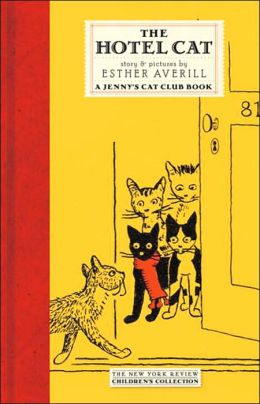
The Hotel Cat is an enjoyable children's novel by Esther Averill. It was originally published in 1969.
The Hotel Cat stars a cat named Tom. He lives at the Royal Hotel, an eight-story building in New York. It is on the older side. And the hotel isn't doing the best business. But all that happens to change during the novel. Tom who is used to having the place to himself, for the most part, at least in terms of CATS ON THE PLACE discovers that there are cats there with their owners. The first few cats he meets he is rude, very rude. But after Tom's owner, Mrs. Wilkins, talks to him, he decides to be more gracious and welcoming. It isn't long before he meets three cats: Jenny, Edward, and Checkers. And those aren't the only cats from the cat club he happens to meet. A difficult winter has resulted in a lot of broken boilers and frustrated cat-owning homeowners are staying at the Royal Hotel. How convenient!
Tom learns a lot about making and keeping friends in The Hotel Cat.
I liked this one.

Captains of the City Streets is a children's novel by Esther Averill originally published in 1972. Two cats star in Captains of the City Street. In this one, the author provides the back story for two cats who have been a part of essentially the whole series. Sinbad and The Duke. These two stray cats are best buddies. They haven't been "owned" by a human in what seems like a very long time by cat reckoning. They are street cats, traveling cats, going from city to city to city, seeing all there is to see, always seeking handouts, but never becoming dependent on any one human. The two travel to "old New York." They are looking for a place of their own, a safe place to stay. They find it. They also find one old man who dependably gives them food day after day on their own terms. He comes and goes leaving the food, never trying to approach the cats, never pushing a relationship. The two cats slowly but surely decide that maybe just maybe humans aren't all that bad. That is when they stumble upon the Cat Club. They learn that the kind human is Captain Tinker. The first cat they befriend is Macaroni. The two are invited to join the Cat Club, but, are hesitant. Do they want to stick around that long? Do they want the responsibility?
I liked meeting Sinbad and Duke. The stories that focus on Jenny certainly mention these two quite a bit, but, this is the first time that readers really learn about these two in detail. It is a fun book.
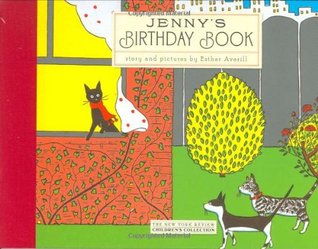
Jenny's Birthday Book by Esther Averill was originally published in 1954. In this cat club book, Jenny Linsky, our star cat, our shy little black cat with the red scarf, has a special birthday with all of her friends whom we've met through the series. Pickles. Sinbad and The Duke. Florio. To name just a few. It is a lovely birthday. The book itself is sweet, simple, and charming. Especially if you like cats and vintage picture books. I think my favorite illustration is of all the cats dancing the Sailor's Hornpipe in the park.

I enjoyed revisiting The Fire Cat by Esther Averill. I read this one many times as a child. But I had no idea it was part of a larger series of books, the Cat Club series by Esther Averill. The Fire Cat does not star Jenny Linsky. It stars Pickles. Pickles has been a delightful character in almost all of the other books in the series. He is probably one of Jenny's best best friends. In the Fire Cat, readers learn more about Pickles. Was he always a fire cat? Of course not! There was a time he was a hopeless cat that was a little bit bad and a little bit good. One of the firemen takes an interest in him and takes him to the fire station. He is hoping that the chief will allow Pickles to stay. Pickles most definitely wants to stay. He wants to prove himself worthy, so he decides to learn by example. He learns to slide down the pole, for example, he learns how to work a hose. The fire chief is definitely charmed, I imagine cat-loving readers are just as charmed. I certainly was! The Fire Cat is a feel-good read. Readers see Pickles transform from a slightly-naughty homeless cat to a brave and dutiful fire cat. He learns responsibility and compassion. Overall, it's just a good story.
© 2014 SukaYuka.com of SukaYuka's Book Reviews