Showing posts with label picture books. Show all posts

Sunday, January 11, 2015

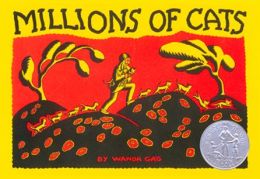
Millions of Cats (1928)

Millions of Cats. Wanda Gag. 1928. Penguin. 40 pages. [Source: Library]

Once upon a time there was a very old man and a very old woman. They lived in a nice clean house which had flowers all around it, except where the door was. But they couldn't be happy because they were so very lonely. 
"If we only had a cat!" sighed the very old woman. "A cat?" asked the very old man. "Yes, a sweet little fluffy cat," said the very old woman. "I will get you a cat, my dear," said the very old man.
And he set out over the hills to look for one. 

Millions of Cats is a Newbery Honor book from 1929.

Premise/Plot: A very old man and a very old woman long for a cat. The husband goes on a quest to bring back a "sweet little fluffy cat" to please them both. Is his quest successful? Yes. A little too successful. For in fact he finds
Cats here, cats there,
Cats and kittens everywhere,
Hundreds of cats,
Thousands of cats,
Millions and billions and trillions of cats.
How is he ever to choose just ONE cat from so many?! Especially since as he picks up or pets each one he sees, he finds it to be the prettiest cat. He can't bring himself to leave any of the cats behind. But it isn't practical to bring home hundreds, thousands, millions, billions, and trillions of cats. You can probably guess what his wife's response will be! Surely, they can't keep them all. For better or worse, he lets the cats decide amongst themselves. One scrawny cat remains, but, it may be the best one of all.

My thoughts: I loved this one growing up. I loved the repetition. I thought it was a fun story. I didn't--at the time--take the man's conclusion that the trillions of cats ate each other up literally. Is the book violent? Perhaps. Perhaps not. See for yourself.  "They bit and scratched and clawed each other and made such a great noise that the very old man and the very old woman ran into the house as fast as they could. They did not like such quarreling." This one might pair well with Eugene Field's "The Duel." (The gingham dog and the calico cat).

Have you read Millions of Cats? Did you like it? love it? hate it?

© 2015 SukaYuka.com of SukaYuka's Book Reviews

Saturday, January 10, 2015

Seuss on Saturday #2

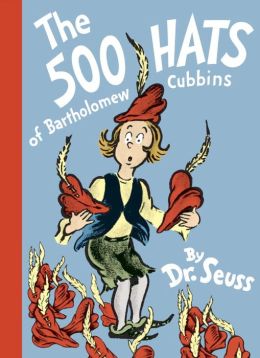
The 500 Hats of Bartholomew Cubbins. 1938/1965. Random House. 56 pages. [Source: Library]

First sentence:
 In the beginning, Bartholomew Cubbins didn't have five hundred hats. He had only one hat. It was an old one that had belonged to his father and his father's father before him. It was probably the oldest and the plainest hat in the whole Kingdom of Didd, where Bartholomew Cubbins lived.
Premise/plot. Bartholomew Cubbins gets into big, big trouble when he "refuses" to remove his hat in the presence of the king. The king gets more and more flustered as he sees the "insolence" of Bartholomew. To Bartholomew's credit, he is trying very hard to remove his hat. But every time he removes a hat, another appears on his head. What is going on?! What will the king do?!

My thoughts: I have only read this one twice. It definitely has more text than And To Think That I Saw it On Mulberry Street. And it also is written in prose. It does not rhyme. The story is just as over-the-top as And To Think That I Saw It On Mulberry Street, but it definitely has a different feel to it. According to Wikipedia, it was received well by reviewers. What did I think? Well, it was silly. I think the key to enjoying it is in focusing on the king and his reaction to the "problem." Seeing the king and those close to him try to solve the problem. For example, at one point he calls in seven black-gowned magicians:
Low and slow, they were chanting words that were strange...
"Dig a hole five furlongs deep,
Down to where the night snakes creep,
Mix and mold the mystic mud,
Malber, Balber, Tidder, Tudd."
In came seven black-gowned magicians, and beside each one stalked a lean black cat. They circled around Bartholomew Cubbins muttering deep and mysterious sounds.
It's never fun to be frustrated yourself. But the king's frustration proves comical. There are no real questions answered in this one.  But the ending proves satisfying enough.

Have you read The 500 Hats of Barthomew Cubbins? Did you like it? love it? hate it? What age do you think it works best for?

If you'd like to join me in reading or rereading Dr. Seuss' picture books (chronologically) I'd love to have you join me! The next book I'll be reviewing is The King's Stilts.


© 2015 SukaYuka.com of SukaYuka's Book Reviews

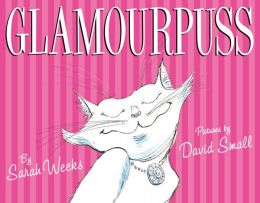
Glamourpuss (2015)

Glamourpuss. Sarah Weeks. Illustrated by David Small. 2015. [January 2015] Scholastic. 40 pages. [Source: Review copy]

First sentence: Once upon a pillow sat a glamorous cat named Glamourpuss. Glamourpuss lived with Mr. and Mrs. Highhorsen in a giant amnion on the top of a hill where they were waited on hand and foot by a pair of devoted servants named Gustav and Rosalie.

I enjoyed reading Sarah Weeks' Glamourpuss. I thought it was a charming picture book about a fabulous cat who was sometimes selfish and sometimes sweet. Glamourpuss, the star of the book, does not like it when Eugenia and Bluebelle come to visit Mr. and Mrs. Highhorsen, her owners. She finds Bluebelle and her many costumes ridiculous. But to her surprise, all the adults seem to find Bluebelle precious and wonderful and even glamorous. Shocking! Can't they tell the difference between tacky and refined?! When Glamourpuss realizes that Bluebelle actually HATES wearing clothes and performing tricks, the two bond. Glamourpuss gives her real lessons on how to behave, how to take her bow-wow to WOW, just as Glamourpuss has taken her meow to ME.

I found the story cute and charming. But I think it was the illustrations that really persuaded me that this story was wonderful. I loved the many expressions of Glamourpuss. I did. David Small did a great job of capturing this cat's magnificent personality. I think some of my favorite illustrations were when she is teaching Bluebelle how to be more refined.

Definitely recommended for cat lovers!

Text: 4 out of 5
Illustrations: 5 out of 5
Total: 9 out of 10

© 2015 SukaYuka.com of SukaYuka's Book Reviews

Saturday, January 3, 2015

Seuss on Saturday #1

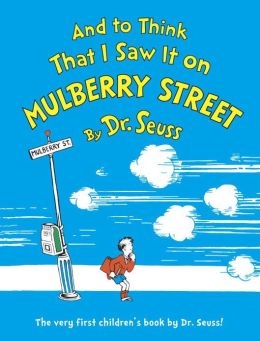
And to Think That I Saw It On Mulberry Street. Dr. Seuss. 1937/1964. Random House. 40 pages. [Source: Library]

First sentence:
When I leave home to walk to school, Dad always says to me, "Marco, keep your eyelids up and see what you can see."
Premise/Plot: While Marco is on his way home, he plans what to say to his father when he asks what he's seen. Marco really sees just a horse and wagon. But what he imagines he sees, well, it gets outlandish. What will he end up telling his father? a pack of lies? or the truth?

My thoughts: It's been years since I read this one. And it is a bit dated when you think about it. For example, as Marco gets carried away with his story, he imagines a reindeer pulling a sled. But he stops himself by adding,
Say--anyone could think of that,
Jack or Fred or Joe or Nat--
Say, even Jane could think of that.
Also of note, it includes a "Chinese man who eats with sticks..." and the illustration of course is not ideal. I'm not mentioning these things to say that the book is "bad" and doesn't belong in your child's library. Just noting that times have changed quite a bit since 1937!!!

Overall, I'd say I liked this one. Didn't necessarily "love" it. But I like it. How many picture books from the 1930s are still in print?! Well, I suppose there's The Story of Ferdinand, Mike Mulligan and His Steam Shovel, Madeline, and The Story of Babar. There may be others as well.

Have you read And To Think I Saw It On Mulberry Street? Did you like it? love it? hate it? I'd love to know what you think of it!

If you'd like to join me in reading or rereading Dr. Seuss' picture books (chronologically) I'd love to have you join me! The next book I'll be reviewing is The 500 Hats of Bartholomew Cubbins.

© 2015 SukaYuka.com of SukaYuka's Book Reviews

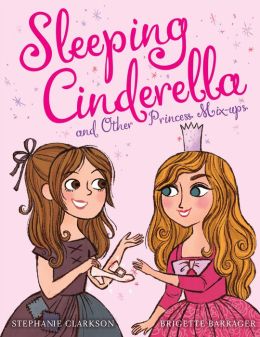
Sleeping Cinderella and Other Princess Mix-Ups (2015)

Sleeping Cinderella and Other Princess Mix-Ups. Stephanie Clarkson. Illustrated by Brigette Barrager. 2015. [January 2015] Scholastic. 40 pages. [Source: Review copy]

First sentence: Once upon a time four fairy tale misses, tired of dwarves, witches, princes, and kisses, so bored and fed up, or just ready to flop, upped and left home for a fairy tale swap…

I enjoyed this one for the most part. It is a cute and clever fractured fairy tale. It begins with a frustrated Snow White leaving the home she shares with seven dwarves. She's searching for a new place to call home. She comes across another princess who is a bit frustrated with her situation as well. They change places. Then she goes off to find someplace new…

It was a fun story starring Snow White, Rapunzel, Cinderella, and Sleeping Beauty. It has a fun and playful premise. The endings have all been adjusted as well. For better or worse. I enjoyed the style of the illustrations. I enjoyed the illustrations of Snow White the best. I loved her look!

I am not sure that I LOVED this one. But I definitely found it fun and worth reading!

Text: 3 out of 5
Illustrations: 4 out of 5
Total: 7 out of 10

© 2015 SukaYuka.com of SukaYuka's Book Reviews

Sunday, December 21, 2014

Eight More Christmas Books

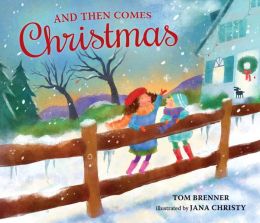
And Then Comes Christmas. Tom Brenner. Illustrated by Jana Christy. 2014. Candlewick Press. 32 pages. [Source: Review copy]

With some picture books, you almost have to read them a few times before you decide if you like them or not. Such is the case with Tom Brenner's And Then Comes Christmas.

And Then Comes Christmas is all about establishing atmosphere and celebrating traditions. Atmosphere is established by description and detail. Phrases like "bare branches rake across the sky" and "romp in snow as smooth as bedcovers." Traditions are celebrated: choosing a tree, decorating a tree, making cookies, wrapping presents, reading stories, attending programs, making crafts, seeing Santa at the mall, etc. Some traditions will likely be familiar. Some may not be. Not every child gets to play in the snow before Christmas--or after Christmas, for that matter! But all children could choose to make paper snowflakes to decorate their windows.

It is a book that slowly and gently counts down to Christmas. (Though not with actual numbers.) There is a certain pattern to it...multiple when/then passages.

I think my favorite when/then passage is:
When elves and reindeer appear in stores, and small trains race through toy villages, and piles of presents nestle in cotton drifts...Then hop from foot to foot, waiting to sit on Santa's knee."
I like this one well enough. But I would hate to have to diagram any of these sentences!

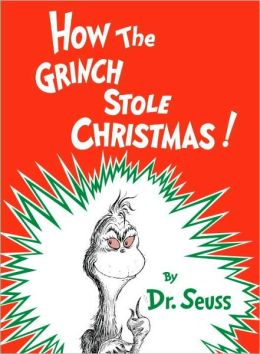
How the Grinch Stole Christmas. Dr. Seuss. 1957. Random House. 64 pages. [Source: Review copy]

I love it. Of course I love it. How could I not? Now, I will admit that I didn't read the actual book until I was an adult. It wasn't one of the Seuss books that I owned growing up. But the christmas special--the cartoon--is one I've seen dozens and dozens of times. The book itself is lovely. If you love one, you'll love the other.

So in case you're unfamiliar with the book or special, The Grinch hates Christmas. His neighbors, the Whos in Who-ville, love Christmas. He is super-cranky this year, and, he decides to steal it. He thinks Christmas is all about the stuff. Take the stuff, do away with it altogether, right? Wrong. The Whos in Who-ville teach the Grinch a lesson about joy.

One of my favorite things about it is it's just SO quotable. Here are a few of my favorite lines:
Every who down in Who-ville liked Christmas a lot...But the Grinch, who lived just north of Who-ville, did NOT!
And THEN they'd do something he liked least of all! Every who down in Who-ville, the tall and the small, would stand close together, with Christmas bells ringing. They'd stand hand-in-hand. And the Whos would start singing. They'd sing! And they'd sing! AND they'd SING! SING! SING!
Then he slid down the chimney. A rather tight pinch. But, if Santa could do it, then so could the Grinch.
Then the last thing he took was the log for their fire! Then he went up the chimney, himself, the old liar.
It came without ribbons! It came without tags! It came without packages, boxes, or bags!"

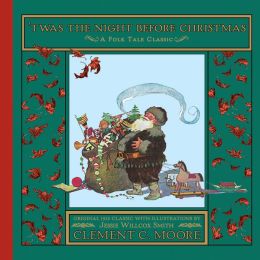
'Twas the Night Before Christmas. Clement C. Moore. Illustrated by Jessie Willcox Smith. 1823/1912. HMH. 32 pages. [Source: Review copy]

I've read 'Twas the Night Before Christmas plenty of times before. But this is the first time I've read the edition of the poem published as a picture book in 1912 with illustrations by Jessie Willcox Smith.

The poem itself is as delightful as it ever is. I think this is a poem that feels familiar no matter what. You don't have to seek it out year after year. It just finds you and sticks. It's just part of the Christmas culture. (I love the Sesame Street play starring Bert and Ernie as featured in Muppet Family Christmas.)

It was interesting to see the illustrations from this time period. (You may see the illustrations at project gutenberg.) Did I love the illustrations? Not particularly.

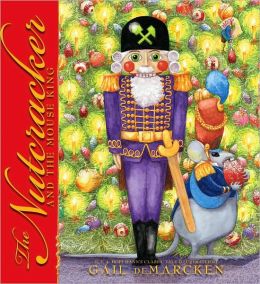
The Nutcracker and the Mouse King. E.T.A. Hoffmann. Adapted by Wren Maysen. Illustrated by Gail de Marcken. 2009. 56 pages. [Source: Review copy]

I am not as familiar with the original story (1816) as I am the story of the ballet. (The two are different.) It's an odd book. I'll be honest. It is just as strange as Alice in Wonderland. (Though, of course, The Nutcracker and the Mouse King came decades before Alice.)

Marie Stahlbaum is the heroine of The Nutcracker and the Mouse King. The book opens with Marie and her brother, Fritz, playing together and waiting, waiting, waiting for all the delights of Christmas. They are waiting to enter the large drawing room where the tree is, and where the presents are. Their mother and father are there as well. As is Godfather Drosselmeier. There is a new doll, Clara, for Marie. There are new toy soldiers for Fritz. And there is a lovely toy castle, Marzipan Castle, for them both. The Nutcracker is a gift for the whole family. Marie does take special interest in it, this interest remains despite the fact that Fritz breaks the Nutcracker when he's showing off.

Marie stays up past her bedtime in the drawing room. This is when things get strange: seeing Godfather Drosselmeier on top of the clock, seeing all the mice attack, seeing the Mouse King, etc. She witnesses a battle. Towards the close of that battle, she throws a slipper at the wicked Mouse King.

Marie awakens in bed the next day. Her mother had found her bleeding on the floor near the tree and toy cupboard. She spends the next few days at least in bed. Spending so much time in bed might seem horrible, and, perhaps Marie found it to be so part of the time at least. But her Godfather tells her strange stories which she believes of course.

Plenty of The Nutcracker and the Mouse King is the Godfather's strange, strange story. This story is about "a king, a queen, some mice, and a young princess named Pirlipat." The story is rich in detail:
Princess Pirlipat was very lovely. She had flawless white skin, with bright blue eyes and flowing locks of golden hair. The generals, noblemen, and ministers of the state all told the king and queen that they had never seen a baby like the princess. Not only was the princess beautiful, but she was also born with two perfect rows of teeth!
The queen insisted that Princess Pirlipat's cradle always be guarded. The royal guards were placed at Pirlipat's door, and directly beside her cradle sat six nurses...and with these six nurses sat six big cats. The nurses had strict orders from the queen to keep one cat in each of their laps and pet them all day and all night so that they would never stop purring. This was indeed strange. No one knew why the queen went to such lengths to protect her princess, but still, every night, the sound of purring cats echoed throughout the castle. But the queen had a very good reason to be on guard, for a curse had been placed on her family.
Readers learn of the family curse, of course. And it's something. The story becomes more and more bizarre as it unfolds. But to Marie, it is completely captivating.

Meanwhile, we have not seen the last of the mice or their dreadful King. Marie knows that sooner or later the final battle will come....

There does come a time when the Nutcracker takes Marie to his magical, fantastic home in Toyland.

So readers see Marie awaken again from yet another dream. Will Marie's ultimate dream come true?

This story is so strange and bizarre and rich in detail--pure fantasy.

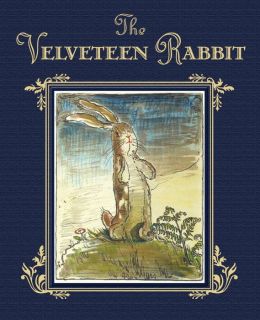
The Velveteen Rabbit. Margery Williams. Illustrated by William Nicholson. 1922/2014. Random House. 48 pages. [Source: Review copy]

Do you know what it is to be real? One little Christmas bunny will learn this and plenty of other life lessons in Margery Williams' classic tale The Velveteen Rabbit.

The Velveteen Rabbit opens with a young boy receiving a rabbit for a Christmas present. All is lovely for the rabbit that first day. But the toy is quickly forgotten. He becomes one toy of many, many, many toys. He's not exactly special to the boy or the other toys. In fact, I'd say the other toys bully him a bit. All except for the Skin Horse, the oldest toy in the nursery. It is this horse that tells the Rabbit all about being real, what it takes to be real, what it feels like, how it changes you, etc.
"Real isn't how you are made," said the Skin Horse. "It's a thing that happens to you. When a child loves you for a long, long time, not just to play with, but REALLY loves you, then you become Real." "Does it hurt?" asked the Rabbit. "Sometimes," said the Skin Horse, for he was always truthful. "When you are Real you don't mind being hurt." "Does it happen all at once, like being wound up," he asked, "or bit by bit?" "It doesn't happen all at once," said the Skin Horse. "You become. It takes a long time. That's why it doesn't often happen to people who break easily, or have sharp edges, or who have to be carefully kept. Generally, by the time you are Real, most of your hair has been loved off, and your eyes drop out and you get loose in the joints and very shabby. But these things don't matter at all, because once you are Real you can't be ugly, except to people who don't understand." "I suppose you are real?" said the Rabbit. And then he wished he had not said it, for he thought the Skin Horse might be sensitive. But the Skin Horse only smiled. "The Boy's Uncle made me Real," he said. "That was a great many years ago; but once you are Real you can't become unreal again. It lasts for always." (5-8)
The Velveteen Rabbit is one of my favorite Christmas books. I love the nursery magic. I love the ending. It was originally published in 1922. The story and illustrations in this edition are original. This is a beautiful edition of the book. One of the best I've seen.

The Velveteen Rabbit was published several years before A.A. Milne's Winnie the Pooh and House at Pooh Corner. Chances are if you enjoy one, you'll enjoy the other.

Do you have a favorite toy-come-to-life fantasy?

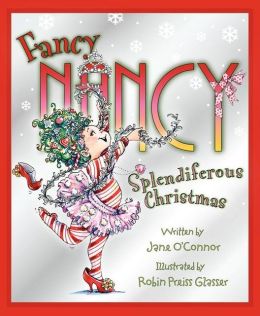
Fancy Nancy: Splendiferous Christmas. Jane O'Connor. Illustrated by Robin Preiss Glasser. 2009. HarperCollins. 32 pages. [Source: Library]

I enjoyed reading Fancy Nancy Splendiferous Christmas. This is actually the first Fancy Nancy book I've read, so it served as a good introduction to the series as well. I liked it very much. I love the illustrations. They were a bit busy, perhaps, but that is part of their charm, I think. I love the amount of detail. Every time I read it, I notice something I hadn't noticed before. There is something almost precious about this book--perhaps because of the illustrations, or even the text. But I don't mind that in a picture book now and then.

In this one, Fancy Nancy and her family are decorating the house for Christmas. They are doing plenty of christmas-y things all together as a family. One of things they are doing is waiting. Waiting is a big part of the holiday, in my opinion. They are waiting for the Grandpa to arrive. When he arrives, they can begin to decorate the tree. They always wait for him. And I imagine every year, she gets a bit impatient because she is oh-so-excited. This year, however, her parents allow her to put on the brand-new tree-topper, something that she picked out and bought with her own money--in the summer...I won't spoil this one. But I ended up liking it very much!
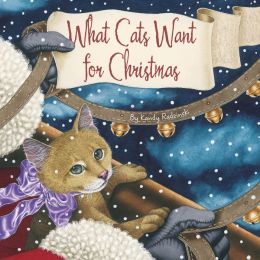
What Cats Want for Christmas. Kandy Radzinski. 2007. Sleeping Bear Press. 32 pages. [Source: Library]

For cat-lovers, this is a charming-enough book to read at Christmas time. The premise is simple: if cats could write letters to Santa, what would they ask for. Each spread shows a cat and his/her letter to Santa. The letters are all written in rhyme. The letters are predictable enough, but, the idea I think is original. I do wish there was more variety in what the letters requested, however. And some letters seem a bit dark and twisted.

I really liked the illustrations. I think I liked looking at the various cats better than reading the letters.

 It's Not About You Mr. Santa Claus. Soraya Diase Coffelt. 2014. Morgan James Publishing. 34 pages. [Source: Review copy]

There are plenty of children who write letters to Santa each year. But how many letters to Santa include the gospel message? In this picture book a young boy does just that.
Dear Mr. Santa Claus,
It's me again--a kid. I know I've written lots of letters to you before with long lists of gifts I wanted for Christmas. Well, not this year. This letter is different. I discovered the real meaning of Christmas has nothing to do with you at all. It is about a very special gift. I want to tell you about this gift. By the way, how are you and Mrs. Santa Claus doing? Have you lost any weight? Did your helpers, the elves, grow any taller? Do you still like cookies and milk? Are you still wearing that red, furry outfit? I've always wondered, what do you wear in the summer time?
It's a simple book with a timeless message. Which timeless message? Well, I suppose I could pick one or two that stand out. First, that Christmas is not about Santa and presents and shopping. It is actually about celebrating Jesus. Second, that the gospel is too good to keep to yourself. The gospel is for sharing.
The real Christmas story began a long time ago, when a Roman emperor named Caesar Augustus ordered that a census be taken. A census is when all the people had to be counted. At that time, A man named Joseph and his wife, Mary had to take a long journey to the city of David, known as Bethlehem, for the census. It wasn't an easy journey as Mary was going to have a baby soon.
The focus of this book is on retelling the Christmas story and communicating the gospel message. Probably leanings toward more retelling.

I was pleasantly surprised by the illustrations. I thought they were very nicely done.

Will this book please every single reader? Probably not. It may not be a perfect fit for every family this holiday season. But I think for some it will be a great find.


© 2014 SukaYuka.com of SukaYuka's Book Reviews

Sunday, December 14, 2014

Eight Christmas Books

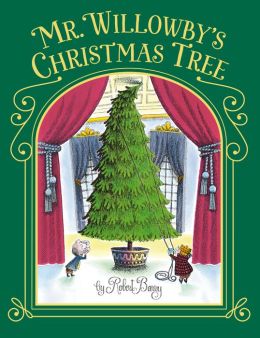
Mr. Willowby's Christmas Tree. Robert E. Barry. 1963. Random House. 32 pages. [Source: Library]

Mr. Willowby's Christmas tree came by special delivery. Full and fresh and glistening green--the biggest tree he had ever seen. He dashed downstairs to open the door--This was the moment he'd waited for.

I loved, loved, loved Mr. Willowby's Christmas Tree. It celebrates giving in a fun and playful way. Mr. Willowby starts off a long chain of giving when he chops off the top of his too-tall Christmas tree. A tree that is splendid in every other way. He gives the tree-top to the upstairs maid. She's delighted. Very delighted. How thoughtful! How cheery! But the tree is too-tall for her small room. The top must go! Chances are you can predict at this point how the story will go. But that doesn't mean it is in any way less delightful. This little tree-top gets passed down and re-trimmed again and again and again and again and again. And it's just WONDERFUL to see how much happiness and cheer it brings to others.

I loved the premise. I loved the writing. The rhyming was delightful. It worked very well for me! I think this one would make a great read-aloud. I also loved how uplifting it is. (After reading Baboushka and the Three Kings, I needed a cheery story!)

Why didn't someone tell me about this wonderful and charming picture book?! Why?! Well, I am glad to have discovered it now!

Which Christmas books would you consider classic? Which would you recommend?

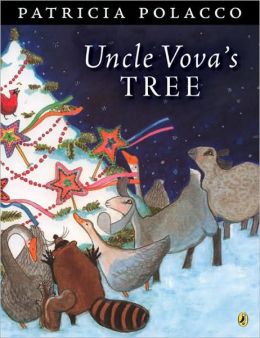
Uncle Vova's Tree. Patricia Polacco. 1989. Penguin. 32 pages. [Source: Library]

Uncle Vova's Tree is rich in detail and tradition. The author, Patricia Polacco, is drawing from her past and recalling some of her childhood Christmases. She writes, "As a child I celebrated Christmas as most American children did, but at Epiphany in January, my brother, my two cousins, my grandparents and I would go to the farm of my Great Uncle Vladimir and Aunt Svetlana to celebrate in the Russian tradition." The book recalls two family gatherings specifically. The first is Uncle Vova's last Christmas. Though of course, most everyone did not *know* it would be his last Christmas. The second is that first Christmas without him. The book definitely has tones of sadness, but, it is ultimately hopeful. Memories, good, strong happy memories, remain.

The book is rich in detail and tradition. It is informative in many ways. Did you know about the tradition of putting hay underneath the tablecloth to remember and honor the stable in Bethlehem where Jesus was born? But in addition to honoring tradition--in this case, Russian tradition--it also celebrates families. Readers meet a family that is close and loving and supportive. Little details make this one work well.

Too Many Tamales. Gary Soto. Illustrated by Ed Martinez. 1993. Penguin. 32 pages. [Source: Library]

Snow drifted through the streets and now that it was dusk, Christmas trees glittered in the windows.

Too Many Tamales is a great family-oriented Christmas story. Maria, our heroine, is helping her mom make tamales. She loves helping her mom, loves being grown-up in the kitchen. But things don't go smoothly with this first batch of tamales. And it is her fault. Mostly. Maria really, really, really wanted to try on her mom's ring. Unfortunately, this-too-big ring falls right into the masa mixture. Hours later, she realizes that she never took the ring off. She doesn't know for sure where the ring is. But she has a strong suspicion that it may very well be in one of the twenty-four tamales. With a little help from her cousins, Maria is in a race to find the ring before her mom--and all the other relatives--realize what has happened. Will she find the ring? Will her mom find out? Will her cousins ever want to eat another tamale?!

I liked this one very much.

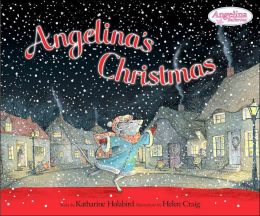
Angelina's Christmas. Katharine Holabird. Illustrated by Helen Craig. 1986. Penguin. 32 pages. [Source: Library]

Christmas was coming, and everyone at Angelina's school was working hard to prepare for the Christmas show.

I enjoyed reading Angelina's Christmas. I enjoyed meeting Angelina and her family. I loved how thoughtful and empathetic Angelina was. She realizes that there is one house in the village that is not decorated. She notices that there is one "old man huddled by a tiny fire." She learns from her parents that this old man is Mr. Bell, a retired postman. She decides that she will do something special for him so he won't be all alone at Christmas time. (And Angelina isn't the only one joining in to help make this Christmas memorable for Mr. Bell.) She makes him cookies, her mom sends along mince pies and fruit, her dad cuts him a Christmas tree. They visit him, Henry, Angelina's brother comes along too. But perhaps even more importantly than showing him kindness through things, they take the time to listen to him, to include him. This one is a lovely book.

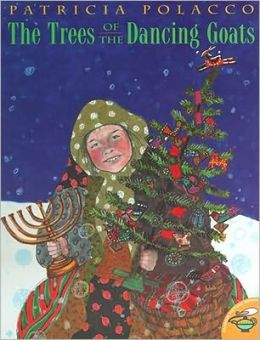
The Trees of the Dancing Goats. Patricia Polacco. 2000. Simon & Schuster. 32 pages. [Source: Library]

At our farm just outside Union City, Michigan, we didn't celebrate the same holidays as most of our neighbors...but we shared their delight and anticipation of them just the same.

I enjoyed reading The Trees of the Dancing Goats by Patricia Polacco. She is sharing yet another holiday memory with young readers in this picture book.

The story focuses on one holiday season when the town is hit by an epidemic, scarlet fever, I believe. The heroine's family is not sick, but, most of their neighbors are. As they are preparing to celebrate Hanukkah, they realize that most of their neighbors are too sick to prepare for and celebrate Christmas. They love their neighbors. They want to do something for them. Working together as a family, they decide to bring Christmas to their neighbors: food, a tree, decorations. Since they don't own any Christmas ornaments, they use animals carved out of wood. One of the animals, as you might have guessed, is a goat. When hung on the tree, it appears to be a dancing goat. Can one family bring Christmas cheer to a community?

I liked this one. I liked the family scenes very much. It is a thoughtful book. I'm glad I finally discovered it!

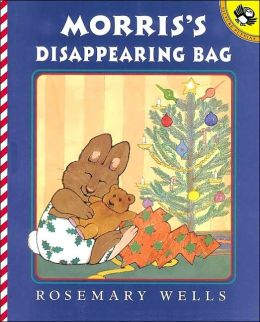
Morris' Disappearing Bag. Rosemary Wells. 1975. Penguin. 40 pages. [Source: Library]

It was Christmas morning. "Wow!" said Morris.

Morris' Disappearing Bag probably isn't my favorite Rosemary Wells, but, this one is enjoyable enough that it's worth reading at least once or twice. Morris stars in this one. He has three older siblings: one big brother, Victor, and two older sisters, Rose and Betty. It is a Christmas book, of course. After all the presents are opened, the three older siblings play with their presents and play with each others presents. Victor got hockey stuff. Betty got a chemistry set. Rose got a beauty kit. They take turns sharing. Much fun is had. But not by all. For Morris has only his present (a teddy bear) to play with. He doesn't get a turn with his siblings' presents. But that changes when Morris discovers a fantastic present under the tree. A bag. A disappearing bag. Whatever is in the bag disappears. His siblings all want a turn, and, he lets them in the bag. While his siblings have disappeared for the day, Morris plays with their stuff before settling into bed with his bear.

Max's Christmas. Rosemary Wells. 1986. Penguin. 32 pages. [Source: Library]

I love watching Max and Ruby. I've seen the adaptation of Max's Christmas plenty of times before I read the book. If you like the show, chances are you'll enjoy reading this book. It is very similar. For those new to these lovable siblings, Ruby is the older sibling. She seems to be raising Max all on her own. (Ruby and Max don't have parents. They have a Grandma, but, she does not live with Max and Ruby.) Max is the younger sibling. He is many things: cute, clever, curious. Yes, he can be mischievous, but, he is also super-observant. I love, love, love them both. I might like Max a tiny bit better than Ruby. But still. I love them both.

In this book, readers join Ruby and Max on Christmas Eve night. Ruby is trying her best to get Max to get ready for bed, to go to sleep. Max is excited, of course. Once he knows that Santa is coming to his house tonight, he wants to see it for himself. So he goes downstairs to wait for Santa....

I liked this one very much.

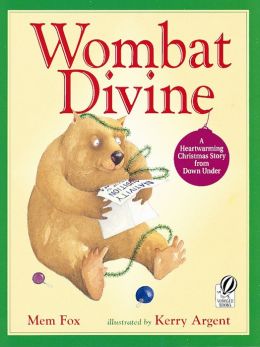
Wombat Divine. Mem Fox. Illustrated by Kerry Argent. 1995/1999. HMH. 32 pages. [Source: Library]

I found Mem Fox's Wombat Divine to be charming. I loved Wombat. He loves, loves, loves Christmas. More than anything, he wants a part in the nativity play. At the auditions, he tries his best. But there are so many parts that he's just not right for. I love the refrain, "Don't lose heart. Why not try for a different part?" which is used throughout the whole auditioning process. He auditions for Archangel Gabriel, Mary, a wise king, Joseph, an innkeeper, and a shepherd. But there's one role that he'd be just perfect playing. Can you guess it?

I liked this one. I thought it was cute and sweet. I liked the writing. I found it unique and oh-so-right.

© 2014 SukaYuka.com of SukaYuka's Book Reviews

Sunday, December 7, 2014

Ten Christmas Picture Books

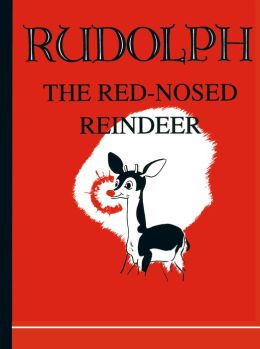
Rudolph the Red-Nosed Reindeer. Robert Lewis May. Illustrated by Denver Gillen. 1939/1990. Applewood Books. 32 pages. [Source: Library]

I enjoyed this one more than I thought I would. This is the original story by Robert L. May with the original illustrations by Denver Gillen. It is so different from the song and the stop-motion animated special. And I think it was the fact that it was different that made me appreciate it more.

The story is told in rhyme. It's essentially one long (perhaps poorly punctuated) poem. Here's how it begins:
Twas the day before Christmas, and all through the hills
The reindeer were playing…enjoying the spills
Of skating and coasting, and climbing the willows…
And hop-scotch and leap-frog (protected by pillows!)
While every so often they'd stop to call names
At one little deer not allowed in their games:--
"Ha ha! Look at Rudolph! His nose is a sight!"
"It's red as a beet!" "Twice as big!" "Twice as bright!"
While Rudolph just wept.
What else could he do?
He knew that the things
they were saying were true!
Readers first meet Rudolph, a young deer who is teased by his peers. He does NOT live at the North Pole. And he's not one of Santa's own reindeer.
What we do learn is that he's a very good, very obedient deer who is expecting Santa to leave him some lovely presents because he's been so very, very good.

Readers then meet Santa and learn of the horrible weather conditions that prove most challenging. Santa starts out on his trip, it isn't until he's delivering presents to Rudolph's house that he notices the brilliant light of his nose.

Santa then decides to wake him up and ask for his help. The rest of the journey goes much easier for Santa!

The book concludes with Santa returning Rudolph to his family, to his hometown. He is now a hero, of course.

I liked this one. I liked some of the rhymes more than others. There are definitely some quirky lines!
Come Dasher! Come Dancer! Come Prancer and Vixen!
Come Comet! Come Cupid! Come Donner and Blitzen!
Be quick with your suppers! Get hitched in a hurry!
You, too, will find fog a delay and a worry!"
And Santa was right. (As he usually is!)
The fog was as thick as a soda's white fizz.
The book is definitely text-heavy. So a longer attention span would be needed for little ones to enjoy this one.

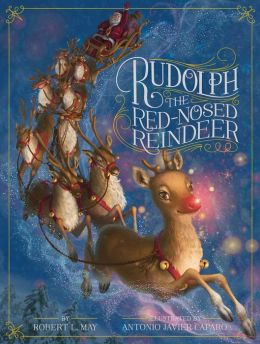
The copy I read was a facsimile edition. A 75th Anniversary edition with new illustrations was released in September 2014.

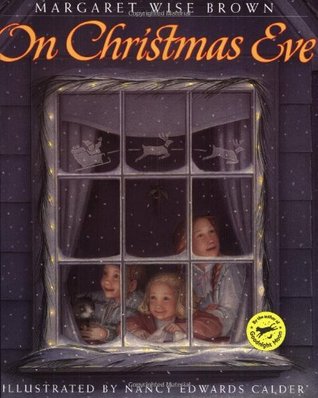
On Christmas Eve. Margaret Wise Brown. Illustrated by Nancy Edwards Calder. 1938/1961/1996. HarperCollins. 32 pages. [Source: Library]

It was the middle of the night. And night of all  nights it was Christmas.

I enjoyed Margaret Wise Brown's On Christmas Eve. It is a descriptive look at what Christmas--at what Christmas Eve--is like for children. It focuses on simple things: what your eyes see, what your ears hear, what your nose smells, what your hands and feet touch. It seeks to capture the emotion of the holiday: the excitement, the waiting, the longing.

Lots of details, lots of adjectives. It's rich in imagery and description. There is also a bit of repetition. The text is lyrical in places.

I can't say that I loved it. But it was very enjoyable. I was also glad to see that one of the presents under the tree was a train. The children are just in awe of the magic of Christmas, of the stockings and packages, of the snow falling outside, of the carolers outside.

It was a sweet story about three siblings.

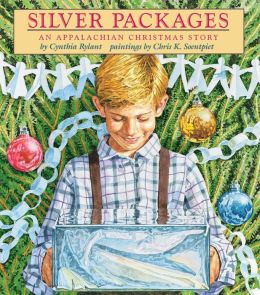
Silver Packages: An Appalachian Christmas Story. Cynthia Rylant. Illustrated by Chris K. Soentpiet. 1987. Scholastic. 32 pages. [Source: Library]

Silver Packages is a picture book for older readers most likely. I wouldn't say it is for an exclusively adult audience. But I think readers need some perspective in order to appreciate the book fully. I think it can resonate with readers, it has the potential. But I don't think the emotional reaction would be--or even should be--automatic. One can't assume that every reader will respond with tears and "this is the best book I've ever read!!!"

Silver Packages is about giving back to the community. In this instance, one very specific community--Appalachia. The book is about the Christmas Train. It starts with one man who wants to show his appreciation for the community that helped him when he needed it. He was injured in an accident, the community took in this stranger and nursed him back to health without asking for anything in return. He decides that he will come every year--by train--and hand out packages to the children who meet the train. These packages are wrapped in silver paper. Every story needs a protagonist. Silver Packages introduces us to Frankie. Readers first meet Frankie as a boy. He's a boy with a dream. He wants to be a doctor. And he really, really, really wants a doctor kit for Christmas. But each year, he's slightly disappointed. He receives a handful of silver packages through the years. Every gift seems to have a toy--something a boy or girl might want--and something a boy or girl might need. The practical gifts include: socks, mittens, hats, scarves, etc. Readers later see Frankie all grown up. He is a doctor. He reflects on his life, on his past Christmases, he has a light-bulb moment. He decides it is his turn to give back to the community in his own special way. It's a book about kindness and gratefulness and community awareness.

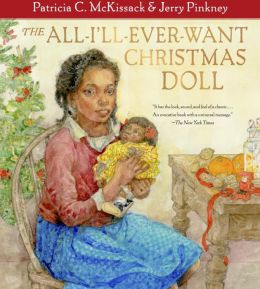
The All-I'll-Ever-Want Christmas Doll. Patricia C. McKissack. Illustrated by Jerry Pinkney. 2007. Schwartz & Wade. 40 pages. [Source: Library]

Christmas always came to our house, but Santy Claus only once in a while.

I haven't read The All-I'll-Ever Want-Christmas Doll in years. It was just as good as I remembered. The book is set during the Depression. A little girl, Nella, knows that her family is poor, that Santy may not come this year at all. Yet, she can't resist writing to him all the same begging for a Baby Betty doll. Her two sisters perhaps think a little less of Nella for her dreaming so big. She shouldn't expect so much from Christmas. But on Christmas morning, there are a few surprises. Each girl gets a Christmas sack filled with walnuts, peppermint candy, an orange, and a box of raisins. But there is one present, one special present remaining: a doll. Nella thinks the doll should be HERS and hers alone. After all, her sisters haven't gone around talking about the doll nonstop, her sisters didn't write Santa a letter begging for the doll. Why should she have to share the doll with them? But does the doll make her happy? Is the doll truly all she'll ever want? She has a few lessons to learn for sure!

I really enjoyed the story and the message.

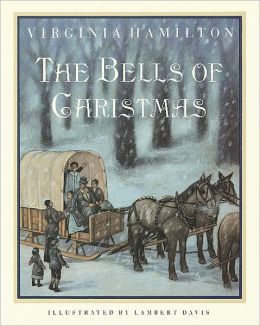
The Bells of Christmas. Virginia Hamilton. Illustrated by Lambert Davis. 1989/1997. Houghton Mifflin Harcourt. 64 pages. [Source: Library]

I didn't dislike Virginia Hamilton's The Bells of Christmas. But I didn't love, love, love it either. I think it depends on what exactly you're expecting from a Christmas book. The Bells of Christmas is very much a celebration of a Christmas long ago. Christmas 1890. Readers meet a young boy, Jason Bell, and experience the holiday through his perspective. We learn about his mom and dad, his brothers and sisters, his cousins, his aunt and uncle, his friend, Matthew. The book is set over a period of several days. Among the things readers learn that Jason's dad is a carpenter, that he wants his sons to join him in his business one day, his dad has only one leg, that his dad wears a peg leg part of the time and is in his wheel chair the rest of the time. Readers also learn that Jason is just a wee bit obsessed with wheels--mainly trains, but, also wagons, etc. The book has plenty of detail and characterization which is a good thing. Jason is waiting for quite a few things: 1) he can't wait for Christmas morning and presents! 2) he can't wait for the Bells to arrive--his uncle and aunt and cousins, 3) he is excited about church, most everyone is performing and participating in some way. (Jason is singing a solo.) The book perhaps seeks to capture one Christmas for one extended family. It is a pleasant, enjoyable book. It isn't quite a chapter book or novel. It isn't quite a picture book.
 
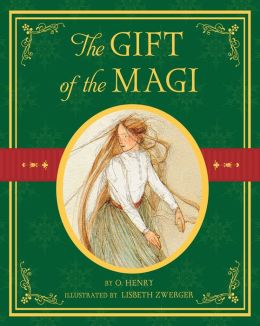
The Gift of the Magi. O. Henry. Illustrated by Lisbeth Zwerger. 1905/2006. Simon & Schuster. 32 pages. [Source: Library]

I've seen adaptations of The Gift of the Magi--who hasn't? (My favorite is Bert and Ernie and Mr. Hooper.) But this is the first time I've read the actual short story. I haven't decided how I feel about it. Is this couple wise or foolish? Or are they at times foolish and at times wise?

The wife, Della, takes extraordinary pride in her long hair. She doesn't seem the vain sort except for when it comes to her hair. And even if she is vain about it, there's no indication it's anything besides a private vanity. The wife apparently has been coveting expensive hair combs as well. The husband, Jim, takes extraordinary pride in the family watch. The narrator uses exaggeration when discussing the woman's long hair and the man's gold watch. I didn't love the narrator. In fact, I think the narrator is a distraction. He won't let the reader forget for a moment that this is a precious story.
Now, there were two possessions of the James Dillingham Youngs in which they both took a mighty pride. One was Jim's gold watch that had been his father's and his grandfather's. The other was Della's hair. Had the queen of Sheba lived in the flat across the airshaft, Della would have let her hair hang out the window some day to dry just to depreciate Her Majesty's jewels and gifts. Had King Solomon been the janitor, with all his treasures piled up in the basement, Jim would have pulled out his watch every time he passed, just to see him pluck at his beard from envy.
The wife can't afford a gift for her husband. The husband can't afford a gift the wife. The wife knows this--or should know this. The husband knows this--or should know this. The wife has saved $1.87. The husband might have saved a small sum as well. Readers don't know one way or the other. Both husband and wife will have something to offer the other, however. Something more than love. For both have decided--quite independently--to give sacrificially. To give up what they supposedly value most: her hair, his watch. And this giving up wasn't to support the family, but, to support the other's vanity.

I think actions can speak more than words. I think the narration took away some of my enjoyment of this one. It felt odd at times. There were sentences that were eloquent and refined and then it would slip into something else.
"It's sold, I tell you--sold and gone, too. It's Christmas Eve, boy. Be good to me, for it went for you. Maybe the hairs of my head were numbered," she went on with sudden serious sweetness, "but nobody could ever count my love for you. Shall I put the chops on, Jim?"
I think I like the adaptations better.

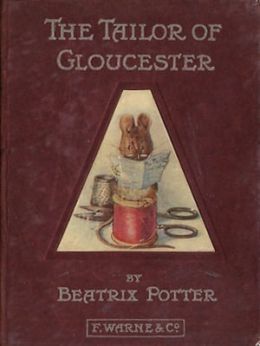
The Tailor of Gloucester. Beatrix Potter. 1903. 58 pages. [Source: Library] 
In the time of swords and periwigs and full-skirted coats with flowered lappets—when gentlemen wore ruffles, and gold-laced waistcoats of paduasoy and taffeta—there lived a tailor in Gloucester.
He sat in the window of a little shop in Westgate Street, cross-legged on a table, from morning till dark.
All day long while the light lasted he sewed and snippeted, piecing out his satin and pompadour, and lutestring; stuffs had strange names, and were very expensive in the days of the Tailor of Gloucester.
I enjoyed rereading Beatrix Potter's The Tailor of Glouchester. In this delightful Christmas tale, readers meet a tailor, a cat named Simpkin, and some lovely mice. It is several days before Christmas. He's working hard to finish a coat and waistcoat for the Mayor of Glouchester. The Mayor is getting married on Christmas day. The tailor has just enough money to finish the coat. Not a penny to spare. He sends his cat, Simpkin, with his money to buy what he needs: a little for himself (food: bread, sausage, milk) a little for his work (one twist of cherry-coloured silk). It is only after the fact that he questions whether he should have sent the cat or gone himself. The cat returns, but, in a mood. The cat is upset for he's discovered that the tailor freed the mice he had captured and hid under the teacups. The cat hides the twist. The man is upset, of course, and sick. He takes to his bed unable to work. The oh-so-thankful mice go to his shop and finish his work for him. But since they are one twist short, they are unable to finish completely. Still, they do what they can, and they do a wonderful job. The cat who spies them at work, I believe, has a change of heart and gives the twist to the old man on Christmas morning. He has just enough time to finish. The Mayor is very, very pleased. And the tailor's luck changes for the better, and his business is much improved. This one is a lovely, delightful read from start to finish.

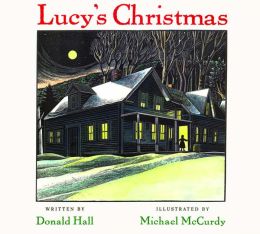
Lucy's Christmas. Donald Hall. Illustrated by Michael McCurdy. 1998. Houghton Mifflin Harcourt. 40 pages. [Source: Library]

I enjoyed reading Lucy's Christmas by Donald Hall. Lucy's Christmas is a picture book set in 1909 in New Hampshire. In the fall of 1909, Lucy and her family start preparing for Christmas. For Lucy, this means starting to make her own gifts for her family and friends. It pays to plan ahead since so many gifts take time, and thought must be placed into each gift. She's not the only one thinking ahead. This year the family is ordering a new stove for the kitchen. The family has spent a lot of time browsing in the Sears catalog. Lucy's choice is the one the family decides upon: the Glenwood Kitchen Range. The focus is not just on gifts: planning, making, giving, receiving. The focus is also on family life and community life. Readers get glimpses of the school and church. Both places are very busy! I enjoyed this glimpse into the past! It was interesting to see the family prepare for the new year--1910. The enthusiasm in the story is sweet. The author's note reveals that this picture book is based on family history.

I really liked this one very much. I liked Lucy and her family. I liked the fact that the church plays such a HUGE role in the Christmas celebrations. There are gifts, it's true. But it's not commercialized and selfish.

Baboushka and the Three Kings. Ruth Robbins. Illustrated by Nicholas Sidjakov. 1960/1986. Houghton Mifflin Harcourt. 32 pages. [Source: Library]

Long ago and far away, on a winter's evening, the wind blew hard and cold around a small hut.

Baboushka and the Three Kings won the Caldecott Medal in 1961. It is Russian folktale with a Christmas setting. The three kings--wise men--come to Baboushka's hut. They only stay a few minutes. Long enough to extend an invitation to the old woman. Will she join them in their procession, in their quest, to find the Babe, the Child? She'd love to join them, she'd love to bring gifts to the Child. But she is not ready to go just yet. Couldn't they all wait until morning? Couldn't they wait for her to finish up a few small, tiny chores first? Couldn't they wait for the storm to clear? Their answer was firm. Their journey to the Child was too important to postpone. They couldn't linger longer. She watched them depart. But they were not easy men to forget. The next morning, she begins a journey of her own. A journey that will take her far. But will her journey lead her to where she wants to go?

It's a simple story, nicely written. "It is no ordinary Babe they seek. Yes! I must go and follow them! To find the new Babe, to offer Him her gift, was now her one yearning. This thought burned in her mind like a candle in the dark." It is also nicely illustrated. The illustrations complement the text well. Both illustrations and text have a different flavor, an authentic flavor, but not exactly American. After several readings, I came to appreciate both a bit more.

In case you're unfamiliar with the story, the book is bittersweet at best. While it is true that Russian children everywhere look forward to Baboushka's gifts each year as her journey continues, it is also true that Baboushka's journey has no happy ending. She never finds the Child. She is never able to give Him her gifts.

Polar Express. Chris Van Allsburg. 1985/2009. Houghton Mifflin Harcourt. 32 pages. [Source: Library]

The Polar Express is one of my favorite Christmas books. It is. The book is a thousand times better than the movie. (Though the soundtrack of the movie isn't bad.) So if you've only seen the movie, you might want to give the book a try to. You might have a different response to it.

The Polar Express is about belief and doubt--in Santa. It's told in the first person, so we never learn the protagonist's name, but it is a little boy with a younger sister named Sarah. One Christmas Eve, the little boy is awakened by The Polar Express. He goes to the North Pole on the Polar Express train, there are other passengers too. All presumably boys and girls on the verge of not-believing. At the North Pole, he sees Santa, reindeer, and elves. He happens to be chosen to receive the first gift of Christmas. He asks for a bell from Santa's reindeer. This gift is not in his possession for long, however, because he has a hole in his pocket. On Christmas day, he receives a special gift under the tree: the bell he had lost. He can hear it. His sister can hear it. But his parents do not. The book ends wonderfully with a message for "all those who truly believe."

I loved this one cover to cover, though I love the ending most of all.


© 2014 SukaYuka.com of SukaYuka's Book Reviews
Sunday, November 2, 2014

Seven 2014 Picture Books

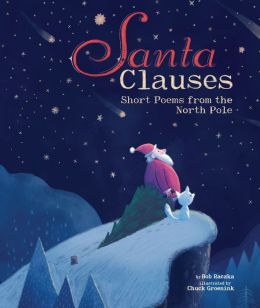
Santa Clauses: Short Poems From the North Pole by Bob Raczka. 2014. Lerner Publishing Group. 32 pages. [Source: Library]

December 1rst
Wishes blowing in
from my overfilled mailbox--
December's first storm.


I enjoyed reading Bob Raczka's Santa Clauses. The book is a poetic countdown to Christmas. Each of the twenty-five poems is written from Santa's perspective. Each poem is dated. Each poem is haiku. I found this to be a delightful read. I loved some of the poems. I liked all of them, for the most part, but there were a few I did LOVE. The book gives young readers a behind-the-scenes glimpse at Santa's life. Very cute.
Some of my favorites:
December 3rd
Mrs. Claus making
an angel, becoming a
little girl again.
December 10th
The north wind and I
whistling to "Let It Snow!"
on the radio.
I would definitely recommend it. I've read it a few times now, and I just love it more each time.

Text: 5 out of 5
Illustrations: 4 out of 5
Total: 9 out of 10

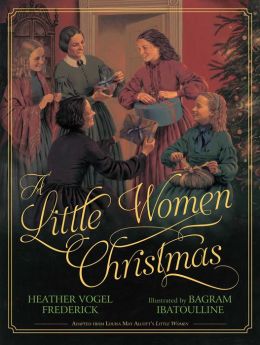
A Little Women Christmas. Heather Vogel Frederick. 2014. Simon & Schuster. 32 pages. [Source: Library]

For people who LOVE, LOVE, LOVE, LOVE Little Women by Louisa May Alcott, I think this one is well worth reading and rereading. I have read the novel once or twice, certainly enjoyed it well enough, but it's never been one that I've gushed about or LOVED passionately.

This picture book focuses on one of the Christmases written about within Little Women. The 22nd chapter of Little Women. The illustrations by Bagram Ibatoulline are wonderful. If you're a fan of his work, you'll probably want to seek this one out because they are BEAUTIFUL.

I do think it is a picture book for older readers. I think it's a beautiful book for fans of the book or movie.

Text: 3 out of 5
Illustrations: 5 out of 5
Total: 8 out of 10

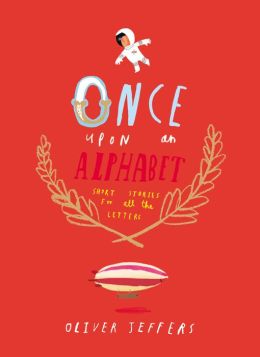
Once Upon An Alphabet: Short Stories for All the Letters. Oliver Jeffers. 2014. Penguin. 112 pages. [Source: Library]

It opens with the premise: "If words make up stories, and letters make up words, then stories are made of letters. In this menagerie we have stories, made of words, made for all the letters."

Once Upon An Alphabet is indeed a book of twenty-six "short stories," one for each letter. The stories can best be described as odd and quirky. I think you have to have a certain sense of humor to "get" the stories and how they all fit together, if they indeed do fit all together. (Some do fit together. I know. But do all twenty-six fit together? I'm not as sure of that.)

This one will definitely be for older readers, not preschoolers. This is NOT Chicka Chicka Boom Boom. But I wouldn't say that it's a book that would appeal to one and all, a book with universal appeal. I could see how some readers might LOVE it and others not so much.

I liked some stories, some letters, better than others. A few I didn't like at all. A few I really did enjoy. But I didn't LOVE this one. I do think it's an interesting premise, however.

Text: 3.5 out of 5
Illustrations: 3.5 out of 5
Total: 7 out of 10

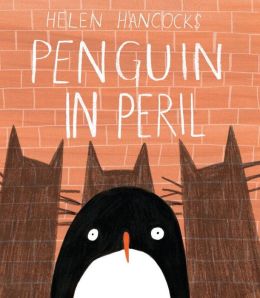
Penguin in Peril. Helen Hancocks. 2014. Candlewick. 32 pages. [Source: Library]

One afternoon, three hungry cats ran out of food. They searched the house high and low and found three gold coins. They set off for the grocery store. On their way, the cats passed a movie theater. A movie called The Fishy Feast was playing. They handed over the three gold coins and went in. 

Three cats are inspired by a movie, The Fishy Feast, to kidnap a penguin. Why do they want a penguin? The way they see it, a penguin can catch fish for them. But will the kidnapped penguin agree to such a scheme? Or will the penguin find a way to escape? Will the cats' scheme result in a bounty of fish or in jail time?!

I liked this one. I can't say I loved it particularly. But I thought it was creative and playful. Definitely worth reading at least once.

Text: 4 out of 5
Illustrations: 3 out of 5
Total: 7 out of 5

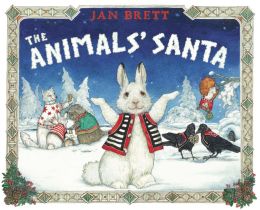
The Animals' Santa. Jan Brett. 2014. Penguin. 32 pages. [Source: Library]

"It's your first Christmas Eve, Little Snow. The animals' Santa comes tonight!" Big Snowshoe told his little brother. "Who is the animals' Santa?" Little Snow asked. "We don't know who he is," Big Snowshoe said. "Did you ever see him?" Little Snow asked. "No," the forest animals chimed in. "But we find presents from him on Christmas."

For those of all ages who love Jan Brett, who love, love, love Jan Brett, I think you'll find much to love and appreciate in her newest picture book, The Animals' Santa. The Animals' Santa is in many ways similar to her previous books. (Incredibly detailed illustrations with animals and nature as the subject.)

In The Animals' Santa readers meet Little Snow, Big Snowshoe, and their animal friends. Every animal is happy to share what he/she knows about the "animals' Santa." One by one, they recall what they've received in previous years, trying to show Little Snow, the skeptic, that the animals' Santa is real, and, that he is coming that night. Every animal seems to have an idea of *who* the animals' Santa might be. But all the talking does little to change Little Snow's mind.

Readers will discover along with Little Snow and all the other animals just who the animals' Santa is. I was a bit surprised by the twist in this one, it was not who I was expecting it to be.

Text: 3 out of 5
Illustrations: 3 out of 5
Total: 6 out of 10

The Book With No Pictures. B.J. Novak. 2014. Penguin. 48 pages. [Source: Library]

There are no illustrations in this picture book. The book exists in order to make adults reading aloud to children say silly things in silly voices. That is the oh-so-simple premise. That words can be entertaining even if they aren't accompanied by pictures. The premise isn't a bad one necessarily. That being said, I want pictures in a picture book. The text can be as over-the-top and silly and ridiculous as can be. It can say things like "My only friend in the whole wide world is a hippo named Boo Boo Butt". It won't change my mind, I still want pictures.

I don't think it takes a picture-less book to get adults to read dramatically and make listeners giggle. I think that is just a part of reading books aloud to kids. Depending on the book, of course, some books may be funnier than others and allow for more opportunities.

The book is also "interactive" in that it addresses the reader directly. This has been done in other picture books, better picture books with actual illustrations. My favorite happens to be We Are In A Book by Mo Willems. And earlier this year there was Help! We Need a Title!

Text: 3 out of 5
Illustrations: none
Total: 3 out of 5

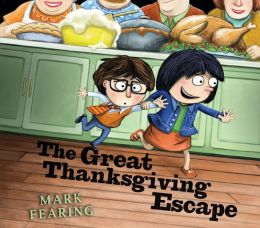
The Great Thanksgiving Escape. Mark Fearing. 2014. Candlewick. 32 pages. [Source: Review copy]

It was another Thanksgiving at Grandma's. "You can play in here with the rest of the kids," Gavin's mother told him. "We'll call you when the turkey's ready." "Have fun!" Gavin's dad called. But Gavin knew it was not going to be fun. Not fun at all. "Hey," someone whispered. It was his cousin Ronda. "What do you say we break out of here and head for the swing set in the backyard?"

How much fun will Gavin have on Thanksgiving at his Grandma's house? More fun that he expected at any rate, in large part due to his cousin, Rhonda. These two sneaky kids team up. The mission: escape the house and actually have some FUN. But it won't be easy. There are obstacles on the path to freedom. And one of those obstacles is "the GREAT WALL OF BUTTS!" There are also zombies to avoid. (Who are the zombies? The teenagers in the basement that are playing video games or on their phones/tablets.) There are SO MANY people in this house: dozens of adults, dozens of kids, dozens of teens. Gavin's family must be HUGE or else Grandma invited the whole neighborhood. Either way, Gavin is going to have a memorable Thanksgiving.

I didn't love this one. I didn't hate this one. I've never really found a Thanksgiving book that I actually loved.

Text: 3 out of 5
Illustrations: 3 out of 5
Total: 6 out of 10

© 2014 SukaYuka.com of SukaYuka's Book Reviews

Sunday, October 5, 2014

Ten 2014 Picture Books

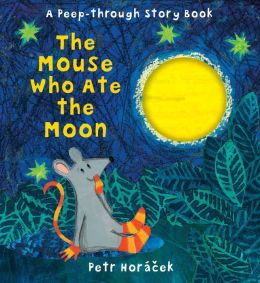
The Mouse Who Ate The Moon. Petr Horacek. 2014. Candlewick. 32 pages. [Source: Review copy]

One evening, Little Mouse peered out of her hole. She was looking at the moon. "The moon is beautiful," she said as she settled down to sleep. "I would love to have my very own piece of the moon."

I enjoyed reading The Mouse Who Ate The Moon. I liked Little Mouse very much. One night Little Mouse wishes she could have a piece of the moon. The next morning, she discovers that her wish has come true. She is delighted to find a piece of the yellow moon had fallen from the sky and landed on her doorstep. She never expected it. She also didn't expect to be tempted by it, tempted to want to eat it. One thing leads to another, and soon Little Mouse is convinced that she's eaten HALF the moon and the sky will never be the same again... Her friends try to gently tell her that she's just being silly. NO ONE can eat the moon they say again and again and again. Can her good friends cheer her up again?

I love the illustrations. I love "the piece of the moon" that Little Mouse discovers. Readers may realize the truth about "the moon" long before Little Mouse does! It is a simple story that is beautifully illustrated.

Text: 3 out of 5
Illustrations: 5 out of 5
Total: 8 out of 10

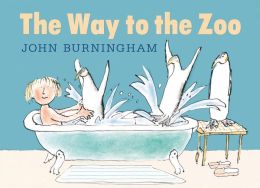
The Way to the Zoo. John Burningham. 2014. Candlewick. 40 pages. [Source: Review copy]

One evening, just before Sylvie went to sleep, she thought she could see a door in the wall of her bedroom. She decided to look again in the morning to see if the door was really there. In the morning, Sylvie was late for school and forgot about the door until bedtime. 

What will Sylvie find when she opens the door? You'll want to read this one and find out for yourself.  (Or you could read the title and take a guess, I suppose!) I loved John Burningham's The Way to the Zoo. It was oh-so-magical for me. I loved the story progression. How Sylvie brings back animals--small animals, mainly--back to her own room night after night. I loved how careful she was with this magic. She always made sure to leave the door closed. But I also loved that there was just this one time when she forgot...

The story is just fun and joyful. I loved seeing what happened next, what animals she brought back with her. I loved the story, I did. But I didn't love the illustrations. At least not as much as I loved the text itself.

Text: 5 out of 5
Illustrations: 3 out of 5
Total: 8 out of 10


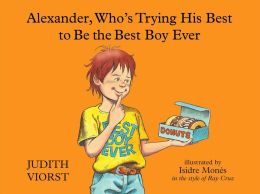
Alexander, Who's Trying His Best To Be The Best Boy Ever. Judith Viorst. Illustrated by Isidre Mones. Simon & Schuster. 40 pages. [Source: Library]

Can Alexander be "the best boy ever" for one whole week?! After suffering the consequences of eating a whole box of donuts, Alexander sets out to prove that he CAN and WILL be good, better than good, the BEST. His parents and his brothers may have their doubts, big doubts, that Alexander can stay away from trouble for even just a day or two. But Alexander has something to prove to himself. His goal is ambitious, his temptations are many. At home and at school, everywhere he goes Alexander is tempted. There are so many things he wants to do during those six or seven days that are a bit naughty--some more naughty than others perhaps. What will Alexander learn about himself during this week? Is it good or bad that he learned it? Will readers agree or disagree with Alexander's conclusions?

I liked it. I didn't love it.


Text: 3 out of 5
Illustrations: 3 out of 5
Total: 6 out of 10 


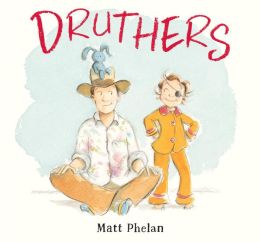
Druthers. Matt Phelan. 2014. Candlewick. 32 pages. [Source: Review Copy]

It was raining. And raining. And RAINING. "I'm bored," said Penelope. "If you had your druthers, what would you do?" asked her Daddy. "What are druthers?" "Druthers are what you would rather do if you could do anything at all." 

I really enjoyed reading Matt Phelan's Druthers. I loved how Penelope and her Dad played together on a rainy day. I loved turning the pages to see what she wanted to do next. Each activity was a "druther" of course. For example, wanting to go to the zoo, wanting to be a cowgirl, wanting to go to the moon, etc. Each druther leads to a fun opportunity for this father and daughter to explore together. This is a book that celebrates imaginative play. It also celebrates family! (I suppose you could also say the book handles disappointments as well.) The book is very sweet. I definitely recommend it.

Text: 4 out of 5
Illustrations: 3 out of 5
Total: 7 out of 10


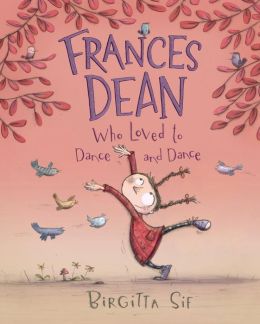
Frances Dean Who Loved To Dance and Dance. Birgitta Sif. 2014. Candlewick. 32 pages. [Source: Review copy]

Once there was a girl whose name was Frances Dean. She loved to dance and dance. 

Frances Dean loves to dance. She does. She loves, loves, loves to dance. But only in private. Only outside surrounded by nature. In front of people, well, Frances Dean gets too shy to dance. Will meeting a little girl who loves to sing inspire her to share her love of dance with another person? It just might! 

I love the illustrations. I do. This is a beautiful book. The story and illustrations are charming. I love how passionate Frances Dean is. This book is dedicated to "all those who live with all their heart."

Text: 4 out of 5
Illustrations: 4 out of 5
Total: 8 out of 10


A Bunny in the Ballet. Robert Beck. 2014. Scholastic. 40 pages. [Source: Review copy]

Of the great many things in this world that we rabbits LOVE to do, ballet dancing tops the list! At least it does for me, Desiree Rabbit. But there were NO BUNNIES in the ballet until I came along. And this is my story...

Desiree is a bunny with big dreams. She is a Parisian bunny that wants to study ballet. She loves it so much. Dancing is her life, her passion. She adores ballet. If only she can convince a couple of humans to give her a real chance to learn and perform. Will Desiree achieve her dreams? Will she dance in a ballet? 

This one is a cute read. It's predictable, I suppose. But charming too. I definitely enjoyed some of the illustrations. There were one or two that were just so very right. (I liked the illustrations of Desiree better than the illustrations of the humans in her life.)

Text: 3 out of 5
Illustrations: 3 out of 5
Total: 6 out of 10


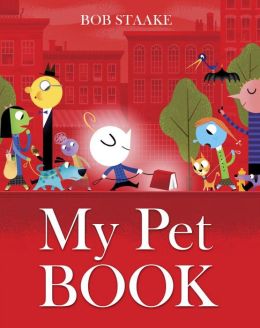
My Pet Book. Bob Staake. 2014. Random House. 40 pages. [Source: Review copy]

Most pets, you know, are cats and dogs. Go out and take a look. But there's a boy in Smartytown whose pet is... a little book. 

The boy in this story has a book for a pet. It's not that his parents wouldn't allow a cat or a dog, but, that this boy really wanted a pet book. The premise is quirky and not without potential. For some readers, this one may prove completely charming. 

My problem with the Pet Book was not the premise. I found the rhythm and rhyme to be a bit off or unnatural. The rhyming just didn't work for me. And it felt like it was the need to rhyme that was driving the book, the story. For example when the book "runs away," this is the rhyme we're "treated" to:
"He ran away! He ran away!" The boy began to bleat. "How could a pet book run away without a pair of feet?" 
It continues, 
The maid could hear the crying boy. (That sound was such a rarity.) "I think I know what happened..." (gulp) "I gave your book to...charity."
Text: 2 out of 5
Illustrations: 2 out of 5
Total: 4 out of 5

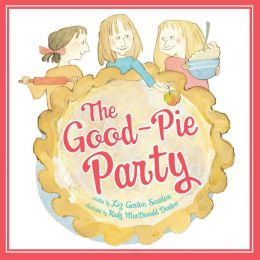
The Good-Pie Party. Elizabeth Garton Scanlon. Illustrated by Kady MacDonald Denton. 2014. Scholastic. 32 pages. [Source: Review copy]

Posy Peyton doesn't want to move. 

Posy Peyton may not want to move, but, Posy Peyton really doesn't have a choice in the matter. What she does have a choice in perhaps is how to handle it, how to cope with it. And one of the ways she does handle it is by baking in the kitchen with her friends. (The kitchen is the only room in the house that hasn't been boxed up...yet.) What she discovers is that GOOD PIE is better than saying good bye. And so inspiration comes, they throw a good-pie party and invite their friends and neighbors. Everyone is to bring a pie....

I liked this one.

Text: 3 out of 5
Illustrations: 3 out of 5
Total: 6 out of 10

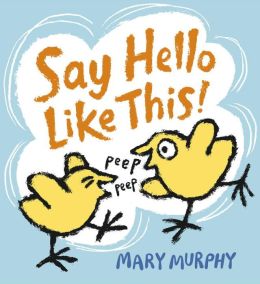
Say Hello Like This! Mary Murphy. Candlewick. 32 pages. [Source: Review copy]

A dog hello is licky and loud...like this!
bow-wow-wow-wow!
A cat hello is prissy and proud...like this!
purrrrrr...meow

Say Hello Like This! is a fun, playful book to read aloud to little ones. It is all about the animal sounds! It is also rich in descriptive words. (licky, loud, prissy, proud, silly, happy, tiny, tappy, etc.)

I would recommend this one as a read aloud. I love the bright illustrations.

Text: 4 out of 5
Illustrations: 4 out of 5
Total: 8 out of 10

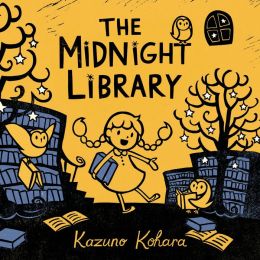
The Midnight Library. Kazuno Kohara. 2014. Roaring Brook. 32 pages. [Source: Library]

Once there was a library that opened only at night. A little librarian worked there with her three assistant owls. Every night, animals came to the library from all over the town. And the little librarian and her three assistant owls helped each and every one find a perfect book. 

I really, really liked this one. I still don't know what it is about it that I do like so very much. If it is the illustrations. If it is the premise. But there is just something magical about this one for me. I find myself mesmerized by the illustrations. Most picture books are after all illustrated in more than three colors. (Midnight Library is all black, blue, and yellow.) They are simple too. Yet I find myself spending time looking at the illustrations carefully. I find the story charming. My favorite part? Well, I guess that would be when the little librarian insists that the tortoise gets a library card. The image of him with the book on his back, it just makes me smile!

Text: 4 out of 5
Illustrations: 5 out of 5
Total: 9 out of 10

© 2014 SukaYuka.com of SukaYuka's Book Reviews
Sunday, September 7, 2014

Nine 2014 Picture Books

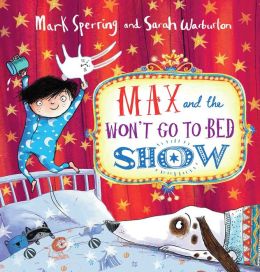
Max and the Won't Go To Bed Show. Mark Sperring. Illustrated by Sarah Warburton. 2014. Scholastic. 32 pages. [Source: Review copy]

Ladies and gentlemen! Boys and girls! Hurry, hurry, for the BEST SHOW ON EARTH! Tonight for your entertainment and delight, we proudly present, from all the way behind the curtain, the world's youngest magician. Please put your hands together for... MAX THE MAGNIFICENT. 
DRUMROLL, PLEASE!
Tonight we will see his world-famous and death-defying PUTTING OFF BEDTIME FOR AS LONG AS POSSIBLE SHOW!
For his first trick...

 Max and the Won't Go To Bed Show is a delightful picture book. The hero, Max, who is not tired and does not want to go to bed--at least not yet--is putting on a show for his family. The show also involves the family dog, Brian. Brian, well, he's not quite as magnificent as Max himself. The text is lively and clever. I love the descriptive language and the playfulness of it. It is a bit over-the-top, but, in a good way. For example,
And now prepare to be SHOCKED and AMAZED. You are about to witness the seldom seen FLOATING PAJAMA TRICK. Max will cause his pajamas to float off the chair and across the room. And, perhaps the most difficult part of all, he'll attempt to put them on. Audience, be warned, this trick can take up to half an hour to perform...though, luckily, not tonight. 
I also love the illustrations. I do. I loved Max's expressions. Overall, this one is oh-so-easy to recommend. (This one was originally published in the UK.)

Text: 5 out 5
Illustrations: 5 out of 5
Total: 10 out of 10

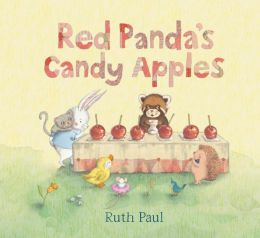
Red Panda's Candy Apples. Ruth Paul. 2014. Candlewick. 32 pages. [Source: Review copy]

Red Panda is selling candy apples. He made them himself. They are delicious and very sticky. Rabbit is his first customer. He gives Red Panda some money. Red Panda counts the coins and puts them in a jar. But Red Panda is sad to give Rabbit the candy apple. He is not very good at selling things he would like to eat himself. Lick. Crackle. Crunch.

I love this book. I do. I love the character of Red Panda. I could sympathize with his dilemma. On the one hand, he has made the apples to sell, and he is making money. On the other hand: Lick, crackle, crunch. He has to watch his customers eating "his" candy apples. I loved this one cover to cover. The text has a just-right feel to it. Not too wordy, not too sparse.

I love the illustrations. They are quaint but not cutesy. I love the subdued colors. I definitely recommend this one. I agree that this book may now wow everyone. (It's not a call-attention-to-myself book like, for example, Max and the Won't Go To Bed Show.) But what picture book ever does, really? (This one was originally published in New Zealand.)

Text: 5 out of 5
Illustrations: 4 out of 5
Total: 9 out of 10

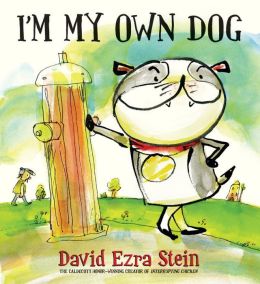
I'm My Own Dog. David Ezra Stein. 2014. Candlewick. 32 pages. [Source: Review copy]

I'm my own dog. Nobody owns me. I own myself. I work like a dog all day. When I get home, I fetch my own slippers. I curl up at my own feet. Sometimes, if I'm not comfortable, I tell myself to roll over. And I do.

What a fun book! I'm My Own Dog is a funny, playful book about a dog and his pet human who follows him home one day. The first half of the book establishes his independence, and the second half focuses on his new relationship. The book ends with a sweet confession.
As I said, it's fun, playful, and a good read-aloud choice. Especially for dog-lovers. I found the text to be quite clever.

Text: 5 out of 5
Illustrations: 4 out 5
Total: 9 out of 10

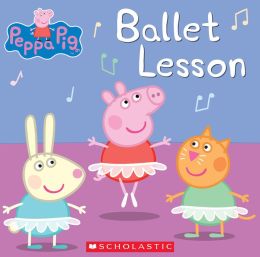
Peppa Pig Ballet Lesson. Adapted by Elizabeth Schaefer. 2014. Scholastic. 24 pages. [Source: Review copy]

Mummy Pig is taking Peppa to her first ballet lesson. Madame Gazelle greets them at the door. "You must be young Peppa," she says with a graceful bow.

I love Peppa Pig. I do. That being said, some Peppa Pig books are better than others. Some seem to capture the magic of the show in book-form better than others. I thought the Ballet Lesson worked well. It captures the playfulness of the episode well. I liked all the thumping. I liked how Mummy Pig and Daddy Pig just happen to have been quite good at ballet back in the day.

For fans of the show, this book is a good read aloud choice. It is also an affordable choice.

Text: 3 out of 5
Illustrations: 3 out of 5
Total: 6 out of 10

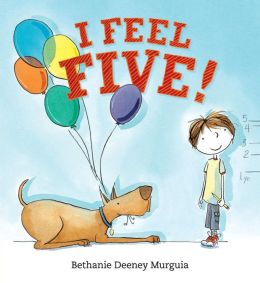
I Feel Five. Bethanie Deeney Murguia. Candlewick. 32 pages. [Source: Review copy]

On his fourth birthday, Fritz Newton ate birthday pancakes, got his very own cape, and picked apples for birthday pie. Being four was fun, but tomorrow...Fritz will be five! And he is quite sure that five will feel very different. He'll probably even lose his first tooth.

 Will Fritz wake up FEELING five on his birthday? Will being five really feel differently than being four? Fritz thinks so. At least in the beginning. He has this idea in his mind of what it will be like to be five, what it will feel like. Ultimately, he's disappointed for most of the book. What he does day-to-day at five is essentially the same as what he did day-to-day when he was four. There does come a point in the book where Fritz does start feeling five. This happens when he helps a girl. He helps her by picking an apple for her from the tree. Something he can do--just barely--by jumping in his brand-new shoes.

I Feel Five! is an almost book for me. The premise makes sense, in a way; people of all ages can have high expectations of BIG birthdays and be a little disappointed at the sameness. And it does handle the concept of disappointment relatively well. It is a thoughtful book. But it isn't exactly a happy again-again read-aloud. It's not funny or playful or sweet.

Text: 3 out of 5
Illustrations: 3 out of 5
Total: 6 out of 10

Go To Sleep, Little Farm. Mary Lyn Ray. Illustrated by Christopher Silas Neal. 2014. Houghton Mifflin Harcourt. 40 pages. [Source: Review copy]

Somewhere a bee makes a bed in a rose,
because the bee knows day has come to a close.
Somewhere a beaver weaves a bed in a bog. 
Somewhere a bear finds a bed in a log.
Somewhere gray mice hide their bed under roots,
safe from the owl who whoo-whoo-hoots.

Well. It has at least one starred review. (Publishers Weekly) But. This bedtime book didn't quite work for me. Not that it was awful. It wasn't. It leans more towards poetry than most picture books. For better or worse. Some lines, some rhymes seem to work well. Take the opening line, for example, "Somewhere a bee makes a bed in a rose, because the bee knows day has come to a close." This book is all about imagery and language and the sounds of words--being lulling. If a lulling bedtime book works, works dependably to send little ones to sleep quickly, or, efficiently then that has some value especially to parents.

The reason this one doesn't quite work for me is because some of the imagery is a bit too bizarre or whimsical...for me. It doesn't start out that way. It really doesn't. So the whimsy sneaks up on a reader. Is that good? Is that bad? Who can say! I'll show you what I mean, "Now little fish lie still in a brook. Somewhere a story goes to sleep in a book. Somewhere a worm sleeps in the dirt. Somewhere a pocket sleeps in a skirt."

The illustrations. Well. Some spreads I do love. Others seem--at least at first glance--even more bizarre than the text itself. They do match the whimsical, surreal tone of the text. So if you love one, you'll probably love the other.

Text: 3 out of 5
Illustrations: 3 out of 5
Total: 6 out of 10

The Scarecrows' Wedding. Julia Donaldson. Illustrated by Axel Scheffler. 2014. Scholastic. 32 pages. [Source: Review copy]

Betty O'Barley and Harry O'Hay were scarecrows. (They scared lots of crows every day.) Harry loved Betty, and Betty loved Harry. So Harry said, "Betty, my beauty, let's marry! Let's have a wedding, the best wedding yet. A wedding that no one will ever forget." Betty agreed, so they hugged and they kissed. Then Betty said, "Harry, dear, let's make a list." "Just as you say," answered Harry O'Hay. So they wrote down the Things they would Need on the Day: a dress of white feathers, a necklace of shells, lots of pink flowers, two rings and some bells. Then Harry gave Betty O'Barley his arm and the scarecrows set off on a hunt round the farm.

It's certainly an interesting story with a couple of unique elements. I had no idea what to expect, and, it certainly ended up surprising me here and there. Which I guess is a good thing? The first half of this book is focused on Betty and Harry being together and looking for all the things on their list. The trouble occurs when the two go their separate ways. Just one item remains on their list. Harry wants to get it himself. But. Harry is slow, very, very, very, very slow. So slow in fact that the farmer presumably gets another scarecrow to replace him! His name is Reginald Rake. Almost everything that occurs after his arrival is a bit bizarre. (I wasn't expecting cigars in a picture book! I actually found that plot twist a bit disturbing.) It is still plenty predictable though by the end. I'm not quite sure how this book was both predictable and surprising, but, it was.

(This one was originally published in the UK.)

Text: 2.5 out of 5
Illustrations: 3 out of 5
Total: 5.5 out of 10

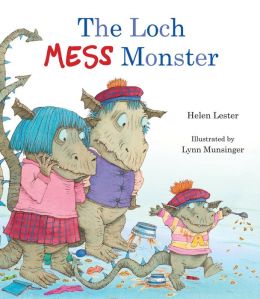
The Loch Mess Monster. Helen Lester. Illustrated by Lynn Munsinger. 2014. Houghton Mifflin Harcourt. 32 pages. [Source: Review copy]

In faraway Scotland there was a famous lake called Loch Ness. And legend had it that deep in this lake lived a monster. No one had ever seen it. But guess what? The legend was false. In truth, way, way, down at the bottom of Loch Ness there lived not one...but three monsters! there was Nessie, her husband, Fergus, and their wee laddie, Angus.

The Loch Mess Monster has a glossary of Scottish terms (in order of appearance) before the story. It is needed. Trust me. Unless you happen to know that hummie-doddies are mittens or that puggy-nits are peanuts. The story will make more sense if you familiarize yourself with the vocabulary!

The Loch Mess Monster is a book about being messy, too messy. It is a book about how one should clean up after himself, to put things back where they belong. Angus is the mess-maker. His messy room is out of control. Some of his mess belongs in the trash. It's simply disgusting. Some of his mess are his own books and toys. Until he sees for himself the dangers of being TOO messy, the problem just keeps growing worse.

The book is obviously a lesson book. For better or worse. This one is not my favorite on the subject. But it's a nice book. This one will appeal especially to storytellers who like to do accents or try to do accents.

Text: 3 out of 5
Illustrations: 2.5 out of 5
Total: 5.5 out of 10

Big Bad Bubble. Adam Rubin. Illustrated by Daniel Salmieri. 2014. Houghton Mifflin Harcourt. 40 pages. [Source: Review copy]

You may not know this, but when a bubble pops, it doesn't just disappear. It reappears in La La Land...where the monsters live. For some reason, all the big, scary monsters are terrified of bubbles. Froofle, why are you running away? Yerburt, what's the matter? Wumpus, stop crying. (Tell Wumpus to stop crying.)

What you see is what you get. For the most part. In my opinion, if a book is going to be strange and bizarre, it's best to know that from the start, preferably from the cover. Monsters and bubbles. That's what readers are promised. Now. Are the bubbles big and bad?! Well, that's a matter of perspective. Readers expect monsters to be big and bad, but, bubbles?

The premise of this one is silly but simple. Monsters live in La La Land. Monsters are scared of bubbles. Bubbles disappear from here--when they're popped--to La La Land. Therefore monsters spend a lot of their summers terrified by bubbles. The narrator (and the reader) try to talk some sense into the monsters. Bubbles are not scary. Bubbles can be easily popped. Especially by monsters. There is no reason to run away from a bubble. Will the narrator successfully help the monsters?

It's silly. It's weird. It's certainly unique. It probably won't be for everyone. It seems like a book people will either love or hate. It was better than I expected. However, I wasn't expecting much.

Text: 4 out of 5
Illustrations: 2 out of 5
Total: 6 out of 10

© 2014 SukaYuka.com of SukaYuka's Book Reviews