Showing posts with label books reread in 2015. Show all posts

Sunday, January 11, 2015

Millions of Cats (1928)

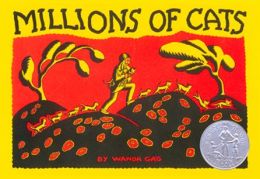
Millions of Cats. Wanda Gag. 1928. Penguin. 40 pages. [Source: Library]

Once upon a time there was a very old man and a very old woman. They lived in a nice clean house which had flowers all around it, except where the door was. But they couldn't be happy because they were so very lonely. 
"If we only had a cat!" sighed the very old woman. "A cat?" asked the very old man. "Yes, a sweet little fluffy cat," said the very old woman. "I will get you a cat, my dear," said the very old man.
And he set out over the hills to look for one. 

Millions of Cats is a Newbery Honor book from 1929.

Premise/Plot: A very old man and a very old woman long for a cat. The husband goes on a quest to bring back a "sweet little fluffy cat" to please them both. Is his quest successful? Yes. A little too successful. For in fact he finds
Cats here, cats there,
Cats and kittens everywhere,
Hundreds of cats,
Thousands of cats,
Millions and billions and trillions of cats.
How is he ever to choose just ONE cat from so many?! Especially since as he picks up or pets each one he sees, he finds it to be the prettiest cat. He can't bring himself to leave any of the cats behind. But it isn't practical to bring home hundreds, thousands, millions, billions, and trillions of cats. You can probably guess what his wife's response will be! Surely, they can't keep them all. For better or worse, he lets the cats decide amongst themselves. One scrawny cat remains, but, it may be the best one of all.

My thoughts: I loved this one growing up. I loved the repetition. I thought it was a fun story. I didn't--at the time--take the man's conclusion that the trillions of cats ate each other up literally. Is the book violent? Perhaps. Perhaps not. See for yourself.  "They bit and scratched and clawed each other and made such a great noise that the very old man and the very old woman ran into the house as fast as they could. They did not like such quarreling." This one might pair well with Eugene Field's "The Duel." (The gingham dog and the calico cat).

Have you read Millions of Cats? Did you like it? love it? hate it?

© 2015 SukaYuka.com of SukaYuka's Book Reviews

Revisiting The Trumpeter of Krakow (1928)

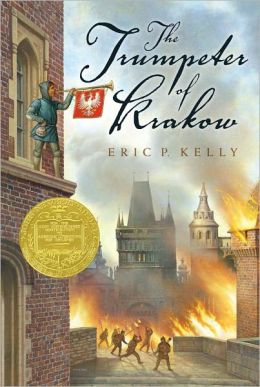
The Trumpeter of Krakow. Eric P. Kelly. 1928. Simon & Schuster. 208 pages. [Source: Library]

It was in late July of the year 1461 that the sun rose one morning red and fiery as if ushering in midsummer's hottest day. His rays fell upon the old city of Krakow and the roads leading up to it, along which rolled and rocked a very caravan of peasants' wagons. 

In the summer of 2011, I read and reviewed Eric P. Kelly's The Trumpeter of Krakow. I remember really enjoying it though I found it plot-driven instead of character driven. Because I had good memories of reading it, I thought I would reread it for Hope Is the Word's Newbery Through the Decades. Unfortunately, I didn't end up enjoying it as much as I did the first time.

I'm not sure if this was because I wasn't in the right mood for this one. Or if it was because since I knew how it ended there just wasn't enough to keep me reading.

The first time I read it: action, mystery, suspense, what will happen next?!

The second time I read it: this is boring, so boring, when will I get to the good part?

I was surprised by my own reaction this time since in my review, I wrote "There is never a dull moment in The Trumpeter of Krakow" and "The novel is exciting."
 

© 2015 SukaYuka.com of SukaYuka's Book Reviews
Saturday, January 10, 2015

Seuss on Saturday #2

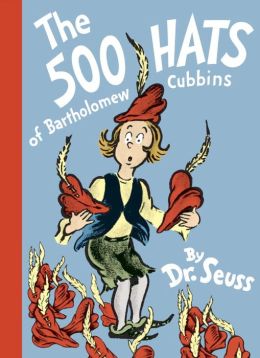
The 500 Hats of Bartholomew Cubbins. 1938/1965. Random House. 56 pages. [Source: Library]

First sentence:
 In the beginning, Bartholomew Cubbins didn't have five hundred hats. He had only one hat. It was an old one that had belonged to his father and his father's father before him. It was probably the oldest and the plainest hat in the whole Kingdom of Didd, where Bartholomew Cubbins lived.
Premise/plot. Bartholomew Cubbins gets into big, big trouble when he "refuses" to remove his hat in the presence of the king. The king gets more and more flustered as he sees the "insolence" of Bartholomew. To Bartholomew's credit, he is trying very hard to remove his hat. But every time he removes a hat, another appears on his head. What is going on?! What will the king do?!

My thoughts: I have only read this one twice. It definitely has more text than And To Think That I Saw it On Mulberry Street. And it also is written in prose. It does not rhyme. The story is just as over-the-top as And To Think That I Saw It On Mulberry Street, but it definitely has a different feel to it. According to Wikipedia, it was received well by reviewers. What did I think? Well, it was silly. I think the key to enjoying it is in focusing on the king and his reaction to the "problem." Seeing the king and those close to him try to solve the problem. For example, at one point he calls in seven black-gowned magicians:
Low and slow, they were chanting words that were strange...
"Dig a hole five furlongs deep,
Down to where the night snakes creep,
Mix and mold the mystic mud,
Malber, Balber, Tidder, Tudd."
In came seven black-gowned magicians, and beside each one stalked a lean black cat. They circled around Bartholomew Cubbins muttering deep and mysterious sounds.
It's never fun to be frustrated yourself. But the king's frustration proves comical. There are no real questions answered in this one.  But the ending proves satisfying enough.

Have you read The 500 Hats of Barthomew Cubbins? Did you like it? love it? hate it? What age do you think it works best for?

If you'd like to join me in reading or rereading Dr. Seuss' picture books (chronologically) I'd love to have you join me! The next book I'll be reviewing is The King's Stilts.


© 2015 SukaYuka.com of SukaYuka's Book Reviews
Saturday, January 3, 2015

Seuss on Saturday #1

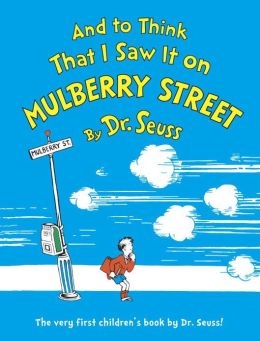
And to Think That I Saw It On Mulberry Street. Dr. Seuss. 1937/1964. Random House. 40 pages. [Source: Library]

First sentence:
When I leave home to walk to school, Dad always says to me, "Marco, keep your eyelids up and see what you can see."
Premise/Plot: While Marco is on his way home, he plans what to say to his father when he asks what he's seen. Marco really sees just a horse and wagon. But what he imagines he sees, well, it gets outlandish. What will he end up telling his father? a pack of lies? or the truth?

My thoughts: It's been years since I read this one. And it is a bit dated when you think about it. For example, as Marco gets carried away with his story, he imagines a reindeer pulling a sled. But he stops himself by adding,
Say--anyone could think of that,
Jack or Fred or Joe or Nat--
Say, even Jane could think of that.
Also of note, it includes a "Chinese man who eats with sticks..." and the illustration of course is not ideal. I'm not mentioning these things to say that the book is "bad" and doesn't belong in your child's library. Just noting that times have changed quite a bit since 1937!!!

Overall, I'd say I liked this one. Didn't necessarily "love" it. But I like it. How many picture books from the 1930s are still in print?! Well, I suppose there's The Story of Ferdinand, Mike Mulligan and His Steam Shovel, Madeline, and The Story of Babar. There may be others as well.

Have you read And To Think I Saw It On Mulberry Street? Did you like it? love it? hate it? I'd love to know what you think of it!

If you'd like to join me in reading or rereading Dr. Seuss' picture books (chronologically) I'd love to have you join me! The next book I'll be reviewing is The 500 Hats of Bartholomew Cubbins.

© 2015 SukaYuka.com of SukaYuka's Book Reviews