Showing posts with label books reviewed in 2015. Show all posts

Tuesday, January 13, 2015

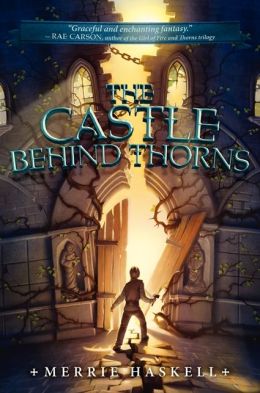
The Castle Behind Thorns (2014)

The Castle Behind Thorns. Merrie Haskell. 2014. HarperCollins. 336 pages. [Source: Library]

Sand woke, curled in the ashes of a great fireplace. Surprised to find himself waking at all, for he had no memory of falling asleep, Sand scrambled to his feet. Soot billowed from him in a cloud and sneaked up his nose. He sneezed four great sneezes that came back in lonely echoes from the vast room beyond the fireplace. Sand had never slept in a fireplace before. He never wanted to again. But he hesitated inside the fireplace, one foot suspended in midair, afraid to leave. In the room beyond, everything was broken. Every single thing.

I loved, loved, loved The Castle Behind Thorns. It is a retelling of Sleeping Beauty, I suppose. It puts a definite spin on it that is completely different from the original, but that is completely fascinating. Sand, the hero, wakes up in a fireplace in a castle that he's only heard stories about. The castle being abandoned quite suddenly when his own father was not yet grown. He finds himself very alone; he's the only living thing in the castle. (No growing plants, no bugs or insects, no birds, no mice, nothing). He keeps the panic to a minimum, in my opinion. Especially considering the situation! He's in an abandoned castle surrounded by hostile, vicious thorns. He explores. He plans. He mends. He learns and adapts. He's hungry and thirsty and tired. He finds a way to survive. In his exploring, he finds the family's crypt. He restores a body that had fallen, placing the young girl's body back gently and carefully.  Several days later, or some time later, readers meet the heroine Perrotte...

The Castle Behind Thorns is a beautiful story with memorable, well-developed characters. I enjoyed every minute of this one! The mystery is quite good! I would definitely recommend this one!

Read the Castle Behind Thorns
  • If you enjoy fairy tale retellings
  • If you enjoy good/great storytelling
  • If you like fantasy novels with a touch of magic
  • If you like mysteries 
  • If you like survival stories

© 2015 SukaYuka.com of SukaYuka's Book Reviews

Monday, January 12, 2015

In The Kingdom of Ice

In the Kingdom of Ice: The Grand and Terrible Polar Voyage of the USS Jeannette. Hampton Sides. 2014. 454 pages. [Source: Library]

I enjoy reading nonfiction. I do. The topic is polar exploration--the North Pole to be precise. (I've read more about the South Pole, by the way.) The good news is that In the Kingdom of Ice: The Grand and Terrible Polar Voyage of the USS Jeannette is fascinating and thorough. It is detailed and focused on personalities and contexts. (Two of the personalities explored are George Washington De Long and James Gordon Bennett, Jr.)

The trip is presented in great detail. Before the trip: how/when De Long became interested in polar exploration, finding financial backers for the trip, finding THE ship, finding men to go with him, finding resources and materials, doing the research, picking and choosing what research to rely on, planning and organizing, etc. During the trip: before the Jeannette got trapped in ice--what it was like on a day-to-day, week-to-week basis, the dangers, the joys, etc., trapped in the ice on ship--what it was like to spend YEARS (I believe almost two years?) on a ship that's trapped in the ice, what it was like to be stuck with the same people in such close quarters for those years, trapped ON the ice with NO ship--what it was like in the final months as thirty-something men with limited provisions and supplies, men not in the best health, fought to survive and reach land and civilization. After the trip: what it was like for the survivors to encounter land and civilization again, who survived, etc.

Most everything is given context and brought to life. That being said, it doesn't mean every person is likable!

I enjoyed reading this one. I found it to be a quick read--just a day or two at most.

© 2015 SukaYuka.com of SukaYuka's Book Reviews

Sunday, January 11, 2015

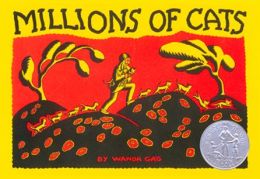
Millions of Cats (1928)

Millions of Cats. Wanda Gag. 1928. Penguin. 40 pages. [Source: Library]

Once upon a time there was a very old man and a very old woman. They lived in a nice clean house which had flowers all around it, except where the door was. But they couldn't be happy because they were so very lonely. 
"If we only had a cat!" sighed the very old woman. "A cat?" asked the very old man. "Yes, a sweet little fluffy cat," said the very old woman. "I will get you a cat, my dear," said the very old man.
And he set out over the hills to look for one. 

Millions of Cats is a Newbery Honor book from 1929.

Premise/Plot: A very old man and a very old woman long for a cat. The husband goes on a quest to bring back a "sweet little fluffy cat" to please them both. Is his quest successful? Yes. A little too successful. For in fact he finds
Cats here, cats there,
Cats and kittens everywhere,
Hundreds of cats,
Thousands of cats,
Millions and billions and trillions of cats.
How is he ever to choose just ONE cat from so many?! Especially since as he picks up or pets each one he sees, he finds it to be the prettiest cat. He can't bring himself to leave any of the cats behind. But it isn't practical to bring home hundreds, thousands, millions, billions, and trillions of cats. You can probably guess what his wife's response will be! Surely, they can't keep them all. For better or worse, he lets the cats decide amongst themselves. One scrawny cat remains, but, it may be the best one of all.

My thoughts: I loved this one growing up. I loved the repetition. I thought it was a fun story. I didn't--at the time--take the man's conclusion that the trillions of cats ate each other up literally. Is the book violent? Perhaps. Perhaps not. See for yourself.  "They bit and scratched and clawed each other and made such a great noise that the very old man and the very old woman ran into the house as fast as they could. They did not like such quarreling." This one might pair well with Eugene Field's "The Duel." (The gingham dog and the calico cat).

Have you read Millions of Cats? Did you like it? love it? hate it?

© 2015 SukaYuka.com of SukaYuka's Book Reviews

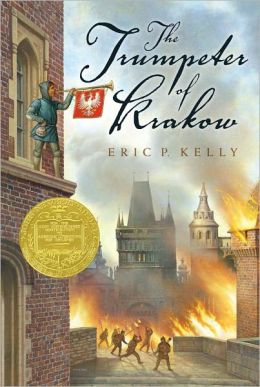
Revisiting The Trumpeter of Krakow (1928)

The Trumpeter of Krakow. Eric P. Kelly. 1928. Simon & Schuster. 208 pages. [Source: Library]

It was in late July of the year 1461 that the sun rose one morning red and fiery as if ushering in midsummer's hottest day. His rays fell upon the old city of Krakow and the roads leading up to it, along which rolled and rocked a very caravan of peasants' wagons. 

In the summer of 2011, I read and reviewed Eric P. Kelly's The Trumpeter of Krakow. I remember really enjoying it though I found it plot-driven instead of character driven. Because I had good memories of reading it, I thought I would reread it for Hope Is the Word's Newbery Through the Decades. Unfortunately, I didn't end up enjoying it as much as I did the first time.

I'm not sure if this was because I wasn't in the right mood for this one. Or if it was because since I knew how it ended there just wasn't enough to keep me reading.

The first time I read it: action, mystery, suspense, what will happen next?!

The second time I read it: this is boring, so boring, when will I get to the good part?

I was surprised by my own reaction this time since in my review, I wrote "There is never a dull moment in The Trumpeter of Krakow" and "The novel is exciting."
 

© 2015 SukaYuka.com of SukaYuka's Book Reviews

Saturday, January 10, 2015

Seuss on Saturday #2

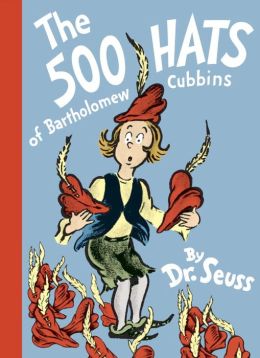
The 500 Hats of Bartholomew Cubbins. 1938/1965. Random House. 56 pages. [Source: Library]

First sentence:
 In the beginning, Bartholomew Cubbins didn't have five hundred hats. He had only one hat. It was an old one that had belonged to his father and his father's father before him. It was probably the oldest and the plainest hat in the whole Kingdom of Didd, where Bartholomew Cubbins lived.
Premise/plot. Bartholomew Cubbins gets into big, big trouble when he "refuses" to remove his hat in the presence of the king. The king gets more and more flustered as he sees the "insolence" of Bartholomew. To Bartholomew's credit, he is trying very hard to remove his hat. But every time he removes a hat, another appears on his head. What is going on?! What will the king do?!

My thoughts: I have only read this one twice. It definitely has more text than And To Think That I Saw it On Mulberry Street. And it also is written in prose. It does not rhyme. The story is just as over-the-top as And To Think That I Saw It On Mulberry Street, but it definitely has a different feel to it. According to Wikipedia, it was received well by reviewers. What did I think? Well, it was silly. I think the key to enjoying it is in focusing on the king and his reaction to the "problem." Seeing the king and those close to him try to solve the problem. For example, at one point he calls in seven black-gowned magicians:
Low and slow, they were chanting words that were strange...
"Dig a hole five furlongs deep,
Down to where the night snakes creep,
Mix and mold the mystic mud,
Malber, Balber, Tidder, Tudd."
In came seven black-gowned magicians, and beside each one stalked a lean black cat. They circled around Bartholomew Cubbins muttering deep and mysterious sounds.
It's never fun to be frustrated yourself. But the king's frustration proves comical. There are no real questions answered in this one.  But the ending proves satisfying enough.

Have you read The 500 Hats of Barthomew Cubbins? Did you like it? love it? hate it? What age do you think it works best for?

If you'd like to join me in reading or rereading Dr. Seuss' picture books (chronologically) I'd love to have you join me! The next book I'll be reviewing is The King's Stilts.


© 2015 SukaYuka.com of SukaYuka's Book Reviews

Glamourpuss (2015)

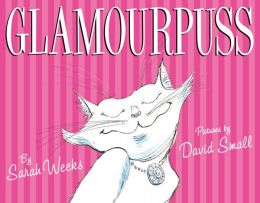
Glamourpuss. Sarah Weeks. Illustrated by David Small. 2015. [January 2015] Scholastic. 40 pages. [Source: Review copy]

First sentence: Once upon a pillow sat a glamorous cat named Glamourpuss. Glamourpuss lived with Mr. and Mrs. Highhorsen in a giant amnion on the top of a hill where they were waited on hand and foot by a pair of devoted servants named Gustav and Rosalie.

I enjoyed reading Sarah Weeks' Glamourpuss. I thought it was a charming picture book about a fabulous cat who was sometimes selfish and sometimes sweet. Glamourpuss, the star of the book, does not like it when Eugenia and Bluebelle come to visit Mr. and Mrs. Highhorsen, her owners. She finds Bluebelle and her many costumes ridiculous. But to her surprise, all the adults seem to find Bluebelle precious and wonderful and even glamorous. Shocking! Can't they tell the difference between tacky and refined?! When Glamourpuss realizes that Bluebelle actually HATES wearing clothes and performing tricks, the two bond. Glamourpuss gives her real lessons on how to behave, how to take her bow-wow to WOW, just as Glamourpuss has taken her meow to ME.

I found the story cute and charming. But I think it was the illustrations that really persuaded me that this story was wonderful. I loved the many expressions of Glamourpuss. I did. David Small did a great job of capturing this cat's magnificent personality. I think some of my favorite illustrations were when she is teaching Bluebelle how to be more refined.

Definitely recommended for cat lovers!

Text: 4 out of 5
Illustrations: 5 out of 5
Total: 9 out of 10

© 2015 SukaYuka.com of SukaYuka's Book Reviews

Friday, January 9, 2015

The Question of Miracles (2015)

The Question of Miracles. Elana K. Arnold. 2015. HMH. 240 pages. [Source: Review copy]


Iris Abernathy has recently moved to Oregon, and she HATES it. Her parents are sympathetic and supportive. (Iris visits a counselor, Dr. Shannon, somewhat regularly. Not because of her angst about the move, but, for other issues.) Iris misses her old life and her old friends. Most particularly she misses her friend Sarah. Part of Iris thinks it would be impossible to ever be happy here,  to ever have another best friend. But this "impossibility" is challenged a bit in The Question of Miracles.

There were a few things that I liked about The Question of Miracles. I liked Iris's new friend, Boris. I liked the slow-and-steady progression of their friendship. I liked getting to know him. I think he was good for Iris. And I think Iris was good for him. I like how their friendship made them both stronger as individuals.

I also liked the families within the novel. I liked getting to know Iris' family and Boris' family. Overall, characterization of even minor characters was well done.

The Question of Miracles is at the very least a sad novel, perhaps a dark one. (By dark, I don't mean as dark as it could possibly be and without any hope or redemption.) How do you move on after losing a best friend? after witnessing her die in the parking lot? Life does go on, but, it feels like it can't, like it shouldn't. The Question of Miracles is about Iris' life after a big loss.

The Question of Miracles is one girl's quest for the answer to all her why questions. Does Iris get her answers? Adults are probably not surprised that she doesn't--not really. But she does come to accept her loss and begin living life again.

I didn't like everything about this one. There were a few things that bothered me--mainly bothered me as a Christian--things that may not bother other readers. (For example, her seeking out a psychic and trying to communicate with her friend's spirit.)

© 2015 SukaYuka.com of SukaYuka's Book Reviews

Thursday, January 8, 2015

Audacity (2015)

Audacity. Melanie Crowder. 2015. Penguin. 400 pages. [Source: Review copy]

I loved Melanie Crowder's Audacity. It was a fascinating read focusing on the life and work of Clara Lemlich. It would pair well with Margaret Peterson Haddix's Uprising and Katherine Paterson's Bread and Roses, Too. Also Margarita Engle's The Lightning Dreamer and Andrea Davis Pinkney's The Red Pencil.

What did I love most about Audacity? I loved, loved, loved Clara herself. I loved her strength, her determination, her ambition, her loyalty, her persistence. Whether in Russia or America, Clara dreamed of one thing above all others: getting an education and making something of herself. She wanted to be able to read and write. She wanted to be able to think and form her own opinions and express them. She was raised in an environment, a community, where education was ONLY for men, the message that was reinforced over and over again (not specifically by her parents, but by the community) was that equated a woman going to school and learning with a prostitute. An educated woman brought shame to her family. It wasn't just that it was pushed aside or made a low priority. It was discouraged and forbidden. Clara wanted a voice of her own, and she wanted to be heard. There were many intense places in Audacity. Some within the Russia setting. Some within America. Some within her own home. Some outside the home. Audacity isn't a light-hearted read.

The novel opens with Clara and her family in Russia at the turn of the twentieth century. After facing persecution--the Jewish community within Russia facing brutal persecution--her family emigrated to America. The focus remains on Clara: her dreams and her reality. For example, while her father and brothers stay home to be scholars, she works seven days a week in a mill. The conditions under which she works, under which all the women work, were horrible. She gives her paycheck to her family faithfully, dutifully. But not without some regret. Why must she be the one working so hard while others take it easy?! Much of the book focuses on her struggle: her struggle to hold onto her dreams, her struggle to hold onto dignity, her fight for right, to see justice done.

Audacity is a novel written in verse. It was powerful and compelling. The verse worked for me. It just wowed me in places! This fascinating book is easy to recommend. It's an emotional read, but oh so worth it!

© 2015 SukaYuka.com of SukaYuka's Book Reviews

Wednesday, January 7, 2015

The Girl with the White Flag

The Girl With The White Flag. Tomiko Higa. Translated by Dorothy Britton. 1989. 130 pages. [Source: Bought]

The Girl with the White Flag is the story of the author's childhood in war-time Japan. It begins by giving the reader ample background into the time and culture and place.

One of the first events she shares with readers is the death of her mother. She then relates what life was like with her father, two older sisters, and her older brother. This portion is hard to navigate. I think in some ways it is just as hard for modern readers to understand the family life--the harshness, the strictness, the discipline, as it is to understand the monstrosities of war and soldiers and starvation. (Or maybe that's just my take on it.)

About halfway through the narrative, the father disappears. He was on his somewhat routine mission of delivering food to the Japanese soldiers, but on this occasion he never returned home. The four children are left to fend for themselves. The American soldiers have just begun their invasion, their battle to capture this island. The children become refugees and the fight to survive has begun. The children ranged in age from 17 to 6. Somewhere along the way, however, two things happen--big things--that make this event even scarier: 1) Their brother dies one night from a stray bullet. 2) Within a few days of burying their brother, our narrator--the six/seven year old girl becomes lost--separated--from her sisters.

The book recounts what it was like to be seven and alone and wandering in and out of danger. There was no safe place. Not really. Japanese soldiers weren't "safe." In fact, in her brief encounters with them she was almost killed. No, being near soldiers wasn't safe. The only "safe" soldier was a dead soldier. She did in fact scavenge around the dead soldiers looking for food.

Her will to survive was strong. Her stamina incredible in my opinion. The sights. The sounds. The smells. All surrounded her. Could have potentially traumatized her and paralyzed her into inaction.

If there is power in the Girl with The White Flag it is in its rawness, its simplicity, its boldness when it comes to being straightforward and honest. The story is incredible is powerful because it's true. Here is an eyewitness account of what it means to be seven and a refugee in a war zone. It can be brutal. It can be intense. But there is more to it than that.

I found The Girl with The White Flag to be an incredibly compelling read, a must-read for adults.

© 2015 SukaYuka.com of SukaYuka's Book Reviews

Tuesday, January 6, 2015

It's The End of the World As We Know It (2015)

It's The End of the World As We Know It. Saci Lloyd. 2015. Hachette Books. 288 pages. [Source: Review copy]

Did I like Saci Lloyd's It's The End of the World As We Know It? Not really. The book is described as surreal and hilarious. And. For some readers, I suppose it might read enough like Douglas Adams to pass as a good read. But overall, I was irritated and frustrated.

The book is science fiction and deals with alternate universes and wormholes. The particular alternate universe readers will experience in the book was created mostly by accident. The mad scientist, Xenron Deva, meant to do something, no doubt, but a strand of hair, leads to complete nonsense in the world he did create. The Deva Corporation did not even remain in power long, for at the time, our hero gets sent there by accident, the world is being managed or mismanaged by KAT. The world is strange and bizarre, which readers might expect and actually prefer. But the differences in spelling, in particular, drove me crazy.

Mikey Malone is the hero of It's the End of the World As We Know It. While trying to impress a girl, Caitlyn, he fakes interest in internet celebrity-hacker-spy GERILLR. Ultimately, he regrets this I think. Since it is during their time together waiting for GERILLR's program/broadcast that he is sucked into this alternate reality. (So is the parrot, Ubu).

Mikey soon finds himself in a strange, strange place: Silikon Valle. And it takes him a bit to adapt and make friends. (Only a few of his friends have names that are easy to type.) Conflict, the book has plenty of it. Mikey, of course, wants to find out a way to get back to his own reality, his own home. And that won't be easy. For not only is he clueless, he's also being hunted/attacked by bad guys. Teamwork can accomplish plenty, but, no matter how hard one tries, sometimes endings are imperfect.

I found the book annoying and unsatisfying. But you might find it entertaining. Especially if you don't mind endings that aren't proper endings.

© 2015 SukaYuka.com of SukaYuka's Book Reviews

Monday, January 5, 2015

El Deafo (2014)

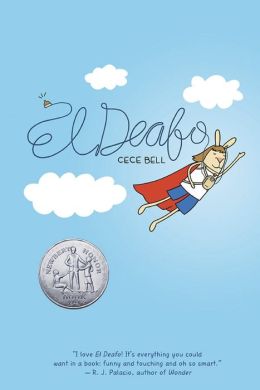
El Deafo. Cece Bell. 2014. Harry N. Abrams. 233 pages. [Source: Library]

I put El Deafo on hold at the library not knowing it was a graphic novel. In a way, I'm glad I didn't know. I don' t read many graphic novels, there are, of course, exceptions to every rule. El Deafo is a coming-of-age memoir in graphic novel format. I loved it. I really loved it. It surprised me in all the right ways.

It begins simply, "I was a regular little kid. I played with my mom's stuff. I watched TV with my big brother, Ashley, and my big sister, Sarah. I rode on the back of my father's bicycle. I found caterpillars with my friend Emma. And I sang. 'We all live in a yellow submarine, a yellow submarine--' But then everything changed." A childhood illness at the age of 4--meningitis--leaves her deaf.

The memoir covers many years of her childhood, from the age of four through her sixth grade year in school. In a way it is about her growing up deaf, growing up different. But in many ways, it is about so much more than that: it's about family and friendship and belonging and struggling to belong. It is about her wanting and needing a 'true' friend. It is about her mishaps in friendships. There are a few untrue friends before there is the one that is true. It is very much about identity: how she sees herself, her struggle to be comfortable with herself, to accept and love herself. Another aspect of El Deafo which I very much enjoyed is Cece's first crush.

In her imagination, she's closer to being there, in that place. She imagines that she is a superhero, El Deafo, the super-hero self stands up for herself to her friends AND her family. Her super-hero self lets others know what she's feeling, when she's mad, when her feelings are hurt, etc. Her superhero self is brave and courageous letting others know that she doesn't need people to talk really loudly or really slowly. Her superhero self lets people know that she hates it when they call her "my deaf friend" or "that deaf kid."

El Deafo is set in the 1970s, I believe. There are plenty of cultural references to place it in that decade. I really enjoyed the scenes where she was watching TV.

So, yes, El Deafo is in my opinion about so much more than growing up deaf. This book is easy to love and oh-so-easy to recommend.

© 2015 SukaYuka.com of SukaYuka's Book Reviews

Sunday, January 4, 2015

Meet Father Christmas

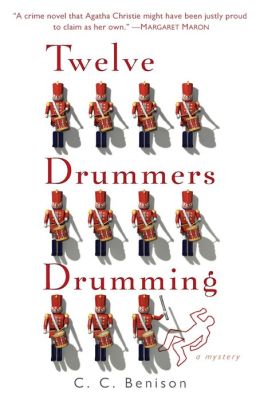
Twelve Drummers Drumming. Father Christmas Mystery #1. C.C. Benison. 2011. Doubleday. 384 pages. [Source: Library]

Twelve Drummers Drumming is the first in the Father Christmas mystery series by C.C. Benison. Tom Christmas, the hero, is a vicar in the village of Thornford Regis. He's a widower with a nine year old daughter, Miranda. Both are still healing and adapting. Tom's wife was murdered. So why settle in Thornford? Tom and his daughter were visiting his sister-in-law and her husband about a year before the novel opens. There was a funeral in the village that day, but, the vicar was missing. Tom Christmas (Father Christmas as people can't help calling him!) stepped in and performed the funeral service. When the position became available, Tom wanted the job for keeps. But village or hamlet life isn't all cozy. There are a few mysteries to be solved. And since Inspector Bliss and Inspector Blessing aren't quick to solve cases, Tom's skills come in handy. Tom is good at observing things, and, it helps that people can't seem to help confiding in him and telling their secrets.

So there are two murders to solve in Twelve Drummers Drumming. I won't say a word about the crimes and the clues. I hate having mysteries spoiled! Just as important as the clues, if not MORE important than the clues are the characters. That I can safely comment on! I really enjoyed the depth of the characters!

Overall, I would say that Twelve Drummers Drumming is an entertaining and satisfying read. I enjoyed spending time with the characters. I would recommend it!

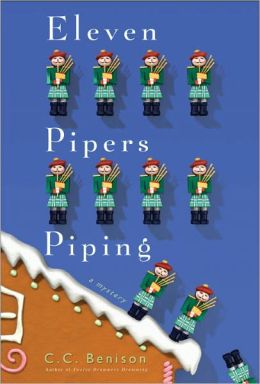
Eleven Piper Piping. Father Christmas Mystery #2. C.C. Benison. 2012. Delacorte. 474 pages. [Source: Library]

I think I enjoyed the second Father Christmas mystery even more than the first. Tom Christmas is the vicar of Thornford Regis. He is also the chaplain to a traditional Scottish pipe band, The Thistle But Mostly Rose South Devon Pipe Band. While Tom's daughter, Miranda, is having a sleepover, and his housekeeper, Madrun, is panicking about a failed yorkshire pudding, Tom Christmas is off--for better or worse--to the Burns Supper. But the weekend is problematic. The horrible weather--the blizzard-like conditions--means that half the band is unable to come, which leaves us with ELEVEN pipers piping. But while half the band is unable to make it through the storm, there is one unexpected guest that shows up at the local hotel where the Burns supper is being held. That guest is Judith Ingley, a retired nurse. Though usually women aren't allowed to attend, they don't turn her away in the storm.

Eleven Pipers Piping IS a murder mystery. So I won't share any details about the crime(s) or victim(s). I will say that the reader gets to spend plenty of time with Father Christmas as he interacts with the whole village before, during, and after the crime. I really enjoyed the setting very much. The characterization didn't disappoint.

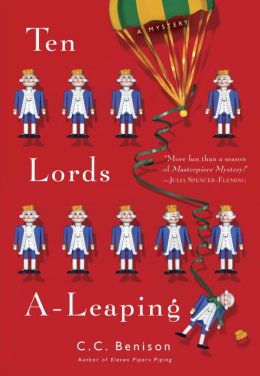
Ten Lords A-Leaping. Father Christmas #3. C.C. Benison. 2013. Delacorte. 512 pages. [Source: Library]

I wish I could give a rating for the first half and a rating for the second half.

Ten Lords A-Leaping is the third book in the Father Christmas series. In Eleven Pipers Piping, Father Christmas brings up a fund raiser idea to help pay for repairs on the church building. It involves sky diving. Ten Lords A-Leaping sees the event through. It is NOT set in Thornford Regis, unfortunately. I think I would have enjoyed it more if it had been.

So. The novel opens with the sky diving. In his jump, Tom has a little accident in the landing with his ankle, an accident that changes his plans and prolongs his visit in that part of the country. He is asked to stay over at Eggescombe Park. First, he's stuck there because of his own injury, then, he's stuck there because of a murder.

I really found myself hating the first half of the book. The series has never been squeaky clean, previous titles in the series have had a few words now and then that keep it from being perfectly clean. Still, it wasn't enough to keep me from reading, from wanting to read on in the series. But Ten Lords A-Leaping turns smutty. And smut in a creepy, inappropriate way. To the book's credit, Tom ends up feeling disgusted by the end of the novel with his own experience. But still.

Even though I really disliked much of the beginning and middle, I kept reading. And the mystery aspects of the novel began to grow on me a bit. I can't say that I "liked" it better than the first two in the series. I can't even say that I "liked" the majority of the characters. There were plenty of despicable characters. I'd say there were more despicable characters than nice ones. But. That is part of the genre, I suppose.

I enjoyed this one enough by the end, but, honestly I was a bit disappointed with this one.
© 2015 SukaYuka.com of SukaYuka's Book Reviews
Saturday, January 3, 2015

Seuss on Saturday #1

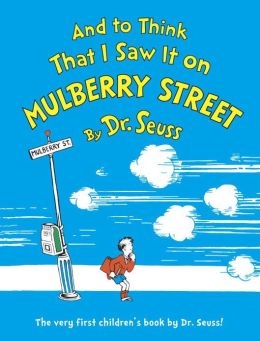
And to Think That I Saw It On Mulberry Street. Dr. Seuss. 1937/1964. Random House. 40 pages. [Source: Library]

First sentence:
When I leave home to walk to school, Dad always says to me, "Marco, keep your eyelids up and see what you can see."
Premise/Plot: While Marco is on his way home, he plans what to say to his father when he asks what he's seen. Marco really sees just a horse and wagon. But what he imagines he sees, well, it gets outlandish. What will he end up telling his father? a pack of lies? or the truth?

My thoughts: It's been years since I read this one. And it is a bit dated when you think about it. For example, as Marco gets carried away with his story, he imagines a reindeer pulling a sled. But he stops himself by adding,
Say--anyone could think of that,
Jack or Fred or Joe or Nat--
Say, even Jane could think of that.
Also of note, it includes a "Chinese man who eats with sticks..." and the illustration of course is not ideal. I'm not mentioning these things to say that the book is "bad" and doesn't belong in your child's library. Just noting that times have changed quite a bit since 1937!!!

Overall, I'd say I liked this one. Didn't necessarily "love" it. But I like it. How many picture books from the 1930s are still in print?! Well, I suppose there's The Story of Ferdinand, Mike Mulligan and His Steam Shovel, Madeline, and The Story of Babar. There may be others as well.

Have you read And To Think I Saw It On Mulberry Street? Did you like it? love it? hate it? I'd love to know what you think of it!

If you'd like to join me in reading or rereading Dr. Seuss' picture books (chronologically) I'd love to have you join me! The next book I'll be reviewing is The 500 Hats of Bartholomew Cubbins.

© 2015 SukaYuka.com of SukaYuka's Book Reviews

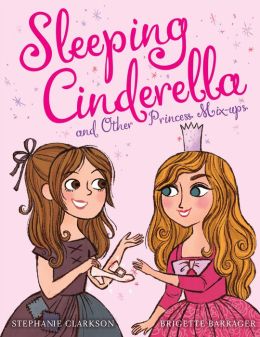
Sleeping Cinderella and Other Princess Mix-Ups (2015)

Sleeping Cinderella and Other Princess Mix-Ups. Stephanie Clarkson. Illustrated by Brigette Barrager. 2015. [January 2015] Scholastic. 40 pages. [Source: Review copy]

First sentence: Once upon a time four fairy tale misses, tired of dwarves, witches, princes, and kisses, so bored and fed up, or just ready to flop, upped and left home for a fairy tale swap…

I enjoyed this one for the most part. It is a cute and clever fractured fairy tale. It begins with a frustrated Snow White leaving the home she shares with seven dwarves. She's searching for a new place to call home. She comes across another princess who is a bit frustrated with her situation as well. They change places. Then she goes off to find someplace new…

It was a fun story starring Snow White, Rapunzel, Cinderella, and Sleeping Beauty. It has a fun and playful premise. The endings have all been adjusted as well. For better or worse. I enjoyed the style of the illustrations. I enjoyed the illustrations of Snow White the best. I loved her look!

I am not sure that I LOVED this one. But I definitely found it fun and worth reading!

Text: 3 out of 5
Illustrations: 4 out of 5
Total: 7 out of 10

© 2015 SukaYuka.com of SukaYuka's Book Reviews

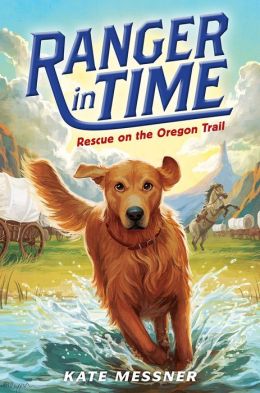
Ranger in Time

Rescue on the Oregon Trail. (Ranger in Time #1) Kate Messner. 2015. Scholastic. 144 pages. [Source: Review copy]

First sentence: Sam Abbott lugged another sack of bacon to the wagon and sat down to wipe his forehead.

Premise/plot: Ranger is a golden retriever who has been trained as a search and rescue dog. But he failed to graduate his training. Ranger wanted to let the humans know that in a real situation, he'd not be distracted by squirrels. But, of course, he couldn't make them get that. Thus he failed, despite his good intentions. But he's given a second chance, of sorts, when he digs up an old first-aid kit. This kit magically transports him BACK in time. Ranger suddenly finds himself in 1850 in Independence, Missouri. He finds a missing girl, Sam Abbott's sister, Amelia, and joins the Abbott family and the wagon train heading west to Oregon. On the way, Ranger will have PLENTY of opportunities to alert Sam and his family--really, the whole wagon train--of dangers on the trail. He proves himself trustworthy when it counts.

My thoughts: It's the first in a new series. I liked this one. I did. You do have to suspend your disbelief a bit, I admit. But once you do, it's just FUN. Time travel can be great fun after all. Readers learn facts about the Oregon trail AND meet a lovable dog. And since this is the first book in the series. Readers shouldn't worry about this dog-on-the-cover book. The book realistically portrays the dangers of trail life, but, not at the expense of the star of the book: Ranger.

Rescue on the Oregon Trail releases this month. And the second in the series, Danger in Ancient Rome, will release this summer.


© 2015 SukaYuka.com of SukaYuka's Book Reviews
Friday, January 2, 2015

Cartwheeling in Thunderstorms (2014)

Cartwheeling in Thunderstorms. Katherine Rundell. 2014. Simon & Schuster. 256 pages. [Source: Library] Mild spoilers.

The heroine of Cartwheeling in Thunderstorms is a girl named Will Silver (full name Wilhelmina, don't dare call her Wilhelmina though!). Will loves living on a farm in Zimbabwe. Her father doesn't own the farm--Captain Browne does--but he manages it. She can't remember her mother, but, life there with her father and her friends (mostly farm workers and local boys) and her animals is near perfect. Until her father dies from malaria. Just like her mother.

After his death, Captain Browne is her legal guardian. The problem? Well, this older gentlemen has fallen head over heels in love with a horrible woman with an evil plan. At least that's how Will sees it. Will soon finds herself heading off to England and boarding school. The situation seems bleak. And it is. And I think that's one reason why I didn't exactly love Cartwheeling in Thunderstorms. It is a bleak middle grade read with little hope. I like hope. I need hope. Will finds herself in dozens of desperate situations, and, it doesn't get better, it just ends. True to life? Probably. Is it important to be true to life and authentic? Sure.

Will is displaced. She's out of her element in England and at school. She's never interacted with girls her own age. She's never formally attended school. She's never had to follow rules. So she struggles with EVERYTHING. For example, she struggles with the concept of staying inside, staying inside classrooms and buildings during school, of staying in her room at night and sleeping. She can't understand why no one will let her sleep outside wherever she wants whenever she wants. She can't understand why no one wants to be near her despite the fact that she hasn't changed clothes or taken a bath or washed her hair or even brushed her hair in three weeks or so. She gets angry when people tell her to use a fork and knife to eat. So it's an understatement to say she's out of her element.

The book is interesting enough, I suppose. But I didn't really enjoy it very much.

© 2015 SukaYuka.com of SukaYuka's Book Reviews
Thursday, January 1, 2015

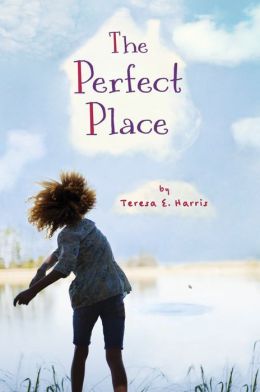
The Perfect Place (2014)

The Perfect Place. Teresa E. Harris. HMH. 272 pages. [Source: Review copy]

Since her dad left, Treasure has struggled with the changes in her life. And she's not the only one struggling. Her younger sister, Tiffany, and her Mom are all struggling a bit. In fact, the novel opens dramatically: "Dad has been gone exactly two months, one week, and four days when Mom stands up and says, "I can't do this anymore." Soon, all three will be on their way to Great Aunt Grace's house. The mom will be leaving her daughters behind while she searches several states for her missing husband. That's the goal, the mission. But will it be successful? Will she find him? be able to talk to him? convince him to come back? agree to live together as a family again? Or is that just an unrealistic wish that Tiffany and Treasure are clinging dearly to?

Great Aunt Grace is a character. She is. She's not used to living with kids. And she's not used to being a nurturer. She will struggle. The kids will struggle. But together the three of them may just be surprised at how they come to feel like a genuine family.

I loved the great aunt. I did. I loved Treasure and Tiffany too. I thought Treasure was a great big sister. I loved how she tried to comfort and support her sister. I thought she was an honest character as well. It was just easy to love her and cheer for her. I loved seeing Treasure develop as a character throughout the book. I loved seeing her open up a bit and allow herself to feel. I loved that she got the chance to start making friends.

Life in Virginia with her great-aunt is not perfect. She has not found a "perfect place." But she's coming to terms with life as it is, and she's learning to appreciate the good things of her imperfect life. Overall, I really thought The Perfect Place was a great coming-of-age novel. (That being said, I wish they'd not taken the Lord's name in vain so many times! There were a few language instances that kept me from loving this one absolutely.)

This one reminded me of A Long Way to Chicago.

© 2015 SukaYuka.com of SukaYuka's Book Reviews