Showing posts with label Historical Fiction. Show all posts

Thursday, January 8, 2015

Audacity (2015)

Audacity. Melanie Crowder. 2015. Penguin. 400 pages. [Source: Review copy]

I loved Melanie Crowder's Audacity. It was a fascinating read focusing on the life and work of Clara Lemlich. It would pair well with Margaret Peterson Haddix's Uprising and Katherine Paterson's Bread and Roses, Too. Also Margarita Engle's The Lightning Dreamer and Andrea Davis Pinkney's The Red Pencil.

What did I love most about Audacity? I loved, loved, loved Clara herself. I loved her strength, her determination, her ambition, her loyalty, her persistence. Whether in Russia or America, Clara dreamed of one thing above all others: getting an education and making something of herself. She wanted to be able to read and write. She wanted to be able to think and form her own opinions and express them. She was raised in an environment, a community, where education was ONLY for men, the message that was reinforced over and over again (not specifically by her parents, but by the community) was that equated a woman going to school and learning with a prostitute. An educated woman brought shame to her family. It wasn't just that it was pushed aside or made a low priority. It was discouraged and forbidden. Clara wanted a voice of her own, and she wanted to be heard. There were many intense places in Audacity. Some within the Russia setting. Some within America. Some within her own home. Some outside the home. Audacity isn't a light-hearted read.

The novel opens with Clara and her family in Russia at the turn of the twentieth century. After facing persecution--the Jewish community within Russia facing brutal persecution--her family emigrated to America. The focus remains on Clara: her dreams and her reality. For example, while her father and brothers stay home to be scholars, she works seven days a week in a mill. The conditions under which she works, under which all the women work, were horrible. She gives her paycheck to her family faithfully, dutifully. But not without some regret. Why must she be the one working so hard while others take it easy?! Much of the book focuses on her struggle: her struggle to hold onto her dreams, her struggle to hold onto dignity, her fight for right, to see justice done.

Audacity is a novel written in verse. It was powerful and compelling. The verse worked for me. It just wowed me in places! This fascinating book is easy to recommend. It's an emotional read, but oh so worth it!

© 2015 SukaYuka.com of SukaYuka's Book Reviews

Tuesday, December 23, 2014

The Christmas Tree

The Christmas Tree. Julie Salamon. 1996. Random House. 118 pages. [Source: Bought]

The Christmas Tree is technically a reread for me, although I haven't reviewed it on my blog. I picked this one up because I remembered enjoying the movie adaptation of it. It didn't disappoint. What I like best about this feel-good Christmas story are the flashbacks.

The chief gardener for Rockefeller Center narrates Julie Salamon's The Christmas Tree. In his own words, this gardener tells of his search, his on-going, never-ending search for THE tree. If he's not looking for this year's tree, his mind is already on finding NEXT year's tree. The book is about one special tree in particular, one that led to an ongoing friendship.

One day the narrator spots THE tree from a helicopter. He learns it's on the property of a convent. He goes. He talks. He asks. He meets Sister Anthony THE nun who will decide if he can have the tree or not. They have more in common than he was expecting certainly. But. She's not ready or willing to part with the tree called, TREE.

Sister Anthony is a storyteller. She is. And the narrator turns out to be a good listener. Over several years at least, he keeps coming back to see her, to visit with her and hear her stories. He has things to share as well. Through these sections, readers learn of Anna.

In the flashbacks, readers meet a young orphan named Anna who eventually came to be raised at the convent. Her story is very personal, and it reveals her affection, her connection to nature. The young girl as you've probably guessed IS Sister Anthony herself.

I loved Anna. I did. Her part in the story is what made it work for me. It was her connection with the tree--in the past and present--that kept me reading.

© 2014 SukaYuka.com of SukaYuka's Book Reviews

Sunday, December 21, 2014

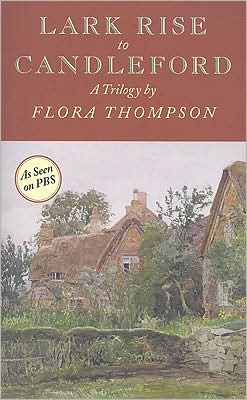
Lark Rise to Candleford (1943)

Lark Rise to Candleford. Flora Thompson. 1943. 537 pages. [Source: Bought]

Did I enjoy reading Flora Thompson's Lark Rise to Candleford? Yes. Did I enjoy all three books equally? Probably not. Did I enjoy any one book as much as I loved the TV adaptation? Probably not. Lark Rise to Candleford is an omnibus edition of a trilogy: Lark Rise, Over to Candleford, and Candleford Green.

The first book in the series is Lark Rise. What I liked about Lark Rise was the fact that it had a cozy yet realistic feel to it. The chapters capture what life was like in a specific time and place, a particular part of the country in the 1880s. Rural vignettes. The book is rich in detail and description. Nothing happens but description. A sampling of chapter titles: "A Hamlet Childhood," "Men Afield," "At the 'Wagon and Horses'," "Callers," "Country Playtime," "School," "May Day," "To Church on Sunday."

The second book in the series is Over to Candleford. This book is definitely more personal in nature. For the most part, it focuses on one young girl, Laura. Readers see Laura at home, at school, at play, at church, visiting cousins, aunts, and uncles, etc. It is still rich in description and detail. Even though it is a more personal look at life in the country in the 1880s and 90s, it is still heavier on the descriptions than the action. This isn't a book that focuses on stories and storytelling. The book ends with a young Laura--perhaps twelve or thirteen--getting an apprentice job in Candleford Green with the postmistress Miss Dorcas Lane.

The third book in the series is Candleford Green. The book opens with Laura leaving home. She's excited and timid. The book will see her established in this new life. She'll be meeting new people, living in a new place, experiencing new things, growing up into a young woman. I was disappointed with this book. I haven't decided if I'm disappointed because it lacks characterization and plot in general OR if I'm disappointed because it lacks the characterization and plot that the television adaptation brought to it. The book's strength is in description and vignettes. The book's weakness is that there are not really any connecting stories or plot sequences. People are mentioned by name, perhaps, but in a very superficial just a few paragraphs way. The characters lack depth. A sentence or two here and there does not make good characterization. If the heroine, Laura, was fully developed and the chapters worked as a personal narrative capturing her experiences, thoughts, and struggles, then I think it might have worked better for me. But there was no person to connect to, no connecting-story to follow. It was just one description after another. There were passages I enjoyed reading. Laura does like to read! But nothing about it that made me LOVE it. I liked it well enough.

© 2014 SukaYuka.com of SukaYuka's Book Reviews
Tuesday, December 16, 2014

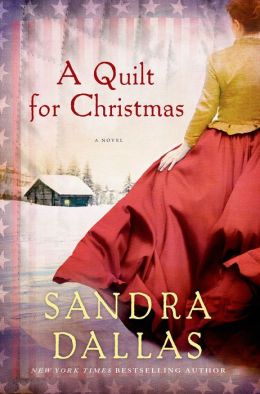
A Quilt for Christmas (2014)

A Quilt for Christmas. Sandra Dallas. 2014. St. Martin's Press. 256 pages. [Source: Library]

For readers who love to read about quilters or quilts, this one may prove satisfying. Also, this one would be a good match for those who like to read about the Civil War. This one is set in Kansas during the last year of the Civil War. I liked Sandra Dallas' A Quilt for Christmas even though I don't consider myself fitting into the ideal audience. (I don't particularly seek out books about quilts. I don't seek out historical fiction set during the Civil War.)

Eliza Spooner is the heroine. She loves, loves, loves to quilt. She loves to get together with other women in the community. The war has had an effect on the community. Many husbands (and brothers, fathers, sons, etc.) are gone, away fighting for one side or the other. Eliza's husband, Will, is fighting for the Union. The novel opens with Eliza finishing a quilt she's made for her husband. She'll be sending the quilt along with a soldier who is returning to her husband's unit from leave. Her love for her husband is obvious, and, not just because she's spent all this time making a quilt. There are dozens of flashbacks. These flashbacks give readers a chance to get to know the couple. However, I must admit that these flashbacks are confusing at times. They are not really set apart in the text, and the transition from present-day to the past can be sloppy at times.

Readers meet Eliza and her son and daughter. Readers meet men and women of the small community as well. Mainly, readers get to know Missouri Ann and her daughter. When Missouri Ann's husband dies, she takes the opportunity to flee from her abusive in-laws. Eliza opens her home to the pair, and this isn't without some risk. Missouri Ann's in-laws are probably without a doubt the meanest and cruelest in the county--if not the state. But not everyone in the community is as immediately open to including Missouri Ann in their group. Her in-laws have tainted her, a bit, no one wants to get close to someone who would marry into that family.

At one point, at a quilting party of sorts, the discussion of slavery and runaway slaves comes up. Opinions are mixed. Prejudices are voiced. Even though most of the women are for the Union--for the Yankees--most if not all have very strong views about blacks.

Eliza's own views will be tested when she's asked to hide a runaway slave: a woman who murdered her mistress. Will she welcome her home to this slave and put her own life and the lives of her children at risk?

A Quilt for Christmas is an odd book at times. It seems to have a handful of plots and stories, any one could be the MAIN one, but really not one seems to stand out as being the one it's all about. It's definitely NOT a plot-driven book. It's mainly about the lives of women in a particular community during the fall of 1864 and throughout 1865.

© 2014 SukaYuka.com of SukaYuka's Book Reviews
Sunday, December 14, 2014

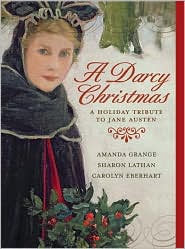
My Year with Jane: A Darcy Christmas

A Darcy Christmas: A Holiday Tribute to Jane Austen. By Amanda Grange, Carolyn Eberhart, and Sharon Lathan. 2010. Sourcebooks. 304 pages. [Source: Library]

I reread two of the three novellas in A Darcy Christmas. I reread Amanda Grange's Christmas Present and Carolyn Eberhart's Mr. Darcy's Christmas Carol. I chose not to reread Sharon Lathan's A Darcy Christmas. Each novella was around a hundred pages. A perfect length, in my opinion, for both stories.

Mr. Darcy's Christmas Carol is an interesting and often entertaining read starring Austen's characters and borrowing much from Charles Dickens. The premise is simple yet not completely predictable. Mr. Darcy is oh-so-happy that Bingley and Jane have married. But. He's still alone this holiday season. Unlike the original, he did not propose marriage to Elizabeth soon after Bingley and Jane's happy announcement. Georgiana, his sister, wants a new sister, a new particular sister for Christmas. His cousin has made a similar request, a particular new cousin. It isn't that Darcy doesn't still love her, want her, need her. But he's a bit proud and stubborn. So on the Christmas Eve in question, Darcy is visited by the ghost of his father who warns him of his faults and promises the visits of three spirits in the night. He adds that they will come with familiar faces. (Can you guess which "familiar face" is the ghost of Christmas future?)

I have conflicting thoughts on Mr. Darcy's Christmas Carol. On the one hand, there would be scenes and passages where I'm: it works, it really works, I can't believe this is working!!! And then perhaps just a page later, I'm: I take it back, this doesn't work at all, how am I suppose to believe this?! So there were plenty of scenes I liked. I liked how she fit it all together and made it work at least some of the time. It would be hard to fit all the great bits of Pride and Prejudice with all the great bits of A Christmas Carol. So I'm surprised it worked as well as it did actually. I like how one of my favorite scenes of A Christmas Carol is reworked from the beginning to the near-ending. That was something! I don't LOVE this one necessarily. As I mentioned, there are places where it is an almost-but-not-quite. It was a fun idea, perhaps, but not absolutely flawless. I alternated between wanting to shout at the book, and cheering. Still, it's worth reading at least once.

What did I think of Amanda Grange's Christmas Present? I liked it very much!!! I tend to like or love Amanda Grange's Austen adaptations. I think she does a great job with keeping Austen's characters as we know them and love them. She is able to capture the essence of each character. In this novella, readers get a glimpse of their second Christmases. (I believe, the two couples married in November or possibly early December?) Bingley and Jane have a baby. Elizabeth and Darcy are oh-so-close to having a baby as well. But have-her-own-way Elizabeth is insistent that even though she is due to have a baby any day, she is perfectly capable of traveling a few hours by carriage so she can spend the holidays with her family. Darcy gives in, of course. So what does a family Christmas look like? Well, this family Christmas borders on insane! Through half-a-dozen coincidences it seems, that most of the family (minus Georgiana) are brought together to share these few days. Including some you might not be expecting to see: Lady Catherine. Mr. Collins. The novella is comical. It's just a satisfying way to spend an afternoon. Sometimes a good, quick read that is light-hearted fun is just what you need.

This is my final post for "My Year With Jane." Here's a look at all the posts about Jane Austen:
© 2014 SukaYuka.com of SukaYuka's Book Reviews
Tuesday, November 11, 2014

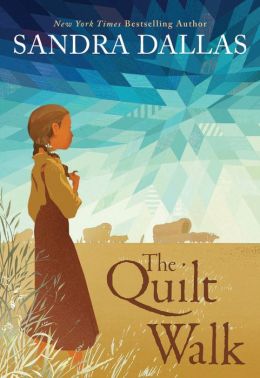
The Quilt Walk (2012)

The Quilt Walk. Sandra Dallas. 2012. Sleeping Bear Press. 215 pages. [Source: Library]

I enjoy historical fiction. I do. And I enjoy a good pioneer story. The Quilt Walk is a middle grade pioneer story. It was satisfying for what it was.

Emmy Blue and her mom and dad are traveling with a wagon train to Golden, Colorado. Her aunt and uncle are also going. Her dad and uncle are the ones who really, really, really want to go. Her aunt and mom, well, they'd have been happy spending the rest of their lives right where they were. Her mom is more outwardly accepting of this change. Her aunt complains plenty. There are things she's sad about, things she's hopeful about.

The focus is on the journey for the most part. Readers meet several other characters traveling in the wagon train. Emmy and her mom make new friends. Emmy makes one friend close to her own age. Emmy makes several friends who are older than her. One woman is newly married. One woman has three children under the age of four. Every person has a story of their own. What will Emmy's story be?

Based on the title alone, one can suppose that her story has to do with a quilt. At the start of the journey, Emmy hates quilting. She does. Not that she's ever properly given it a go. She knows that her mom loves, loves, loves to quilt. Loves getting together with other ladies to quilt. But Emmy sees it as tedious and boring. But. Her grandmother gives her blocks to quilt together to make a quilt top for her doll. Blocks to piece together on the journey, on the trip. And her mom expects her to do just that. To piece this quilt together some each day. And Emmy does. And by the end, she might have begun to change her mind about quilting. At least a little bit.

© 2014 SukaYuka.com of SukaYuka's Book Reviews
Tuesday, September 30, 2014

Good Night, Mr. Tom (1981)

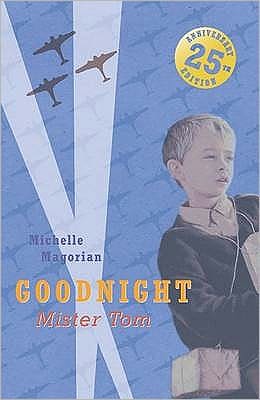
Goodnight, Mr. Tom. Michelle Magorian. 1981. HarperCollins. 320 pages. [Source: Library]

 "Yes," said Tom bluntly, on opening the front door. "What d'you want?"
A harassed middle-aged woman in a green coat and felt hat stood on his step. He glanced at the armband on her sleeve. She gave him an awkward smile.
"I'm the Billeting Officer for this area," she bagan.
"Oh yes, and what's that got to do wi' me?"
She flushed slightly. "Well, Mr., Mr..."
"Oakley. Thomas Oakley."
"Ah, thank you, Mr Oakley." She paused and took a deep breath. "Mr Oakley with the declaration of war imminent..."
Tom waved his hand. "I knows all that. Git to the point. What d'you want?" He noticed a small boy at her side.
"It's him I've come about," she said. "I'm on my way to your village hall with the others."

 Read this book. Read it. At the very least, you should consider watching the movie adaptation. I doubt you regret meeting Willie Beech and Tom Oakley.

Goodnight Mister Tom is set during the early months of World War II. For the most part, it is set in the English countryside. William (Willie) Beech is one of many children being evacuated to the country for safety reasons. Willie has been assigned to a widower, Tom Oakley. Willie isn't quite sure what to think about his new home? Everything in the country seems to surprise him including Tom's dog, Sammy. Tom isn't quite sure what to think about Willie either. He's a bit puzzled because Willie does act a bit off. It's not just the fact that he's never been out of the city. Willie doesn't know how to read or write even though he's almost nine. (He also wets the bed.)

Tom soon learns enough to get him good and angry. Willie arrives essentially with nothing but the clothes he has on. But his mom has included a belt with a note on how and when to use it on her son. Tom soon sees the evidence of abuse for himself.

It was oh-so-easy to care for the characters, especially Tom and Willie. As Willie spends time in the country, it is in many ways his first taste of safety and freedom. And love and kindness. And stability. And friendship. I loved seeing Tom with Willie. I loved his patience and firmness. I loved his kindness and encouragement. I loved seeing Tom work with Willie on his writing and reading. I loved seeing them read together every day. I loved seeing Tom encourage Willie with his drawing.

Willie also finds friends his own age. His best, best friend is a Jewish boy named Zach. Plenty of time is spent with Willie and Zach and their other friends and/or classmates.

The novel is both intense and ultimately satisfying. It it intense for multiple reasons. I expected it to be intense because of the war. And it was. I wasn't necessarily expecting it to be intense for psychological reasons. The novel is ultimately satisfying, but, don't expect sweet scene after sweet scene. The sweetness is found in friendship and hope, but, there are some bitter shocks as well. 

I loved this one. I did. I loved, loved, loved the characters. I am so glad I read this one.

© 2014 SukaYuka.com of SukaYuka's Book Reviews
Friday, September 26, 2014

Reread #39 Blackout

Blackout. Connie Willis. 2010. Random House. 495 pages. [Source: Bought]


This year I've decided to reread all of Connie Willis' time travel books. This is the third book I've reread. I've also reread Doomsday Book and To Say Nothing of the Dog. I first reviewed Blackout in November 2010. I reviewed it again in January 2012.


Blackout is about (three) time travelers studying World War II. For the most part, the novel is set in the year 1940. However, the novel also contains other stories--almost like riddles. These small stories are set in 1944 and 1945, they feature other characters--or do they?--studying World War II: V1 Rockets and V-E Day.

Merope Ward (aka Eileen O'Reilly) has gone back to study the evacuation of children to the country. She is working as a nurse/maid on a country estate. Her assignment was for the spring of 1940.

Polly "Sebastian" (she takes on a different Shakespearean last name for every assignment) has gone back to study the London Blitz. She wants to work as a London shopgirl. Her assignment was for the fall of 1940.

Michael Davies (Mike) has gone back to observe the Dunkirk evacuation. His assignment was for the summer of 1940.

They've heard over and over again that historians cannot change the past, that historians cannot damage the timeline, that historians can merely observe past events. But what if everyone was wrong? What if time travel is dangerous and risky? Not just dangerous for the time traveler who may find himself/herself in trouble, but dangerous for everyone. What if there are negative consequences for time travel?

Eileen, Polly, and Mike will question what they've all been told when they find themselves trapped in 1940 unable to return to Oxford and their own time. Eileen missed her deadline because of a quarantine initially. Months later she tried to use her drop and failed. She thought it was because there were too many people nearby--the military has just taken possession of the estate where she worked. She remembers that Polly Churchill will be in London soon. She wants to find her and use her drop to go back. Mike was injured during the Dunkirk evacuation. An injury that kept him trapped for weeks. His drop is also impossible to use. He remembers Polly's assignment. He goes to London desperate to find another time traveler. These three reunite only to discover what Polly already knew--her own drop was damaged--she thinks because of a bomb. She was hoping that THEY were there to rescue her. Being trapped changes everything.

Blackout is an intense read. Primarily the focus is on what war was like on the homefront, what the war was like for Londoners. I definitely recommend this one. But it does come with a warning. It is only half the story. All Clear is the sequel, and, you'll want to read it to finish the story. Blackout does not stand on its own.

© 2014 SukaYuka.com of SukaYuka's Book Reviews

Tuesday, September 23, 2014

The Late Scholar (2014)

The Late Scholar. Jill Paton Walsh. 2014. St. Martin's Press. 368 pages. [Source: Library]

I enjoyed The Late Scholar enough while reading it, for the most part, but the more I think about it, the more disappointed I am. I have liked or enjoyed Jill Paton Walsh's sequels to Dorothy Sayer's Lord Peter mysteries. The Late Scholar is set in the 1950s. (I'm not sure if it's early, mid, or late 50s. But Queen Elizabeth is on the throne, I believe.) The novel opens with the Duke of Denver (aka Lord Peter Wimsey) learning that he is a Visitor at Oxford. He is being called upon to settle a dispute among the fellows. The person--ultimately one of many suspects, I suppose--who initially requested his interference comes to regret it. Lord Peter is thorough. He doesn't want to just cast a vote on a controversial topic without any thought. He wants to study the situation, learn both sides, draw his own conclusions about what is best. The dispute is about selling a medieval book to get the money to buy land next door that has come up for sell. Is land more valuable to the college than one book in the library? Or is the ancient book more valuable to the college than a piece of real estate? It wouldn't be a mystery book if it didn't turn to violence and murder. Lord Peter, Harriet Vane, and Bunter must follow all the clues to catch a murderer or two.

There were a few things that felt a bit off, that kept this one from feeling like a genuine, authentic Lord Peter/Harriet Vane mystery. I allow some change would be natural enough. Two decades would change a person, would change a couple. But the changes in a way have a very surface feel to them. I'm not sure the characters have the depth that they need, they are very much reliant on familiarity with the original.

I have not reread the whole (original) series, but, Lord Peter seems changed and not always for the better. I could not show you a passage where Lord Peter reveals a personal faith in God. But I have a feeling I would have remembered if Lord Peter revealed a cold mockery for Christianity and/or stated openly and unashamedly that he did NOT believe in God. There were a few uncomfortable scenes in Late Scholar where Peter's atheism comes to light, I suppose. It was done in an almost ha, ha, don't be silly, of course I don't believe in God kind of way. It just struck me as wrong. I'm not saying that I consider Lord Peter evangelical. But. I always got the impression that he believed there was a God, that at the very least he was agnostic. The reason this strikes me as wrong is that Dorothy Sayers was a Christian, she wrote Christian books. I've read some of her theological essays and they are quite good. I just don't see HER Lord Peter being one to make light of or mock Christianity or the Bible or the fundamental belief that there is a God. Of course times have changed. Decades have passed since his creation, so maybe modern readers assume that naturally Lord Peter is "smart enough" to have outgrown any idea of God.

© 2014 SukaYuka.com of SukaYuka's Book Reviews

Tuesday, September 16, 2014

Death of a Schoolgirl (2012)

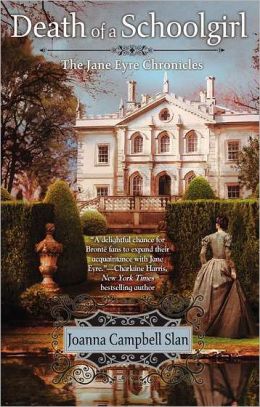
Death of a Schoolgirl (Jane Eyre Chronicles #1) Joanna Campbell Slan. 2012. Berkley Trade. 340 pages. [Source: Library]

My expectations were low, so I was quite pleasantly surprised by how enjoyable this Jane Eyre mystery was. It may not be perfectly perfect from start to finish. There might be a paragraph or two here and there that bothered me. (For example, I didn't understand why Mrs. Fairfax was pushing Jane Eyre to take the family diamonds with her on her visit to Adele's school. Here she was going to check on the child's welfare, and Mrs. Fairfax is urging her to take jewels so she can dress up for her hosts in London?! I don't know if part of me thought it was foreshadowing--for better or worse--but when she put them in her reticule, I wanted to shout WHY are you traveling with expensive jewelry?!?! Why?! And sure enough--predictably enough--Jane Eyre gets robbed on her way to London. See! I told you not to take the family jewels!) But for the most part, I found the book to be an entertaining read.

Mrs. Rochester (aka Jane Eyre) is a new mother. She loves, loves, loves her new baby boy. But. When she receives a short letter from Adele with a French message included asking--begging--for help, she decides to leave her husband and son behind to check on Adele at her boarding school. If all is well, if it is just Adele being Adele, being childish and wanting her own way, then she may leave her at the school. If the school is less than ideal, if she does not like what she sees--how she sees the children being treated, if she thinks Adele's misery is justifiable, then she may take her out of the school. Because Jane Eyre was beaten up by the thief, because she doesn't particularly look RICH and IMPORTANT, she is initially mistaken as the new German teacher who was supposed to arrive several weeks earlier. That first day Jane Eyre is a bit flabbergasted and too overwhelmed to correct anyone. She has just learned that one of Adele's classmates was murdered. Eventually, one of the teachers convinces Jane that she should continue the deception, that she should resume her teaching duties temporarily and watch over the students herself. She debates what is best. Should she take Adele immediately to safety and let others solve the crime? Or should she become an amateur detective herself and work as a team with others to help solve the case?

Is Jane Eyre the best detective ever? Not really. But to me that almost doesn't matter. I liked spending time in her company. The setting intrigued me. I had never placed Jane Eyre in the Regency time period. But here we have the sequel set during the reign of George IV, and Queen Caroline, the scandalous Queen Caroline has not died yet. This places the book within a specific time frame. The sprinkling of historical details may not speak to all readers. Little details can be easily dismissed or ignored. But to me it's the little things that help ground a book. The book does deal with prejudices and judgments: how the lower classes feel about the upper classes, how the poor feel about the rich, how the rich feel about the poor, do they see them as human, are they compassionate and kind, or, haughty or cruel. One of the characters is VERY prejudiced against French people. Again and again we see characters making judgments or being judged. Sometimes the people that are being judged in certain situations are making judgments about others just a chapter or two later.

There were places I loved this one. There were places I merely liked it. But at times it just felt RIGHT. Maybe it didn't feel RIGHT cover to cover. But I read it quickly and enjoyed it very much.
© 2014 SukaYuka.com of SukaYuka's Book Reviews
Tuesday, September 9, 2014

The Attenbury Emeralds

The Attenbury Emeralds. Jill Paton Walsh. 2010/2011. St. Martin's Press. 352 pages. [Source: Library]

I enjoyed reading The Attenbury Emeralds. I love Lord Peter Wimsey. I do. I love, love, love him. And I like the romance between Harriet and Lord Peter. So it was charming to revisit Lord Peter and Harriet several decades later in 1951. This mystery novel opens with a bit of storytelling. Lord Peter and Bunter team up and take turns telling Harriet about some early detecting concerning the Attenbury family jewels. The first such story begins in 1921. At one point the first mystery was solved, and I was unsure what direction the novel would take. It was only then I realized the story was far from over. For this simple case about the Attenbury emeralds was not as simple as it seemed. It was a mystery with no clear beginning or end in fact! The novel was not merely a sharing of former detecting successes, but, a new opportunity for Lord Peter to solve the case and prove he still has it.

I enjoyed spending time with Lord Peter and Bunter. I love their relationship. I do. I also enjoy seeing Lord Peter and Harriet together. And the brief glimpses we get of their children are nice enough. I really liked knowing that Lord Peter's mother, the Dowager Duchess, was still around! I do find her delightful!!!

For so many reasons this one was just a joy to read. I do recommend it for fans of Dorothy Sayers' mysteries.
© 2014 SukaYuka.com of SukaYuka's Book Reviews

Tuesday, August 19, 2014

The Princess of Celle (1967)

The Princess of Celle. Jean Plaidy. 1967/1985. Ballantine. 400 pages. [Source: Bought]

The Princess of Celle felt longer than it actually was. Perhaps because the chapters were so long. Perhaps because the book was complicated. If it helps, it was necessarily complicated. It is the story of a dysfunctional German family, one of whom would come to the throne of England as George I.

I was a bit disappointed that George Lewis does not become George I until the epilogue of this one! I suppose I had the silly idea that this book would focus on the obviously unhappy marriage between George Lewis (George I) and Sophia Dorothea (the so-called Princess of Celle). And, in a way, it is. But George Lewis is one of the most unimportant characters in the whole book. Seriously. Readers get to know--for better or worse--his mother, his father, his uncle, his aunt, some of his brothers. But for George himself? Well, he gets a tiny fraction of the author's attention.

If I had to describe The Princess of Celle, I would say it was a tug of war between multiple generations of mistresses in a super dysfunctional German family. I would say that almost all the men in the novel are vile, power-hungry, lusty creatures with big egos. I would say that the mistresses in the novel are vile, power-hungry, lusty creatures with big egos. The wives, well, have to make the best of it. They may hate their husbands. They may hate the mistresses their husbands keep. They may be humiliated in public by those mistresses. But they can take comfort that their children are legitimate.

For better or worse, the "main" story of The Princess of Celle begins in the middle of the novel. It is at the halfway point that readers see Sophia Dorothea marry her cousin George Lewis. She had wanted to marry someone else, another cousin. He had not cared who he married. He was content to marry whomever pleased his mother...and his father. He very much cared about picking his own mistresses. But a wife?! Not worth his bother. It's not like he'll be enjoying her company!

Is Sophia Dorothea the main character? I'm not sure that she is if I'm honest. She's not the strongest character. The most obnoxious or ambitious or strong-willed. George Lewis's mother is SOMETHING. As is his father's mistress, Clara von Platen. I would say that Clara gets more time and attention from the novel than any other character in this one. What does Clara want? What will Clara do to get what she wants? Who will Clara hurt to get her way? How many lives can she destroy? How much power can she grab? How can she keep the power? Clara is a disgusting character, truly revolting.

Did I like Sophia Dorothea? Well. She may not be as horrid as Clara. Who could be?! But she could not keep my sympathy. Yes, to a certain point I could see why she was so miserable and so trapped. She could not escape her in-laws and her husband. Not that her husband stayed remotely close to her. He was off doing whatever, whenever, whoever. But court-life was miserable for her because of the dominant women: her mother-in-law and her father-in-law's mistress. There were people at court, namely Clara that hated her and were actively plotting against her, plotting to ruin her life thoroughly. It was almost Clara's one ambition in life to destroy Sophia Dorothea, or perhaps the right word is obsession.

A sick love triangle. What every book needs is a love triangle, right?! Sophia Dorothea falls for the same man as Clara. His name was Königsmarck. There was nothing about him that I could admire or respect. Because his love for Sophia Dorothea was oh-so-pure and oh-so-true, he satisfied his lusts with Clara. Until he went off to war and was thought to be missing in action. Then Sophia Dorothea rejoiced with his return! Of course, she abandoned her morals, she was so happy! Clara then takes evil to a whole new level. You see, Clara already hated her and despised her. She already was out to get her. But NOW...she was a million times more determined to win the day.

I did not like spending time with any of these characters. I really didn't.


© 2014 SukaYuka.com of SukaYuka's Book Reviews

Sunday, August 10, 2014

Sundays with Jane: Two by Cornthwaite

Charity Envieth Not. (George Knightley #1) Barbara Cornthwaite. 2009. CreateSpace. 260 pages. [Source: Library]
and
Lend Me Leave. (George Knightley #2) Barbara Cornthwaite. 2011. CreateSpace. 246 pages. [Source: Library]

I absolutely loved reading Charity Envieth Not and Lend Me Leave. These two books tell the novel Emma through the perspective of George Knightley. I almost wish they were combined into one edition, however. Still, I can't begin to recommend these enough to all Austen fans!!!

I enjoyed many aspects of both books. I really, really loved George Knightley. That in and of itself is far from shocking. Dare I say he's probably the best thing about Austen's novel?! I loved seeing the characters (and/or the community) through his eyes. I loved his involvement in the community. I loved meeting various characters--rich and poor, from all classes or statuses. I especially, especially liked Spencer! I loved getting to know his brother John better. And I liked seeing him in the role of uncle! I liked how wide the perspective is--if that makes sense! Emma, to me, comes across as very self-centered, the world through her eyes seem a bit narrow.

I also appreciate how both books treat the character of Emma. I think to fully appreciate Emma, one HAS to see her AS Knightley sees her. This book accomplishes that! I don't think I've ever seen Emma in such a positive light before. And it made me think a bit, what if Emma is blinded to her strengths JUST as she's blinded to her weaknesses. OR in other words, what if the narration is a bit too close to accurately judge her strengths/weaknesses. Of course, Knightley cannot absolutely read all her motives and intentions, so maybe he's reading more compassion, more tenderness, more generosity than is really truly there. But maybe just maybe Emma's heart is bigger than I have previously thought. And maybe just maybe her mind isn't quite as empty as I thought it. I kept asking myself what does Knightley see in Emma that I don't?

I would recommend it to those who already love Emma, and even to those that don't really like her. Knightley is a great hero! And he's definitely worth reading about!

© 2014 SukaYuka.com of SukaYuka's Book Reviews

Tuesday, August 5, 2014

The Auschwitz Escape (2014)

The Auschwitz Escape. Joel C. Rosenberg. 2014. Tyndale. 468 pages. [Source: Library]

The Auschwitz Escape is a compelling historical novel starring two wonderful heroes. Readers meet Jean Luc Leclerc a pastor who follows his heart and sets out to rescue as many Jews as he can. He "rescues" them by providing for the needs of refugees. He takes Jews into his home and hides them, he encourages every one in his town to do so. His rescue work continues for several years before he is arrested by the Nazis and taken to Auschwitz. Readers also meet a young Jewish man named Jacob Weisz. He is part of the Resistance, Belgium Resistance, I believe? He is doing his all to help as well. He too is captured by the Nazis and sent to Auschwitz. However they don't learn his true name for many months. Both men learn the upsetting fate of most Jews upon arrival. Both realize that it is not a work camp, but, instead a death camp. Both men are chosen by others in the camp to be part of an underground resistance. Both are chosen to be part of an escape program. They feel very strongly that several teams of two-men need to escape from the camp and seek not only immediate refuge, but, to be messengers. They feel that if the outside world had even a small clue what was happening, they would act, they would do something, they couldn't not do something, right? So Luc and Jacob are the third or maybe fourth team over a year to attempt to escape. Will their escape succeed? Will they survive? Will they be able to find help? What will happen when they speak the truth?

The Auschwitz Escape is fiction. But there were men who did manage to escape who did carry messages and horrific proof about the camp with them to share with the outside world.

I would definitely recommend this one.

© 2014 SukaYuka.com of SukaYuka's Book Reviews

Tuesday, July 29, 2014

China Dolls (2014)

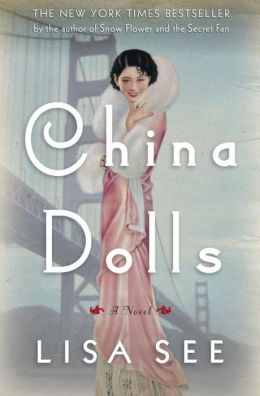
China Dolls. Lisa See. 2014. Random House. 376 pages. [Source: Library]

China Dolls is historical fiction. The novel follows three women through the latter days of the 1930s through the 1940s. Three very different women I might add. The friendship between these three women is not quite pure or ideal. Grace, one of the heroines, is running away from an abusive father. Her dream is to sing and dance and to go into show business. Ruby, another heroine, is also a dancer and performer. Helen is the third heroine. Before a chance meeting with Ruby and Grace, Helen had no big dreams of show business. In fact, Helen could not even dance! Yet, a chance meeting one day led all three women to audition for an Oriental nightclub. (For the record, Oriental is the term used throughout China Dolls.) Talent is only half of what is required, they learn. Appearance is super important. It is more important to be beautiful and amazing and be somewhat teachable than to be incredibly talented. Helen and Grace are hired to be essentially part of a chorus. (They're called Ponies.) But Ruby remains a part of their lives. For better or worse.

While each woman is given a back story and/or a sob story, I had a hard time liking any of the characters. Helen, Grace, and Ruby may spend time together, but, that doesn't mean they like each other and want each other to succeed. Helen, Ruby, and Grace could be quite mean and awful to each other.

The history is interesting. The story is certainly full of drama. The characters are incredibly flawed and remain consistently selfish.

I liked it fine, but, I definitely did not love it.

© 2014 SukaYuka.com of SukaYuka's Book Reviews
Tuesday, July 15, 2014

Merry Monarch's Wife (1991)

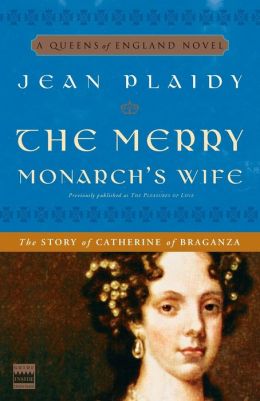
The Merry Monarch's Wife. (A Queens of England Novel). Jean Plaidy. 1991/2008. Crown. 352 pages. [Source: Bought]

MY LIFE WILL END WHERE IT BEGAN, FOR IN THE YEAR 1692 I left England where I had gone some thirty years before as a bride to the most romantic prince in Europe. I smile now to consider how ill-equipped I was for such a position, and when I look back I say to myself, “If I had done this…,” “If I had not done that…how much happier my life would have been.” But then, although I was not very young—I was twenty-four, which is a mature age for a princess to embark on marriage—I was quite innocent of the world and had hardly ever strayed from the walls of the convent where I had received my education, or the precincts of the royal palace. 
 
I enjoyed reading Jean Plaidy's The Merry Monarch's Wife. Catherine of Braganza was the queen of Charles II. For those familiar with the reign of Charles II, you can imagine what a life she led for better or worse. The book seeks to capture her personal perspective of her husband, of her marriage, of her adopted country. (She's coming from Portugal to England.)

Plaidy's depiction has Catherine truly in love with the King, and oh-so-aware of his shortcomings. In her reckoning, Charles II could not help himself at all, he was completely incapable of fidelity. Readers catch glimpses here and there of Charles' many, many mistresses. But not as much as you might imagine. That is, the focus is on HER and not truly on him and his activities. She is aware of his favorites at any given time, and at times she's sought out in conversation by mistresses in and out of favor.

There is definitely a lot of POLITICS in Merry Monarch's Wife. Readers learn about various plots and threats and conspiracies. Readers meet men and women who are ambitious and manipulative and power-hungry.

I was familiar, in a way, with some of the details of his reign. But not of what life was like for her before and after. Before her arrival in England and after Charles II's death. This book tells a fairly complete story.

Quotes:
We do not know what the future holds, but I believe that one day you are going to be Queen of England, and when you are, you will do your duty to God and your country.” “Oh yes,” I said fervently, “I will.” I had a mission now. Not only was I going to marry Prince Charles, but I was going to save his soul.
He always called himself an ugly fellow, and when one considered his features that could be true, but his charm was overwhelming. There could never have been a more attractive man. I know that I loved him and one is apt to be unaware of the faults of the object of one’s devotion, but I can vouch for it that I was not alone in my opinion. He used to talk of the ringing of bells, the flowers strewn in his path, the women who threw kisses at him, the shouts of loyalty. “Odds fish!” he said. It was a favorite oath of his. “They gave me such a welcome home that I thought it must have been my own fault that I had stayed away so long.”
He laughed. “You remind me of my mother. You and she will be good friends when you meet, I’ll swear. As for this Catholic ceremony…you see, my dear, you are Queen of this country and you must be married according to the religious observances of the place. But you say you will not be happy…and I cannot allow you to be unhappy. I will tell you how we will resolve this matter. There shall be a ceremony here in this bedchamber. It shall be as you wish, and the other one will take place as arranged on the same day. It means you will have to marry me twice. Could you bear that?” I felt my lips tremble. I was going to weep because I was so touched, so happy. “You are all that I hoped for…and all that I dreamed,” I said emotionally. He looked at me in mock dismay. “Do not have too good an opinion of me, I beg you. I fear you will find me a somewhat sinful fellow.” “Oh no. You are the kindest and best man in the world.” He leaned toward me and kissed my cheek. He was sober suddenly. He said: “You shame me.” Then he was merry again. His gravity seemed always to be fleeting, as though his gaiety was waiting impatiently to break in on it.
Charles is fond of you. He likes you very much…but he will never be faithful to you. It is not in him to be faithful…not to any woman. My father was like him. I saw how my mother lived. So I understand. Accept this weakness in him and he will be grateful to you, he will be kind.
We would drink tea, for I had brought this custom with me from Portugal. For a short time people had thought the beverage very strange, but they were soon aware of the pleasure of taking that soothing drink, and my ladies quickly became as ardent tea drinkers as I myself. Indeed the custom was spreading all over the country.

© 2014 SukaYuka.com of SukaYuka's Book Reviews
Friday, July 11, 2014

Reread #28 To Say Nothing of the Dog

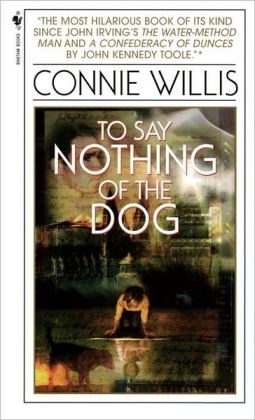
To Say Nothing of the Dog. Connie Willis. 1998. Bantam. 493 pages. [Source: Bought]

I have every intention of rereading all four Oxford time travel books by Connie Willis this year. Earlier in the year, I reread the first book, Doomsday Book. To Say Nothing of the Dog, the second book, is a book I originally read and reviewed in July 2009. While the first book offers drama, drama, more drama, with just a touch of humor now and then, the second book is a romantic comedy. I happen to love both books though they are very different from one another.

Ned Henry is the hero of To Say Nothing of the Dog. He is on a mission, not a mission of his own choosing perhaps, but a big mission all the same. He is one of many time travelers working for Lady Schrapnell on her latest project: restoring Coventry Cathedral. The novel opens with a very overworked Ned Henry beginning to show severe signs of time-lag. What he needs is rest, permission to rest. That isn't likely to happen if Lady Schrapnell learns his whereabouts. For better or worse, Ned Henry is sent to the past--to Victorian times--to recuperate. He's been given another mission too. This time by someone much nicer and calmer than Lady Schrapnell. The problem? Ned Henry wasn't capable of listening and understanding. Now he's in the past without a real clue of WHY he's there and what he's supposed to accomplish.

Verity Kindle is the heroine of To Say Nothing of the Dog. She is on a mission of her own. While Ned Henry was given the assignment of finding out the whereabouts of the bishop's bird stump, Verity's assignment is to read Tocelyn's diary. The diary is available to read in the future. But the most relevant pages to the Coventry Cathedral project were damaged. So she's been sent to the oh-so-important summer of 1888 to read the newly written diary entries. She's having about as much success as Ned Henry. In other words, not much luck at all! These two work together as best they can. Verity manages to travel back and forth a few times to the future. Their mission--as they see it has changed a bit. They worry that they've damaged the future and that something horrible may happen as a result. Like Tocelyn, they know, was supposed to marry a "Mr. C". They know this for a fact from future diary entries. Yet here they are and she's engaged to someone else! Their "new mission" is to find the identity of "Mr. C." and make sure they meet when they're supposed to meet....

I loved this one. I have always loved this one. It is a delightful time travel novel. I love the humor! I do! It's so very, very funny! And I love the details and the dialogue. This one is just a joy cover to cover!

© 2014 SukaYuka.com of SukaYuka's Book Reviews
Tuesday, June 10, 2014

A Tree Grows In Brooklyn (1943)

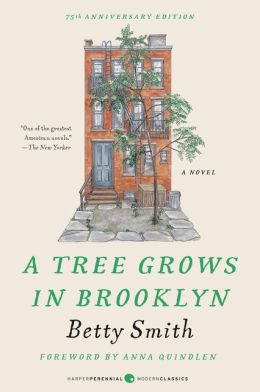
A Tree Grows in Brooklyn. Betty Smith. 1943/2006. HarperCollins. 496 pages. [Source: Bought]

Oh how I loved Betty Smith's A Tree Grows in Brooklyn. Readers get the chance to get to know Francie, the heroine, her brother, Neeley, her mother, Katie, her father, Johnny, her aunts, Sissy and Evy, and her grandmother, Mary Rommely. A Tree Grows in Brooklyn is set circa 1910-1918 in Brooklyn, New York; it is very much a coming-of-age novel focusing on Francie, yet expanding to include several generations of her family. The book has a good number of flashbacks letting readers get to know all the members of the family before getting good and settled in Francie's life. It is a book that embraces ALL of life: the big things, the little things: no matter how ugly or beautiful. Truth does not equal beauty as Francie learns. I loved Francie's passion for living. I loved her observations.

A Tree Grows In Brooklyn is rich in detail AND rich in characterization. It is not a fast-paced action, adventure novel. It is a character-driven, family-focused historical novel. It doesn't try to make people better than they are. It is realistic and honest. The characters are very human, very fallible. One of the themes is in fact being true and honest. Francie has a confrontation with an English teacher. The teacher is trying to shame Francie into writing only about the beautiful, precious things of life. Sunsets. Stars. Flowers. She has been writing about her life, about her father, about her childhood. Her teacher tells her to go home and burn these writings and say "this is ugliness, this is ugliness, this is ugliness." Francie finally submits enough to be able to end the conversation and leave the room, but she's holding strong to who she is and where she comes from.

It is a beautifully written novel. It is very quotable.
The one tree in Francie’s yard was neither a pine nor a hemlock. It had pointed leaves which grew along green switches which radiated from the bough and made a tree which looked like a lot of opened green umbrellas. Some people called it the Tree of Heaven. No matter where its seed fell, it made a tree which struggled to reach the sky. It grew in boarded-up lots and out of neglected rubbish heaps and it was the only tree that grew out of cement. It grew lushly, but only in the tenements districts.
An eleven-year-old girl sitting on this fire escape could imagine that she was living in a tree. That’s what Francie imagined every Saturday afternoon in summer.
THE LIBRARY WAS A LITTLE OLD SHABBY PLACE. FRANCIE THOUGHT it was beautiful. The feeling she had about it was as good as the feeling she had about church. She pushed open the door and went in. She liked the combined smell of worn leather bindings, library paste and freshly inked stamping pads better than she liked the smell of burning incense at high mass.
Francie thought that all the books in the world were in that library and she had a plan about reading all the books in the world. She was reading a book a day in alphabetical order and not skipping the dry ones.
“Mother, I am young. Mother, I am just eighteen. I am strong. I will work hard, Mother. But I do not want this child to grow up just to work hard. What must I do, Mother, what must I do to make a different world for her? How do I start?” “The secret lies in the reading and the writing. You are able to read. Every day you must read one page from some good book to your child. Every day this must be until the child learns to read. Then she must read every day, I know this is the secret.”
“I will read,” promised Katie. “What is a good book?” “There are two great books. Shakespeare is a great book. I have heard tell that all the wonder of life is in that book; all that man has learned of beauty, all that he may know of wisdom and living are on those pages. It is said that these stories are plays to be acted out on the stage. I have never spoken to anyone who has seen this great thing. But I heard the lord of our land back in Austria say that some of the pages sing themselves like songs.”
“And what is the other great book?” “It is the Bible that the Protestant people read.” “We have our own Bible, the Catholic one.” Mary looked around the room furtively. “It is not fitting for a good Catholic to say so but I believe that the Protestant Bible contains more of the loveliness of the greatest story on this earth and beyond it. A much-loved Protestant friend once read some of her Bible to me and I found it as I have said.
“That is the book, then, and the book of Shakespeare. And every day you must read a page of each to your child—even though you yourself do not understand what is written down and cannot sound the words properly. You must do this that the child will grow up knowing of what is great—knowing that these tenements of Williamsburg are not the whole world.”
Everything struggles to live. Look at that tree growing up there out of that grating. It gets no sun, and water only when it rains. It’s growing out of sour earth. And it’s strong because its hard struggle to live is making it strong. My children will be strong that way.”
Well, everybody’s something. We all got a tag of some kind.
She found to her agony, that the doctor was still there, poised needle and all. He was staring at her arm in distaste. Francie looked too. She saw a small white area on a dirty dark-brown arm. She heard the doctor talking to the nurse. “Filth, filth, filth, from morning to night. I know they’re poor but they could wash. Water is free and soap is cheap. Just look at that arm, nurse.” The nurse looked and clucked in horror. Francie stood there with the hot flamepoints of shame burning her face.
After the doctor’s outburst, Francie stood hanging her head. She was a dirty girl. That’s what the doctor meant. He was talking more quietly now asking the nurse how that kind of people could survive; that it would be a better world if they were all sterilized and couldn’t breed anymore. Did that mean he wanted her to die? Would he do something to make her die because her hands and arms were dirty from the mud pies?
“My brother is next. His arm is just as dirty as mine so don’t be surprised. And you don’t have to tell him. You told me.” They stared at this bit of humanity who had become so strangely articulate. Francie’s voice went ragged with a sob. “You don’t have to tell him. Besides it won’t do no good. He’s a boy and he don’t care if he is dirty.”
She put her arm around her and held her close to her own life warmth. “Francie, baby, you’re trembling like a leaf.” Francie had never heard that expression and it made her thoughtful. She looked at the little tree growing out of the concrete at the side of the house. There were still a few dried leaves clinging to it. One of them rustled dryly in the wind. Trembling like a leaf. She stored the phrase away in her mind.
“Forgiveness,” said Mary Rommely, “is a gift of high value. Yet its cost is nothing.”
OH, MAGIC HOUR WHEN A CHILD FIRST KNOWS IT CAN READ PRINTED WORDS!
For quite a while, Francie had been spelling out letters, sounding them and then putting the sounds together to mean a word. But one day, she looked at a page and the word “mouse” had instantaneous meaning. She looked at the word, and the picture of a gray mouse scampered through her mind. She looked further and when she saw “horse,” she heard him pawing the ground and saw the sun glint on his glossy coat. The word “running” hit her suddenly and she breathed hard as though running herself. The barrier between the individual sound of each letter and the whole meaning of the word was removed and the printed word meant a thing at one quick glance. She read a few pages rapidly and almost became ill with excitement. She wanted to shout it out. She could read! She could read! From that time on, the world was hers for the reading. She would never be lonely again, never miss the lack of intimate friends. Books became her friends and there was one for every mood. There was poetry for quiet companionship. There was adventure when she tired of quiet hours. There would be love stories when she came into adolescence and when she wanted to feel a closeness to someone she could read a biography. On that day when she first knew she could read, she made a vow to read one book a day as long as she lived.
She liked numbers and sums. She devised a game in which each number was a family member and the “answer” made a family grouping with a story to it. Naught was a babe in arms. He gave no trouble. Whenever he appeared you just “carried” him. The figure 1 was a pretty baby girl just learning to walk, and easy to handle; 2 was a baby boy who could walk and talk a little. He went into family life (into sums, etc.) with very little trouble. And 3 was an older boy in kindergarten, who had to be watched a little. Then there was 4, a girl of Francie’s age. She was almost as easy to “mind” as 2. The mother was 5, gentle and kind. In large sums, she came along and made everything easy the way a mother should. The father, 6, was harder than the others but very just. But 7 was mean. He was a crotchety old grandfather and not at all accountable for how he came out. The grandmother, 8, was hard too, but easier to understand than 7. Hardest of all was 9. He was company and what a hard time fitting him into family life! When Francie added a sum, she would fix a little story to go with the result. If the answer was 924, it meant that the little boy and girl were being minded by company while the rest of the family went out. When a number such as 1024 appeared, it meant that all the little children were playing together in the yard. The number 62 meant that papa was taking the little boy for a walk; 50 meant that mama had the baby out in the buggy for an airing and 78 meant grandfather and grandmother sitting home by the fire of a winter’s evening. Each single combination of numbers was a new set-up for the family and no two stories were ever the same.
Francie was ten years old when she first found an outlet in writing. What she wrote was of little consequence. What was important was that the attempt to write stories kept her straight on the dividing line between truth and fiction.
“TODAY, I AM A WOMAN,” WROTE FRANCIE IN HER DIARY IN THE summer when she was thirteen. She looked at the sentence and absently scratched a mosquito bite on her bare leg. She looked down on her long thin and as yet formless legs. She crossed out the sentence and started over. “Soon, I shall become a woman.” She looked down on her chest which was as flat as a washboard and ripped the page out of the book. She started fresh on a new page.
“But poverty, starvation and drunkenness are ugly subjects to choose. We all admit these things exist. But one doesn’t write about them.” “What does one write about?” Unconsciously, Francie picked up the teacher’s phraseology. “One delves into the imagination and finds beauty there. The writer, like the artist, must strive for beauty always.” “What is beauty?” asked the child. “I can think of no better definition than Keats’: ‘Beauty is truth, truth beauty.’”
Francie took her courage into her two hands and said, “Those stories are the truth.”
“Nonsense!” exploded Miss Garnder. Then, softening her tone, she continued: “By truth, we mean things like the stars always being there and the sun always rising and the true nobility of man and mother-love and love for one’s country,” she ended anti-climactically. “I see,” said Francie. As Miss Garnder continued talking, Francie answered her bitterly in her mind. “Drunkenness is neither truth nor beauty. It’s a vice. Drunkards belong in jail, not in stories. And poverty. There is no excuse for that. There’s work enough for all who want it. People are poor because they’re too lazy to work. There’s nothing beautiful about laziness. (Imagine Mama lazy!) “Hunger is not beautiful. It is also unnecessary. We have well-organized charities. No one need go hungry.” Francie ground her teeth. Her mother hated the word “charity” above any word in the language and she had brought up her children to hate it too. “Now, I’m not a snob,” stated Miss Garnder. “I do not come from a wealthy family. My father was a minister with a very small salary.” (But it was a salary, Miss Garnder.)
“And the only help my mother had was a succession of untrained maids, mostly girls from the country.” (I see. You were poor, Miss Garnder, poor with a maid.) “Many times we were without a maid and my mother had to do all the housework herself.” (And my mother, Miss Garnder, has to do all her own housework, and yes, ten times more cleaning than that.) “I wanted to go to the state university but we couldn’t afford it. My father had to send me to a small denominational college.” (But admit you had no trouble going to college.) “And believe me, you’re poor when you go to such a college. I know what hunger is, too. Time and time again my father’s salary was held up and there was no money for food. Once we had to live on tea and toast for three days.” (So you know what it is to be hungry, too.) “But I’d be a dull person if I wrote about nothing but being poor and hungry, wouldn’t I?” Francie didn’t answer. “Wouldn’t I?” repeated Miss Garnder emphatically. “Yes ma’am.”
“I’ve taken all this time with you because I honestly believe that you have promise. Now that we’ve talked things out, I’m sure you’ll stop writing those sordid little stories.” Sordid. Francie turned the word over. It was not in her vocabulary. “What does that mean—sordid?”
Sordid: Filthy. Filthy? She thought of her father wearing a fresh dicky and collar every day of his life and shining his worn shoes as often as twice a day. Dirty. Papa had his own mug at the barber shop. Base. Francie passed that up not knowing exactly what it meant. Gross. Never! Papa was a dancer. He was slender and quick. His body wasn’t gross. Also mean and low. She remembered a hundred and one little tendernesses and acts of thoughtfulness on the part of her father. She remembered how everyone had loved him so. Her face got hot. She couldn’t see the next words because the page turned red under her eyes. She turned on Miss Garnder, her face twisted with fury. “Don’t you ever dare use that word about us!” “Us?” asked Miss Garnder blankly. “We were talking about your compositions. Why, Frances!” Her voice was shocked. “I’m surprised! A well-behaved girl like you. What would your mother say if she knew you had been impertinent to your teacher?” Francie was frightened. Impertinence to a teacher was almost a reformatory offense in Brooklyn. “Please excuse me. Please excuse me,” she repeated abjectly. “I didn’t mean it.” “I understand,” said Miss Garnder gently. She put her arm around Francie and led her to the door. “Our little talk has made an impression on you, I see. Sordid is an ugly word and I’m glad you resented my using it. It shows that you understand. Probably you don’t like me any more, but please believe that I spoke for your own good.
 Yes, the world was changing rapidly and this time she knew it was the world and not herself.
“Dear God,” she prayed, “let me be something every minute of every hour of my life. Let me be gay; let me be sad. Let me be cold; let me be warm. Let me be hungry…have too much to eat. Let me be ragged or well dressed. Let me be sincere—be deceitful. Let me be truthful; let me be a liar. Let me be honorable and let me sin. Only let me be something every blessed minute. And when I sleep, let me dream all the time so that not one little piece of living is ever lost.”
The last time of anything has the poignancy of death itself. This that I see now, she thought, to see no more this way. Oh, the last time how clearly you see everything; as though a magnifying light had been turned on it. And you grieve because you hadn’t held it tighter when you had it every day. What had Granma Mary Rommely said? “To look at everything always as though you were seeing it either for the first or last time: Thus is your time on earth filled with glory.”

© 2014 SukaYuka.com of SukaYuka's Book Reviews
Tuesday, June 3, 2014

Tendrils of Life (2012)

Tendrils of Life: A Story of Love, Loss, and Survival in the Turmoil of the Korean War. Owen Choi. 2012. Princeton Falcon Press. 408 pages. [Source: Review copy]

Tendrils of Life is historical fiction set in Korea. Most of the story, though not all of the story, occurs during the early years of the Korean War, 1950-1953. Flashbacks. Tendrils of Life has plenty of flashbacks. These take readers back even further, several decades further in some cases. These flashbacks do place the "main story" into context. I will say that there were times I was confused, but, by the end, I saw how the pieces of the puzzle fit together and I understood, for the most part, WHY the flashbacks were so important to the overall story. It is a complex story. I won't lie. For those unfamiliar with the Korean War--like me--this one may prove challenging: not impossible, just challenging. I believe it seeks to provide some answers, some insight, into the war itself: the history and politics. Trying to explain a war is not ever easy, and, I appreciate the complexity of this one.

The characters. I felt all the characters had strengths and weaknesses. I felt they were human which is the best compliment I can give any author. Tendrils of Life is at best bittersweet, if I'm being honest, more bitter than sweet. It felt bleak, very bleak, but its an honest bleakness and not mere manipulation.

Tendrils of Life was a bit outside my comfort zone, but, I am so glad I read it.

© 2014 SukaYuka.com of SukaYuka's Book Reviews

Tuesday, May 27, 2014

By My Side (2014)

By My Side. Sue Reid. 2014. Scholastic. 176 pages. [Source: Review copy]

I definitely enjoyed reading Sue Reid's novel By My Side. This novel is told entirely through diary entries; it is set in the Netherlands during World War II during Nazi Occupation. The heroine of By My Side, Katrien, falls in love with a Jewish boy, Jan. Katrien, unlike some of her friends, is not boy crazy. She wasn't looking for a boyfriend; she wasn't planning on falling in love. But there was something different about Jan, setting him apart from other boys she knew. He was slightly older, true, but that wasn't really it. One thing she does learn early on, however, is the fact that he's Jewish. That is why he stopped attending school. That is why he's sometimes a bit hesitant to do the things she wants. At the very, very beginning, she does seem a bit oblivious and insensitive. Her intentions were always good, mind you, but she didn't stop to think about how his being Jewish could effect WHAT they do together: going to the park, going to the movies, etc. She'd never had reason really to stop and think about how many restrictions are placed on the Jews and the seriousness of the situation. Of course, after seeing him a few weeks, she's grown up quite a bit. That doesn't mean Katrien is mature and wise, mind you. She decides to keep Jan a complete secret from her parents; he wants her to be honest, he wants to come to her house as her boyfriend. She is reluctant.

I definitely enjoyed this romance. It was a quick read. By the end, it had gotten quite intense as well.

© 2014 SukaYuka.com of SukaYuka's Book Reviews