Showing posts with label Jane Austen. Show all posts

Thursday, December 11, 2014

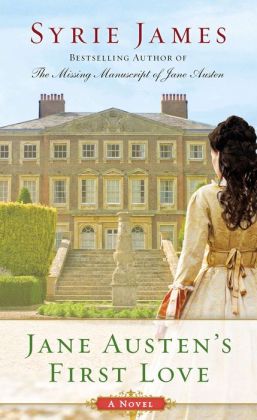
Jane Austen's First Love

Jane Austen's First Love. Syrie James. 2014. Berkley Trade. 400 pages. [Source: Review copy]

  I enjoyed reading Jane Austen's First Love. I admit I had my doubts at the beginning. On the one hand, after being so disappointed in Becoming Jane, I was hesitant to read anything giving Jane Austen a romance of her own. Also I wasn't wowed by The Lost Memoirs of Jane Austen. On the other hand, several people I respect really did love Jane Austen's First Love. While I can't say that I loved, loved, LOVED Jane Austen's First Love, I did really enjoy it. More than I thought I would at any rate.

1791. Summer of 1791. Jane and Cassandra travel to meet their brother Edward's fiancee, Elizabeth Bridges, and her family. (Several other family members go as well. The mother, but, not the father. Another brother, Charles, I believe. But the focus is mostly on Jane and Cassandra). Jane is just fifteen, she's not "out" yet. Her sister is a year or two older and is. Part of what makes this trip special, is that Jane is to be allowed certain privileges. She'll be allowed to go to dances and balls. She'll be allowed to powder her hair, etc. Most--if not all--the events will be family and friends. (Bringing together multiple families. Several of the Bridges' sisters are engaged to be married. All the engagements are being celebrated. There will be plenty of people there.)

On their trip, they happen to meet--quite dramatically--a young man named Edward Taylor. (He happens to be a neighbor, I believe.) Jane becomes smitten with him. He enjoys being with her, but, there aren't any OBVIOUS signs that he's madly, deeply in forever-and-ever-love with her. She may hope that he is "the one." But he is sixteen and not anywhere close to proposing marriage to anyone, no matter how lively, witty, charming, talented, beautiful, etc. Does Jane hope he is the one? The fictional, Jane, I mean? Perhaps. Perhaps not. Without a doubt, Jane enjoys herself tremendously, and finds time with him thrilling.

Strawberry picking. Dances. Dinners. Walks. Riding horses. Play acting. Matchmaking. Such is the stuff of Jane Austen's First Love.

One of the main plots surrounds the Bridges' sisters: Fanny, Elizabeth, and Sophia. They are all older than Jane. They are all of the courting age. Elizabeth and Fanny are engaged. Sophia is close to an engagement as well. Jane is watching; watching carefully, closely, analyzing and taking notes. Jane's observations lead her to believe that the sisters are mismatched! Readers meet a young Jane, an opinionated Jane, who is enjoying the idea of love, of falling in love, of finding love. What does she know of LOVE? What does she know of what makes two people compatible? It's interesting!

I also enjoyed how readers get a behind-the-scenes glimpse of Jane writing The Three Sisters. I would say that readers should take the time to read this little story on their own before, during, or after the novel.

© 2014 SukaYuka.com of SukaYuka's Book Reviews

Sunday, November 9, 2014

Sundays with Jane: Persuasion (1818)

Persuasion. Jane Austen 1818/1992. Knopf Doubleday. 304 pages. [Source: Bought]

Persuasion is my favorite Jane Austen novel. It just is. I believe this is the third time I've reviewed it. April 2011. January 2008. Out of all of Austen's opening lines, I have to admit that Persuasion's first sentence is my least favorite. Wouldn't you agree?

Opening to Sense and Sensibility: The family of Dashwood had long been settled in Sussex.

Opening to Pride and Prejudice: It is a truth universally acknowledged, that a single man in possession of a good fortune, must be in want of a wife.

Opening to Mansfield ParkAbout thirty years ago Miss Maria Ward, of Huntingdon, with only seven thousand pounds, had the good luck to captivate Sir Thomas Bertram, of Mansfield Park, in the county of Northampton, and to be thereby raised to the rank of a baronet's lady, with all the comforts and consequences of an handsome house and large income.

Opening to EmmaEmma Woodhouse, handsome, clever, and rich, with a comfortable home and happy disposition, seemed to unite some of the best blessings of existence; and had lived nearly twenty-one years in the world with very little to distress or vex her. 

Opening to Northanger AbbeyNo one who had ever seen Catherine Morland in her infancy would have supposed her born to be an heroine. Her situation in life, the character of her father and mother, her own person and disposition, were all equally against her. 

Opening to Persuasion: Sir Walter Elliot, of Kellynch Hall, in Somersetshire, was a man who, for his own amusement, never took up any book but the Baronetage; there he found occupation for an idle hour, and consolation in a distressed one; there his faculties were roused into admiration and respect, by contemplating the limited remnant of the earliest patents; there any unwelcome sensations, arising from domestic affairs changed naturally into pity and contempt as he turned over the almost endless creations of the last century; and there, if every other leaf were powerless, he could read his own history with an interest which never failed.

I've already summarized the plot twice before, and, the problem with reread posts is that I have to always (try to) find new ways to say what I've already said.

Anne Elliot is the heroine of Persuasion. If you haven't read Persuasion before let me add this, please, don't expect Anne to be Elizabeth Bennet. Just don't. You'll be happier for letting Anne be Anne and not comparing her to Elizabeth, Emma, Elinor, Marianne, Catherine, or Fanny. Plenty of people misunderstand Anne--the top offenders being her very own family--I don't want you to be one of them. Don't let her family persuade you that Anne is someone to easily dismiss, a nobody.

As I was saying, Anne is the heroine of Persuasion. Eight years before the novel opens, Anne fell in love. It was a forever-love. She wanted to marry Frederick Wentworth. He wanted to marry her too. They loved each other very much. But he had no way to support her. It wasn't just that he couldn't support her in style. Her family disapproved. Her friends disapproved. Long story short, the engagement was broken off. Persuasion is all about her second chance. When Anne and Captain Wentworth meet again, eight years later, can these two come together and make it work, can they have their happily ever after? That is the very simplified version, I suppose! Austen being Austen, there are plenty of characters and stories introduced in Persuasion. It is a very enjoyable read. In places, it is quite giddy-making.

Do you have a favorite Austen hero? Captain Wentworth is perhaps one of the strongest Austen heroes. Of course, everyone is familiar with Darcy. But Wentworth has his fans as well! Perhaps in large part due to his letter to Anne:
I can listen no longer in silence. I must speak to you by such means as are within my reach. You pierce my soul. I am half agony, half hope. Tell me not that I am too late, that such precious feelings are gone forever. I offer myself to you again with a heart even more your own than when you almost broke it eight years and a half ago. Dare not say that a man forgets sooner than woman, that his love has an earlier death. I have loved none but you. Unjust I may have been, weak and resentful I have been, but never inconstant. You alone have brought me to Bath. For you alone I think and plan. (234)
Personally, I love Henry Tilney, Mr. Knightley, and Captain Wentworth.

Favorite quotes:
Excepting one short period of her life, she had never, since the age of fourteen, never since the loss of her dear mother, known the happiness of being listened to, or encouraged by any just appreciation or real taste.
No, it was not regret which made Anne’s heart beat in spite of herself, and brought the colour into her cheeks when she thought of Captain Wentworth unshackled and free. She had some feelings which she was ashamed to investigate. They were too much like joy, senseless joy!
She hoped to be wise and reasonable in time; but alas! alas! she must confess to herself that she was not wise yet.

© 2014 SukaYuka.com of SukaYuka's Book Reviews
Sunday, October 12, 2014

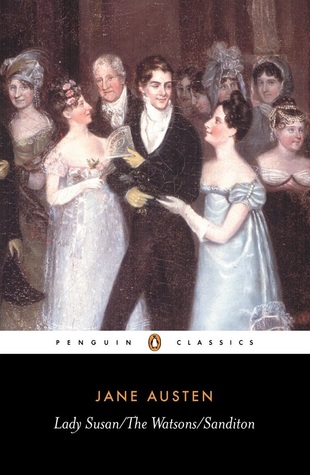
My Year with Jane: Lady Susan, Watsons, Sandition

Lady Susan, The Watsons, Sandition. Jane Austen. 1975. Penguin. 211 pages. [Source: Bought]

Lady Susan. I've read Lady Susan several times now. This is a quick, enjoyable read. I always forget how playful it is until I'm rereading it. I do have a tendency to dismiss it. The story, the drama, is told almost exclusively through letters. The epilogue being the exception. While I'm glad that readers do learn what happens next, how happily ever after is achieved for certain characters, it doesn't quite feel like it belongs either.

In the novel, readers meet Lady Susan and her daughter. She has invited herself to stay with a brother-in-law, I believe, and his family. Catherine is one of the main characters. She HATES Lady Susan and wishes she could politely throw her out of her home. She LOVES Lady Susan's daughter, however. One of Lady Susan's biggest fans is Reginald, Catherine's brother. Lady Susan can do no wrong in his eyes. His journey to the truth is interesting but frustrating.

The characters in this one are certainly different. Lady Susan reminds me of Mary Crawford in a way, with Mary Crawford being the tamer. Lady Susan is SOMETHING. She belongs on a soap opera perhaps.
Where there is a disposition to dislike, a motive will never be wanting.
In short, when a person is always to deceive, it is impossible to be consistent.
Facts are such horrid things!
The Watsons. This was my first time to read this incomplete novel. I would have loved it if Austen had finished it, I'm sure. It has so much potential. It had me from hello. Unfortunately, it is too brief to be truly satisfying. But in just a few short chapters, I found everything I love about Austen to be present.   
Miss Emma Watson, who was very recently returned to her family from the care of an aunt who had brought her up, was to make her first public appearance in the neighbourhood, and her eldest sister, whose delight in a ball was not lessened by a ten years’ enjoyment, had some merit in cheerfully undertaking to drive her and all her finery in the old chair to D. on the important morning.
Sandition. This was also my first time to read this incomplete novel. I think I liked the beginning of The Watsons more than I liked Sandition. (Even though Sandition is longer. Even though I found Sandition more quotable.) I am glad I read it...once. It was certainly enjoyable enough for what it was.
Sanditon was a second wife and four children to him, hardly less dear, and certainly more engrossing. He could talk of it forever. lt had indeed the highest claims; not only those of birthplace, property and home; it was his mine, his lottery, his speculation and his hobby horse; his occupation, his hope and his futurity.
EVERY NEIGHBOURHOOD should have a great lady. The great lady of Sanditon was Lady Denham; and in their journey from Willingden to the coast, Mr. Parker gave Charlotte a more detailed account of her than had been called for before. She had been necessarily often mentioned at Willingden -- for being his colleague in speculation, Sanditon itself could not be talked of long without the introduction of Lady Denham. That she was a very rich old lady, who had buried two husbands, who knew the value of money, and was very much looked up to and had a poor cousin living with her, were facts already known; but some further particulars of her history and her character served to lighten the tediousness of a long hill, or a heavy bit of road, and to give the visiting young lady a suitable knowledge of the person with whom she might now expect to be daily associating.
She took up a book; it happened to be a volume of Camilla. She had not Camilla’s youth, and had no intention of having her distress; so she turned from the drawers of rings and brooches, repressed further solicitation and paid for what she had bought.
 
© 2014 SukaYuka.com of SukaYuka's Book Reviews
Sunday, September 14, 2014

My Year with Jane: Northanger Abbey

Northanger Abbey. Jane Austen. 1817/1992. Everyman's Library. 288 pages. [Source: Library]

No one who had ever seen Catherine Morland in her infancy, would have supposed her born to be an heroine. Her situation in life, the character of her father and mother, her own person and disposition, were all equally against her. 

I know I say this with every Austen review, but, it's true: I love her novels more each time I read them. Now that I've read Northanger Abbey three or four times, I have to admit that I really do love it. Perhaps not as much as I love, love, love Persuasion. But I really am very fond of it. I am especially fond of Henry Tilney. He may just be my favorite, favorite, favorite Austen hero.

My latest review of the novel is from 2011. I am going to challenge myself to keep the summary as brief as possible:

Catherine Morland, our heroine, loves to read; she especially loves to read gothic novels. When she travels to Bath with her neighbors, she meets a new best friend, Isabella Thorpe, and a potential soul mate, Henry Tilney. While Miss Thorpe ends up disappointing her, Catherine's journey is not in vain for her crush, Henry, has a saint for a sister. When invited to visit the Tilney household, Catherine is beyond excited to accept. Her time at Northanger Abbey, the Tilney's home, proves shocking, but not at all in the way she expected.

I love the newest movie adaptation. I would definitely recommend it.

My favorite quotes:
She had reached the age of seventeen, without having seen one amiable youth who could call forth her sensibility, without having inspired one real passion, and without having excited even any admiration but what was very moderate and very transient. This was strange indeed! But strange things may be generally accounted for if their cause be fairly searched out. There was not one lord in the neighbourhood; no — not even a baronet. There was not one family among their acquaintance who had reared and supported a boy accidentally found at their door — not one young man whose origin was unknown. Her father had no ward, and the squire of the parish no children. But when a young lady is to be a heroine, the perverseness of forty surrounding families cannot prevent her. Something must and will happen to throw a hero in her way.
The master of the ceremonies introduced to her a very gentlemanlike young man as a partner; his name was Tilney. He seemed to be about four or five and twenty, was rather tall, had a pleasing countenance, a very intelligent and lively eye, and, if not quite handsome, was very near it. His address was good, and Catherine felt herself in high luck. There was little leisure for speaking while they danced; but when they were seated at tea, she found him as agreeable as she had already given him credit for being. He talked with fluency and spirit — and there was an archness and pleasantry in his manner which interested, though it was hardly understood by her. After chatting some time on such matters as naturally arose from the objects around them, he suddenly addressed her with — ”I have hitherto been very remiss, madam, in the proper attentions of a partner here; I have not yet asked you how long you have been in Bath; whether you were ever here before; whether you have been at the Upper Rooms, the theatre, and the concert; and how you like the place altogether. I have been very negligent — but are you now at leisure to satisfy me in these particulars? If you are I will begin directly.” “You need not give yourself that trouble, sir.” “No trouble, I assure you, madam.” Then forming his features into a set smile, and affectedly softening his voice, he added, with a simpering air, “Have you been long in Bath, madam?” “About a week, sir,” replied Catherine, trying not to laugh. “Really!” with affected astonishment. “Why should you be surprised, sir?” “Why, indeed!” said he, in his natural tone. “But some emotion must appear to be raised by your reply, and surprise is more easily assumed, and not less reasonable than any other. Now let us go on. Were you never here before, madam?” “Never, sir.” “Indeed! Have you yet honoured the Upper Rooms?” “Yes, sir, I was there last Monday.” “Have you been to the theatre?” “Yes, sir, I was at the play on Tuesday.” “To the concert?” “Yes, sir, on Wednesday.” “And are you altogether pleased with Bath?” “Yes — I like it very well.” “Now I must give one smirk, and then we may be rational again.” Catherine turned away her head, not knowing whether she might venture to laugh. “I see what you think of me,” said he gravely — ”I shall make but a poor figure in your journal tomorrow.”
“My journal!” “Yes, I know exactly what you will say: Friday, went to the Lower Rooms; wore my sprigged muslin robe with blue trimmings — plain black shoes — appeared to much advantage; but was strangely harassed by a queer, half-witted man, who would make me dance with him, and distressed me by his nonsense.” “Indeed I shall say no such thing.” “Shall I tell you what you ought to say?” “If you please.” “I danced with a very agreeable young man, introduced by Mr. King; had a great deal of conversation with him — seems a most extraordinary genius — hope I may know more of him. That, madam, is what I wish you to say.” “But, perhaps, I keep no journal.” “Perhaps you are not sitting in this room, and I am not sitting by you. These are points in which a doubt is equally possible. Not keep a journal! How are your absent cousins to understand the tenour of your life in Bath without one?
My dear madam, I am not so ignorant of young ladies’ ways as you wish to believe me; it is this delightful habit of journaling which largely contributes to form the easy style of writing for which ladies are so generally celebrated. Everybody allows that the talent of writing agreeable letters is peculiarly female. Nature may have done something, but I am sure it must be essentially assisted by the practice of keeping a journal.”
“What are you thinking of so earnestly?” said he, as they walked back to the ballroom; “not of your partner, I hope, for, by that shake of the head, your meditations are not satisfactory.” Catherine coloured, and said, “I was not thinking of anything.” “That is artful and deep, to be sure; but I had rather be told at once that you will not tell me.” “Well then, I will not.” “Thank you; for now we shall soon be acquainted, as I am authorized to tease you on this subject whenever we meet, and nothing in the world advances intimacy so much.”
I have no notion of loving people by halves; it is not my nature. My attachments are always excessively strong.
I consider a country-dance as an emblem of marriage. Fidelity and complaisance are the principal duties of both; and those men who do not choose to dance or marry themselves, have no business with the partners or wives of their neighbours.” “But they are such very different things!” “ — That you think they cannot be compared together.” “To be sure not. People that marry can never part, but must go and keep house together. People that dance only stand opposite each other in a long room for half an hour.” “And such is your definition of matrimony and dancing. Taken in that light certainly, their resemblance is not striking; but I think I could place them in such a view. You will allow, that in both, man has the advantage of choice, woman only the power of refusal; that in both, it is an engagement between man and woman, formed for the advantage of each; and that when once entered into, they belong exclusively to each other till the moment of its dissolution; that it is their duty, each to endeavour to give the other no cause for wishing that he or she had bestowed themselves elsewhere, and their best interest to keep their own imaginations from wandering towards the perfections of their neighbours, or fancying that they should have been better off with anyone else. You will allow all this?” “Yes, to be sure, as you state it, all this sounds very well; but still they are so very different. I cannot look upon them at all in the same light, nor think the same duties belong to them.” “In one respect, there certainly is a difference. In marriage, the man is supposed to provide for the support of the woman, the woman to make the home agreeable to the man; he is to purvey, and she is to smile. But in dancing, their duties are exactly changed; the agreeableness, the compliance are expected from him, while she furnishes the fan and the lavender water. That, I suppose, was the difference of duties which struck you, as rendering the conditions incapable of comparison.”
“The person, be it gentleman or lady, who has not pleasure in a good novel, must be intolerably stupid. I have read all Mrs. Radcliffe’s works, and most of them with great pleasure. The Mysteries of Udolpho, when I had once begun it, I could not lay down again; I remember finishing it in two days — my hair standing on end the whole time.” “Yes,” added Miss Tilney, “and I remember that you undertook to read it aloud to me, and that when I was called away for only five minutes to answer a note, instead of waiting for me, you took the volume into the Hermitage Walk, and I was obliged to stay till you had finished it.” “Thank you, Eleanor — a most honourable testimony. You see, Miss Morland, the injustice of your suspicions. Here was I, in my eagerness to get on, refusing to wait only five minutes for my sister, breaking the promise I had made of reading it aloud, and keeping her in suspense at a most interesting part, by running away with the volume, which, you are to observe, was her own, particularly her own. I am proud when I reflect on it, and I think it must establish me in your good opinion.”
“I am very glad to hear it indeed, and now I shall never be ashamed of liking Udolpho myself. But I really thought before, young men despised novels amazingly.” “It is amazingly; it may well suggest amazement if they do — for they read nearly as many as women. I myself have read hundreds and hundreds. Do not imagine that you can cope with me in a knowledge of Julias and Louisas. If we proceed to particulars, and engage in the never-ceasing inquiry of ‘Have you read this?’ and ‘Have you read that?’ I shall soon leave you as far behind me as — what shall I say? — I want an appropriate simile. — as far as your friend Emily herself left poor Valancourt when she went with her aunt into Italy. Consider how many years I have had the start of you. I had entered on my studies at Oxford, while you were a good little girl working your sampler at home!” “Not very good, I am afraid. But now really, do not you think Udolpho the nicest book in the world?”
The word ‘nicest,’ as you used it, did not suit him; and you had better change it as soon as you can, or we shall be overpowered with Johnson and Blair all the rest of the way.” “I am sure,” cried Catherine, “I did not mean to say anything wrong; but it is a nice book, and why should not I call it so?” “Very true,” said Henry, “and this is a very nice day, and we are taking a very nice walk, and you are two very nice young ladies. Oh! It is a very nice word indeed! It does for everything. Originally perhaps it was applied only to express neatness, propriety, delicacy, or refinement — people were nice in their dress, in their sentiments, or their choice. But now every commendation on every subject is comprised in that one word.” 
It was no effort to Catherine to believe that Henry Tilney could never be wrong. His manner might sometimes surprise, but his meaning must always be just: and what she did not understand, she was almost as ready to admire, as what she did.
The past, present, and future were all equally in gloom.
Wherever you are you should always be contented, but especially at home, because there you must spend the most of your time.
© 2014 SukaYuka.com of SukaYuka's Book Reviews
Sunday, August 10, 2014

Sundays with Jane: Two by Cornthwaite

Charity Envieth Not. (George Knightley #1) Barbara Cornthwaite. 2009. CreateSpace. 260 pages. [Source: Library]
and
Lend Me Leave. (George Knightley #2) Barbara Cornthwaite. 2011. CreateSpace. 246 pages. [Source: Library]

I absolutely loved reading Charity Envieth Not and Lend Me Leave. These two books tell the novel Emma through the perspective of George Knightley. I almost wish they were combined into one edition, however. Still, I can't begin to recommend these enough to all Austen fans!!!

I enjoyed many aspects of both books. I really, really loved George Knightley. That in and of itself is far from shocking. Dare I say he's probably the best thing about Austen's novel?! I loved seeing the characters (and/or the community) through his eyes. I loved his involvement in the community. I loved meeting various characters--rich and poor, from all classes or statuses. I especially, especially liked Spencer! I loved getting to know his brother John better. And I liked seeing him in the role of uncle! I liked how wide the perspective is--if that makes sense! Emma, to me, comes across as very self-centered, the world through her eyes seem a bit narrow.

I also appreciate how both books treat the character of Emma. I think to fully appreciate Emma, one HAS to see her AS Knightley sees her. This book accomplishes that! I don't think I've ever seen Emma in such a positive light before. And it made me think a bit, what if Emma is blinded to her strengths JUST as she's blinded to her weaknesses. OR in other words, what if the narration is a bit too close to accurately judge her strengths/weaknesses. Of course, Knightley cannot absolutely read all her motives and intentions, so maybe he's reading more compassion, more tenderness, more generosity than is really truly there. But maybe just maybe Emma's heart is bigger than I have previously thought. And maybe just maybe her mind isn't quite as empty as I thought it. I kept asking myself what does Knightley see in Emma that I don't?

I would recommend it to those who already love Emma, and even to those that don't really like her. Knightley is a great hero! And he's definitely worth reading about!

© 2014 SukaYuka.com of SukaYuka's Book Reviews

Sunday, July 13, 2014

My Year with Jane: Emma (1815)

Emma. Jane Austen. 1815. 544 pages. [Source: Bought]
Emma Woodhouse, handsome, clever, and rich, with a comfortable home and happy disposition, seemed to unite some of the best blessings of existence; and had lived nearly twenty-one years in the world with very little to distress or vex her. She was the youngest of the two daughters of a most affectionate, indulgent father; and had, in consequence of her sister’s marriage, been mistress of his house from a very early period. Her mother had died too long ago for her to have more than an indistinct remembrance of her caresses; and her place had been supplied by an excellent woman as governess, who had fallen little short of a mother in affection.
Did I like Emma more the second time around? That would be a definite yes. Is Emma my new favorite Austen? Of course not! Emma is still Emma. She'll never be a heroine that I love and adore. But have I learned to appreciate her? I think so. At least to a certain extent. There must be something about her if Mr. Knightley loves her so much. I trust Mr. Knightley. He's one big reason why I think Emma will always be worth reading and rereading.

The plot: Emma and her father are "mourning" the loss of Miss Taylor who married Mr. Weston. Emma doesn't have anyone exactly her equal in terms of social status, so she bends a bit and befriends Harriet. When the novel opens, Harriet and Mr. Martin are on the way to making a match. Emma sees Harriet as potentially being her equal and staying her equal--if she marries well, marries above her current status. Emma sees Harriet as being desperately in need of saving. Harriet becomes her project. Find a husband for Harriet, she will! Who is in need of a wife? Well, there's Mr. Elton. He's available, of course. Wouldn't it be splendid if those two got together?! The problem, as you might be aware, is that Mr. Elton has a wife in mind, and that wife is so not Harriet...

Meanwhile, Mr. and Mrs. Weston are hoping that Frank Churchill, Mr. Weston's son from his first marriage, will come to visit as he promised. There's always an excuse, a good excuse, or at least a valid excuse. When Frank does come to the community, well, expect trouble.

Oh, how I HATE HATE HATE Frank Churchill. Even if I try to stretch myself and see it from his point of view, I can't find my way to justifying ANYTHING he says and does before he is found out.

It was interesting to be reading Emma while watching the series  Emma Approved. I am a big, big Emma Approved fan, and, I must admit it was fun to go back to the original.

Have you read Emma? Do you have a favorite adaptation? What do you think of Clueless and Emma Approved?

Quotes:
The real evils, indeed, of Emma’s situation were the power of having rather too much her own way, and a disposition to think a little too well of herself; these were the disadvantages which threatened alloy to her many enjoyments. The danger, however, was at present so unperceived, that they did not by any means rank as misfortunes with her.
Mr. Knightley, in fact, was one of the few people who could see faults in Emma Woodhouse, and the only one who ever told her of them: and though this was not particularly agreeable to Emma herself, she knew it would be so much less so to her father, that she would not have him really suspect such a circumstance as her not being thought perfect by every body.
“Emma has been meaning to read more ever since she was twelve years old. I have seen a great many lists of her drawing-up at various times of books that she meant to read regularly through — and very good lists they were — very well chosen, and very neatly arranged — sometimes alphabetically, and sometimes by some other rule. The list she drew up when only fourteen — I remember thinking it did her judgment so much credit, that I preserved it some time; and I dare say she may have made out a very good list now. But I have done with expecting any course of steady reading from Emma. She will never submit to any thing requiring industry and patience, and a subjection of the fancy to the understanding. Where Miss Taylor failed to stimulate, I may safely affirm that Harriet Smith will do nothing. — You never could persuade her to read half so much as you wished. — You know you could not.”
A poet in love must be encouraged in both capacities, or neither.
Were I to fall in love, indeed, it would be a different thing! but I never have been in love; it is not my way, or my nature; and I do not think I ever shall. And, without love, I am sure I should be a fool to change such a situation as mine. Fortune I do not want; employment I do not want; consequence I do not want: I believe few married women are half as much mistress of their husband’s house as I am of Hartfield; and never, never could I expect to be so truly beloved and important; so always first and always right in any man’s eyes as I am in my father’s.
There are people, who the more you do for them, the less they will do for themselves.
It is very unfair to judge of any body’s conduct, without an intimate knowledge of their situation.
Nobody, who has not been in the interior of a family, can say what the difficulties of any individual of that family may be.
Wickedness is always wickedness, but folly is not always folly.
Emma continued to entertain no doubt of her being in love. Her ideas only varied as to the how much.
A vast deal may be done by those who dare to act.
How long had Mr. Knightley been so dear to her, as every feeling declared him now to be? When had his influence, such influence begun? — When had he succeeded to that place in her affection, which Frank Churchill had once, for a short period, occupied? — She looked back; she compared the two — compared them, as they had always stood in her estimation, from the time of the latter’s becoming known to her — and as they must at any time have been compared by her, had it — oh! had it, by any blessed felicity, occurred to her, to institute the comparison. — She saw that there never had been a time when she did not consider Mr. Knightley as infinitely the superior, or when his regard for her had not been infinitely the most dear. She saw, that in persuading herself, in fancying, in acting to the contrary, she had been entirely under a delusion, totally ignorant of her own heart — and, in short, that she had never really cared for Frank Churchill at all!
If I loved you less, I might be able to talk about it more. But you know what I am. — You hear nothing but truth from me. — I have blamed you, and lectured you, and you have borne it as no other woman in England would have borne it. — Bear with the truths I would tell you now, dearest Emma, as well as you have borne with them. The manner, perhaps, may have as little to recommend them. God knows, I have been a very indifferent lover. — But you understand me. — Yes, you see, you understand my feelings — and will return them if you can. At present, I ask only to hear, once to hear your voice.

© 2014 SukaYuka.com of SukaYuka's Book Reviews
Sunday, June 8, 2014

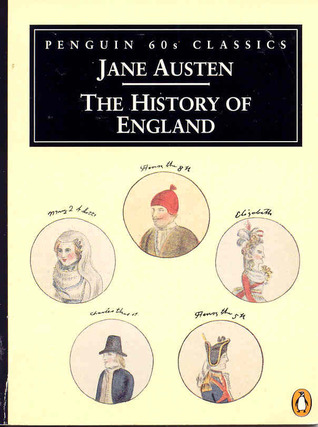
My Year With Jane: History of England

History of England. Jane Austen. 1977. 64 pages. [Source: Book I Bought]

Jane Austen's The History of England is a short and worthy read for any lover of Austen OR for any lover of British history. Austen does not seek to cover every single king or queen in her "history." She begins with Henry IV and ends with Charles I. Some monarchs get only one or two paragraphs. Others get much more attention. But more attention does not equal favorable attention. After all, this isn't a history book by a historian. No, never forget that this history is "by a partial, prejudiced, and ignorant" historian.

I would definitely recommend this one! Have you read this one? Do you have a favorite "history of England" book to recommend?
Henry VI: "I cannot say much for this Monarch's sense. Nor would I if I could, for he was a Lancastrian. I suppose you know all about the Wars between him and the Duke of York who was of the right side; if you do not, you had better read some other History, for I shall not be very diffuse in this, meaning by it only to vent my spleen against, and shew my Hatred to all those people whose parties or principles do not suit with mine, and not to give information. This King married Margaret of Anjou, a Woman whose distresses and misfortunes were so great as almost to make me who hate her, pity her. It was in this reign that Joan of Arc lived and made such a row among the English. They should not have burnt her —but they did. There were several Battles between the Yorkists and Lancastrians, in which the former (as they ought) usually conquered. At length they were entirely overcome; The King was murdered—The Queen was sent home—and Edward the 4th ascended the Throne."
Edward IV: "One of Edward's Mistresses was Jane Shore, who has had a play written about her, but it is a tragedy and therefore not worth reading."
Henry VIII: "It would be an affront to my Readers were I to suppose that they were not as well acquainted with the particulars of this King's reign as I am myself. It will therefore be saving them the task of reading again what they have read before, and myself the trouble of writing what I do not perfectly recollect, by giving only a slight sketch of the principal Events which marked his reign." 
 Bloody Mary: "This woman had the good luck of being advanced to the throne of England, in spite of the superior pretensions, Merit, and Beauty of her Cousins Mary Queen of Scotland and Jane Grey. Nor can I pity the Kingdom for the misfortunes they experienced during her Reign, since they fully deserved them, for having allowed her to succeed her Brother—which was a double peice of folly, since they might have foreseen that as she died without children, she would be succeeded by that disgrace to humanity, that pest of society, Elizabeth. Many were the people who fell martyrs to the protestant Religion during her reign; I suppose not fewer than a dozen. She married Philip King of Spain who in her sister's reign was famous for building Armadas. She died without issue, and then the dreadful moment came in which the destroyer of all comfort, the deceitful Betrayer of trust reposed in her, and the Murderess of her Cousin succeeded to the Throne.——" 
© 2014 SukaYuka.com of SukaYuka's Book Reviews
Sunday, April 13, 2014

My Year with Jane: Mansfield Park

Mansfield Park. Jane Austen. 1814. 464 pages. [Source: Book I Bought]

I have read Mansfield Park three times. The first time I found myself frustrated and bored. Where was the romance? Where was the satisfaction? Who was supposed to be THE HERO?! Was it really supposed to be Edmund?! The second time I read it, I found myself entertained. I also found myself falling for the wrong hero, Henry Crawford and asking plenty of what might have been questions. The third time it was a joy to revisit. This isn't the first time that it has taken multiple readings to enjoy and appreciate and love an Austen novel. I haven't decided what this means exactly. If it is a good thing that Austen's novels are layered and complex and take some time to absorb, or, if it's a weakness. If you don't exactly "enjoy" something the first time, what is there to make you want to go back and read it again and again? I think Pride and Prejudice is the one big exception to the rule. Also perhaps Persuasion.

Fanny Price is the heroine of Mansfield Park. She is intelligent, observant, selfless, and considerate. Part of this is her upbringing, she's been brought up to put everyone else's wants and needs and whims ahead of her own. Part of this is just her nature, in my opinion. She treats everyone with kindness and respect regardless of whether they "deserve" it or not.  
It would be delightful to feel myself of consequence to anybody.
Fanny, being always a very courteous listener, and often the only listener at hand, came in for the complaints and the distresses of most of them.
Edmund Bertram is Fanny's cousin. He will be a minister. He falls madly in love (if it is truly love and not lust) with Mary Crawford. For almost the entire novel, he talks on and on and on and on about Mary to poor Fanny. He can at any given time give you a top ten list on why Mary is completely wrong for him and why it would never work out in the end. But she is the ONLY WOMAN IN THE WORLD HE COULD EVER LOVE. Of course, Fanny is in love with Edmund. Fanny's patience in listening to Edmund alone would make her worthy of being a saint.
I cannot give her up, Fanny. She is the only woman in the world whom I could ever think of as a wife. If I did not believe that she had some regard for me, of course I should not say this, but I do believe it.
Mary Crawford is Fanny's opposite in many, many ways. She doesn't know how to be serious. She talks way too much. She shares way too much. She's rude and inconsiderate. And her first love, her forever love, will always be herself.
Selfishness must always be forgiven, you know, because there is no hope of a cure.
Henry Crawford is Mary's brother. He is Fanny's opposite too. He has a very high opinion of himself. And he finds nothing so satisfying as making women fall in love with him. He loves being loved and adored. He determines at one point that it would be SOMETHING to have Fanny fall in love with him. He knows it will be the most difficult challenge he's faced so far. She's no fool. In the attempting, it is Henry who falls hard. He finds himself for the first time actually caring and loving someone else. Or does he? Austen is a bit ambiguous how far his reform goes.
I never was so long in company with a girl in my life, trying to entertain her, and succeed so ill! Never met with a girl who looked so grave on me! I must try to get the better of this. Her looks say, ‘I will not like you, I am determined not to like you’; and I say she shall.
They will now see what sort of woman it is that can attach me, that can attach a man of sense. I wish the discovery may do them any good. And they will now see their cousin treated as she ought to be, and I wish they may be heartily ashamed of their own abominable neglect and unkindness. They will be angry,” he added, after a moment’s silence, and in a cooler tone; “Mrs. Rushworth will be very angry. It will be a bitter pill to her; that is, like other bitter pills, it will have two moments’ ill flavour, and then be swallowed and forgotten; for I am not such a coxcomb as to suppose her feelings more lasting than other women’s, though I was the object of them. Yes, Mary, my Fanny will feel a difference indeed: a daily, hourly difference, in the behaviour of every being who approaches her; and it will be the completion of my happiness to know that I am the doer of it, that I am the person to give the consequence so justly her due.
Now she is dependent, helpless, friendless, neglected, forgotten.” “Nay, Henry, not by all; not forgotten by all; not friendless or forgotten. Her cousin Edmund never forgets her.” “Edmund! True, I believe he is, generally speaking, kind to her, and so is Sir Thomas in his way; but it is the way of a rich, superior, long-worded, arbitrary uncle. What can Sir Thomas and Edmund together do, what do they do for her happiness, comfort, honour, and dignity in the world, to what I shall do?”   
Mansfield Park is without a doubt one of the messier Austen novels. Messy isn't the perfect word, I know. The characters of Mansfield Park are so messed up, so in need of fixing. Readers never know exactly why Fanny loves Edmund with all her heart and soul. Readers just have to take Fanny's love on faith, believing that she knows best, that she knows her heart better than we do, and, that Edmund BEFORE Mary was worth loving. Austen's ending is far from romantic in that the romance between Fanny and Edmund is not developed on the page.

I can easily imagine Fanny in these words:

You give your hand to me
And then you say, "Hello."
And I can hardly speak,
My heart is beating so.
And anyone can tell
You think you know me well.
Well, you don't know me.


And with a big, big stretch, maybe Edmund in these words:

Are those your eyes
Is that your smile
I've been looking at you forever
Yet I never saw you before
Are these your hands holding mine
Now I wonder how I could have been so blind
And for the first time I am looking in your eyes
For the first time I'm seeing who you are
I can't believe how much I see
When you're looking back at me

 The first is "You Don't Know Me" and the second is "For The First Time."

© 2014 SukaYuka.com of SukaYuka's Book Reviews

Sunday, March 9, 2014

My Year with Jane: Pride and Prejudice

Pride and Prejudice. Jane Austen. 1813. 386 pages. [Source: Book I Bought]

It is a truth universally acknowledged, that a single man in possession of a good fortune, must be in want of a wife. However little known the feelings or views of such a man may be on his first entering a neighbourhood, this truth is so well fixed in the minds of the surrounding families, that he is considered the rightful property of some one or other of their daughters.

Is Pride and Prejudice your favorite Jane Austen novel? Why or why not?

I must admit that Pride and Prejudice is not my favorite, favorite Austen. I almost like that it is not my favorite book by Austen. But. No matter how much I say it isn't my favorite, every single time I reread this one, I am surprised by how satisfying and lovely it really is. It is so incredibly familiar, and I think that is part of the charm. The dialogue is so familiar, the characters feel like old friends, you can't help getting swept up into the story, the romance once again. The movies probably have more than a little to do with that. Do you have a favorite adaptation?

There are so many characters to love, so many characters to love to hate. Do you have a favorite? Elizabeth is not my favorite Austen heroine, but, she is probably among my favorites from Pride and Prejudice. I love her relationships: seeing Elizabeth with Jane, seeing Elizabeth with Charlotte, seeing Elizabeth with Lady Catherine, seeing Elizabeth with Darcy!

Like most Austen novels, the more attention you pay to the little details, the more you'll be rewarded! That is why rereading is oh-so-essential.

Quotes:
His character was decided. He was the proudest, most disagreeable man in the world, and everybody hoped that he would never come there again. Amongst the most violent against him was Mrs. Bennet, whose dislike of his general behaviour was sharpened into particular resentment by his having slighted one of her daughters. Elizabeth Bennet had been obliged, by the scarcity of gentlemen, to sit down for two dances; and during part of that time, Mr. Darcy had been standing near enough for her to hear a conversation between him and Mr. Bingley, who came from the dance for a few minutes, to press his friend to join it. “Come, Darcy,” said he, “I must have you dance. I hate to see you standing about by yourself in this stupid manner. You had much better dance.”
“I certainly shall not. You know how I detest it, unless I am particularly acquainted with my partner. At such an assembly as this it would be insupportable. Your sisters are engaged, and there is not another woman in the room whom it would not be a punishment to me to stand up with.” “I would not be so fastidious as you are,” cried Mr. Bingley, “for a kingdom! Upon my honour, I never met with so many pleasant girls in my life as I have this evening; and there are several of them you see uncommonly pretty.” “You are dancing with the only handsome girl in the room,” said Mr. Darcy, looking at the eldest Miss Bennet. “Oh! She is the most beautiful creature I ever beheld! But there is one of her sisters sitting down just behind you, who is very pretty, and I dare say very agreeable. Do let me ask my partner to introduce you.” “Which do you mean?” and turning round he looked for a moment at Elizabeth, till catching her eye, he withdrew his own and coldly said: “She is tolerable, but not handsome enough to tempt me; I am in no humour at present to give consequence to young ladies who are slighted by other men. You had better return to your partner and enjoy her smiles, for you are wasting your time with me.” Mr. Bingley followed his advice. Mr. Darcy walked off; and Elizabeth remained with no very cordial feelings toward him.
“My dear Miss Eliza, why are you not dancing? Mr. Darcy, you must allow me to present this young lady to you as a very desirable partner. You cannot refuse to dance, I am sure when so much beauty is before you.” And, taking her hand, he would have given it to Mr. Darcy who, though extremely surprised, was not unwilling to receive it, when she instantly drew back, and said with some discomposure to Sir William: “Indeed, sir, I have not the least intention of dancing. I entreat you not to suppose that I moved this way in order to beg for a partner.” Mr. Darcy, with grave propriety, requested to be allowed the honour of her hand, but in vain. Elizabeth was determined; nor did Sir William at all shake her purpose by his attempt at persuasion. “You excel so much in the dance, Miss Eliza, that it is cruel to deny me the happiness of seeing you; and though this gentleman dislikes the amusement in general, he can have no objection, I am sure, to oblige us for one half-hour.” “Mr. Darcy is all politeness,” said Elizabeth, smiling. “He is, indeed; but, considering the inducement, my dear Miss Eliza, we cannot wonder at his complaisance — for who would object to such a partner?” Elizabeth looked archly, and turned away. Her resistance had not injured her with the gentleman, and he was thinking of her with some complacency, when thus accosted by Miss Bingley: “I can guess the subject of your reverie.” “I should imagine not.” My mind was more agreeably engaged. I have been meditating on the very great pleasure which a pair of fine eyes in the face of a pretty woman can bestow.”
“It is a rule with me, that a person who can write a long letter with ease, cannot write ill.” “That will not do for a compliment to Darcy, Caroline,” cried her brother, “because he does not write with ease. He studies too much for words of four syllables. Do not you, Darcy?” “My style of writing is very different from yours.” “Oh!” cried Miss Bingley, “Charles writes in the most careless way imaginable. He leaves out half his words, and blots the rest.” “My ideas flow so rapidly that I have not time to express them — by which means my letters sometimes convey no ideas at all to my correspondents.” “Your humility, Mr. Bingley,” said Elizabeth, “must disarm reproof.” “Nothing is more deceitful,” said Darcy, “than the appearance of humility. It is often only carelessness of opinion, and sometimes an indirect boast.” “And which of the two do you call my little recent piece of modesty?” “The indirect boast; for you are really proud of your defects in writing, because you consider them as proceeding from a rapidity of thought and carelessness of execution, which, if not estimable, you think at least highly interesting. The power of doing anything with quickness is always prized much by the possessor, and often without any attention to the imperfection of the performance.
“Miss Eliza Bennet, let me persuade you to follow my example, and take a turn about the room. I assure you it is very refreshing after sitting so long in one attitude.” Elizabeth was surprised, but agreed to it immediately. Miss Bingley succeeded no less in the real object of her civility; Mr. Darcy looked up. He was as much awake to the novelty of attention in that quarter as Elizabeth herself could be, and unconsciously closed his book. He was directly invited to join their party, but he declined it, observing that he could imagine but two motives for their choosing to walk up and down the room together, with either of which motives his joining them would interfere. “What could he mean? She was dying to know what could be his meaning?” — and asked Elizabeth whether she could at all understand him? “Not at all,” was her answer; “but depend upon it, he means to be severe on us, and our surest way of disappointing him will be to ask nothing about it.” Miss Bingley, however, was incapable of disappointing Mr. Darcy in anything, and persevered therefore in requiring an explanation of his two motives. “I have not the smallest objection to explaining them,” said he, as soon as she allowed him to speak. “You either choose this method of passing the evening because you are in each other’s confidence, and have secret affairs to discuss, or because you are conscious that your figures appear to the greatest advantage in walking; if the first, I would be completely in your way, and if the second, I can admire you much better as I sit by the fire.” “Oh! shocking!” cried Miss Bingley. “I never heard anything so abominable. How shall we punish him for such a speech?” “Nothing so easy, if you have but the inclination,” said Elizabeth. “We can all plague and punish one another. Tease him — laugh at him. Intimate as you are, you must know how it is to be done.”
It is happy for you that you possess the talent of flattering with delicacy. May I ask whether these pleasing attentions proceed from the impulse of the moment, or are the result of previous study?” “They arise chiefly from what is passing at the time, and though I sometimes amuse myself with suggesting and arranging such little elegant compliments as may be adapted to ordinary occasions, I always wish to give them as unstudied an air as possible.” Mr. Bennet’s expectations were fully answered. His cousin was as absurd as he had hoped, and he listened to him with the keenest enjoyment, maintaining at the same time the most resolute composure of countenance, and, except in an occasional glance at Elizabeth, requiring no partner in his pleasure.
When those dances were over, she returned to Charlotte Lucas, and was in conversation with her, when she found herself suddenly addressed by Mr. Darcy who took her so much by surprise in his application for her hand, that, without knowing what she did, she accepted him. He walked away again immediately, and she was left to fret over her own want of presence of mind; Charlotte tried to console her: “I dare say you will find him very agreeable.” “Heaven forbid! That would be the greatest misfortune of all! To find a man agreeable whom one is determined to hate! Do not wish me such an evil.”
I must stop quoting now! I have a feeling that they could get out of control!

My first review September 2007
My second review December 2011

© 2014 SukaYuka.com of SukaYuka's Book Reviews

Sunday, February 9, 2014

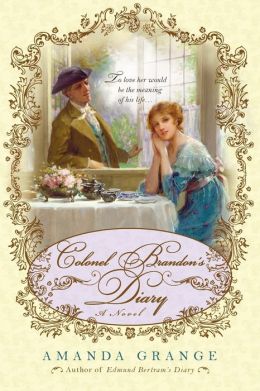
My Year with Jane: Colonel Brandon's Diary

Colonel Brandon's Diary. Amanda Grange. 2009. Penguin. 304 pages. [Source: Library]

When I decided to reread Jane Austen in 2014, I had a feeling that I'd also end up rereading Amanda Grange's Diary series. After finishing Austen's Sense and Sensibility, I felt the need to reread Colonel Brandon's Diary. It was just as lovely as I remembered; I first read it in November 2009. In fact, if I hadn't fallen in love with Amanda Grange's novel, I might not have gone back to Austen's novel again and again. The first time I read Sense and Sensibility, something was missing. I suppose I wasn't in the proper mood to read it and appreciate it, to savor and treasure each page. I rushed through it vaguely dissatisfied. Every time I've reread it since, I've loved it, really truly loved it. I've been surprised that I could have ever found it unsatisfying.

I love and adore Colonel Brandon. I love getting his story. I love seeing things through his point of view. I love getting to know the two Eliza's in his life: mother and daughter. I love how Grange gives a whole new perspective to his courtship with Marianne. I love seeing Colonel Brandon's reaction to Mrs. Jennings too. I love that he wasn't as quick to fall madly, deeply in love with Marianne as Mrs. Jennings is to suspect him of doing just that. His conversations with Marianne in the last part of the novel really worked for me. Marianne's "transformation" does not come across as so sudden, so dramatic. The relationship feels to be moving along at just the right pace; a relationship built on friendship and respect and love.

I would definitely recommend this one! I only wish that Amanda Grange would write more Diaries. I would love to see Edward Ferrars' Diary. I'd love his perspective, to catch a glimpse of his past, of his relationships with his family, of his infatuation with Lucy Steele, and his first impressions of Elinor! I also admit that I'd want to read Willoughby's Diary! After all, Willoughby is at least as interesting as Wickham!

© 2014 SukaYuka.com of SukaYuka's Book Reviews