Showing posts with label favorite authors. Show all posts

Friday, September 12, 2014

Reread #37 Fahrenheit 451

Fahrenheit 451. Ray Bradbury. 1953/1991. Del Rey. 179 pages. [Source: Bought]

It was a pleasure to burn. 

I've written about Fahrenheit 451 quite a bit. Once in May 2007, which was the first time I read it. Twice in 2010; one was a graphic novel. I've read A Pleasure To Burn: Fahrenheit 451 Stories, a book of short stories and novellas that show the thematic evolution of Fahrenheit 451. I've reviewed the movie. I reread it in June 2012 and September 2013.

Obviously this is a book that I absolutely love.

Fahrenheit 451 is a novel set in a world where thinking is a crime. I exaggerate perhaps. Thinking deeply is dangerous. Thinking for yourself is dangerous. Thinking superficial thoughts that everyone-else-in-society is thinking--like about what to watch, what to listen to, what to buy, where to go to have a good time--that is okay, more than okay. It is to be encouraged. It is individuality and contemplation and reflection that is dangerous. Every minute of every hour of every day is to be packed full of distractions making it impossible to think, to consider, to reflect, to observe, to question, to feel anything truly and deeply. It's a more, more, faster, faster world. And it's a world that our hero, Guy Montag realizes he loathes. He is a fireman. He burns books, houses, and sometimes people. But Guy Montag is living a secret life: he doesn't like burning books; in fact, he wishes he could save them and read them. He does manage to "save" a handful here and there. But taking them home and hiding them, well, there's a risk involved. He's willing to take it because he's so miserable, and he feels that society is so unreal and pointless. He wants answers, not ads. He wants to learn, to know, to feel.

Quotes:
"People don't talk about anything."
"Oh, they must!"
"No, not anything. They name a lot of cars or clothes or swimming pools mostly and say how swell! But they all say the same things and nobody says anything different from anyone else..." (31)
"We need not to be let alone. We need to be really bothered once in a while. How long is it since you were really bothered? About something important, about something real?" (52)
Who knows who might be the target of the well-read man? Me? I won't stomach them for a minute. (58)
Ask yourself, What do we want in this country, above all? People want to be happy, isn't that right right? Haven't you heart it all your life? I want to be happy, people say. Well, aren't they? Don't we keep them moving, don't we give them fun? That's all we live for, isn't it? For pleasure, for titillation? And you must admit our culture provides plenty of these. (59)
Did you listen to him? He knows all the answers. He's right. Happiness is important. Fun is everything. (65)
"We cannot tell the precise moment when friendship is formed. As in filling a vessel drop by drop, there is at last a drop which makes it run over; so in a series of kindnesses there is at last one which makes the heart run over." (71)
Every hour so many damn things in the sky! How in hell did those bombers get up there every single second of our lives! Why doesn't someone want to talk about it! We've started and won two atomic wars since 1990! Is it because we're having so much fun at home we've forgotten the world? Is it because we're so rich and the rest of the world's so poor and we just don't care if they are? Is that why we're hated so much? Do you know why? I don't, that's sure! Maybe the books can get us half out of the cave. God, Millie, don't you see? An hour a day, two hours, with these books, and maybe. (73-4)
It’s been a long time. I’m not a religious man. But it’s been a long time.’ Faber turned the pages, stopping here and there to read. ‘It’s as good as I remember. Lord, how they’ve changed it in our parlors these days. Christ is one of the family now. I often wonder if God recognizes His own son the way we’ve dressed him up, or is it dressed him down? He’s a regular peppermint stick now, all sugar-crystal and saccharine when he isn’t making veiled references to certain commercial products that every worshiper absolutely needs.’ (81)
"You're a hopeless romantic," said Faber. "It would be funny if it were not serious. It's not books you need, it's some of the things that once were in books. The same things could be in the 'parlor families' today. The same infinite detail and awareness could be projected through the radios and televisors, but are not. (82)
 Do you know why books such as this are so important? Because they have quality. And what does the word quality mean? To me it means texture. This book has pores. It has features. This book can go under the microscope. You'd find life under the glass, streaming past in infinite profusion. The more pores, the more truthfully recorded details of life per square inch you can get on a sheet of paper, the more 'literary' you are. That's my definition, anyway. Telling detail. Fresh detail. The good writers touch life often. the mediocre ones run a quick hand over her. The bad ones rape her and leave her for the flies. So now do you see why books are hated and feared? They show the pores in the face of life. The comfortable people want only wax moon faces, poreless, hairless, expressionless. we are living in a time when flowers are trying to live on flowers, instead of growing on good rain and black loam. (83)
"Caesarians or not, children are ruinous; you're out of your mind," said Mrs. Phelps.
"I plunk the children in school nine days out of ten. I put up with them when they come home three days a month; it's not bad at all. You heave them into the 'parlor' and turn the switch. It's like washing clothes: stuff laundry in and slam the lid." Mrs. Bowles tittered. "They'd just as soon kick as kiss me. Thank God, I can kick back!" (96)
© 2014 SukaYuka.com of SukaYuka's Book Reviews

Sunday, June 15, 2014

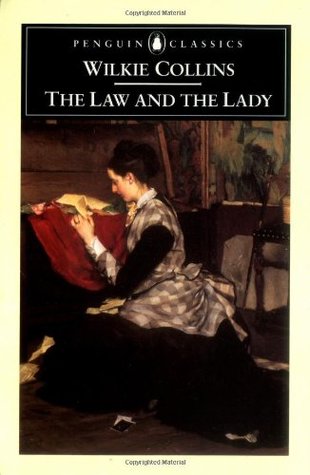
The Law and the Lady (1875)

The Law and the Lady. Wilkie Collins. 1875. 430 pages. [Source: Book I Bought]

The Law and the Lady may not be my favorite Wilkie Collins novel, but, I am glad I finally read this "first" female detective novel. Valeria is our heroine, our amateur detective. Readers meet her on her wedding day. Foreshadowing is abundant. All is not well. Things may never be well for this couple. Within days, Valeria is noticing inconsistencies and becoming super suspicious of her husband. She snoops in his things; she goes to his friends to ask questions, etc. She makes a DISCOVERY.

Her husband was married before. His first wife died. He was tried for murder--suspected of poisoning her by arsenic. The Scottish Verdict was "Not Proven" which essentially means that people, that society, could still choose to look upon him with suspicion as a murderer. He may not be "guilty" but he's not been deemed "innocent."

Once he knows that she knows his past, he leaves her. Valeria while seeming to be full of doubt and hesitation and fear BEFORE she discovered his past, is suddenly completely confident in her husband's innocence AND more in love with him than ever before. It seems her love for her husband has tripled since she read her husband's trial. She is now fiercely determined to prove that her husband is innocent, to take her proof to court.

Over half the novel is focused on Valeria's efforts to prove her husband's innocence. Valeria only has to talk to one or two people to know what's what. Getting proof that her intuition is right may prove slightly more challenging, but Valeria with a little help from others is stubborn enough to see the job through to the end.

Or is she? The Law and the Lady has a not-quite-satisfying ending. For her husband to "receive" justice, it means that someone else will be assigned blame. (That seemed obvious from the beginning.) And in the end, both husband and wife prove reluctant and hesitant to act.

The Law and the Lady is a strange novel with a strong heroine. As a romance, it was extremely weak. Valeria, readers are told, loves, loves, loves her husband. He is her EVERYTHING. But readers never see the husband at his supposed best. Readers just see Valeria in various dramatic scenes supposedly acting on her husband's behalf and with his best interests in mind. Because readers don't necessarily share faith in Valeria's husband or in Valeria's judgment, it could have easily gone the other way. Collins could have written this as a dark, dramatic piece with a less than happy ending. 

© 2014 SukaYuka.com of SukaYuka's Book Reviews

Monday, June 9, 2014

A Child's History of England (1854)

A Child's History of England. Charles Dickens. 1851-1853.  390 pages. [Source: Book I Bought]

What a treat to discover Charles Dickens' A Child's History of England. I enjoyed Dickens style. I liked the action and characterization. It was also rich in description. Here's the first sentence,
"In the old days, a long, long while ago, before Our Saviour was born on earth and lay asleep in a manger, these Islands were in the same place, and the stormy sea roared round them, just as it roars now. But the sea was not alive, then, with great ships and brave sailors, sailing to and from all parts of the world. It was very lonely. The Islands lay solitary, in the great expanse of water. The foaming waves dashed against their cliffs, and the bleak winds blew over their forests; but the winds and waves brought no adventurers to land upon the Islands, and the savage Islanders knew nothing of the rest of the world, and the rest of the world knew nothing of them."
Not that every sentence is that scripted or forced. The book itself is very readable. The chapters are rarely--if ever--boring. That being said, some chapters are more exciting than others.

I recently read Jane Austen's History of England. Dickens is definitely partial and prejudiced in his historical approach as well, even, if his book tries (with varying success) to carry more authority and substance. While I think Austen approached her work in fun with a good amount of playfulness, Dickens takes his subject much more seriously. While one can entertain doubts that Austen truly means every word she wrote in A History of England, Dickens opinions, which are even harsher in some ways, sound genuine enough. For better or worse. I don't have a problem with historians having opinions, and being passionate about the subject. But it's always nice to know that they know it's all so very subjective. Dickens and I would definitely disagree in places!!! Especially when he includes women in his history. And especially about Richard III!

Strengths:
  • Begins around the time of the Romans, ends around 1688 Revolution
  • Covers centuries of stories and legends and facts
  • Mainly focuses on royalty
  • Seeks to explain big subjects simply
  • Written with emphasis on characters and personalities
  • Shows the subjectivity of history
Quotes:
Hengist and Horsa drove out the Picts and Scots; and Vortigern, being grateful to them for that service, made no opposition to their settling themselves in that part of England which is called the Isle of Thanet, or to their inviting over more of their countrymen to join them. But Hengist had a beautiful daughter named Rowena; and when, at a feast, she filled a golden goblet to the brim with wine, and gave it to Vortigern, saying in a sweet voice, ‘Dear King, thy health!’ the King fell in love with her. My opinion is, that the cunning Hengist meant him to do so, in order that the Saxons might have greater influence with him; and that the fair Rowena came to that feast, golden goblet and all, on purpose.
But the Duke showed so little inclination to do so now, that he proposed to Canute to marry his sister, the widow of The Unready; who, being but a showy flower, and caring for nothing so much as becoming a queen again, left her children and was wedded to him.
The King’s brother, Robert of Normandy, seeming quite content to be only Duke of that country; and the King’s other brother, Fine-Scholar, being quiet enough with his five thousand pounds in a chest; the King flattered himself, we may suppose, with the hope of an easy reign. But easy reigns were difficult to have in those days. [The King was William II]
Although King Stephen was, for the time in which he lived, a humane and moderate man, with many excellent qualities; and although nothing worse is known of him than his usurpation of the Crown, which he probably excused to himself by the consideration that King Henry the First was a usurper too — which was no excuse at all; the people of England suffered more in these dread nineteen years, than at any former period even of their suffering history. In the division of the nobility between the two rival claimants of the Crown, and in the growth of what is called the Feudal System (which made the peasants the born vassals and mere slaves of the Barons), every Noble had his strong Castle, where he reigned the cruel king of all the neighbouring people. Accordingly, he perpetrated whatever cruelties he chose. And never were worse cruelties committed upon earth than in wretched England in those nineteen years. The writers who were living then describe them fearfully. They say that the castles were filled with devils rather than with men; that the peasants, men and women, were put into dungeons for their gold and silver, were tortured with fire and smoke, were hung up by the thumbs, were hung up by the heels with great weights to their heads, were torn with jagged irons, killed with hunger, broken to death in narrow chests filled with sharp-pointed stones, murdered in countless fiendish ways. In England there was no corn, no meat, no cheese, no butter, there were no tilled lands, no harvests. Ashes of burnt towns, and dreary wastes, were all that the traveller, fearful of the robbers who prowled abroad at all hours, would see in a long day’s journey; and from sunrise until night, he would not come upon a home. The clergy sometimes suffered, and heavily too, from pillage, but many of them had castles of their own, and fought in helmet and armour like the barons, and drew lots with other fighting men for their share of booty. The Pope (or Bishop of Rome), on King Stephen’s resisting his ambition, laid England under an Interdict at one period of this reign; which means that he allowed no service to be performed in the churches, no couples to be married, no bells to be rung, no dead bodies to be buried. Any man having the power to refuse these things, no matter whether he were called a Pope or a Poulterer, would, of course, have the power of afflicting numbers of innocent people. That nothing might be wanting to the miseries of King Stephen’s time, the Pope threw in this contribution to the public store — not very like the widow’s contribution, as I think, when Our Saviour sat in Jerusalem over-against the Treasury, ‘and she threw in two mites, which make a farthing.’
He had four sons. Henry, now aged eighteen — his secret crowning of whom had given such offence to Thomas à Becket. Richard, aged sixteen; Geoffrey, fifteen; and John, his favourite, a young boy whom the courtiers named Lackland, because he had no inheritance, but to whom the King meant to give the Lordship of Ireland. All these misguided boys, in their turn, were unnatural sons to him, and unnatural brothers to each other. Prince Henry, stimulated by the French King, and by his bad mother, Queen Eleanor, began the undutiful history, First, he demanded that his young wife, Margaret, the French King’s daughter, should be crowned as well as he. His father, the King, consented, and it was done. It was no sooner done, than he demanded to have a part of his father’s dominions, during his father’s life. This being refused, he made off from his father in the night, with his bad heart full of bitterness, and took refuge at the French King’s Court. Within a day or two, his brothers Richard and Geoffrey followed. Their mother tried to join them — escaping in man’s clothes — but she was seized by King Henry’s men, and immured in prison, where she lay, deservedly, for sixteen years. [Henry II and his children]
Nothing can make war otherwise than horrible.
Ah! happy had it been for the Maid of Orleans, if she had resumed her rustic dress that day, and had gone home to the little chapel and the wild hills, and had forgotten all these things, and had been a good man’s wife, and had heard no stranger voices than the voices of little children!
Sir Robert Brackenbury was at that time Governor of the Tower. To him, by the hands of a messenger named John Green, did King Richard send a letter, ordering him by some means to put the two young princes to death. But Sir Robert — I hope because he had children of his own, and loved them — sent John Green back again, riding and spurring along the dusty roads, with the answer that he could not do so horrible a piece of work. The King, having frowningly considered a little, called to him Sir James Tyrrel, his master of the horse, and to him gave authority to take command of the Tower, whenever he would, for twenty-four hours, and to keep all the keys of the Tower during that space of time. Tyrrel, well knowing what was wanted, looked about him for two hardened ruffians, and chose John Dighton, one of his own grooms, and Miles Forest, who was a murderer by trade. Having secured these two assistants, he went, upon a day in August, to the Tower, showed his authority from the King, took the command for four-and-twenty hours, and obtained possession of the keys. And when the black night came he went creeping, creeping, like a guilty villain as he was, up the dark, stone winding stairs, and along the dark stone passages, until he came to the door of the room where the two young princes, having said their prayers, lay fast asleep, clasped in each other’s arms. And while he watched and listened at the door, he sent in those evil demons, John Dighton and Miles Forest, who smothered the two princes with the bed and pillows, and carried their bodies down the stairs, and buried them under a great heap of stones at the staircase foot. And when the day came, he gave up the command of the Tower, and restored the keys, and hurried away without once looking behind him; and Sir Robert Brackenbury went with fear and sadness to the princes’ room, and found the princes gone for ever.
We now come to King Henry the Eighth, whom it has been too much the fashion to call ‘Bluff King Hal,’ and ‘Burly King Harry,’ and other fine names; but whom I shall take the liberty to call, plainly, one of the most detestable villains that ever drew breath. You will be able to judge, long before we come to the end of his life, whether he deserves the character.
Her bad marriage with a worse man came to its natural end. Its natural end was not, as we shall too soon see, a natural death for her.
Henry the Eighth has been favoured by some Protestant writers, because the Reformation was achieved in his time. But the mighty merit of it lies with other men and not with him; and it can be rendered none the worse by this monster’s crimes, and none the better by any defence of them. The plain truth is, that he was a most intolerable ruffian, a disgrace to human nature, and a blot of blood and grease upon the History of England.
Mary was now crowned Queen. She was thirty-seven years of age, short and thin, wrinkled in the face, and very unhealthy. But she had a great liking for show and for bright colours, and all the ladies of her Court were magnificently dressed. She had a great liking too for old customs, without much sense in them; and she was oiled in the oldest way, and blessed in the oldest way, and done all manner of things to in the oldest way, at her coronation. I hope they did her good. She soon began to show her desire to put down the Reformed religion, and put up the unreformed one: though it was dangerous work as yet, the people being something wiser than they used to be. They even cast a shower of stones — and among them a dagger — at one of the royal chaplains who attacked the Reformed religion in a public sermon. But the Queen and her priests went steadily on.
It would seem that Philip, the Prince of Spain, was a main cause of this change in Elizabeth’s fortunes. He was not an amiable man, being, on the contrary, proud, overbearing, and gloomy; but he and the Spanish lords who came over with him, assuredly did discountenance the idea of doing any violence to the Princess. It may have been mere prudence, but we will hope it was manhood and honour. The Queen had been expecting her husband with great impatience, and at length he came, to her great joy, though he never cared much for her.
She was clever, but cunning and deceitful, and inherited much of her father’s violent temper. I mention this now, because she has been so over-praised by one party, and so over-abused by another, that it is hardly possible to understand the greater part of her reign without first understanding what kind of woman she really was... The Queen always declared in good set speeches, that she would never be married at all, but would live and die a Maiden Queen. It was a very pleasant and meritorious declaration, I suppose; but it has been puffed and trumpeted so much, that I am rather tired of it myself... It is very difficult to make out, at this distance of time, and between opposite accounts, whether Elizabeth really was a humane woman, or desired to appear so, or was fearful of shedding the blood of people of great name who were popular in the country. [About Queen Elizabeth]
‘Our cousin of Scotland’ was ugly, awkward, and shuffling both in mind and person. His tongue was much too large for his mouth, his legs were much too weak for his body, and his dull goggle-eyes stared and rolled like an idiot’s. He was cunning, covetous, wasteful, idle, drunken, greedy, dirty, cowardly, a great swearer, and the most conceited man on earth... While these events were in progress, and while his Sowship was making such an exhibition of himself, from day to day and from year to year, as is not often seen in any sty... [About King James I]
Baby Charles became King Charles the First, in the twenty-fifth year of his age. Unlike his father, he was usually amiable in his private character, and grave and dignified in his bearing; but, like his father, he had monstrously exaggerated notions of the rights of a king, and was evasive, and not to be trusted. If his word could have been relied upon, his history might have had a different end... With all my sorrow for him, I cannot agree with him that he died ‘the martyr of the people;’ for the people had been martyrs to him, and to his ideas of a King’s rights, long before.
There never were such profligate times in England as under Charles the Second. Whenever you see his portrait, with his swarthy, ill-looking face and great nose, you may fancy him in his Court at Whitehall, surrounded by some of the very worst vagabonds in the kingdom (though they were lords and ladies), drinking, gambling, indulging in vicious conversation, and committing every kind of profligate excess. It has been a fashion to call Charles the Second ‘The Merry Monarch.’ Let me try to give you a general idea of some of the merry things that were done, in the merry days when this merry gentleman sat upon his merry throne, in merry England. The first merry proceeding was — of course — to declare that he was one of the greatest, the wisest, and the noblest kings that ever shone, like the blessed sun itself, on this benighted earth. The next merry and pleasant piece of business was, for the Parliament, in the humblest manner, to give him one million two hundred thousand pounds a year, and to settle upon him for life that old disputed tonnage and poundage which had been so bravely fought for. 
King James the Second was a man so very disagreeable, that even the best of historians has favoured his brother Charles, as becoming, by comparison, quite a pleasant character.
As you can see, Dickens is very, very, very opinionated! A Child's History of England is an interesting and entertaining read for the history lover.
© 2014 SukaYuka.com of SukaYuka's Book Reviews

Sunday, June 8, 2014

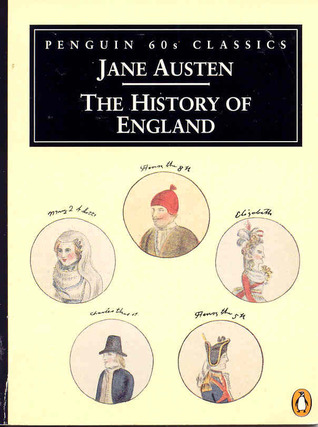
My Year With Jane: History of England

History of England. Jane Austen. 1977. 64 pages. [Source: Book I Bought]

Jane Austen's The History of England is a short and worthy read for any lover of Austen OR for any lover of British history. Austen does not seek to cover every single king or queen in her "history." She begins with Henry IV and ends with Charles I. Some monarchs get only one or two paragraphs. Others get much more attention. But more attention does not equal favorable attention. After all, this isn't a history book by a historian. No, never forget that this history is "by a partial, prejudiced, and ignorant" historian.

I would definitely recommend this one! Have you read this one? Do you have a favorite "history of England" book to recommend?
Henry VI: "I cannot say much for this Monarch's sense. Nor would I if I could, for he was a Lancastrian. I suppose you know all about the Wars between him and the Duke of York who was of the right side; if you do not, you had better read some other History, for I shall not be very diffuse in this, meaning by it only to vent my spleen against, and shew my Hatred to all those people whose parties or principles do not suit with mine, and not to give information. This King married Margaret of Anjou, a Woman whose distresses and misfortunes were so great as almost to make me who hate her, pity her. It was in this reign that Joan of Arc lived and made such a row among the English. They should not have burnt her —but they did. There were several Battles between the Yorkists and Lancastrians, in which the former (as they ought) usually conquered. At length they were entirely overcome; The King was murdered—The Queen was sent home—and Edward the 4th ascended the Throne."
Edward IV: "One of Edward's Mistresses was Jane Shore, who has had a play written about her, but it is a tragedy and therefore not worth reading."
Henry VIII: "It would be an affront to my Readers were I to suppose that they were not as well acquainted with the particulars of this King's reign as I am myself. It will therefore be saving them the task of reading again what they have read before, and myself the trouble of writing what I do not perfectly recollect, by giving only a slight sketch of the principal Events which marked his reign." 
 Bloody Mary: "This woman had the good luck of being advanced to the throne of England, in spite of the superior pretensions, Merit, and Beauty of her Cousins Mary Queen of Scotland and Jane Grey. Nor can I pity the Kingdom for the misfortunes they experienced during her Reign, since they fully deserved them, for having allowed her to succeed her Brother—which was a double peice of folly, since they might have foreseen that as she died without children, she would be succeeded by that disgrace to humanity, that pest of society, Elizabeth. Many were the people who fell martyrs to the protestant Religion during her reign; I suppose not fewer than a dozen. She married Philip King of Spain who in her sister's reign was famous for building Armadas. She died without issue, and then the dreadful moment came in which the destroyer of all comfort, the deceitful Betrayer of trust reposed in her, and the Murderess of her Cousin succeeded to the Throne.——" 
© 2014 SukaYuka.com of SukaYuka's Book Reviews

Friday, May 23, 2014

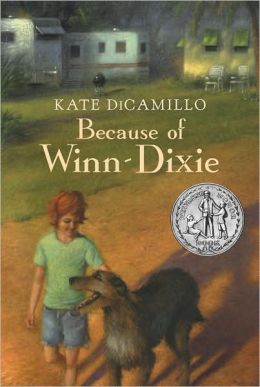
Reread #21 Because of Winn Dixie

Because of Winn Dixie. Kate DiCamillo. 2000. Candlewick. 182 pages. [Source: Book I bought]

Because of Winn Dixie is one of my favorite, favorite, favorite books. I love, love, love this one! Opal Buloni, our young heroine, has recently moved with her father, a preacher, to a small town in Florida. He is the new preacher at a small church, a church held in an old convenient store building, a church with no pews but lawn chairs. The novel, I believe, is set during the summer. Opal, when the novel opens, is still adjusting. She misses her mother tremendously. Her mother's leaving is not recent, but, as Opal grows up, she is beginning to realize more and more how much she misses her mother. Her curiosity and longing has changed. She feels her father ignores her, not because he doesn't love her, not because he doesn't want her or need her, but simply because he's always busy and quiet. Opal needs friends. Find friends she will and all because of Winn Dixie, the dog she finds at the grocery store. Winn Dixie, the dog with an irresistible smile, needs Opal just as much as she needs him. And with a little love from Opal and her Dad, Winn Dixie sets out to charm EVERYONE in town, even people who don't "like" dogs.

I love, love, love the characters in this one. I love Opal. I do. I love her dad. I love that he listens to his daughter and shares with her ten things about her mother. I love Gloria Dump, Miss Franny, Otis, and Sweetie Pie. And, of course, I love Winn Dixie. I also love Opal coming up with a ten things list for Winn Dixie.

I love the writing. This is one of those novels that is just so easy to quote!!!

Favorite quotes:
“Thinking about her was the same as the hole you keep on feeling with your tongue after you lose a tooth. Time after time, my mind kept going to that empty spot, the spot where I felt like she should be.”
“You can't always judge people by the things they done. You got to judge them by what they are doing now.”
“Do you think everybody misses somebody? Like I miss my mama?” “Mmmm-hmmm,” said Gloria. She closed her eyes. “I believe, sometimes, that the whole world has an aching heart.”
© 2014 SukaYuka.com of SukaYuka's Book Reviews

Sunday, April 13, 2014

My Year with Jane: Mansfield Park

Mansfield Park. Jane Austen. 1814. 464 pages. [Source: Book I Bought]

I have read Mansfield Park three times. The first time I found myself frustrated and bored. Where was the romance? Where was the satisfaction? Who was supposed to be THE HERO?! Was it really supposed to be Edmund?! The second time I read it, I found myself entertained. I also found myself falling for the wrong hero, Henry Crawford and asking plenty of what might have been questions. The third time it was a joy to revisit. This isn't the first time that it has taken multiple readings to enjoy and appreciate and love an Austen novel. I haven't decided what this means exactly. If it is a good thing that Austen's novels are layered and complex and take some time to absorb, or, if it's a weakness. If you don't exactly "enjoy" something the first time, what is there to make you want to go back and read it again and again? I think Pride and Prejudice is the one big exception to the rule. Also perhaps Persuasion.

Fanny Price is the heroine of Mansfield Park. She is intelligent, observant, selfless, and considerate. Part of this is her upbringing, she's been brought up to put everyone else's wants and needs and whims ahead of her own. Part of this is just her nature, in my opinion. She treats everyone with kindness and respect regardless of whether they "deserve" it or not.  
It would be delightful to feel myself of consequence to anybody.
Fanny, being always a very courteous listener, and often the only listener at hand, came in for the complaints and the distresses of most of them.
Edmund Bertram is Fanny's cousin. He will be a minister. He falls madly in love (if it is truly love and not lust) with Mary Crawford. For almost the entire novel, he talks on and on and on and on about Mary to poor Fanny. He can at any given time give you a top ten list on why Mary is completely wrong for him and why it would never work out in the end. But she is the ONLY WOMAN IN THE WORLD HE COULD EVER LOVE. Of course, Fanny is in love with Edmund. Fanny's patience in listening to Edmund alone would make her worthy of being a saint.
I cannot give her up, Fanny. She is the only woman in the world whom I could ever think of as a wife. If I did not believe that she had some regard for me, of course I should not say this, but I do believe it.
Mary Crawford is Fanny's opposite in many, many ways. She doesn't know how to be serious. She talks way too much. She shares way too much. She's rude and inconsiderate. And her first love, her forever love, will always be herself.
Selfishness must always be forgiven, you know, because there is no hope of a cure.
Henry Crawford is Mary's brother. He is Fanny's opposite too. He has a very high opinion of himself. And he finds nothing so satisfying as making women fall in love with him. He loves being loved and adored. He determines at one point that it would be SOMETHING to have Fanny fall in love with him. He knows it will be the most difficult challenge he's faced so far. She's no fool. In the attempting, it is Henry who falls hard. He finds himself for the first time actually caring and loving someone else. Or does he? Austen is a bit ambiguous how far his reform goes.
I never was so long in company with a girl in my life, trying to entertain her, and succeed so ill! Never met with a girl who looked so grave on me! I must try to get the better of this. Her looks say, ‘I will not like you, I am determined not to like you’; and I say she shall.
They will now see what sort of woman it is that can attach me, that can attach a man of sense. I wish the discovery may do them any good. And they will now see their cousin treated as she ought to be, and I wish they may be heartily ashamed of their own abominable neglect and unkindness. They will be angry,” he added, after a moment’s silence, and in a cooler tone; “Mrs. Rushworth will be very angry. It will be a bitter pill to her; that is, like other bitter pills, it will have two moments’ ill flavour, and then be swallowed and forgotten; for I am not such a coxcomb as to suppose her feelings more lasting than other women’s, though I was the object of them. Yes, Mary, my Fanny will feel a difference indeed: a daily, hourly difference, in the behaviour of every being who approaches her; and it will be the completion of my happiness to know that I am the doer of it, that I am the person to give the consequence so justly her due.
Now she is dependent, helpless, friendless, neglected, forgotten.” “Nay, Henry, not by all; not forgotten by all; not friendless or forgotten. Her cousin Edmund never forgets her.” “Edmund! True, I believe he is, generally speaking, kind to her, and so is Sir Thomas in his way; but it is the way of a rich, superior, long-worded, arbitrary uncle. What can Sir Thomas and Edmund together do, what do they do for her happiness, comfort, honour, and dignity in the world, to what I shall do?”   
Mansfield Park is without a doubt one of the messier Austen novels. Messy isn't the perfect word, I know. The characters of Mansfield Park are so messed up, so in need of fixing. Readers never know exactly why Fanny loves Edmund with all her heart and soul. Readers just have to take Fanny's love on faith, believing that she knows best, that she knows her heart better than we do, and, that Edmund BEFORE Mary was worth loving. Austen's ending is far from romantic in that the romance between Fanny and Edmund is not developed on the page.

I can easily imagine Fanny in these words:

You give your hand to me
And then you say, "Hello."
And I can hardly speak,
My heart is beating so.
And anyone can tell
You think you know me well.
Well, you don't know me.


And with a big, big stretch, maybe Edmund in these words:

Are those your eyes
Is that your smile
I've been looking at you forever
Yet I never saw you before
Are these your hands holding mine
Now I wonder how I could have been so blind
And for the first time I am looking in your eyes
For the first time I'm seeing who you are
I can't believe how much I see
When you're looking back at me

 The first is "You Don't Know Me" and the second is "For The First Time."

© 2014 SukaYuka.com of SukaYuka's Book Reviews

Friday, March 28, 2014

Reread #13 Five Children and It

Five Children and It. E. Nesbit. 1902/2004. Puffin Classics. 240 pages. [Source: Book I bought]

 The house was three miles from the station, but before the dusty hired fly had rattled along for five minutes the children began to put their heads out of the carriage window and to say, 'Aren't we nearly there?' And every time they passed a house, which was not very often, they all said, 'Oh, is this it?' But it never was, till they reached the very top of the hill, just past the chalk-quarry and before you come to the gravel-pit. And then there was a white house with a green garden and an orchard beyond, and mother said, 'Here we are!'

I have now read Five Children and It three times. It's a children's book that I love and adore. It is not the fact that it is absolutely perfect, that it is flawless. It was very much written in 1902. There will be situations and/or sentences that reflect the times in which they were written, and not our times. In Five Children and It, I'm referring to the chapter on the children "playing Indian" and warring with a "Red Indian" tribe who wants to scalp them and eat them. But. In spite of its flaws, in spite of the fact that its dated, I really do enjoy spending time with Robert, Cyril, Anthea, Jane, and Lamb.

Four children 'discover' a Sand Fairy (Psammead) one summer day. They learn that he can begrudgingly grant wishes. They have a wish per day, sometimes if they get into BIG trouble, he'll allow an extra wish or two. Do these children get into big trouble with their wishes?! Of course!!! Their wishes always have HORRIBLE consequences. They try and try to be smart and clever about their wishing, but some things can't be helped!

Favorite quotes:
Grown-up people find it very difficult to believe really wonderful things, unless they have what they call proof. But children will believe almost anything, and grown-ups know this. That is why they tell you that the earth is round like an orange, when you can see perfectly well that it is flat and lumpy; and why they say that the earth goes round the sun, when you can see for yourself any day that the sun gets up in the morning and goes to bed at night like a good sun as it is, and the earth knows its place, and lies as still as a mouse. Yet I daresay you believe all that about the earth and the sun, and if so you will find it quite easy to believe that before Anthea and Cyril and the others had been a week in the country they had found a fairy. At least they called it that, because that was what it called itself; and of course it knew best, but it was not at all like any fairy you ever saw or heard of or read about.
Each of the children carried its own spade, and took it in turns to carry the Lamb. He was the baby, and they called him that because “Baa” was the first thing he ever said. They called Anthea “Panther,” which seems silly when you read it, but when you say it it sounds a little like her name.
“You don’t know?” it said. “Well, I knew the world had changed — but — well, really — Do you mean to tell me seriously you don’t know a Psammead when you see one?” “A Sammyadd? That’s Greek to me.” “So it is to everyone,” said the creature sharply. “Well, in plain English, then, a Sand-fairy. Don’t you know a Sand-fairy when you see one?” It looked so grieved and hurt that Jane hastened to say, “Of course I see you are, now. It’s quite plain now one comes to look at you.” “You came to look at me, several sentences ago,” it said crossly, beginning to curl up again in the sand. “Oh — don’t go away again! Do talk some more,” Robert cried. “I didn’t know you were a Sand-fairy, but I knew directly I saw you that you were much the wonderfullest thing I’d ever seen.” The Sand-fairy seemed a shade less disagreeable after this.
It is wonderful how quickly you get used to things, even the most astonishing. Five minutes before, the children had had no more idea than you had that there was such a thing as a Sand-fairy in the world, and now they were talking to it as though they had known it all their lives.
We Sand-fairies used to live on the seashore, and the children used to come with their little flint-spades and flint-pails and make castles for us to live in. That’s thousands of years ago, but I hear that children still build castles on the sand. It’s difficult to break yourself of a habit.
I daresay you have often thought what you would do if you had three wishes given you, and have despised the old man and his wife in the black-pudding story, and felt certain that if you had the chance you could think of three really useful wishes without a moment’s hesitation. These children had often talked this matter over, but, now the chance had suddenly come to them, they could not make up their minds. “Quick,” said the Sand-fairy crossly. No one could think of anything, only Anthea did manage to remember a private wish of her own and Jane’s which they had never told the boys. She knew the boys would not care about it — but still it was better than nothing. “I wish we were all as beautiful as the day,” she said in a great hurry. The children looked at each other, but each could see that the others were not any better-looking than usual. The Psammead pushed out his long eyes, and seemed to be holding its breath and swelling itself out till it was twice as fat and furry as before. Suddenly it let its breath go in a long sigh. “I’m really afraid I can’t manage it,” it said apologetically; “I must be out of practice.” The children were horribly disappointed. “Oh, do try again!” they said. “Well,” said the Sand-fairy, “the fact is, I was keeping back a little strength to give the rest of you your wishes with. If you’ll be contented with one wish a day among the lot of you I daresay I can screw myself up to it. Do you agree to that?” “Yes, oh yes!” said Jane and Anthea. The boys nodded. They did not believe the Sand-fairy could do it. You can always make girls believe things much easier than you can boys.

“Humph!” said the Sand-fairy. (If you read this story aloud, please pronounce “humph” exactly as it is spelt, for that is how he said it.)
And that, my dear children, is the moral of this chapter. I did not mean it to have a moral, but morals are nasty forward beings, and will keep putting in their oars where they are not wanted. And since the moral has crept in, quite against my wishes, you might as well think of it next time you feel piggy yourself and want to get rid of any of your brothers and sisters. I hope this doesn’t often happen, but I daresay it has happened sometimes, even to you!
It was a long day, and it was not till the afternoon that all the children suddenly decided to write letters to their mother.
“Darling Mother, — I hope you are quite well, and I hope Granny is better. The other day we....” Then came a flood of ink, and at the bottom these words in pencil — “It was not me upset the ink, but it took such a time clearing up, so no more as it is post-time. — From your loving daughter “Anthea.”
Robert’s letter had not even been begun. He had been drawing a ship on the blotting paper while he was trying to think of what to say. And of course after the ink was upset he had to help Anthea to clean out her desk, and he promised to make her another secret drawer, better than the other. And she said, “Well, make it now.” So it was post-time and his letter wasn’t done. And the secret drawer wasn’t done either.
Cyril wrote a long letter, very fast, and then went to set a trap for slugs that he had read about in the Home-made Gardener, and when it was post-time the letter could not be found, and it was never found. Perhaps the slugs ate it.
Jane’s letter was the only one that went. She meant to tell her mother all about the Psammead, — in fact they had all meant to do this, — but she spent so long thinking how to spell the word that there was no time to tell the story properly, and it is useless to tell a story unless you do tell it properly, so she had to be contented with this — “My dear Mother Dear, — We are all as good as we can, like you told us to, and the Lamb has a little cold, but Martha says it is nothing, only he upset the gold-fish into himself yesterday morning. When we were up at the sand-pit the other day we went round by the safe way where carts go, and we found a” — Half an hour went by before Jane felt quite sure that they could none of them spell Psammead. And they could not find it in the dictionary either, though they looked. Then Jane hastily finished her letter — “We found a strange thing, but it is nearly post-time, so no more at present from your little girl, “Jane. “P.S. — If you could have a wish come true what would you have?”
Anthea woke at five. She had made herself wake, and I must tell you how it is done, even if it keeps you waiting for the story to go on. You get into bed at night, and lie down quite flat on your little back, with your hands straight down by your sides. Then you say “I must wake up at five” (or six, or seven, or eight, or nine, or whatever the time is that you want), and as you say it you push your chin down on your chest and then whack your head back on the pillow. And you do this as many times as there are ones in the time you want to wake up at. (It is quite an easy sum.) Of course everything depends on your really wanting to get up at five (or six, or seven, or eight, or nine); if you don’t really want to, it’s all of no use. But if you do — well, try it and see. Of course in this, as in doing Latin proses or getting into mischief, practice makes perfect. Anthea was quite perfect.
“I was always generous from a child,” said the Sand-fairy. “I’ve spent the whole of my waking hours in giving. But one thing I won’t give — that’s advice.” “Child,” said the Sand-fairy sleepily, “I can only advise you to think before you speak” — “But I thought you never gave advice.” “That piece doesn’t count,” it said. “You’ll never take it! Besides, it’s not original. It’s in all the copy-books.”

Anthea was late for breakfast. It was Robert who quietly poured a spoonful of molasses down the Lamb’s frock, so that he had to be taken away and washed thoroughly directly after breakfast. And it was of course a very naughty thing to do; yet it served two purposes — it delighted the Lamb, who loved above all things to be completely sticky, and it engaged Martha’s attention so that the others could slip away to the sand-pit without the Lamb.
First review August 2009.
Second review  August 2011
Movie review July 2011
Cover talk July 2011

© 2014 SukaYuka.com of SukaYuka's Book Reviews

Sunday, March 16, 2014

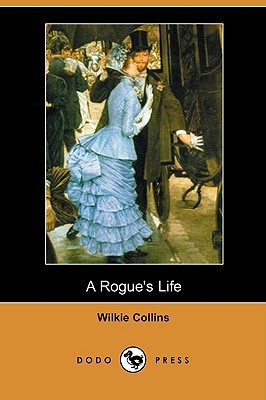
A Rogue's Life (1856)

A Rogue's Life. Wilkie Collins. 1856. 159 pages. [Source: Book I bought]

I am going to try if I can't write something about myself. My life has been rather a strange one. It may not seem particularly useful or respectable; but it has been, in some respects, adventurous; and that may give it claims to be read, even in the most prejudiced circles.

 Who is the rogue in Wilkie Collins A Rogue's Life? None other than Frank Softly. He comes from a respectable (though not wealthy) family. He falls OUT of favor with his parents and INTO a good bit of trouble. Debt factoring into this rogue's story quite often. He doesn't really "fit" with any of the "respectable" professions allowed to his class. And I believe his first "profession" is as a caricaturist. He sells his work, has it published, is quite successful using a pseudonym... for a while But. When people match his real identity with his pseudonym...well, that just won't do. That is when his parents make a stand.

A Rogue's Life is a short, pleasant read. It's told in first-person narrative. And the narration is quite lively. His adventures and misadventures are a bit crazy perhaps, making the whole too complex to easily summarize for review. But. It is an easy enough story to follow when you're actually reading it.

Essentially when this 'rogue' falls madly in love--and, of course, it's love AT FIRST SIGHT, with a beautiful yet mysterious young woman, there is NOTHING he won't do to find out who she is...he will woo her no matter what it costs him...

Another 'fun' element (if 'fun' is the right word?) is the speculation involving an inheritance. Frank's sister will inherit a good deal of money from someone (I can't remember who) IF and only IF Frank can outlive the grandmother. So throughout the book, there is all this speculation about the future! The grandmother is very old and determined to live forever, and, of course, Frank's misadventures (including prison time) could lead to his dying young...

It's an odd book in a way. But overall, it was a pleasant way to spend an hour.

© 2014 SukaYuka.com of SukaYuka's Book Reviews

Sunday, March 9, 2014

My Year with Jane: Pride and Prejudice

Pride and Prejudice. Jane Austen. 1813. 386 pages. [Source: Book I Bought]

It is a truth universally acknowledged, that a single man in possession of a good fortune, must be in want of a wife. However little known the feelings or views of such a man may be on his first entering a neighbourhood, this truth is so well fixed in the minds of the surrounding families, that he is considered the rightful property of some one or other of their daughters.

Is Pride and Prejudice your favorite Jane Austen novel? Why or why not?

I must admit that Pride and Prejudice is not my favorite, favorite Austen. I almost like that it is not my favorite book by Austen. But. No matter how much I say it isn't my favorite, every single time I reread this one, I am surprised by how satisfying and lovely it really is. It is so incredibly familiar, and I think that is part of the charm. The dialogue is so familiar, the characters feel like old friends, you can't help getting swept up into the story, the romance once again. The movies probably have more than a little to do with that. Do you have a favorite adaptation?

There are so many characters to love, so many characters to love to hate. Do you have a favorite? Elizabeth is not my favorite Austen heroine, but, she is probably among my favorites from Pride and Prejudice. I love her relationships: seeing Elizabeth with Jane, seeing Elizabeth with Charlotte, seeing Elizabeth with Lady Catherine, seeing Elizabeth with Darcy!

Like most Austen novels, the more attention you pay to the little details, the more you'll be rewarded! That is why rereading is oh-so-essential.

Quotes:
His character was decided. He was the proudest, most disagreeable man in the world, and everybody hoped that he would never come there again. Amongst the most violent against him was Mrs. Bennet, whose dislike of his general behaviour was sharpened into particular resentment by his having slighted one of her daughters. Elizabeth Bennet had been obliged, by the scarcity of gentlemen, to sit down for two dances; and during part of that time, Mr. Darcy had been standing near enough for her to hear a conversation between him and Mr. Bingley, who came from the dance for a few minutes, to press his friend to join it. “Come, Darcy,” said he, “I must have you dance. I hate to see you standing about by yourself in this stupid manner. You had much better dance.”
“I certainly shall not. You know how I detest it, unless I am particularly acquainted with my partner. At such an assembly as this it would be insupportable. Your sisters are engaged, and there is not another woman in the room whom it would not be a punishment to me to stand up with.” “I would not be so fastidious as you are,” cried Mr. Bingley, “for a kingdom! Upon my honour, I never met with so many pleasant girls in my life as I have this evening; and there are several of them you see uncommonly pretty.” “You are dancing with the only handsome girl in the room,” said Mr. Darcy, looking at the eldest Miss Bennet. “Oh! She is the most beautiful creature I ever beheld! But there is one of her sisters sitting down just behind you, who is very pretty, and I dare say very agreeable. Do let me ask my partner to introduce you.” “Which do you mean?” and turning round he looked for a moment at Elizabeth, till catching her eye, he withdrew his own and coldly said: “She is tolerable, but not handsome enough to tempt me; I am in no humour at present to give consequence to young ladies who are slighted by other men. You had better return to your partner and enjoy her smiles, for you are wasting your time with me.” Mr. Bingley followed his advice. Mr. Darcy walked off; and Elizabeth remained with no very cordial feelings toward him.
“My dear Miss Eliza, why are you not dancing? Mr. Darcy, you must allow me to present this young lady to you as a very desirable partner. You cannot refuse to dance, I am sure when so much beauty is before you.” And, taking her hand, he would have given it to Mr. Darcy who, though extremely surprised, was not unwilling to receive it, when she instantly drew back, and said with some discomposure to Sir William: “Indeed, sir, I have not the least intention of dancing. I entreat you not to suppose that I moved this way in order to beg for a partner.” Mr. Darcy, with grave propriety, requested to be allowed the honour of her hand, but in vain. Elizabeth was determined; nor did Sir William at all shake her purpose by his attempt at persuasion. “You excel so much in the dance, Miss Eliza, that it is cruel to deny me the happiness of seeing you; and though this gentleman dislikes the amusement in general, he can have no objection, I am sure, to oblige us for one half-hour.” “Mr. Darcy is all politeness,” said Elizabeth, smiling. “He is, indeed; but, considering the inducement, my dear Miss Eliza, we cannot wonder at his complaisance — for who would object to such a partner?” Elizabeth looked archly, and turned away. Her resistance had not injured her with the gentleman, and he was thinking of her with some complacency, when thus accosted by Miss Bingley: “I can guess the subject of your reverie.” “I should imagine not.” My mind was more agreeably engaged. I have been meditating on the very great pleasure which a pair of fine eyes in the face of a pretty woman can bestow.”
“It is a rule with me, that a person who can write a long letter with ease, cannot write ill.” “That will not do for a compliment to Darcy, Caroline,” cried her brother, “because he does not write with ease. He studies too much for words of four syllables. Do not you, Darcy?” “My style of writing is very different from yours.” “Oh!” cried Miss Bingley, “Charles writes in the most careless way imaginable. He leaves out half his words, and blots the rest.” “My ideas flow so rapidly that I have not time to express them — by which means my letters sometimes convey no ideas at all to my correspondents.” “Your humility, Mr. Bingley,” said Elizabeth, “must disarm reproof.” “Nothing is more deceitful,” said Darcy, “than the appearance of humility. It is often only carelessness of opinion, and sometimes an indirect boast.” “And which of the two do you call my little recent piece of modesty?” “The indirect boast; for you are really proud of your defects in writing, because you consider them as proceeding from a rapidity of thought and carelessness of execution, which, if not estimable, you think at least highly interesting. The power of doing anything with quickness is always prized much by the possessor, and often without any attention to the imperfection of the performance.
“Miss Eliza Bennet, let me persuade you to follow my example, and take a turn about the room. I assure you it is very refreshing after sitting so long in one attitude.” Elizabeth was surprised, but agreed to it immediately. Miss Bingley succeeded no less in the real object of her civility; Mr. Darcy looked up. He was as much awake to the novelty of attention in that quarter as Elizabeth herself could be, and unconsciously closed his book. He was directly invited to join their party, but he declined it, observing that he could imagine but two motives for their choosing to walk up and down the room together, with either of which motives his joining them would interfere. “What could he mean? She was dying to know what could be his meaning?” — and asked Elizabeth whether she could at all understand him? “Not at all,” was her answer; “but depend upon it, he means to be severe on us, and our surest way of disappointing him will be to ask nothing about it.” Miss Bingley, however, was incapable of disappointing Mr. Darcy in anything, and persevered therefore in requiring an explanation of his two motives. “I have not the smallest objection to explaining them,” said he, as soon as she allowed him to speak. “You either choose this method of passing the evening because you are in each other’s confidence, and have secret affairs to discuss, or because you are conscious that your figures appear to the greatest advantage in walking; if the first, I would be completely in your way, and if the second, I can admire you much better as I sit by the fire.” “Oh! shocking!” cried Miss Bingley. “I never heard anything so abominable. How shall we punish him for such a speech?” “Nothing so easy, if you have but the inclination,” said Elizabeth. “We can all plague and punish one another. Tease him — laugh at him. Intimate as you are, you must know how it is to be done.”
It is happy for you that you possess the talent of flattering with delicacy. May I ask whether these pleasing attentions proceed from the impulse of the moment, or are the result of previous study?” “They arise chiefly from what is passing at the time, and though I sometimes amuse myself with suggesting and arranging such little elegant compliments as may be adapted to ordinary occasions, I always wish to give them as unstudied an air as possible.” Mr. Bennet’s expectations were fully answered. His cousin was as absurd as he had hoped, and he listened to him with the keenest enjoyment, maintaining at the same time the most resolute composure of countenance, and, except in an occasional glance at Elizabeth, requiring no partner in his pleasure.
When those dances were over, she returned to Charlotte Lucas, and was in conversation with her, when she found herself suddenly addressed by Mr. Darcy who took her so much by surprise in his application for her hand, that, without knowing what she did, she accepted him. He walked away again immediately, and she was left to fret over her own want of presence of mind; Charlotte tried to console her: “I dare say you will find him very agreeable.” “Heaven forbid! That would be the greatest misfortune of all! To find a man agreeable whom one is determined to hate! Do not wish me such an evil.”
I must stop quoting now! I have a feeling that they could get out of control!

My first review September 2007
My second review December 2011

© 2014 SukaYuka.com of SukaYuka's Book Reviews

Friday, March 7, 2014

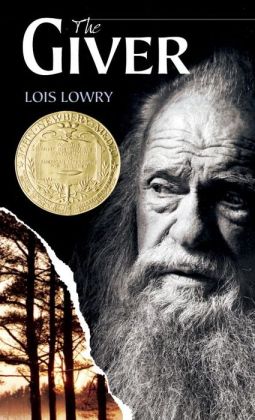
Reread #10 The Giver

The Giver. Lois Lowry. 1993. Houghton Mifflin. 180 pages. [Source: Library]

It was almost December, and Jonas was beginning to be frightened. No. Wrong word, Jonas thought. Frightened meant that deep, sickening feeling of something terrible about to happen. Frightened was the way he had felt a year ago when an unidentified aircraft had overflown the community twice. He had seen it both times. Squinting toward the sky, he had seen the sleek jet, almost a blur at its high speed, go past, and a second later heard the blast of sound that followed. Then one more time, a moment later, from the opposite direction, the same plane.  

When I decided to dedicate my Fridays to rereads, I knew that I'd "have" to reread The Giver at some point. It is one of my favorite books. This will be my fourth time to review it on SukaYuka's Book Reviews! I reviewed it in 2007, 2011, 2012. Honestly, I'm not sure there is anything more I can say about why this book is a must read. It has everything I look for in a great book: well-developed characters, interesting premise, good world-building, dialogue that draws me in and makes me think. 

Have you read The Giver? Have you read it more than once? Do you find the ending ambiguous? Have you read the sequels? Do you think they add to the story? Are you looking forward to the movie?

Favorite quotes:
"We don't dare to let people make choices of their own."
"Not safe?" The Giver suggested.
"Definitely not safe," Jonas said with certainty. "What if they were allowed to choose their own mate? And chose wrong? Or what if," he went on, almost laughing at the absurdity, "they chose their own jobs?'
"Frightening, isn't it? The Giver said.
Jonas chuckled. "Very frightening. I can't even imagine it. We really have to protect people from wrong choices."
"It's safer."
"Yes," Jonas agreed. "Much safer." (98-9)
"Do you love me?"
There was an awkward silence for a moment. Then Father gave a little chuckle. "Jonas, You, of all people. Precision of language, please!"
"What do you mean?" Jonas asked. Amusement was not at all what he had anticipated.
"Your father means that you used a very generalized word, so meaningless that it's become almost obsolete," his mother explained carefully.
Jonas stared at them. Meaningless? He had never before felt anything as meaningful as the memory.
"And of course our community can't function smoothly if people don't use precise language. You could ask, 'Do you enjoy me?' The answer is 'Yes,'" his mother said. "Or," his father suggested, "Do you take pride in my accomplishments?' And the answer is wholeheartedly 'Yes.'"
"Do you understand why it's inappropriate to use a word like 'love'?" Mother asked.
Jonas nodded. "Yes, thank you, I do," he replied slowly.
It was his first lie to his parents. (127)
© 2014 SukaYuka.com of SukaYuka's Book Reviews