Showing posts with label adult romance. Show all posts

Sunday, December 14, 2014

My Year with Jane: A Darcy Christmas

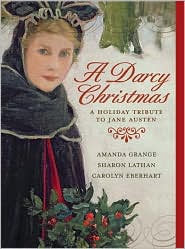
A Darcy Christmas: A Holiday Tribute to Jane Austen. By Amanda Grange, Carolyn Eberhart, and Sharon Lathan. 2010. Sourcebooks. 304 pages. [Source: Library]

I reread two of the three novellas in A Darcy Christmas. I reread Amanda Grange's Christmas Present and Carolyn Eberhart's Mr. Darcy's Christmas Carol. I chose not to reread Sharon Lathan's A Darcy Christmas. Each novella was around a hundred pages. A perfect length, in my opinion, for both stories.

Mr. Darcy's Christmas Carol is an interesting and often entertaining read starring Austen's characters and borrowing much from Charles Dickens. The premise is simple yet not completely predictable. Mr. Darcy is oh-so-happy that Bingley and Jane have married. But. He's still alone this holiday season. Unlike the original, he did not propose marriage to Elizabeth soon after Bingley and Jane's happy announcement. Georgiana, his sister, wants a new sister, a new particular sister for Christmas. His cousin has made a similar request, a particular new cousin. It isn't that Darcy doesn't still love her, want her, need her. But he's a bit proud and stubborn. So on the Christmas Eve in question, Darcy is visited by the ghost of his father who warns him of his faults and promises the visits of three spirits in the night. He adds that they will come with familiar faces. (Can you guess which "familiar face" is the ghost of Christmas future?)

I have conflicting thoughts on Mr. Darcy's Christmas Carol. On the one hand, there would be scenes and passages where I'm: it works, it really works, I can't believe this is working!!! And then perhaps just a page later, I'm: I take it back, this doesn't work at all, how am I suppose to believe this?! So there were plenty of scenes I liked. I liked how she fit it all together and made it work at least some of the time. It would be hard to fit all the great bits of Pride and Prejudice with all the great bits of A Christmas Carol. So I'm surprised it worked as well as it did actually. I like how one of my favorite scenes of A Christmas Carol is reworked from the beginning to the near-ending. That was something! I don't LOVE this one necessarily. As I mentioned, there are places where it is an almost-but-not-quite. It was a fun idea, perhaps, but not absolutely flawless. I alternated between wanting to shout at the book, and cheering. Still, it's worth reading at least once.

What did I think of Amanda Grange's Christmas Present? I liked it very much!!! I tend to like or love Amanda Grange's Austen adaptations. I think she does a great job with keeping Austen's characters as we know them and love them. She is able to capture the essence of each character. In this novella, readers get a glimpse of their second Christmases. (I believe, the two couples married in November or possibly early December?) Bingley and Jane have a baby. Elizabeth and Darcy are oh-so-close to having a baby as well. But have-her-own-way Elizabeth is insistent that even though she is due to have a baby any day, she is perfectly capable of traveling a few hours by carriage so she can spend the holidays with her family. Darcy gives in, of course. So what does a family Christmas look like? Well, this family Christmas borders on insane! Through half-a-dozen coincidences it seems, that most of the family (minus Georgiana) are brought together to share these few days. Including some you might not be expecting to see: Lady Catherine. Mr. Collins. The novella is comical. It's just a satisfying way to spend an afternoon. Sometimes a good, quick read that is light-hearted fun is just what you need.

This is my final post for "My Year With Jane." Here's a look at all the posts about Jane Austen:
© 2014 SukaYuka.com of SukaYuka's Book Reviews

Thursday, December 11, 2014

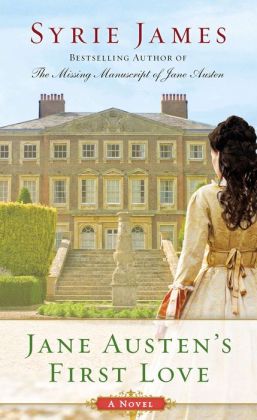
Jane Austen's First Love

Jane Austen's First Love. Syrie James. 2014. Berkley Trade. 400 pages. [Source: Review copy]

  I enjoyed reading Jane Austen's First Love. I admit I had my doubts at the beginning. On the one hand, after being so disappointed in Becoming Jane, I was hesitant to read anything giving Jane Austen a romance of her own. Also I wasn't wowed by The Lost Memoirs of Jane Austen. On the other hand, several people I respect really did love Jane Austen's First Love. While I can't say that I loved, loved, LOVED Jane Austen's First Love, I did really enjoy it. More than I thought I would at any rate.

1791. Summer of 1791. Jane and Cassandra travel to meet their brother Edward's fiancee, Elizabeth Bridges, and her family. (Several other family members go as well. The mother, but, not the father. Another brother, Charles, I believe. But the focus is mostly on Jane and Cassandra). Jane is just fifteen, she's not "out" yet. Her sister is a year or two older and is. Part of what makes this trip special, is that Jane is to be allowed certain privileges. She'll be allowed to go to dances and balls. She'll be allowed to powder her hair, etc. Most--if not all--the events will be family and friends. (Bringing together multiple families. Several of the Bridges' sisters are engaged to be married. All the engagements are being celebrated. There will be plenty of people there.)

On their trip, they happen to meet--quite dramatically--a young man named Edward Taylor. (He happens to be a neighbor, I believe.) Jane becomes smitten with him. He enjoys being with her, but, there aren't any OBVIOUS signs that he's madly, deeply in forever-and-ever-love with her. She may hope that he is "the one." But he is sixteen and not anywhere close to proposing marriage to anyone, no matter how lively, witty, charming, talented, beautiful, etc. Does Jane hope he is the one? The fictional, Jane, I mean? Perhaps. Perhaps not. Without a doubt, Jane enjoys herself tremendously, and finds time with him thrilling.

Strawberry picking. Dances. Dinners. Walks. Riding horses. Play acting. Matchmaking. Such is the stuff of Jane Austen's First Love.

One of the main plots surrounds the Bridges' sisters: Fanny, Elizabeth, and Sophia. They are all older than Jane. They are all of the courting age. Elizabeth and Fanny are engaged. Sophia is close to an engagement as well. Jane is watching; watching carefully, closely, analyzing and taking notes. Jane's observations lead her to believe that the sisters are mismatched! Readers meet a young Jane, an opinionated Jane, who is enjoying the idea of love, of falling in love, of finding love. What does she know of LOVE? What does she know of what makes two people compatible? It's interesting!

I also enjoyed how readers get a behind-the-scenes glimpse of Jane writing The Three Sisters. I would say that readers should take the time to read this little story on their own before, during, or after the novel.

© 2014 SukaYuka.com of SukaYuka's Book Reviews

Sunday, November 9, 2014

Sundays with Jane: Persuasion (1818)

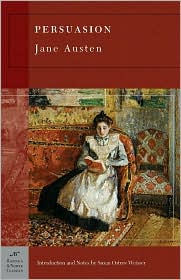
Persuasion. Jane Austen 1818/1992. Knopf Doubleday. 304 pages. [Source: Bought]

Persuasion is my favorite Jane Austen novel. It just is. I believe this is the third time I've reviewed it. April 2011. January 2008. Out of all of Austen's opening lines, I have to admit that Persuasion's first sentence is my least favorite. Wouldn't you agree?

Opening to Sense and Sensibility: The family of Dashwood had long been settled in Sussex.

Opening to Pride and Prejudice: It is a truth universally acknowledged, that a single man in possession of a good fortune, must be in want of a wife.

Opening to Mansfield ParkAbout thirty years ago Miss Maria Ward, of Huntingdon, with only seven thousand pounds, had the good luck to captivate Sir Thomas Bertram, of Mansfield Park, in the county of Northampton, and to be thereby raised to the rank of a baronet's lady, with all the comforts and consequences of an handsome house and large income.

Opening to EmmaEmma Woodhouse, handsome, clever, and rich, with a comfortable home and happy disposition, seemed to unite some of the best blessings of existence; and had lived nearly twenty-one years in the world with very little to distress or vex her. 

Opening to Northanger AbbeyNo one who had ever seen Catherine Morland in her infancy would have supposed her born to be an heroine. Her situation in life, the character of her father and mother, her own person and disposition, were all equally against her. 

Opening to Persuasion: Sir Walter Elliot, of Kellynch Hall, in Somersetshire, was a man who, for his own amusement, never took up any book but the Baronetage; there he found occupation for an idle hour, and consolation in a distressed one; there his faculties were roused into admiration and respect, by contemplating the limited remnant of the earliest patents; there any unwelcome sensations, arising from domestic affairs changed naturally into pity and contempt as he turned over the almost endless creations of the last century; and there, if every other leaf were powerless, he could read his own history with an interest which never failed.

I've already summarized the plot twice before, and, the problem with reread posts is that I have to always (try to) find new ways to say what I've already said.

Anne Elliot is the heroine of Persuasion. If you haven't read Persuasion before let me add this, please, don't expect Anne to be Elizabeth Bennet. Just don't. You'll be happier for letting Anne be Anne and not comparing her to Elizabeth, Emma, Elinor, Marianne, Catherine, or Fanny. Plenty of people misunderstand Anne--the top offenders being her very own family--I don't want you to be one of them. Don't let her family persuade you that Anne is someone to easily dismiss, a nobody.

As I was saying, Anne is the heroine of Persuasion. Eight years before the novel opens, Anne fell in love. It was a forever-love. She wanted to marry Frederick Wentworth. He wanted to marry her too. They loved each other very much. But he had no way to support her. It wasn't just that he couldn't support her in style. Her family disapproved. Her friends disapproved. Long story short, the engagement was broken off. Persuasion is all about her second chance. When Anne and Captain Wentworth meet again, eight years later, can these two come together and make it work, can they have their happily ever after? That is the very simplified version, I suppose! Austen being Austen, there are plenty of characters and stories introduced in Persuasion. It is a very enjoyable read. In places, it is quite giddy-making.

Do you have a favorite Austen hero? Captain Wentworth is perhaps one of the strongest Austen heroes. Of course, everyone is familiar with Darcy. But Wentworth has his fans as well! Perhaps in large part due to his letter to Anne:
I can listen no longer in silence. I must speak to you by such means as are within my reach. You pierce my soul. I am half agony, half hope. Tell me not that I am too late, that such precious feelings are gone forever. I offer myself to you again with a heart even more your own than when you almost broke it eight years and a half ago. Dare not say that a man forgets sooner than woman, that his love has an earlier death. I have loved none but you. Unjust I may have been, weak and resentful I have been, but never inconstant. You alone have brought me to Bath. For you alone I think and plan. (234)
Personally, I love Henry Tilney, Mr. Knightley, and Captain Wentworth.

Favorite quotes:
Excepting one short period of her life, she had never, since the age of fourteen, never since the loss of her dear mother, known the happiness of being listened to, or encouraged by any just appreciation or real taste.
No, it was not regret which made Anne’s heart beat in spite of herself, and brought the colour into her cheeks when she thought of Captain Wentworth unshackled and free. She had some feelings which she was ashamed to investigate. They were too much like joy, senseless joy!
She hoped to be wise and reasonable in time; but alas! alas! she must confess to herself that she was not wise yet.

© 2014 SukaYuka.com of SukaYuka's Book Reviews

Sunday, August 17, 2014

The Belton Estate

The Belton Estate. Anthony Trollope. 1866/1993. Penguin. 432 pages. [Source: Bought]

 To state it simply: it was LOVE. I have loved quite a few Anthony Trollope novels in the past. So it wasn't a big, big surprise that I loved Belton Estate. Perhaps I was surprised by just how MUCH I loved, loved, loved it! It was completely satisfying and practically perfect.

Clara Amedroz is the heroine of The Belton Estate. When her brother dies--he committed suicide--Clara's future becomes uncertain. Her father's property is entailed. She's unable to inherit from her father despite his wishes. There was a slim possibility that an aunt-like figure--a wealthy woman, of course--could leave her something. But she's left out of that will as well.

There are two men who could potentially "save" Clara. Captain Frederic Aylmer is a young (and I'm assuming relatively handsome) relation of Mrs. Winterfield (the aunt-like figure to Clara). He is the one who inherits her estate. She really wanted Clara and Frederic to marry one another. She spoke often about how much she wanted these two to marry. Days after her death, Clara receives a proposal of sorts from Frederic. The other potential "savior" is Will Belton. He is a distant cousin. He is the one who will be inheriting Clara's father's estate. He visits. Unlike Mr. Collins (from Pride and Prejudice) he is charming and likable and within weeks--if not days--Clara and her father LOVE him. He loves, loves, loves Clara. He does. He seeks permission to marry her. Clara's father thinks that would be lovely. What a good son he'd be! He also proposes to Clara.

Which man is right for Clara? Which proposal will she accept? Will she have a happily ever after?

It was oh-so-easy for me to have a favorite! I adore Will Belton. I do. I just LOVE him. I enjoyed the characters in this one so very much. I loved getting to spend so much time with Clara. This is one of Trollope's "simple" novels. Instead of having three or more couples to keep up with, or, three or more stories to follow since not all stories may end up in romance, readers just get treated to one fully developed story. There are more characters, of course. We meet Clara's closest friend and her husband. We meet Frederic's family. His mother is SOMETHING. I thought the characterization was great. I also thought it was a very thoughtful novel.

I would recommend Belton Estate to anyone who loves classic romances or historical romances. It is a GREAT love story.

Quotes:
And what did Will Belton think about his cousin, insured as he was thus supposed to be against the dangers of love? He, also, lay awake for awhile that night, thinking over this new friendship. Or rather he thought of it walking about his room, and looking out at the bright harvest moon;—for with him to be in bed was to be asleep. He sat himself down, and he walked about, and he leaned out of the window into the cool night air; and he made some comparisons in his mind, and certain calculations; and he thought of his present home, and of his sister, and of his future prospects as they were concerned with the old place at which he was now staying; and he portrayed to himself, in his mind, Clara's head and face and figure and feet;—and he resolved that she should be his wife. He had never seen a girl who seemed to suit him so well. Though he had only been with her for a day, he swore to himself that he knew he could love her. Nay;—he swore to himself that he did love her. Then,—when he had quite made up his mind, he tumbled into his bed and was asleep in five minutes.
"But, my dear, why should not he fall in love with you? It would be the most proper, and also the most convenient thing in the world."
"I hate talking of falling in love;—as though a woman has nothing else to think of whenever she sees a man."
"A woman has nothing else to think of."
"I have,—a great deal else. And so has he."
"It's quite out of the question on his part, then?"  "Quite out of the question. I'm sure he likes me. I can see it in his face, and hear it in his voice, and am so happy that it is so. But it isn't in the way that you mean. Heaven knows that I may want a friend some of these days, and I feel that I may trust to him. His feelings to me will be always those of a brother." "Perhaps so. I have seen that fraternal love before under similar circumstances, and it has always ended in the same way."
"I hope it won't end in any way between us."
"But the joke is that this suspicion, as you call it,—which makes you so indignant,—is simply a suggestion that a thing should happen which, of all things in the world, would be the best for both of you."
© 2014 SukaYuka.com of SukaYuka's Book Reviews

Sunday, August 10, 2014

Sundays with Jane: Two by Cornthwaite

Charity Envieth Not. (George Knightley #1) Barbara Cornthwaite. 2009. CreateSpace. 260 pages. [Source: Library]
and
Lend Me Leave. (George Knightley #2) Barbara Cornthwaite. 2011. CreateSpace. 246 pages. [Source: Library]

I absolutely loved reading Charity Envieth Not and Lend Me Leave. These two books tell the novel Emma through the perspective of George Knightley. I almost wish they were combined into one edition, however. Still, I can't begin to recommend these enough to all Austen fans!!!

I enjoyed many aspects of both books. I really, really loved George Knightley. That in and of itself is far from shocking. Dare I say he's probably the best thing about Austen's novel?! I loved seeing the characters (and/or the community) through his eyes. I loved his involvement in the community. I loved meeting various characters--rich and poor, from all classes or statuses. I especially, especially liked Spencer! I loved getting to know his brother John better. And I liked seeing him in the role of uncle! I liked how wide the perspective is--if that makes sense! Emma, to me, comes across as very self-centered, the world through her eyes seem a bit narrow.

I also appreciate how both books treat the character of Emma. I think to fully appreciate Emma, one HAS to see her AS Knightley sees her. This book accomplishes that! I don't think I've ever seen Emma in such a positive light before. And it made me think a bit, what if Emma is blinded to her strengths JUST as she's blinded to her weaknesses. OR in other words, what if the narration is a bit too close to accurately judge her strengths/weaknesses. Of course, Knightley cannot absolutely read all her motives and intentions, so maybe he's reading more compassion, more tenderness, more generosity than is really truly there. But maybe just maybe Emma's heart is bigger than I have previously thought. And maybe just maybe her mind isn't quite as empty as I thought it. I kept asking myself what does Knightley see in Emma that I don't?

I would recommend it to those who already love Emma, and even to those that don't really like her. Knightley is a great hero! And he's definitely worth reading about!

© 2014 SukaYuka.com of SukaYuka's Book Reviews

Friday, July 25, 2014

Reread #30 North and South

North and South. Elizabeth Gaskell. 1854-1855. 452 pages. [Source: Bought]

'Edith!' said Margaret, gently, 'Edith!'
But, as Margaret half suspected, Edith had fallen asleep.


I can't believe it's been two years since I last read North and South! As many of you know, I love, love, love, LOVE North and South! And I have gushed about it plenty since discovering it in May 2010.  There was my initial review, my first impressions of the audio book and movie, my quote-heavy review from 2011, and my review from 2012. The good news? I still LOVE and ADORE it. The not-so-good news? What haven't I said before?! I've given several summaries! I've gushed about the movie and how it's an ABSOLUTE MUST. I've shared lots of quotes!

Journaling of North and South:

Victorian definition of friendship?!
They were the familiar acquaintances of the house; neighbours whom Mrs. Shaw called friends, because she happened to dine with them more frequently than with any other people, and because if she or Edith wanted anything from them, or they from her, they did not scruple to make a call at each other's houses before luncheon. (6)
Margaret on weddings:
'No. I think after this evening we shall feel at rest, which I am sure I have not done for many weeks; at least, that kind of rest when the hands have nothing more to do, and all the arrangements are complete for an event which must occupy one's head and heart. I shall be glad to have time to think, and I am sure Edith will.'
'I am not so sure about her; but I can fancy that you will. Whenever I have seen you lately, you have been carried away by a whirlwind of some other person's making.'
'Yes,' said Margaret, rather sadly, remembering the never-ending commotion about trifles that had been going on for more than a month past: 'I wonder if a marriage must always be preceded by what you call a whirlwind, or whether in some cases there might not rather be a calm and peaceful time just before it.'
<'Cinderella's godmother ordering the trousseau, the wedding-breakfast, writing the notes of invitation, for instance,' said Mr. Lennox, laughing.
'But are all these quite necessary troubles?' asked Margaret, looking up straight at him for an answer. A sense of indescribable weariness of all the arrangements for a pretty effect, in which Edith had been busied as supreme authority for the last six weeks, oppressed her just now; and she really wanted some one to help her to a few pleasant, quiet ideas connected with a marriage.
'Oh, of course,' he replied with a change to gravity in his tone. 'There are forms and ceremonies to be gone through, not so much to satisfy oneself, as to stop the world's mouth, without which stoppage there would be very little satisfaction in life. But how would you have a wedding arranged?'
'Oh, I have never thought much about it; only I should like it to be a very fine summer morning; and I should like to walk to church through the shade of trees; and not to have so many bridesmaids, and to have no wedding-breakfast. I dare say I am resolving against the very things that have given me the most trouble just now.'
'No, I don't think you are. The idea of stately simplicity accords well with your character.' (11)
 From the start, I knew Margaret was my kind of heroine!

And I thought this was quite a true observation about worrying:
But the cloud never comes in that quarter of the horizon from which we watch for it. (18)
And have you noticed how often heroines in classics are absolutely shocked by marriage proposals? Margaret is no different.
'Margaret, I wish you did not like Helstone so much—did not seem so perfectly calm and happy here. I have been hoping for these three months past to find you regretting London—and London friends, a little—enough to make you listen more kindly' (for she was quietly, but firmly, striving to extricate her hand from his grasp) 'to one who has not much to offer, it is true—nothing but prospects in the future—but who does love you, Margaret, almost in spite of himself. Margaret, have I startled you too much? Speak!' For he saw her lips quivering almost as if she were going to cry. She made a strong effort to be calm; she would not speak till she had succeeded in mastering her voice, and then she said:
'I was startled. I did not know that you cared for me in that way. I have always thought of you as a friend; and, please, I would rather go on thinking of you so. I don't like to be spoken to as you have been doing. I cannot answer you as you want me to do, and yet I should feel so sorry if I vexed you.'
'Margaret,' said he, looking into her eyes, which met his with their open, straight look, expressive of the utmost good faith and reluctance to give pain.
'Do you'—he was going to say—'love any one else?' But it seemed as if this question would be an insult to the pure serenity of those eyes. 'Forgive me I have been too abrupt. I am punished. Only let me hope. Give me the poor comfort of telling me you have never seen any one whom you could—— ' Again a pause. He could not end his sentence. Margaret reproached herself acutely as the cause of his distress.
'Ah! if you had but never got this fancy into your head! It was such a pleasure to think of you as a friend.'
'But I may hope, may I not, Margaret, that some time you will think of me as a lover? Not yet, I see—there is no hurry—but some time—— ' She was silent for a minute or two, trying to discover the truth as it was in her own heart, before replying; then she said:
'I have never thought of—you, but as a friend. I like to think of you so; but I am sure I could never think of you as anything else. Pray, let us both forget that all this' ('disagreeable,' she was going to say, but stopped short) 'conversation has taken place.' (29)
Margaret has to be practical and no-nonsense. It definitely was not fair that she had to be the one to break the BIG BIG news to her mother because her father was too weak to do something so unpleasant. It won't be the last time Margaret has to step up to an unpleasant duty. 
'I shall not be at home till evening. I am going to Bracy Common, and will ask Farmer Dobson to give me something for dinner. I shall be back to tea at seven.' He did not look at either of them, but Margaret knew what he meant. By seven the announcement must be made to her mother. Mr. Hale would have delayed making it till half-past six, but Margaret was of different stuff. She could not bear the impending weight on her mind all the day long: better get the worst over; the day would be too short to comfort her mother. But while she stood by the window, thinking how to begin, and waiting for the servant to have left the room, her mother had gone up-stairs to put on her things to go to the school. She came down ready equipped, in a brisker mood than usual. (43)
I wonder if I'm the only one who imagines fictional characters on House Hunters (or House Hunters International)?! I certainly pay more attention these days.
They set out on their house-hunting. Thirty pounds a-year was all they could afford to give, but in Hampshire they could have met with a roomy house and pleasant garden for the money. Here, even the necessary accommodation of two sitting-rooms and four bed-rooms seemed unattainable. They went through their list, rejecting each as they visited it. Then they looked at each other in dismay.
'We must go back to the second, I think. That one,—in Crampton, don't they call the suburb? There were three sitting-rooms; don't you remember how we laughed at the number compared with the three bed-rooms? But I have planned it all. The front room down-stairs is to be your study and our dining-room (poor papa!), for, you know, we settled mamma is to have as cheerful a sitting-room as we can get; and that front room up-stairs, with the atrocious blue and pink paper and heavy cornice, had really a pretty view over the plain, with a great bend of river, or canal, or whatever it is, down below. Then I could have the little bed-room behind, in that projection at the head of the first flight of stairs—over the kitchen, you know—and you and mamma the room behind the drawing-room, and that closet in the roof will make you a splendid dressing-room.'
'But Dixon, and the girl we are to have to help?'
'Oh, wait a minute. I am overpowered by the discovery of my own genius for management. Dixon is to have—let me see, I had it once—the back sitting-room. I think she will like that. She grumbles so much about the stairs at Heston; and the girl is to have that sloping attic over your room and mamma's. Won't that do?'
'I dare say it will. But the papers. What taste! And the overloading such a house with colour and such heavy cornices!'
'Never mind, papa! Surely, you can charm the landlord into re-papering one or two of the rooms—the drawing-room and your bed-room—for mamma will come most in contact with them; and your book-shelves will hide a great deal of that gaudy pattern in the dining-room.'
'Then you think it the best? If so, I had better go at once and call on this Mr. Donkin, to whom the advertisement refers me. I will take you back to the hotel, where you can order lunch, and rest, and by the time it is ready, I shall be with you. I hope I shall be able to get new papers.'
Margaret hoped so too, though she said nothing. She had never come fairly in contact with the taste that loves ornament, however bad, more than the plainness and simplicity which are of themselves the framework of elegance. Her father took her through the entrance of the hotel, and leaving her at the foot of the staircase, went to the address of the landlord of the house they had fixed upon. (60-1)
And this just makes me giddy: reading of Mr. Thornton changing the horrid wallpaper. Of course, I didn't even think about it the first time I read the book. But now my eyes search for Mr. Thornton's goodness everywhere.
But, oh mamma! speaking of vulgarity and commonness, you must prepare yourself for our drawing-room paper. Pink and blue roses, with yellow leaves! And such a heavy cornice round the room!'
But when they removed to their new house in Milton, the obnoxious papers were gone. The landlord received their thanks very composedly; and let them think, if they liked, that he had relented from his expressed determination not to repaper. There was no particular need to tell them, that what he did not care to do for a Reverend Mr. Hale, unknown in Milton, he was only too glad to do at the one short sharp remonstrance of Mr. Thornton, the wealthy manufacturer. (65)
The Higgins. I am so very, very glad to see Margaret making friends. I really do love, love, love Bess and Nicholas.
'Where do you live? I think we must be neighbours, we meet so often on this road.'
'We put up at nine Frances Street, second turn to th' left at after yo've past th' Goulden Dragon.'
'And your name? I must not forget that.'
'I'm none ashamed o' my name. It's Nicholas Higgins. Hoo's called Bessy Higgins. Whatten yo' asking for?'
Margaret was surprised at this last question, for at Helstone it would have been an understood thing, after the inquiries she had made, that she intended to come and call upon any poor neighbour whose name and habitation she had asked for.
'I thought—I meant to come and see you.' She suddenly felt rather shy of offering the visit, without having any reason to give for her wish to make it, beyond a kindly interest in a stranger. It seemed all at once to take the shape of an impertinence on her part; she read this meaning too in the man's eyes.
'I'm none so fond of having strange folk in my house.' But then relenting, as he saw her heightened colour, he added, 'Yo're a foreigner, as one may say, and maybe don't know many folk here, and yo've given my wench here flowers out of yo'r own hand;—yo may come if yo like.'
Margaret was half-amused, half-nettled at this answer. She was not sure if she would go where permission was given so like a favour conferred. But when they came to the town into Frances Street, the girl stopped a minute, and said,
'Yo'll not forget yo're to come and see us.' (73)
Margaret's early thoughts on Mr. Thornton:
'But, east or west wind, I suppose this man comes.'
'Oh, mamma, that shows you never saw Mr. Thornton. He looks like a person who would enjoy battling with every adverse thing he could meet with—enemies, winds, or circumstances. The more it rains and blows, the more certain we are to have him. But I'll go and help Dixon. I'm getting to be a famous clear-starcher. And he won't want any amusement beyond talking to papa. Papa, I am really longing to see the Pythias to your Damon. You know I never saw him but once, and then we were so puzzled to know what to say to each other that we did not get on particularly well.'
'I don't know that you would ever like him, or think him agreeable, Margaret. He is not a lady's man.'
Margaret wreathed her throat in a scornful curve.
'I don't particularly admire ladies' men, papa. But Mr. Thornton comes here as your friend—as one who has appreciated you'—
'The only person in Milton,' said Mrs. Hale.
'So we will give him a welcome, and some cocoa-nut cakes. Dixon will be flattered if we ask her to make some; and I will undertake to iron your caps, mamma.'
Many a time that morning did Margaret wish Mr. Thornton far enough away. (75)
 And I believe this is the first but definitely not last mention of Mrs. Thornton--John's mother. She's certainly not easy to forget!!!
'John! Is that you?'
Her son opened the door and showed himself.
'What has brought you home so early? I thought you were going to tea with that friend of Mr. Bell's; that Mr. Hale.'
'So I am, mother; I am come home to dress!'
'Dress! humph! When I was a girl, young men were satisfied with dressing once in a day. Why should you dress to go and take a cup of tea with an old parson?'
'Mr. Hale is a gentleman, and his wife and daughter are ladies.'
'Wife and daughter! Do they teach too? What do they do? You have never mentioned them.'
'No! mother, because I have never seen Mrs. Hale; I have only seen Miss Hale for half an hour.'
'Take care you don't get caught by a penniless girl, John.'
'I am not easily caught, mother, as I think you know. But I must not have Miss Hale spoken of in that way, which, you know, is offensive to me. I never was aware of any young lady trying to catch me yet, nor do I believe that any one has ever given themselves that useless trouble.'
Mrs. Thornton did not choose to yield the point to her son; or else she had, in general, pride enough for her sex.
'Well! I only say, take care. Perhaps our Milton girls have too much spirit and good feeling to go angling after husbands; but this Miss Hale comes out of the aristocratic counties, where, if all tales be true, rich husbands are reckoned prizes.'
Mr. Thornton's brow contracted, and he came a step forward into the room.
'Mother' (with a short scornful laugh), 'you will make me confess. The only time I saw Miss Hale, she treated me with a haughty civility which had a strong flavour of contempt in it. She held herself aloof from me as if she had been a queen, and I her humble, unwashed vassal. Be easy, mother.'
'No! I am not easy, nor content either. What business had she, a renegade clergyman's daughter, to turn up her nose at you! I would dress for none of them—a saucy set! if I were you.' As he was leaving the room, he said:—
'Mr. Hale is good, and gentle, and learned. He is not saucy. As for Mrs. Hale, I will tell you what she is like to-night, if you care to hear.' He shut the door and was gone.
'Despise my son! treat him as her vassal, indeed! Humph! I should like to know where she could find such another! Boy and man, he's the noblest, stoutest heart I ever knew. I don't care if I am his mother; I can see what's what, and not be blind. I know what Fanny is; and I know what John is. Despise him! I hate her!' (77)
John noticing Margaret...
She looked as if she was not attending to the conversation, but solely busy with the tea-cups, among which her round ivory hands moved with pretty, noiseless, daintiness. She had a bracelet on one taper arm, which would fall down over her round wrist. Mr. Thornton watched the replacing of this troublesome ornament with far more attention than he listened to her father. It seemed as if it fascinated him to see her push it up impatiently, until it tightened her soft flesh; and then to mark the loosening—the fall. He could almost have exclaimed—'There it goes, again!' There was so little left to be done after he arrived at the preparation for tea, that he was almost sorry the obligation of eating and drinking came so soon to prevent his watching Margaret. She handed him his cup of tea with the proud air of an unwilling slave; but her eye caught the moment when he was ready for another cup; and he almost longed to ask her to do for him what he saw her compelled to do for her father, who took her little finger and thumb in his masculine hand, and made them serve as sugar-tongs. Mr. Thornton saw her beautiful eyes lifted to her father, full of light, half-laughter and half-love, as this bit of pantomime went on between the two, unobserved, as they fancied, by any. (79)
A missed opportunity...it won't be the only missed opportunity either.
When Mr. Thornton rose up to go away, after shaking hands with Mr. and Mrs. Hale, he made an advance to Margaret to wish her good-bye in a similar manner. It was the frank familiar custom of the place; but Margaret was not prepared for it. She simply bowed her farewell; although the instant she saw the hand, half put out, quickly drawn back, she was sorry she had not been aware of the intention. Mr. Thornton, however, knew nothing of her sorrow, and, drawing himself up to his full height, walked off, muttering as he left the house—
'A more proud, disagreeable girl I never saw. Even her great beauty is blotted out of one's memory by her scornful ways.' (86)
Margaret speaks out on Mr. Thornton (again):
'Papa, I do think Mr. Thornton a very remarkable man; but personally I don't like him at all.'
'And I do!' said her father laughing. 'Personally, as you call it, and all. I don't set him up for a hero, or anything of that kind. But good night, child. (88)
And here we have the first of many references to Revelation!
'Do you think such life as this is worth caring for?' gasped Bessy, at last. Margaret did not speak, but held the water to her lips. Bessy took a long and feverish draught, and then fell back and shut her eyes. Margaret heard her murmur to herself: 'They shall hunger no more, neither thirst any more; neither shall the sun light on them, nor any heat.'
Margaret bent over and said, 'Bessy, don't be impatient with your life, whatever it is—or may have been. Remember who gave it you, and made it what it is!' She was startled by hearing Nicholas speak behind her; he had come in without her noticing him. (90)
Not that they only talk about death and dying. They also talk about factory life.

Margaret meeting John's mother...she does love to boast!
'To hold and maintain a high, honourable place among the merchants of his country—the men of his town. Such a place my son has earned for himself. Go where you will—I don't say in England only, but in Europe—the name of John Thornton of Milton is known and respected amongst all men of business. Of course, it is unknown in the fashionable circles,' she continued, scornfully.
'Idle gentlemen and ladies are not likely to know much of a Milton manufacturer, unless he gets into parliament, or marries a lord's daughter.' Both Mr. Hale and Margaret had an uneasy, ludicrous consciousness that they had never heard of this great name, until Mr. Bell had written them word that Mr. Thornton would be a good friend to have in Milton. The proud mother's world was not their world of Harley Street gentilities on the one hand, or country clergymen and Hampshire squires on the other. Margaret's face, in spite of all her endeavours to keep it simply listening in its expression told the sensitive Mrs. Thornton this feeling of hers.
'You think you never heard of this wonderful son of mine, Miss Hale. You think I'm an old woman whose ideas are bounded by Milton, and whose own crow is the whitest ever seen.'
'No,' said Margaret, with some spirit. 'It may be true, that I was thinking I had hardly heard Mr. Thornton's name before I came to Milton. But since I have come here, I have heard enough to make me respect and admire him, and to feel how much justice and truth there is in what you have said of him.'
'Who spoke to you of him?' asked Mrs. Thornton, a little mollified, yet jealous lest any one else's words should not have done him full justice. Margaret hesitated before she replied. She did not like this authoritative questioning. Mr. Hale came in, as he thought, to the rescue.
'It was what Mr. Thornton said himself, that made us know the kind of man he was. Was it not, Margaret?'
Mrs. Thornton drew herself up, and said—
'My son is not the one to tell of his own doings. May I again ask you, Miss Hale, from whose account you formed your favourable opinion of him? A mother is curious and greedy of commendation of her children, you know.'
Margaret replied, 'It was as much from what Mr. Thornton withheld of that which we had been told of his previous life by Mr. Bell,—it was more that than what he said, that made us all feel what reason you have to be proud of him.'
'Mr. Bell! What can he know of John? He, living a lazy life in a drowsy college. But I'm obliged to you, Miss Hale. Many a missy young lady would have shrunk from giving an old woman the pleasure of hearing that her son was well spoken of.' (114)
Margaret and John definitely know how to have a tense conversation:
'I shall only be too glad to explain to you all that may seem anomalous or mysterious to a stranger; especially at a time like this, when our doings are sure to be canvassed by every scribbler who can hold a pen.'
'Thank you,' she answered, coldly. 'Of course, I shall apply to my father in the first instance for any information he can give me, if I get puzzled with living here amongst this strange society.'
'You think it strange. Why?'
'I don't know—I suppose because, on the very face of it, I see two classes dependent on each other in every possible way, yet each evidently regarding the interests of the other as opposed to their own; I never lived in a place before where there were two sets of people always running each other down.'
'Who have you heard running the masters down? I don't ask who you have heard abusing the men; for I see you persist in misunderstanding what I said the other day. But who have you heard abusing the masters?'
Margaret reddened; then smiled as she said,
'I am not fond of being catechised. I refuse to answer your question. Besides, it has nothing to do with the fact. You must take my word for it, that I have heard some people, or, it may be, only someone of the workpeople, speak as though it were the interest of the employers to keep them from acquiring money—that it would make them too independent if they had a sum in the savings' bank.' (118)
 One of Margaret's many burdens... Gaskell certainly did a good job on making Margaret so very strong and resilient. Yet she's not hard and unfeeling.
'What is the matter with mamma? You will oblige me by telling the simple truth.' Then, seeing a slight hesitation on the doctor's part, she added—
'I am the only child she has—here, I mean. My father is not sufficiently alarmed, I fear; and, therefore, if there is any serious apprehension, it must be broken to him gently. I can do this. I can nurse my mother. Pray, speak, sir; to see your face, and not be able to read it, gives me a worse dread than I trust any words of yours will justify.'
'My dear young lady, your mother seems to have a most attentive and efficient servant, who is more like her friend—'
'I am her daughter, sir.'
'But when I tell you she expressly desired that you might not be told—'
'I am not good or patient enough to submit to the prohibition. Besides, I am sure you are too wise—too experienced to have promised to keep the secret.'
'Well,' said he, half-smiling, though sadly enough, 'there you are right. I did not promise. In fact, I fear, the secret will be known soon enough without my revealing it.'
He paused. Margaret went very white, and compressed her lips a little more. Otherwise not a feature moved. With the quick insight into character, without which no medical man can rise to the eminence of Dr. Donaldson, he saw that she would exact the full truth; that she would know if one iota was withheld; and that the withholding would be torture more acute than the knowledge of it. He spoke two short sentences in a low voice, watching her all the time; for the pupils of her eyes dilated into a black horror and the whiteness of her complexion became livid. He ceased speaking. He waited for that look to go off,—for her gasping breath to come. Then she said:—
'I thank you most truly, sir, for your confidence. That dread has haunted me for many weeks. It is a true, real agony. My poor, poor mother!' her lips began to quiver, and he let her have the relief of tears, sure of her power of self-control to check them.
A few tears—those were all she shed, before she recollected the many questions she longed to ask. (126)
I share Bessy's love of Revelation. I do. It is one of my favorite, favorite books as well.
'I ask your pardon,' replied Bessy, humbly. 'Sometimes, when I've thought o' my life, and the little pleasure I've had in it, I've believed that, maybe, I was one of those doomed to die by the falling of a star from heaven; "And the name of the star is called Wormwood;" and the third part of the waters became wormwood; and men died of the waters, because they were made bitter." One can bear pain and sorrow better if one thinks it has been prophesied long before for one: somehow, then it seems as if my pain was needed for the fulfilment; otherways it seems all sent for nothing.'
'Nay, Bessy—think!' said Margaret. 'God does not willingly afflict. Don't dwell so much on the prophecies, but read the clearer parts of the Bible.'
'I dare say it would be wiser; but where would I hear such grand words of promise—hear tell o' anything so far different fro' this dreary world, and this town above a', as in Revelations? Many's the time I've repeated the verses in the seventh chapter to myself, just for the sound. It's as good as an organ, and as different from every day, too. No, I cannot give up Revelations. It gives me more comfort than any other book i' the Bible.' (137)
Mr. Thornton tries to be kind to Margaret, but, she's not quite ready!
What business had he to be the only person, except Dr. Donaldson and Dixon, admitted to the awful secret, which she held shut up in the most dark and sacred recess of her heart—not daring to look at it, unless she invoked heavenly strength to bear the sight—that, some day soon, she should cry aloud for her mother, and no answer would come out of the blank, dumb darkness? Yet he knew all. She saw it in his pitying eyes. She heard it in his grave and tremulous voice. How reconcile those eyes, that voice, with the hard-reasoning, dry, merciless way in which he laid down axioms of trade, and serenely followed them out to their full consequences? The discord jarred upon her inexpressibly. (153)
Margaret has another conversation with her Dad about that man!
'Oh, papa!'
'Well! I only want you to do justice to Mr. Thornton, who is, I suspect, of an exactly opposite nature,—a man who is far too proud to show his feelings. Just the character I should have thought beforehand, you would have admired, Margaret.'
'So I do,—so I should; but I don't feel quite so sure as you do of the existence of those feelings. He is a man of great strength of character,—of unusual intellect, considering the few advantages he has had.'
'Not so few. He has led a practical life from a very early age; has been called upon to exercise judgment and self-control. All that develops one part of the intellect. To be sure, he needs some of the knowledge of the past, which gives the truest basis for conjecture as to the future; but he knows this need,—he perceives it, and that is something. You are quite prejudiced against Mr. Thornton, Margaret.' (166)
Tender yet uncomfortable witness:
'Not the disease. We cannot touch the disease, with all our poor vaunted skill. We can only delay its progress—alleviate the pain it causes. Be a man, sir—a Christian. Have faith in the immortality of the soul, which no pain, no mortal disease, can assail or touch!'
But all the reply he got, was in the choked words, 'You have never been married, Dr. Donaldson; you do not know what it is,' and in the deep, manly sobs, which went through the stillness of the night like heavy pulses of agony. Margaret knelt by him, caressing him with tearful caresses. No one, not even Dr. Donaldson, knew how the time went by. Mr. Hale was the first to dare to speak of the necessities of the present moment.
'What must we do?' asked he. 'Tell us both. Margaret is my staff—my right hand.' (169)
The strike or riot gets intense, very intense!
'Mr. Thornton,' said Margaret, shaking all over with her passion, 'go down this instant, if you are not a coward. Go down and face them like a man. Save these poor strangers, whom you have decoyed here. Speak to your workmen as if they were human beings. Speak to them kindly. Don't let the soldiers come in and cut down poor creatures who are driven mad. I see one there who is. If you have any courage or noble quality in you, go out and speak to them, man to man.'
He turned and looked at her while she spoke. A dark cloud came over his face while he listened. He set his teeth as he heard her words.
'I will go. Perhaps I may ask you to accompany me downstairs, and bar the door behind me; my mother and sister will need that protection.'
'Oh! Mr. Thornton! I do not know—I may be wrong—only—' But he was gone; he was downstairs in the hall; he had unbarred the front door; all she could do, was to follow him quickly, and fasten it behind him, and clamber up the stairs again with a sick heart and a dizzy head. Again she took her place by the farthest window. He was on the steps below; she saw that by the direction of a thousand angry eyes; but she could neither see nor hear anything save the savage satisfaction of the rolling angry murmur. She threw the window wide open. Many in the crowd were mere boys; cruel and thoughtless,—cruel because they were thoughtless; some were men, gaunt as wolves, and mad for prey. (177)
and
She only thought how she could save him. She threw her arms around him; she made her body into a shield from the fierce people beyond. Still, with his arms folded, he shook her off.
'Go away,' said he, in his deep voice. 'This is no place for you.'
'It is!' said she. 'You did not see what I saw.' If she thought her sex would be a protection,—if, with shrinking eyes she had turned away from the terrible anger of these men, in any hope that ere she looked again they would have paused and reflected, and slunk away, and vanished,—she was wrong. Their reckless passion had carried them too far to stop—at least had carried some of them too far; for it is always the savage lads, with their love of cruel excitement, who head the riot—reckless to what bloodshed it may lead. A clog whizzed through the air. Margaret's fascinated eyes watched its progress; it missed its aim, and she turned sick with affright, but changed not her position, only hid her face on Mr. Thornton s arm. Then she turned and spoke again:'
'For God's sake! do not damage your cause by this violence. You do not know what you are doing.' She strove to make her words distinct.
A sharp pebble flew by her, grazing forehead and cheek, and drawing a blinding sheet of light before her eyes. She lay like one dead on Mr. Thornton's shoulder. Then he unfolded his arms, and held her encircled in one for an instant:
'You do well!' said he. 'You come to oust the innocent stranger. You fall—you hundreds—on one man; and when a woman comes before you, to ask you for your own sakes to be reasonable creatures, your cowardly wrath falls upon her! You do well!' They were silent while he spoke. They were watching, open-eyed and open-mouthed, the thread of dark-red blood which wakened them up from their trance of passion. Those nearest the gate stole out ashamed; there was a movement through all the crowd—a retreating movement. Only one voice cried out:
'Th' stone were meant for thee; but thou wert sheltered behind a woman!'
Mr. Thornton quivered with rage. The blood-flowing had made Margaret conscious—dimly, vaguely conscious. He placed her gently on the door-step, her head leaning against the frame.
'Can you rest there?' he asked. But without waiting for her answer, he went slowly down the steps right into the middle of the crowd. 'Now kill me, if it is your brutal will. There is no woman to shield me here. You may beat me to death—you will never move me from what I have determined upon—not you!' He stood amongst them, with his arms folded, in precisely the same attitude as he had been in on the steps. (179)
This moment changes everything...but not as much as Mr. Thornton would like!!!
'Miss Hale, I was very ungrateful yesterday—'
'You had nothing to be grateful for,' said she, raising her eyes, and looking full and straight at him. 'You mean, I suppose, that you believe you ought to thank me for what I did.' In spite of herself—in defiance of her anger—the thick blushes came all over her face, and burnt into her very eyes; which fell not nevertheless from their grave and steady look. 'It was only a natural instinct; any woman would have done just the same. We all feel the sanctity of our sex as a high privilege when we see danger. I ought rather,' said she, hastily, 'to apologise to you, for having said thoughtless words which sent you down into the danger.'
'It was not your words; it was the truth they conveyed, pungently as it was expressed. But you shall not drive me off upon that, and so escape the expression of my deep gratitude, my—' he was on the verge now; he would not speak in the haste of his hot passion; he would weigh each word. He would; and his will was triumphant. He stopped in mid career.
'I do not try to escape from anything,' said she. 'I simply say, that you owe me no gratitude; and I may add, that any expression of it will be painful to me, because I do not feel that I deserve it. Still, if it will relieve you from even a fancied obligation, speak on.'
'I do not want to be relieved from any obligation,' said he, goaded by her calm manner. 'Fancied, or not fancied—I question not myself to know which—I choose to believe that I owe my very life to you—ay—smile, and think it an exaggeration if you will. I believe it, because it adds a value to that life to think—oh, Miss Hale!' continued he, lowering his voice to such a tender intensity of passion that she shivered and trembled before him, 'to think circumstance so wrought, that whenever I exult in existence henceforward, I may say to myself, "All this gladness in life, all honest pride in doing my work in the world, all this keen sense of being, I owe to her!" And it doubles the gladness, it makes the pride glow, it sharpens the sense of existence till I hardly know if it is pain or pleasure, to think that I owe it to one—nay, you must, you shall hear'—said he, stepping forwards with stern determination—'to one whom I love, as I do not believe man ever loved woman before.' He held her hand tight in his. He panted as he listened for what should come. He threw the hand away with indignation, as he heard her icy tone; for icy it was, though the words came faltering out, as if she knew not where to find them.
'Your way of speaking shocks me. It is blasphemous. I cannot help it, if that is my first feeling. It might not be so, I dare say, if I understood the kind of feeling you describe. I do not want to vex you; and besides, we must speak gently, for mamma is asleep; but your whole manner offends me—'
'How!' exclaimed he. 'Offends you! I am indeed most unfortunate.'
'Yes!' said she, with recovered dignity. 'I do feel offended; and, I think, justly. You seem to fancy that my conduct of yesterday'—again the deep carnation blush, but this time with eyes kindling with indignation rather than shame—'was a personal act between you and me; and that you may come and thank me for it, instead of perceiving, as a gentleman would—yes! a gentleman,' she repeated, in allusion to their former conversation about that word, 'that any woman, worthy of the name of woman, would come forward to shield, with her reverenced helplessness, a man in danger from the violence of numbers.'
'And the gentleman thus rescued is forbidden the relief of thanks!' he broke in contemptuously. 'I am a man. I claim the right of expressing my feelings.'
'And I yielded to the right; simply saying that you gave me pain by insisting upon it,' she replied, proudly. 'But you seem to have imagined, that I was not merely guided by womanly instinct, but'—and here the passionate tears (kept down for long—struggled with vehemently) came up into her eyes, and choked her voice—'but that I was prompted by some particular feeling for you—you! Why, there was not a man—not a poor desperate man in all that crowd—for whom I had not more sympathy—for whom I should not have done what little I could more heartily.'
'You may speak on, Miss Hale. I am aware of all these misplaced sympathies of yours. I now believe that it was only your innate sense of oppression—(yes; I, though a master, may be oppressed)—that made you act so nobly as you did. I know you despise me; allow me to say, it is because you do not understand me.'
'I do not care to understand,' she replied, taking hold of the table to steady herself; for she thought him cruel—as, indeed, he was—and she was weak with her indignation.
'No, I see you do not. You are unfair and unjust.'
Margaret compressed her lips. She would not speak in answer to such accusations. But, for all that—for all his savage words, he could have thrown himself at her feet, and kissed the hem of her garment. She did not speak; she did not move. The tears of wounded pride fell hot and fast. He waited awhile, longing for her to say something, even a taunt, to which he might reply. But she was silent. He took up his hat.
'One word more. You look as if you thought it tainted you to be loved by me. You cannot avoid it. Nay, I, if I would, cannot cleanse you from it. But I would not, if I could. I have never loved any woman before: my life has been too busy, my thoughts too much absorbed with other things. Now I love, and will love. But do not be afraid of too much expression on my part.'
'I am not afraid,' she replied, lifting herself straight up. 'No one yet has ever dared to be impertinent to me, and no one ever shall. But, Mr. Thornton, you have been very kind to my father,' said she, changing her whole tone and bearing to a most womanly softness. 'Don't let us go on making each other angry. Pray don't!' He took no notice of her words: he occupied himself in smoothing the nap of his hat with his coat-sleeve, for half a minute or so; and then, rejecting her offered hand, and making as if he did not see her grave look of regret, he turned abruptly away, and left the room. Margaret caught one glance at his face before he went.
When he was gone, she thought she had seen the gleam of unshed tears in his eyes; and that turned her proud dislike into something different and kinder, if nearly as painful—self-reproach for having caused such mortification to any one.
'But how could I help it?' asked she of herself. 'I never liked him. I was civil; but I took no trouble to conceal my indifference. Indeed, I never thought about myself or him, so my manners must have shown the truth. All that yesterday, he might mistake. But that is his fault, not mine. I would do it again, if need were, though it does lead me into all this shame and trouble.' (194-6)
I do love, love, love Mr. Thornton.

Margaret can't forget the proposal as easily as she'd like:
For, although at first it had struck her, that his offer was forced and goaded out of him by sharp compassion for the exposure she had made of herself,—which he, like others, might misunderstand—yet, even before he left the room,—and certainly, not five minutes after, the clear conviction dawned upon her, shined bright upon her, that he did love her; that he had loved her; that he would love her. And she shrank and shuddered as under the fascination of some great power, repugnant to her whole previous life. She crept away, and hid from his idea. (197)
Awkward and emotional scene between two mothers...
'Margaret—you have a daughter—my sister is in Italy. My child will be without a mother;—in a strange place,—if I die—will you'——
And her filmy wandering eyes fixed themselves with an intensity of wistfulness on Mrs. Thornton's face. For a minute, there was no change in its rigidness; it was stern and unmoved;—nay, but that the eyes of the sick woman were growing dim with the slow-gathering tears, she might have seen a dark cloud cross the cold features. And it was no thought of her son, or of her living daughter Fanny, that stirred her heart at last; but a sudden remembrance, suggested by something in the arrangement of the room,—of a little daughter—dead in infancy—long years ago—that, like a sudden sunbeam, melted the icy crust, behind which there was a real tender woman.
'You wish me to be a friend to Miss Hale,' said Mrs. Thornton, in her measured voice, that would not soften with her heart, but came out distinct and clear.
Mrs. Hale, her eyes still fixed on Mrs. Thornton's face, pressed the hand that lay below hers on the coverlet. She could not speak. Mrs. Thornton sighed, 'I will be a true friend, if circumstances require it. Not a tender friend. That I cannot be,'—('to her,' she was on the point of adding, but she relented at the sight of that poor, anxious face.)—'It is not my nature to show affection even where I feel it, nor do I volunteer advice in general. Still, at your request,—if it will be any comfort to you, I will promise you.' Then came a pause. Mrs. Thornton was too conscientious to promise what she did not mean to perform; and to perform any-thing in the way of kindness on behalf of Margaret, more disliked at this moment than ever, was difficult; almost impossible.
'I promise,' said she, with grave severity; which, after all, inspired the dying woman with faith as in something more stable than life itself,—flickering, flitting, wavering life! 'I promise that in any difficulty in which Miss Hale'——
'Call her Margaret!' gasped Mrs. Hale.
'In which she comes to me for help, I will help her with every power I have, as if she were my own daughter. I also promise that if ever I see her doing what I think is wrong'——
'But Margaret never does wrong—not wilfully wrong,' pleaded Mrs. Hale. Mrs. Thornton went on as before; as if she had not heard:
'If ever I see her doing what I believe to be wrong—such wrong not touching me or mine, in which case I might be supposed to have an interested motive—I will tell her of it, faithfully and plainly, as I should wish my own daughter to be told.'
There was a long pause. Mrs. Hale felt that this promise did not include all; and yet it was much. It had reservations in it which she did not understand; but then she was weak, dizzy, and tired. Mrs. Thornton was reviewing all the probable cases in which she had pledged herself to act. She had a fierce pleasure in the idea of telling Margaret unwelcome truths, in the shape of performance of duty. Mrs. Hale began to speak:
'I thank you. I pray God to bless you. I shall never see you again in this world. But my last words are, I thank you for your promise of kindness to my child.'
'Not kindness!' testified Mrs. Thornton, ungraciously truthful to the last. But having eased her conscience by saying these words, she was not sorry that they were not heard. She pressed Mrs. Hale's soft languid hand; and rose up and went her way out of the house without seeing a creature. (241)
Oh, Margaret! And it's just getting started!
'There have been such strange unexpected changes in my life during these last two years, that I feel more than ever that it is not worth while to calculate too closely what I should do if any future event took place. I try to think only upon the present.' (263)
Mr. Thornton and Mr. Hale bond...
Whatever was the reason, he could unburden himself better to Mr. Thornton than to her of all the thoughts and fancies and fears that had been frost-bound in his brain till now. Mr. Thornton said very little; but every sentence he uttered added to Mr. Hale's reliance and regard for him. Was it that he paused in the expression of some remembered agony, Mr. Thornton's two or three words would complete the sentence, and show how deeply its meaning was entered into. Was it a doubt—a fear—a wandering uncertainty seeking rest, but finding none—so tear-blinded were its eyes—Mr. Thornton, instead of being shocked, seemed to have passed through that very stage of thought himself, and could suggest where the exact ray of light was to be found, which should make the dark places plain. Man of action as he was, busy in the world's great battle, there was a deeper religion binding him to God in his heart, in spite of his strong wilfulness, through all his mistakes, than Mr. Hale had ever dreamed. They never spoke of such things again, as it happened; but this one conversation made them peculiar people to each other; knit them together, in a way which no loose indiscriminate talking about sacred things can ever accomplish. (276)
And his love endures as he saves Margaret from scandal or at the very least embarrassment:
'There will be no inquest. Medical evidence not sufficient to justify it. Take no further steps. I have not seen the coroner; but I will take the responsibility.' (280)
Is it this that acts as a catalyst for Margaret's heart? Not his saving her. No, she's embarrassed that he had to save her. She's anxious that she'll never get a chance to explain her side. She fears that he will never look at her the same way again. That she'll always be tainted...

Margaret is not the only one tortured...
It was this that made the misery—that he passionately loved her, and thought her, even with all her faults, more lovely and more excellent than any other woman; yet he deemed her so attached to some other man, so led away by her affection for him as to violate her truthful nature. The very falsehood that stained her, was a proof how blindly she loved another—this dark, slight, elegant, handsome man—while he himself was rough, and stern, and strongly made. He lashed himself into an agony of fierce jealousy. He thought of that look, that attitude!—how he would have laid his life at her feet for such tender glances, such fond detention! He mocked at himself, for having valued the mechanical way in which she had protected him from the fury of the mob; now he had seen how soft and bewitching she looked when with a man she really loved. He remembered, point by point, the sharpness of her words—'There was not a man in all that crowd for whom she would not have done as much, far more readily than for him.' He shared with the mob, in her desire of averting bloodshed from them; but this man, this hidden lover, shared with nobody; he had looks, words, hand-cleavings, lies, concealment, all to himself. Mr. Thornton was conscious that he had never been so irritable as he was now, in all his life long; he felt inclined to give a short abrupt answer, more like a bark than a speech, to every one that asked him a question; and this consciousness hurt his pride: he had always piqued himself on his self-control, and control himself he would. (310)
I love the fact that Mr. Thornton and Nicholas Higgins are brought together, in a way, by Margaret.
He came to tell Higgins he would give him work; and he was more annoyed to find Margaret there than by hearing her last words, for then he understood that she was the woman who had urged Higgins to come to him; and he dreaded the admission of any thought of her, as a motive to what he was doing solely because it was right.
'So that was the lady you spoke of as a woman?' said he indignantly to Higgins. 'You might have told me who she was.
'And then, maybe, yo'd ha' spoken of her more civil than yo' did; yo'd getten a mother who might ha' kept yo'r tongue in check when yo' were talking o' women being at the root o' all the plagues.'
'Of course you told that to Miss Hale?'
'In coorse I did. Leastways, I reckon I did. I telled her she weren't to meddle again in aught that concerned yo'.'
'Whose children are those—yours?' Mr. Thornton had a pretty good notion whose they were, from what he had heard; but he felt awkward in turning the conversation round from this unpromising beginning.
'They're not mine, and they are mine.'
'They are the children you spoke of to me this morning?'
'When yo' said,' replied Higgins, turning round, with ill-smothered fierceness, 'that my story might be true or might not, bur it were a very unlikely one. Measter, I've not forgetten.'
Mr. Thornton was silent for a moment; then he said: 'No more have I. I remember what I said. I spoke to you about those children in a way I had no business to do. I did not believe you. I could not have taken care of another man's children myself, if he had acted towards me as I hear Boucher did towards you. But I know now that you spoke truth. I beg your pardon.'
Higgins did not turn round, or immediately respond to this. But when he did speak, it was in a softened tone, although the words were gruff enough.
'Yo've no business to go prying into what happened between Boucher and me. He's dead, and I'm sorry. That's enough.'
'So it is. Will you take work with me? That's what I came to ask.'
Higgins's obstinacy wavered, recovered strength, and stood firm. He would not speak. Mr. Thornton would not ask again. Higgins's eye fell on the children.
'Yo've called me impudent, and a liar, and a mischief-maker, and yo' might ha' said wi' some truth, as I were now and then given to drink. An' I ha' called you a tyrant, an' an oud bull-dog, and a hard, cruel master; that's where it stands. But for th' childer. Measter, do yo' think we can e'er get on together?'
'Well!' said Mr. Thornton, half-laughing, 'it was not my proposal that we should go together. But there's one comfort, on your own showing. We neither of us can think much worse of the other than we do now.'
'That's true,' said Higgins, reflectively. 'I've been thinking, ever sin' I saw you, what a marcy it were yo' did na take me on, for that I ne'er saw a man whom I could less abide. But that's maybe been a hasty judgment; and work's work to such as me. So, measter, I'll come; and what's more, I thank yo'; and that's a deal fro' me,' said he, more frankly, suddenly turning round and facing Mr. Thornton fully for the first time.
'And this is a deal from me,' said Mr. Thornton, giving Higgins's hand a good grip. 'Now mind you come sharp to your time,' continued he, resuming the master. 'I'll have no laggards at my mill. What fines we have, we keep pretty sharply. And the first time I catch you making mischief, off you go. So now you know where you are.' (325-6)
A scene with potential...
'Higgins did not quite tell you the exact truth.' The word 'truth,' reminded her of her own untruth, and she stopped short, feeling exceedingly uncomfortable.
Mr. Thornton at first was puzzled to account for her silence; and then he remembered the lie she had told, and all that was foregone. 'The exact truth!' said he. 'Very few people do speak the exact truth. I have given up hoping for it. Miss Hale, have you no explanation to give me? You must perceive what I cannot but think.'
Margaret was silent. She was wondering whether an explanation of any kind would be consistent with her loyalty to Frederick.
'Nay,' said he, 'I will ask no farther. I may be putting temptation in your way. At present, believe me, your secret is safe with me. But you run great risks, allow me to say, in being so indiscreet. I am now only speaking as a friend of your father's: if I had any other thought or hope, of course that is at an end. I am quite disinterested.'
'I am aware of that,' said Margaret, forcing herself to speak in an indifferent, careless way. 'I am aware of what I must appear to you, but the secret is another person's, and I cannot explain it without doing him harm.'
'I have not the slightest wish to pry into the gentleman's secrets,' he said, with growing anger. 'My own interest in you is—simply that of a friend. You may not believe me, Miss Hale, but it is—in spite of the persecution I'm afraid I threatened you with at one time—but that is all given up; all passed away. You believe me, Miss Hale?'
'Yes,' said Margaret, quietly and sadly. (327-8)
And Mr. Bell speaks GREAT TRUTH...
'Hale! did it ever strike you that Thornton and your daughter have what the French call a tendresse for each other?'
'Never!' said Mr. Hale, first startled and then flurried by the new idea. 'No, I am sure you are wrong. I am almost certain you are mistaken. If there is anything, it is all on Mr. Thornton's side. Poor fellow! I hope and trust he is not thinking of her, for I am sure she would not have him.'
'Well! I'm a bachelor, and have steered clear of love affairs all my life; so perhaps my opinion is not worth having. Or else I should say there were very pretty symptoms about her!'
'Then I am sure you are wrong,' said Mr. Hale. 'He may care for her, though she really has been almost rude to him at times. But she!—why, Margaret would never think of him, I'm sure! Such a thing has never entered her head.'
'Entering her heart would do. But I merely threw out a suggestion of what might be. I dare say I was wrong. And whether I was wrong or right, I'm very sleepy; so, having disturbed your night's rest (as I can see) with my untimely fancies, I'll betake myself with an easy mind to my own.'
But Mr. Hale resolved that he would not be disturbed by any such nonsensical idea; so he lay awake, determining not to think about it.
Mr. Bell took his leave the next day, bidding Margaret look to him as one who had a right to help and protect her in all her troubles, of whatever nature they might be. To Mr. Hale he said,—
'That Margaret of yours has gone deep into my heart. Take care of her, for she is a very precious creature,—a great deal too good for Milton,—only fit for Oxford, in fact. The town, I mean; not the men. I can't match her yet. When I can, I shall bring my young man to stand side by side with your young woman, just as the genie in the Arabian Nights brought Prince Caralmazan to match with the fairy's Princess Badoura.'
'I beg you'll do no such thing. Remember the misfortunes that ensued; and besides, I can't spare Margaret.' (337)
Of course, it takes Margaret and John a bit more time--the novel is 436 pages--to be honest with each other about their feelings! The closing scenes of the book and movie are quite different from one another!

© 2014 SukaYuka.com of SukaYuka's Book Reviews

Tuesday, July 15, 2014

Merry Monarch's Wife (1991)

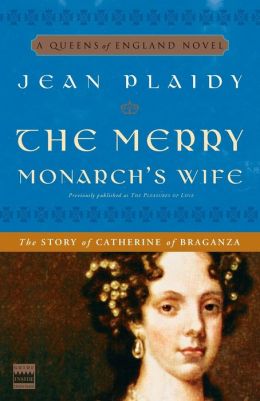
The Merry Monarch's Wife. (A Queens of England Novel). Jean Plaidy. 1991/2008. Crown. 352 pages. [Source: Bought]

MY LIFE WILL END WHERE IT BEGAN, FOR IN THE YEAR 1692 I left England where I had gone some thirty years before as a bride to the most romantic prince in Europe. I smile now to consider how ill-equipped I was for such a position, and when I look back I say to myself, “If I had done this…,” “If I had not done that…how much happier my life would have been.” But then, although I was not very young—I was twenty-four, which is a mature age for a princess to embark on marriage—I was quite innocent of the world and had hardly ever strayed from the walls of the convent where I had received my education, or the precincts of the royal palace. 
 
I enjoyed reading Jean Plaidy's The Merry Monarch's Wife. Catherine of Braganza was the queen of Charles II. For those familiar with the reign of Charles II, you can imagine what a life she led for better or worse. The book seeks to capture her personal perspective of her husband, of her marriage, of her adopted country. (She's coming from Portugal to England.)

Plaidy's depiction has Catherine truly in love with the King, and oh-so-aware of his shortcomings. In her reckoning, Charles II could not help himself at all, he was completely incapable of fidelity. Readers catch glimpses here and there of Charles' many, many mistresses. But not as much as you might imagine. That is, the focus is on HER and not truly on him and his activities. She is aware of his favorites at any given time, and at times she's sought out in conversation by mistresses in and out of favor.

There is definitely a lot of POLITICS in Merry Monarch's Wife. Readers learn about various plots and threats and conspiracies. Readers meet men and women who are ambitious and manipulative and power-hungry.

I was familiar, in a way, with some of the details of his reign. But not of what life was like for her before and after. Before her arrival in England and after Charles II's death. This book tells a fairly complete story.

Quotes:
We do not know what the future holds, but I believe that one day you are going to be Queen of England, and when you are, you will do your duty to God and your country.” “Oh yes,” I said fervently, “I will.” I had a mission now. Not only was I going to marry Prince Charles, but I was going to save his soul.
He always called himself an ugly fellow, and when one considered his features that could be true, but his charm was overwhelming. There could never have been a more attractive man. I know that I loved him and one is apt to be unaware of the faults of the object of one’s devotion, but I can vouch for it that I was not alone in my opinion. He used to talk of the ringing of bells, the flowers strewn in his path, the women who threw kisses at him, the shouts of loyalty. “Odds fish!” he said. It was a favorite oath of his. “They gave me such a welcome home that I thought it must have been my own fault that I had stayed away so long.”
He laughed. “You remind me of my mother. You and she will be good friends when you meet, I’ll swear. As for this Catholic ceremony…you see, my dear, you are Queen of this country and you must be married according to the religious observances of the place. But you say you will not be happy…and I cannot allow you to be unhappy. I will tell you how we will resolve this matter. There shall be a ceremony here in this bedchamber. It shall be as you wish, and the other one will take place as arranged on the same day. It means you will have to marry me twice. Could you bear that?” I felt my lips tremble. I was going to weep because I was so touched, so happy. “You are all that I hoped for…and all that I dreamed,” I said emotionally. He looked at me in mock dismay. “Do not have too good an opinion of me, I beg you. I fear you will find me a somewhat sinful fellow.” “Oh no. You are the kindest and best man in the world.” He leaned toward me and kissed my cheek. He was sober suddenly. He said: “You shame me.” Then he was merry again. His gravity seemed always to be fleeting, as though his gaiety was waiting impatiently to break in on it.
Charles is fond of you. He likes you very much…but he will never be faithful to you. It is not in him to be faithful…not to any woman. My father was like him. I saw how my mother lived. So I understand. Accept this weakness in him and he will be grateful to you, he will be kind.
We would drink tea, for I had brought this custom with me from Portugal. For a short time people had thought the beverage very strange, but they were soon aware of the pleasure of taking that soothing drink, and my ladies quickly became as ardent tea drinkers as I myself. Indeed the custom was spreading all over the country.

© 2014 SukaYuka.com of SukaYuka's Book Reviews

Sunday, July 13, 2014

My Year with Jane: Emma (1815)

Emma. Jane Austen. 1815. 544 pages. [Source: Bought]
Emma Woodhouse, handsome, clever, and rich, with a comfortable home and happy disposition, seemed to unite some of the best blessings of existence; and had lived nearly twenty-one years in the world with very little to distress or vex her. She was the youngest of the two daughters of a most affectionate, indulgent father; and had, in consequence of her sister’s marriage, been mistress of his house from a very early period. Her mother had died too long ago for her to have more than an indistinct remembrance of her caresses; and her place had been supplied by an excellent woman as governess, who had fallen little short of a mother in affection.
Did I like Emma more the second time around? That would be a definite yes. Is Emma my new favorite Austen? Of course not! Emma is still Emma. She'll never be a heroine that I love and adore. But have I learned to appreciate her? I think so. At least to a certain extent. There must be something about her if Mr. Knightley loves her so much. I trust Mr. Knightley. He's one big reason why I think Emma will always be worth reading and rereading.

The plot: Emma and her father are "mourning" the loss of Miss Taylor who married Mr. Weston. Emma doesn't have anyone exactly her equal in terms of social status, so she bends a bit and befriends Harriet. When the novel opens, Harriet and Mr. Martin are on the way to making a match. Emma sees Harriet as potentially being her equal and staying her equal--if she marries well, marries above her current status. Emma sees Harriet as being desperately in need of saving. Harriet becomes her project. Find a husband for Harriet, she will! Who is in need of a wife? Well, there's Mr. Elton. He's available, of course. Wouldn't it be splendid if those two got together?! The problem, as you might be aware, is that Mr. Elton has a wife in mind, and that wife is so not Harriet...

Meanwhile, Mr. and Mrs. Weston are hoping that Frank Churchill, Mr. Weston's son from his first marriage, will come to visit as he promised. There's always an excuse, a good excuse, or at least a valid excuse. When Frank does come to the community, well, expect trouble.

Oh, how I HATE HATE HATE Frank Churchill. Even if I try to stretch myself and see it from his point of view, I can't find my way to justifying ANYTHING he says and does before he is found out.

It was interesting to be reading Emma while watching the series  Emma Approved. I am a big, big Emma Approved fan, and, I must admit it was fun to go back to the original.

Have you read Emma? Do you have a favorite adaptation? What do you think of Clueless and Emma Approved?

Quotes:
The real evils, indeed, of Emma’s situation were the power of having rather too much her own way, and a disposition to think a little too well of herself; these were the disadvantages which threatened alloy to her many enjoyments. The danger, however, was at present so unperceived, that they did not by any means rank as misfortunes with her.
Mr. Knightley, in fact, was one of the few people who could see faults in Emma Woodhouse, and the only one who ever told her of them: and though this was not particularly agreeable to Emma herself, she knew it would be so much less so to her father, that she would not have him really suspect such a circumstance as her not being thought perfect by every body.
“Emma has been meaning to read more ever since she was twelve years old. I have seen a great many lists of her drawing-up at various times of books that she meant to read regularly through — and very good lists they were — very well chosen, and very neatly arranged — sometimes alphabetically, and sometimes by some other rule. The list she drew up when only fourteen — I remember thinking it did her judgment so much credit, that I preserved it some time; and I dare say she may have made out a very good list now. But I have done with expecting any course of steady reading from Emma. She will never submit to any thing requiring industry and patience, and a subjection of the fancy to the understanding. Where Miss Taylor failed to stimulate, I may safely affirm that Harriet Smith will do nothing. — You never could persuade her to read half so much as you wished. — You know you could not.”
A poet in love must be encouraged in both capacities, or neither.
Were I to fall in love, indeed, it would be a different thing! but I never have been in love; it is not my way, or my nature; and I do not think I ever shall. And, without love, I am sure I should be a fool to change such a situation as mine. Fortune I do not want; employment I do not want; consequence I do not want: I believe few married women are half as much mistress of their husband’s house as I am of Hartfield; and never, never could I expect to be so truly beloved and important; so always first and always right in any man’s eyes as I am in my father’s.
There are people, who the more you do for them, the less they will do for themselves.
It is very unfair to judge of any body’s conduct, without an intimate knowledge of their situation.
Nobody, who has not been in the interior of a family, can say what the difficulties of any individual of that family may be.
Wickedness is always wickedness, but folly is not always folly.
Emma continued to entertain no doubt of her being in love. Her ideas only varied as to the how much.
A vast deal may be done by those who dare to act.
How long had Mr. Knightley been so dear to her, as every feeling declared him now to be? When had his influence, such influence begun? — When had he succeeded to that place in her affection, which Frank Churchill had once, for a short period, occupied? — She looked back; she compared the two — compared them, as they had always stood in her estimation, from the time of the latter’s becoming known to her — and as they must at any time have been compared by her, had it — oh! had it, by any blessed felicity, occurred to her, to institute the comparison. — She saw that there never had been a time when she did not consider Mr. Knightley as infinitely the superior, or when his regard for her had not been infinitely the most dear. She saw, that in persuading herself, in fancying, in acting to the contrary, she had been entirely under a delusion, totally ignorant of her own heart — and, in short, that she had never really cared for Frank Churchill at all!
If I loved you less, I might be able to talk about it more. But you know what I am. — You hear nothing but truth from me. — I have blamed you, and lectured you, and you have borne it as no other woman in England would have borne it. — Bear with the truths I would tell you now, dearest Emma, as well as you have borne with them. The manner, perhaps, may have as little to recommend them. God knows, I have been a very indifferent lover. — But you understand me. — Yes, you see, you understand my feelings — and will return them if you can. At present, I ask only to hear, once to hear your voice.

© 2014 SukaYuka.com of SukaYuka's Book Reviews

Sunday, March 9, 2014

My Year with Jane: Pride and Prejudice

Pride and Prejudice. Jane Austen. 1813. 386 pages. [Source: Book I Bought]

It is a truth universally acknowledged, that a single man in possession of a good fortune, must be in want of a wife. However little known the feelings or views of such a man may be on his first entering a neighbourhood, this truth is so well fixed in the minds of the surrounding families, that he is considered the rightful property of some one or other of their daughters.

Is Pride and Prejudice your favorite Jane Austen novel? Why or why not?

I must admit that Pride and Prejudice is not my favorite, favorite Austen. I almost like that it is not my favorite book by Austen. But. No matter how much I say it isn't my favorite, every single time I reread this one, I am surprised by how satisfying and lovely it really is. It is so incredibly familiar, and I think that is part of the charm. The dialogue is so familiar, the characters feel like old friends, you can't help getting swept up into the story, the romance once again. The movies probably have more than a little to do with that. Do you have a favorite adaptation?

There are so many characters to love, so many characters to love to hate. Do you have a favorite? Elizabeth is not my favorite Austen heroine, but, she is probably among my favorites from Pride and Prejudice. I love her relationships: seeing Elizabeth with Jane, seeing Elizabeth with Charlotte, seeing Elizabeth with Lady Catherine, seeing Elizabeth with Darcy!

Like most Austen novels, the more attention you pay to the little details, the more you'll be rewarded! That is why rereading is oh-so-essential.

Quotes:
His character was decided. He was the proudest, most disagreeable man in the world, and everybody hoped that he would never come there again. Amongst the most violent against him was Mrs. Bennet, whose dislike of his general behaviour was sharpened into particular resentment by his having slighted one of her daughters. Elizabeth Bennet had been obliged, by the scarcity of gentlemen, to sit down for two dances; and during part of that time, Mr. Darcy had been standing near enough for her to hear a conversation between him and Mr. Bingley, who came from the dance for a few minutes, to press his friend to join it. “Come, Darcy,” said he, “I must have you dance. I hate to see you standing about by yourself in this stupid manner. You had much better dance.”
“I certainly shall not. You know how I detest it, unless I am particularly acquainted with my partner. At such an assembly as this it would be insupportable. Your sisters are engaged, and there is not another woman in the room whom it would not be a punishment to me to stand up with.” “I would not be so fastidious as you are,” cried Mr. Bingley, “for a kingdom! Upon my honour, I never met with so many pleasant girls in my life as I have this evening; and there are several of them you see uncommonly pretty.” “You are dancing with the only handsome girl in the room,” said Mr. Darcy, looking at the eldest Miss Bennet. “Oh! She is the most beautiful creature I ever beheld! But there is one of her sisters sitting down just behind you, who is very pretty, and I dare say very agreeable. Do let me ask my partner to introduce you.” “Which do you mean?” and turning round he looked for a moment at Elizabeth, till catching her eye, he withdrew his own and coldly said: “She is tolerable, but not handsome enough to tempt me; I am in no humour at present to give consequence to young ladies who are slighted by other men. You had better return to your partner and enjoy her smiles, for you are wasting your time with me.” Mr. Bingley followed his advice. Mr. Darcy walked off; and Elizabeth remained with no very cordial feelings toward him.
“My dear Miss Eliza, why are you not dancing? Mr. Darcy, you must allow me to present this young lady to you as a very desirable partner. You cannot refuse to dance, I am sure when so much beauty is before you.” And, taking her hand, he would have given it to Mr. Darcy who, though extremely surprised, was not unwilling to receive it, when she instantly drew back, and said with some discomposure to Sir William: “Indeed, sir, I have not the least intention of dancing. I entreat you not to suppose that I moved this way in order to beg for a partner.” Mr. Darcy, with grave propriety, requested to be allowed the honour of her hand, but in vain. Elizabeth was determined; nor did Sir William at all shake her purpose by his attempt at persuasion. “You excel so much in the dance, Miss Eliza, that it is cruel to deny me the happiness of seeing you; and though this gentleman dislikes the amusement in general, he can have no objection, I am sure, to oblige us for one half-hour.” “Mr. Darcy is all politeness,” said Elizabeth, smiling. “He is, indeed; but, considering the inducement, my dear Miss Eliza, we cannot wonder at his complaisance — for who would object to such a partner?” Elizabeth looked archly, and turned away. Her resistance had not injured her with the gentleman, and he was thinking of her with some complacency, when thus accosted by Miss Bingley: “I can guess the subject of your reverie.” “I should imagine not.” My mind was more agreeably engaged. I have been meditating on the very great pleasure which a pair of fine eyes in the face of a pretty woman can bestow.”
“It is a rule with me, that a person who can write a long letter with ease, cannot write ill.” “That will not do for a compliment to Darcy, Caroline,” cried her brother, “because he does not write with ease. He studies too much for words of four syllables. Do not you, Darcy?” “My style of writing is very different from yours.” “Oh!” cried Miss Bingley, “Charles writes in the most careless way imaginable. He leaves out half his words, and blots the rest.” “My ideas flow so rapidly that I have not time to express them — by which means my letters sometimes convey no ideas at all to my correspondents.” “Your humility, Mr. Bingley,” said Elizabeth, “must disarm reproof.” “Nothing is more deceitful,” said Darcy, “than the appearance of humility. It is often only carelessness of opinion, and sometimes an indirect boast.” “And which of the two do you call my little recent piece of modesty?” “The indirect boast; for you are really proud of your defects in writing, because you consider them as proceeding from a rapidity of thought and carelessness of execution, which, if not estimable, you think at least highly interesting. The power of doing anything with quickness is always prized much by the possessor, and often without any attention to the imperfection of the performance.
“Miss Eliza Bennet, let me persuade you to follow my example, and take a turn about the room. I assure you it is very refreshing after sitting so long in one attitude.” Elizabeth was surprised, but agreed to it immediately. Miss Bingley succeeded no less in the real object of her civility; Mr. Darcy looked up. He was as much awake to the novelty of attention in that quarter as Elizabeth herself could be, and unconsciously closed his book. He was directly invited to join their party, but he declined it, observing that he could imagine but two motives for their choosing to walk up and down the room together, with either of which motives his joining them would interfere. “What could he mean? She was dying to know what could be his meaning?” — and asked Elizabeth whether she could at all understand him? “Not at all,” was her answer; “but depend upon it, he means to be severe on us, and our surest way of disappointing him will be to ask nothing about it.” Miss Bingley, however, was incapable of disappointing Mr. Darcy in anything, and persevered therefore in requiring an explanation of his two motives. “I have not the smallest objection to explaining them,” said he, as soon as she allowed him to speak. “You either choose this method of passing the evening because you are in each other’s confidence, and have secret affairs to discuss, or because you are conscious that your figures appear to the greatest advantage in walking; if the first, I would be completely in your way, and if the second, I can admire you much better as I sit by the fire.” “Oh! shocking!” cried Miss Bingley. “I never heard anything so abominable. How shall we punish him for such a speech?” “Nothing so easy, if you have but the inclination,” said Elizabeth. “We can all plague and punish one another. Tease him — laugh at him. Intimate as you are, you must know how it is to be done.”
It is happy for you that you possess the talent of flattering with delicacy. May I ask whether these pleasing attentions proceed from the impulse of the moment, or are the result of previous study?” “They arise chiefly from what is passing at the time, and though I sometimes amuse myself with suggesting and arranging such little elegant compliments as may be adapted to ordinary occasions, I always wish to give them as unstudied an air as possible.” Mr. Bennet’s expectations were fully answered. His cousin was as absurd as he had hoped, and he listened to him with the keenest enjoyment, maintaining at the same time the most resolute composure of countenance, and, except in an occasional glance at Elizabeth, requiring no partner in his pleasure.
When those dances were over, she returned to Charlotte Lucas, and was in conversation with her, when she found herself suddenly addressed by Mr. Darcy who took her so much by surprise in his application for her hand, that, without knowing what she did, she accepted him. He walked away again immediately, and she was left to fret over her own want of presence of mind; Charlotte tried to console her: “I dare say you will find him very agreeable.” “Heaven forbid! That would be the greatest misfortune of all! To find a man agreeable whom one is determined to hate! Do not wish me such an evil.”
I must stop quoting now! I have a feeling that they could get out of control!

My first review September 2007
My second review December 2011

© 2014 SukaYuka.com of SukaYuka's Book Reviews