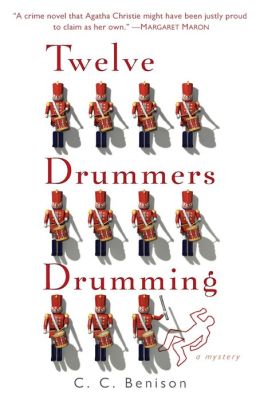
Twelve Drummers Drumming. Father Christmas Mystery #1. C.C. Benison. 2011. Doubleday. 384 pages. [Source: Library]
Twelve Drummers Drumming is the first in the Father Christmas mystery series by C.C. Benison. Tom Christmas, the hero, is a vicar in the village of Thornford Regis. He's a widower with a nine year old daughter, Miranda. Both are still healing and adapting. Tom's wife was murdered. So why settle in Thornford? Tom and his daughter were visiting his sister-in-law and her husband about a year before the novel opens. There was a funeral in the village that day, but, the vicar was missing. Tom Christmas (Father Christmas as people can't help calling him!) stepped in and performed the funeral service. When the position became available, Tom wanted the job for keeps. But village or hamlet life isn't all cozy. There are a few mysteries to be solved. And since Inspector Bliss and Inspector Blessing aren't quick to solve cases, Tom's skills come in handy. Tom is good at observing things, and, it helps that people can't seem to help confiding in him and telling their secrets.
So there are two murders to solve in Twelve Drummers Drumming. I won't say a word about the crimes and the clues. I hate having mysteries spoiled! Just as important as the clues, if not MORE important than the clues are the characters. That I can safely comment on! I really enjoyed the depth of the characters!
Overall, I would say that Twelve Drummers Drumming is an entertaining and satisfying read. I enjoyed spending time with the characters. I would recommend it!
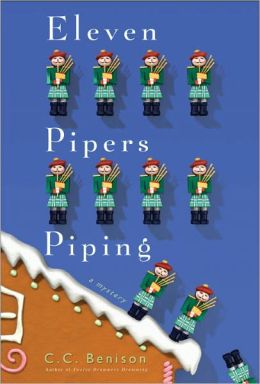
Eleven Piper Piping. Father Christmas Mystery #2. C.C. Benison. 2012. Delacorte. 474 pages. [Source: Library]
I think I enjoyed the second Father Christmas mystery even more than the first. Tom Christmas is the vicar of Thornford Regis. He is also the chaplain to a traditional Scottish pipe band, The Thistle But Mostly Rose South Devon Pipe Band. While Tom's daughter, Miranda, is having a sleepover, and his housekeeper, Madrun, is panicking about a failed yorkshire pudding, Tom Christmas is off--for better or worse--to the Burns Supper. But the weekend is problematic. The horrible weather--the blizzard-like conditions--means that half the band is unable to come, which leaves us with ELEVEN pipers piping. But while half the band is unable to make it through the storm, there is one unexpected guest that shows up at the local hotel where the Burns supper is being held. That guest is Judith Ingley, a retired nurse. Though usually women aren't allowed to attend, they don't turn her away in the storm.
Eleven Pipers Piping IS a murder mystery. So I won't share any details about the crime(s) or victim(s). I will say that the reader gets to spend plenty of time with Father Christmas as he interacts with the whole village before, during, and after the crime. I really enjoyed the setting very much. The characterization didn't disappoint.
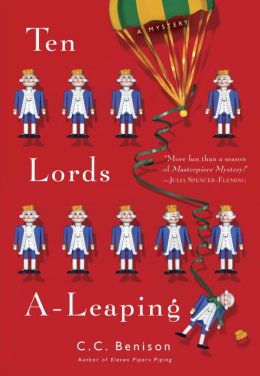
Ten Lords A-Leaping. Father Christmas #3. C.C. Benison. 2013. Delacorte. 512 pages. [Source: Library]
I wish I could give a rating for the first half and a rating for the second half.
Ten Lords A-Leaping is the third book in the Father Christmas series. In Eleven Pipers Piping, Father Christmas brings up a fund raiser idea to help pay for repairs on the church building. It involves sky diving. Ten Lords A-Leaping sees the event through. It is NOT set in Thornford Regis, unfortunately. I think I would have enjoyed it more if it had been.
So. The novel opens with the sky diving. In his jump, Tom has a little accident in the landing with his ankle, an accident that changes his plans and prolongs his visit in that part of the country. He is asked to stay over at Eggescombe Park. First, he's stuck there because of his own injury, then, he's stuck there because of a murder.
I really found myself hating the first half of the book. The series has never been squeaky clean, previous titles in the series have had a few words now and then that keep it from being perfectly clean. Still, it wasn't enough to keep me from reading, from wanting to read on in the series. But Ten Lords A-Leaping turns smutty. And smut in a creepy, inappropriate way. To the book's credit, Tom ends up feeling disgusted by the end of the novel with his own experience. But still.
Even though I really disliked much of the beginning and middle, I kept reading. And the mystery aspects of the novel began to grow on me a bit. I can't say that I "liked" it better than the first two in the series. I can't even say that I "liked" the majority of the characters. There were plenty of despicable characters. I'd say there were more despicable characters than nice ones. But. That is part of the genre, I suppose.
I enjoyed this one enough by the end, but, honestly I was a bit disappointed with this one.
© 2015 SukaYuka.com of SukaYuka's Book Reviews
Showing posts with label 2011. Show all posts
Sunday, January 4, 2015
Wednesday, September 3, 2014
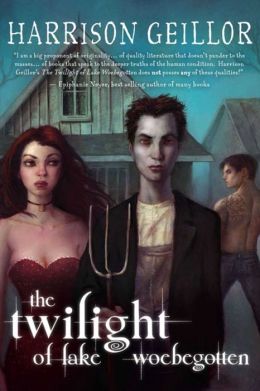
The Twilight of Lake Woebegotten
The Twilight of Lake Woebegotten. Harrison Geillor. 2011. Night Shade Books. 320 pages. [Source: Review copy]
Is it a horror novel or comedy? Readers will be the final judge in the end.
I do not like horror novels. There are a few slight exceptions now and then that I've discovered by accident. But. For the most part, I don't seek out horror novels. So, if I don't seek out horror novels, why would I read The Twilight of Lake Woebegotten? For one reason, primarily. The book pokes fun at Stephanie Meyer's Twilight series. It asks a big 'what if?' What if the heroine is not good, clumsy, and naive? What if the heroine is evil and manipulative? What if she wears a mask in every relationship? Being who she needs to be--in that moment--to get what she ultimately wants?
Bonnie Grayduck is the heroine who appears to fall madly and deeply in love with Edwin Scullen, a vampire. And she is one of the monsters in this horror novel. The events loosely fit into the Twilight books, so, one could definitely see the book as being a parody. But this parody isn't a ha-ha parody.
Bonnie is a dark person. She doesn't think nice, happy thoughts. She wants what she wants when she wants it. It is all about power and control and desire. And she has adult desires. Don't expect the "innocent" tension or chemistry from Twilight. This book is for more mature readers, I'd say.
Is it a horror novel or comedy? Readers will be the final judge in the end.
I do not like horror novels. There are a few slight exceptions now and then that I've discovered by accident. But. For the most part, I don't seek out horror novels. So, if I don't seek out horror novels, why would I read The Twilight of Lake Woebegotten? For one reason, primarily. The book pokes fun at Stephanie Meyer's Twilight series. It asks a big 'what if?' What if the heroine is not good, clumsy, and naive? What if the heroine is evil and manipulative? What if she wears a mask in every relationship? Being who she needs to be--in that moment--to get what she ultimately wants?
Bonnie Grayduck is the heroine who appears to fall madly and deeply in love with Edwin Scullen, a vampire. And she is one of the monsters in this horror novel. The events loosely fit into the Twilight books, so, one could definitely see the book as being a parody. But this parody isn't a ha-ha parody.
Bonnie is a dark person. She doesn't think nice, happy thoughts. She wants what she wants when she wants it. It is all about power and control and desire. And she has adult desires. Don't expect the "innocent" tension or chemistry from Twilight. This book is for more mature readers, I'd say.
So Edwin had taken a sudden trip to Canada. Interesting. It was insane to think he'd left town because of me...but in my experience, most things in the world do seem to resolve around me. And if they don't start out that way, they get there eventually. (50, ARC)
"Ike's great," I said, because if I told her I thought he was podgy and dull she'd get offended, "but I like Edwin."
She looked at me, now. "Really? Scullen? You don't like Ike?"
"I like him, what's not to like, but, not that way."
"I don't understand you," J said, voice heavy with mistrust. "Ike is so sweet and good and kind, and Edwin...he's so cold and condescending and superior."
I gave a great sigh. "I know. I've always been attracted to boys like that." (80, ARC)
I'm not much of a reader, but if I was, apparently I'd have a hard time reading any novel written in the last fifty years that didn't have a brooding sexy conflicted vampire in it--the shelves were just full of the stuff. (91, ARC)
"You are a brave, wonderful, suicidally stupid, diplomatic-incident-causing, amazing woman," Edwin said, kissing my face all over. We were in my bed, two nights after Gretchen's very timely demise. He'd only been back for about ten minutes, and he'd already called me names, clutched me to his bosom, sobbed a bit, brooded a fair amount, and proclaimed his love in a fairly operatic fashion. He'd finally settled down to snuggling me in bed which was rather less exhausting. (196, ARC)© 2014 SukaYuka.com of SukaYuka's Book Reviews
Sunday, August 10, 2014
Sundays with Jane: Two by Cornthwaite
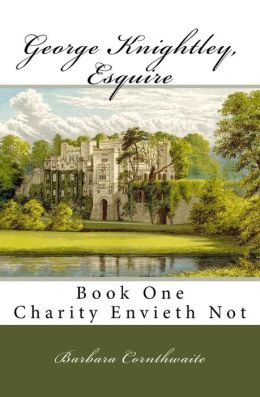
Charity Envieth Not. (George Knightley #1) Barbara Cornthwaite. 2009. CreateSpace. 260 pages. [Source: Library]
and
Lend Me Leave. (George Knightley #2) Barbara Cornthwaite. 2011. CreateSpace. 246 pages. [Source: Library]
I absolutely loved reading Charity Envieth Not and Lend Me Leave. These two books tell the novel Emma through the perspective of George Knightley. I almost wish they were combined into one edition, however. Still, I can't begin to recommend these enough to all Austen fans!!!
I enjoyed many aspects of both books. I really, really loved George Knightley. That in and of itself is far from shocking. Dare I say he's probably the best thing about Austen's novel?! I loved seeing the characters (and/or the community) through his eyes. I loved his involvement in the community. I loved meeting various characters--rich and poor, from all classes or statuses. I especially, especially liked Spencer! I loved getting to know his brother John better. And I liked seeing him in the role of uncle! I liked how wide the perspective is--if that makes sense! Emma, to me, comes across as very self-centered, the world through her eyes seem a bit narrow.
I also appreciate how both books treat the character of Emma. I think to fully appreciate Emma, one HAS to see her AS Knightley sees her. This book accomplishes that! I don't think I've ever seen Emma in such a positive light before. And it made me think a bit, what if Emma is blinded to her strengths JUST as she's blinded to her weaknesses. OR in other words, what if the narration is a bit too close to accurately judge her strengths/weaknesses. Of course, Knightley cannot absolutely read all her motives and intentions, so maybe he's reading more compassion, more tenderness, more generosity than is really truly there. But maybe just maybe Emma's heart is bigger than I have previously thought. And maybe just maybe her mind isn't quite as empty as I thought it. I kept asking myself what does Knightley see in Emma that I don't?
I would recommend it to those who already love Emma, and even to those that don't really like her. Knightley is a great hero! And he's definitely worth reading about!
© 2014 SukaYuka.com of SukaYuka's Book Reviews
and
Lend Me Leave. (George Knightley #2) Barbara Cornthwaite. 2011. CreateSpace. 246 pages. [Source: Library]
I absolutely loved reading Charity Envieth Not and Lend Me Leave. These two books tell the novel Emma through the perspective of George Knightley. I almost wish they were combined into one edition, however. Still, I can't begin to recommend these enough to all Austen fans!!!
I enjoyed many aspects of both books. I really, really loved George Knightley. That in and of itself is far from shocking. Dare I say he's probably the best thing about Austen's novel?! I loved seeing the characters (and/or the community) through his eyes. I loved his involvement in the community. I loved meeting various characters--rich and poor, from all classes or statuses. I especially, especially liked Spencer! I loved getting to know his brother John better. And I liked seeing him in the role of uncle! I liked how wide the perspective is--if that makes sense! Emma, to me, comes across as very self-centered, the world through her eyes seem a bit narrow.
I also appreciate how both books treat the character of Emma. I think to fully appreciate Emma, one HAS to see her AS Knightley sees her. This book accomplishes that! I don't think I've ever seen Emma in such a positive light before. And it made me think a bit, what if Emma is blinded to her strengths JUST as she's blinded to her weaknesses. OR in other words, what if the narration is a bit too close to accurately judge her strengths/weaknesses. Of course, Knightley cannot absolutely read all her motives and intentions, so maybe he's reading more compassion, more tenderness, more generosity than is really truly there. But maybe just maybe Emma's heart is bigger than I have previously thought. And maybe just maybe her mind isn't quite as empty as I thought it. I kept asking myself what does Knightley see in Emma that I don't?
I would recommend it to those who already love Emma, and even to those that don't really like her. Knightley is a great hero! And he's definitely worth reading about!
© 2014 SukaYuka.com of SukaYuka's Book Reviews
Monday, July 21, 2014
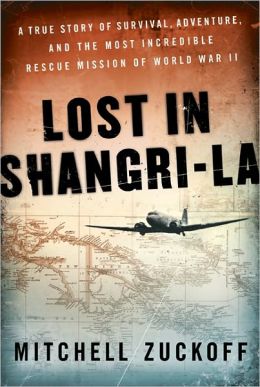
Lost in Shangri-La
Lost in Shangri-La. Mitchell Zuckoff. 2011. HarperCollins. 384 pages. [Source: Library]
After reading Frozen in Time, I knew I wanted to read another by Mitchell Zuckoff. Lost In Shangri-La: A True Story of Survival, Adventure, and the Most Incredible Rescue Mission of World War II did not disappoint. The two books are similar in that both books are about plane crashes, survivors, and rescue attempts. Also, obviously, both books are set during World War II.
Lost In Shangri-La tells the story of Margaret Hastings, John McCollom, and Kenneth Decker. These three were the survivors of the plane crash. All three were stationed in Dutch New Guinea, all three were taking part in a little sight-seeing holiday. All hoped to see "Shangri-La" safely from above. Twenty-four were on the plane, but after the crash, after the first twenty-four hours, only three remained alive. The three are able to leave the crash site and make their way to a better place, they are hoping to get to where a passing plane, a search plane, can see them.
The book goes on to tell of the men involved in the rescuing. Hastings and Decker were suffering severe injuries and in need of immediate medical attention. A rescue could not be accomplished quickly, in just a day or two. No, it would take time and careful planning...
Survivors. Rescuers. Natives. The book is very interesting. I definitely recommend it!
© 2014 SukaYuka.com of SukaYuka's Book Reviews
After reading Frozen in Time, I knew I wanted to read another by Mitchell Zuckoff. Lost In Shangri-La: A True Story of Survival, Adventure, and the Most Incredible Rescue Mission of World War II did not disappoint. The two books are similar in that both books are about plane crashes, survivors, and rescue attempts. Also, obviously, both books are set during World War II.
Lost In Shangri-La tells the story of Margaret Hastings, John McCollom, and Kenneth Decker. These three were the survivors of the plane crash. All three were stationed in Dutch New Guinea, all three were taking part in a little sight-seeing holiday. All hoped to see "Shangri-La" safely from above. Twenty-four were on the plane, but after the crash, after the first twenty-four hours, only three remained alive. The three are able to leave the crash site and make their way to a better place, they are hoping to get to where a passing plane, a search plane, can see them.
The book goes on to tell of the men involved in the rescuing. Hastings and Decker were suffering severe injuries and in need of immediate medical attention. A rescue could not be accomplished quickly, in just a day or two. No, it would take time and careful planning...
Survivors. Rescuers. Natives. The book is very interesting. I definitely recommend it!
© 2014 SukaYuka.com of SukaYuka's Book Reviews
Thursday, July 17, 2014
You'll Like It Here (Everybody Does) (2011)
You'll Like It Here (Everybody Does). Ruth White. 2011/2012. Random House. 272 pages. [Source: Review copy]
You'll Like It Here (Everybody Does) makes a great, quick, entertaining read. If you enjoy classic twilight zone episodes, you'll likely enjoy this middle grade science fiction novel. Meggie Blue, and her brother, David, narrate this one. Though readers spend time with the characters before the move to FASHION CITY, most of this one takes place in Fashion City. (To be clear from the start, Fashion City is located in an alternate/parallel universe.) I think the details surrounding Fashion City and the Fathers is best left to the reader to discover. Some of the details about WHO is living in this parallel world is intriguing. For example, Elvis is contemporary with L. Frank Baum who is contemporary with Abraham Lincoln who is contemporary with Grandma Moses who is contemporary with Martin Luther King Jr. I imagine it was very fun for the author to fit these people into her alternate universe and play around with the facts of history. (In this parallel world, Walt Disney was killed as a teenager in war, as was Laura Ingalls.) The character of Gramps is very, very fun! The book is odd and quirky. But. I found it entertaining.
© 2014 SukaYuka.com of SukaYuka's Book Reviews
You'll Like It Here (Everybody Does) makes a great, quick, entertaining read. If you enjoy classic twilight zone episodes, you'll likely enjoy this middle grade science fiction novel. Meggie Blue, and her brother, David, narrate this one. Though readers spend time with the characters before the move to FASHION CITY, most of this one takes place in Fashion City. (To be clear from the start, Fashion City is located in an alternate/parallel universe.) I think the details surrounding Fashion City and the Fathers is best left to the reader to discover. Some of the details about WHO is living in this parallel world is intriguing. For example, Elvis is contemporary with L. Frank Baum who is contemporary with Abraham Lincoln who is contemporary with Grandma Moses who is contemporary with Martin Luther King Jr. I imagine it was very fun for the author to fit these people into her alternate universe and play around with the facts of history. (In this parallel world, Walt Disney was killed as a teenager in war, as was Laura Ingalls.) The character of Gramps is very, very fun! The book is odd and quirky. But. I found it entertaining.
© 2014 SukaYuka.com of SukaYuka's Book Reviews
Wednesday, July 9, 2014
Alice-Miranda At School (2011)
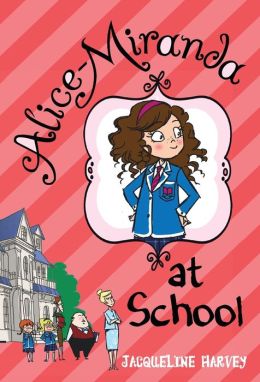
Alice-Miranda At School. Jacqueline Harvey. 2010/2011. Random House. 257 pages. [Source: Review copy]
Alice Miranda at School is a manipulatively cute book. It tries to be "cute" and "charming" and "delightful" and "amusing" and "endearing" on almost every single page. It tries to fit a certain mold in its storytelling.
Alice Miranda, our heroine, is seven. She wants to attend a certain boarding school. Even though she's a good six months younger than most of the other beginning students. Eight is usual age, after all. Alice Miranda has to be the most intuitive child on the planet. She can "read" people of all ages extremely well. On her first day at the school, she finds three adults who need her help. The cook needs a vacation so she can go visit her grandchildren for the first time. The gardener is depressed because he can't have flowers on the school grounds anymore. The assistant or secretary (the second in command) is sad because she can't marry her true love because she'd be fired if she marries. Alice Miranda also finds some students nearer her own age who need fixing.
Alice Miranda would definitely be "Emma Approved." (I am currently watching "Emma Approved" which is an adaptation of Emma by Jane Austen.) Alice Miranda almost demands a reaction from everyone she meets: instant love or instant hate.
If this book actually has a real plot, it is the "three tests" that Alice-Miranda must take in order to stay at the school.
I liked this one. I didn't dislike it. I found Alice Miranda's character to be unbelievable and silly. But since I felt it was completely intentional for her to be so over-the-top and unnatural, I didn't mind it so much.
© 2014 SukaYuka.com of SukaYuka's Book Reviews
Alice Miranda at School is a manipulatively cute book. It tries to be "cute" and "charming" and "delightful" and "amusing" and "endearing" on almost every single page. It tries to fit a certain mold in its storytelling.
Alice Miranda, our heroine, is seven. She wants to attend a certain boarding school. Even though she's a good six months younger than most of the other beginning students. Eight is usual age, after all. Alice Miranda has to be the most intuitive child on the planet. She can "read" people of all ages extremely well. On her first day at the school, she finds three adults who need her help. The cook needs a vacation so she can go visit her grandchildren for the first time. The gardener is depressed because he can't have flowers on the school grounds anymore. The assistant or secretary (the second in command) is sad because she can't marry her true love because she'd be fired if she marries. Alice Miranda also finds some students nearer her own age who need fixing.
Alice Miranda would definitely be "Emma Approved." (I am currently watching "Emma Approved" which is an adaptation of Emma by Jane Austen.) Alice Miranda almost demands a reaction from everyone she meets: instant love or instant hate.
If this book actually has a real plot, it is the "three tests" that Alice-Miranda must take in order to stay at the school.
I liked this one. I didn't dislike it. I found Alice Miranda's character to be unbelievable and silly. But since I felt it was completely intentional for her to be so over-the-top and unnatural, I didn't mind it so much.
© 2014 SukaYuka.com of SukaYuka's Book Reviews
Tuesday, July 1, 2014
The Year We Were Famous
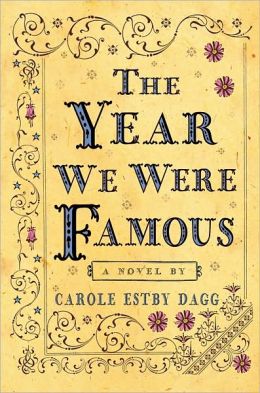
The Year We Were Famous. Carole Estby Dagg. 2011. Houghton Mifflin Harcourt. 256 pages. [Source: Review copy]
I definitely liked Carole Estby Dagg's The Year We Were Famous. This is historical fiction based on a true story, a true family story. It is fiction; liberties have been taken. Liberties that work in favor of a not-so-bleak ending.
Clara Estby is the heroine of The Year We Were Famous. She is the oldest daughter; she is seventeen. The family farm is in big, big trouble. Her mother, Helga, who suffers--and suffers understandably--from depression, works with her daughter to brainstorm a way to "save" the farm. Her daughter's careless comment about wanting to travel the world and be a journalist sparks an idea that can't be swept aside. Helga is determined to find sponsors, wealthy sponsors who want to test what women are capable of. She wants to make a deal. She and her daughter will walk across country, over three thousand miles, starting with no more than $5, if they reach New York City by the deadline, they will receive $10,000--more than enough to keep the farm. This is where the details are a bit fuzzy in reality because the journals and such were purposefully destroyed by the family. No one is sure *who* the sponsor was, if there even was a sponsor, the intentions of the sponsor, etc.
For over seven months May through December, these two women are on their own and on an adventure of sorts. It is dangerous and exhausting and overwhelming and a once in a lifetime opportunity. They meet new people almost every single day. They are sharing their stories with various newspapers across the country. They are speaking at suffragette events across the country. They are challenging themselves day and night...
I liked this one. It is set in 1896. I appreciated the fact that the author was inspired by her family history.
© 2014 SukaYuka.com of SukaYuka's Book Reviews
I definitely liked Carole Estby Dagg's The Year We Were Famous. This is historical fiction based on a true story, a true family story. It is fiction; liberties have been taken. Liberties that work in favor of a not-so-bleak ending.
Clara Estby is the heroine of The Year We Were Famous. She is the oldest daughter; she is seventeen. The family farm is in big, big trouble. Her mother, Helga, who suffers--and suffers understandably--from depression, works with her daughter to brainstorm a way to "save" the farm. Her daughter's careless comment about wanting to travel the world and be a journalist sparks an idea that can't be swept aside. Helga is determined to find sponsors, wealthy sponsors who want to test what women are capable of. She wants to make a deal. She and her daughter will walk across country, over three thousand miles, starting with no more than $5, if they reach New York City by the deadline, they will receive $10,000--more than enough to keep the farm. This is where the details are a bit fuzzy in reality because the journals and such were purposefully destroyed by the family. No one is sure *who* the sponsor was, if there even was a sponsor, the intentions of the sponsor, etc.
For over seven months May through December, these two women are on their own and on an adventure of sorts. It is dangerous and exhausting and overwhelming and a once in a lifetime opportunity. They meet new people almost every single day. They are sharing their stories with various newspapers across the country. They are speaking at suffragette events across the country. They are challenging themselves day and night...
I liked this one. It is set in 1896. I appreciated the fact that the author was inspired by her family history.
© 2014 SukaYuka.com of SukaYuka's Book Reviews
Wednesday, June 18, 2014
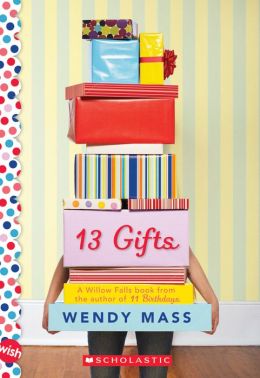
13 Gifts (2011)
13 Gifts. (Willow Falls #3) Wendy Mass. 2011. Scholastic. 341 pages. [Source: Review copy]
Tara Brennan is the heroine of Wendy Mass's 13 Gifts. It is a companion novel to 11 Birthdays and Finally. It is set in Willow Falls. Tara's mom and dad were born and raised in Willow Falls. They have moved dozens of times since they got married. Tara is tired, very tired, of all the moving. Tara wishes that she had some place to call her own, to be HOME. After an incident at school involving a stuffed goat in the principal's office, Tara is "sent away" to Willow Falls to live with her aunt, uncle, and cousin. This cousin, Emily, was first introduced in Finally. Emily was Rory's first babysitting job. Tara just happens to be the same age as Rory, Leo, and Amanda. All characters introduced in previous books. The group soon realizes that Tara belongs, that she too has been chosen by Angelina d'Angelo. Tara is given a task, a big task, a can't-handle-it-by-herself task to accomplish by her thirteenth birthday in July. She is to acquire what appears to be completely random items from individuals in the town.
The list:
I enjoyed 13 Gifts. I liked how Tara's quest was about healing the community and righting past wrongs. I liked that Tara--and readers--were clueless about the bigger task until the very end. I liked spending time in Willow Falls. Readers get to spend more time interacting with residents than in any previous novel. It was fun.
© 2014 SukaYuka.com of SukaYuka's Book Reviews
Tara Brennan is the heroine of Wendy Mass's 13 Gifts. It is a companion novel to 11 Birthdays and Finally. It is set in Willow Falls. Tara's mom and dad were born and raised in Willow Falls. They have moved dozens of times since they got married. Tara is tired, very tired, of all the moving. Tara wishes that she had some place to call her own, to be HOME. After an incident at school involving a stuffed goat in the principal's office, Tara is "sent away" to Willow Falls to live with her aunt, uncle, and cousin. This cousin, Emily, was first introduced in Finally. Emily was Rory's first babysitting job. Tara just happens to be the same age as Rory, Leo, and Amanda. All characters introduced in previous books. The group soon realizes that Tara belongs, that she too has been chosen by Angelina d'Angelo. Tara is given a task, a big task, a can't-handle-it-by-herself task to accomplish by her thirteenth birthday in July. She is to acquire what appears to be completely random items from individuals in the town.
The list:
- One wicker basket with handles in the shape of hearts
- One gray wool blanket with two-inch red stripes around the border
- One brass candlestick in the shape of a fish
- One large white shawl with the initials ER on the left corner
- One knife with a black handle inside a red sheath
- A 2-ounce purple glass bottle with a silver stopper
- One long strand of pearls with a gold clasp
- One leather-bound copy of the Bible, black, Book of Genesis repeated twice
- One wooden key with the words "Made in Willow Falls, 1974" carved in the shank
- One black steamer trunk with gold latch
- One violin, silver plating on back reads Sam, 1902
- One bottle of apple wine, 1925, brewed by Ellerby-Fitzpatrick Brewers
- One wooden cane, handle shaped like a duck's beak
I enjoyed 13 Gifts. I liked how Tara's quest was about healing the community and righting past wrongs. I liked that Tara--and readers--were clueless about the bigger task until the very end. I liked spending time in Willow Falls. Readers get to spend more time interacting with residents than in any previous novel. It was fun.
© 2014 SukaYuka.com of SukaYuka's Book Reviews
Thursday, May 29, 2014
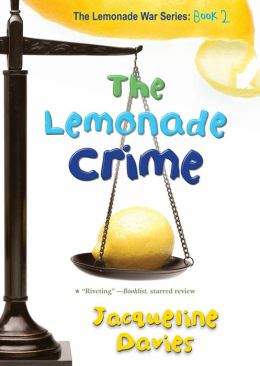
The Lemonade Crime (2011)
The Lemonade Crime. Jacqueline Davies. 2011. Houghton Mifflin Harcourt. 160 pages. [Source: Library book]
The Lemonade Crime opens with the fourth day of fourth grade for Jessie and Evan Treski. Evan and Jessie are still convinced that Scott Spencer STOLE $208 from Evan's short pockets on the last day of summer. They become even more convinced of his guilt when Scott starts bragging that he has the latest Xbox. And brag he does to anyone and everyone who will listen. And the teacher seems to be fine with this bragging taking up class time. Jessie wants justice. So she serves him with papers. These "fake" legal papers tell him he has to arrive in court on Friday after-school for his trial by his peers. Jessie assigns roles to her classmates. Her brother, Evan, is the plaintiff. She is his lawyer. Scott is the defendant. Megan is Scott's lawyer. Twelve of their classmates become jurors; six boys, six girls, I believe. David a boy that isn't particularly friendly with either Scott or Evan is chosen to be judge. The rest of the class will be the audience. Jessie takes this trial very seriously. If Scott is found guilty, he will "have" to give up his new Xbox. If Scott is found innocent, then Jessie and Evan will have to apologize in front of everyone.
It's obvious that The Lemonade Crime has a theme of justice. Two kids who feel they were wronged want justice, they want a wrong to be righted. They imagine how sweet it will be to prove Scott to be a liar and a thief in front of everyone. Holding onto this anger, however, is changing Jessie and Evan.
There is also a not-so-subtle, but oh-so-pleasant theme of forgiveness in this novel. This is first hinted at when Jessie notes that Saturday will be Yom Kippur, the Day of Atonement. Several of Evan's friends are Jewish. Several of his friends come to him privately and ask forgiveness for things they did previously. Evan lets this resonate and he begins to reflect. I really liked this turn of events.
I definitely enjoyed this second book in the series.
© 2014 SukaYuka.com of SukaYuka's Book Reviews
The Lemonade Crime opens with the fourth day of fourth grade for Jessie and Evan Treski. Evan and Jessie are still convinced that Scott Spencer STOLE $208 from Evan's short pockets on the last day of summer. They become even more convinced of his guilt when Scott starts bragging that he has the latest Xbox. And brag he does to anyone and everyone who will listen. And the teacher seems to be fine with this bragging taking up class time. Jessie wants justice. So she serves him with papers. These "fake" legal papers tell him he has to arrive in court on Friday after-school for his trial by his peers. Jessie assigns roles to her classmates. Her brother, Evan, is the plaintiff. She is his lawyer. Scott is the defendant. Megan is Scott's lawyer. Twelve of their classmates become jurors; six boys, six girls, I believe. David a boy that isn't particularly friendly with either Scott or Evan is chosen to be judge. The rest of the class will be the audience. Jessie takes this trial very seriously. If Scott is found guilty, he will "have" to give up his new Xbox. If Scott is found innocent, then Jessie and Evan will have to apologize in front of everyone.
It's obvious that The Lemonade Crime has a theme of justice. Two kids who feel they were wronged want justice, they want a wrong to be righted. They imagine how sweet it will be to prove Scott to be a liar and a thief in front of everyone. Holding onto this anger, however, is changing Jessie and Evan.
There is also a not-so-subtle, but oh-so-pleasant theme of forgiveness in this novel. This is first hinted at when Jessie notes that Saturday will be Yom Kippur, the Day of Atonement. Several of Evan's friends are Jewish. Several of his friends come to him privately and ask forgiveness for things they did previously. Evan lets this resonate and he begins to reflect. I really liked this turn of events.
I definitely enjoyed this second book in the series.
© 2014 SukaYuka.com of SukaYuka's Book Reviews
Tuesday, May 6, 2014
The Winter Pony (2011)
The Winter Pony. Ian Lawrence. 2011. Random House. 256 pages. [Source: Review copy]
By the time I was halfway through The Winter Pony, I knew I had made a mistake, a big mistake. It isn't just that all the animals die, the ponies, the dogs, and lots of other Antarctic animals that were killed for food or fur, or both. It isn't just the fact that almost all the human characters die too.
I think it's the fact, and this is purely subjective on my part, that it was all so pointless. What could possibly be heroic or noble about starving to death and/or freezing to death? For what did these men risk their lives? For the glory of man? For pride? The men had a choice. They, for whatever reason, were excited and motivated and aware of the risks and hardships. The animals, well, they had no choice at any point. The animals were essentially doomed from the moment they were selected to be a part of Robert Falcon Scott's quest, his mission, to be the first to the South Pole.
Why am I focusing on the animals instead of the men? For the simple fact that this book does. The Winter Pony is told through a pony's perspective. The pony hero is James Pigg. The novel opens with James Pigg free and running wild, happy and innocent. It ends with him being shot and fed to the remaining dogs and men. (The men, the dogs, the ponies, all shared the same fate, it was just a matter of when.)
The author seems to like and respect Robert Scott, and has sought to tell the story honestly for better or worse. He does point out that big mistakes were made by Scott on his journey, that the story could have had a different ending, if Scott had made different choices, better choices. One of the mistakes is that Scott failed to push the ponies hard enough at the beginning. He had planned to create a supply cache, "One Ton Depot" at a certain degree, he stopped short of his goal for the sake of the ponies. On his return journey, he never came close to reaching the much-needed supplies that would have saved his life and the lives of his men. If he had stuck to the original plan, then he would have reached his supplies. There were other mistakes made as well.
There was nothing in Ian Lawrence's novel that made me like or respect Scott.
The Winter Pony stays relatively close to the facts. James Pigg's part in the story is stretched and expanded to tell more of what it was like to be one of twenty (or is nineteen?) ponies on the expedition.
The narrative switches between the pony's perspective AND an omniscient narrator that shares plenty of information.
© 2014 SukaYuka.com of SukaYuka's Book Reviews
By the time I was halfway through The Winter Pony, I knew I had made a mistake, a big mistake. It isn't just that all the animals die, the ponies, the dogs, and lots of other Antarctic animals that were killed for food or fur, or both. It isn't just the fact that almost all the human characters die too.
I think it's the fact, and this is purely subjective on my part, that it was all so pointless. What could possibly be heroic or noble about starving to death and/or freezing to death? For what did these men risk their lives? For the glory of man? For pride? The men had a choice. They, for whatever reason, were excited and motivated and aware of the risks and hardships. The animals, well, they had no choice at any point. The animals were essentially doomed from the moment they were selected to be a part of Robert Falcon Scott's quest, his mission, to be the first to the South Pole.
Why am I focusing on the animals instead of the men? For the simple fact that this book does. The Winter Pony is told through a pony's perspective. The pony hero is James Pigg. The novel opens with James Pigg free and running wild, happy and innocent. It ends with him being shot and fed to the remaining dogs and men. (The men, the dogs, the ponies, all shared the same fate, it was just a matter of when.)
The author seems to like and respect Robert Scott, and has sought to tell the story honestly for better or worse. He does point out that big mistakes were made by Scott on his journey, that the story could have had a different ending, if Scott had made different choices, better choices. One of the mistakes is that Scott failed to push the ponies hard enough at the beginning. He had planned to create a supply cache, "One Ton Depot" at a certain degree, he stopped short of his goal for the sake of the ponies. On his return journey, he never came close to reaching the much-needed supplies that would have saved his life and the lives of his men. If he had stuck to the original plan, then he would have reached his supplies. There were other mistakes made as well.
There was nothing in Ian Lawrence's novel that made me like or respect Scott.
The Winter Pony stays relatively close to the facts. James Pigg's part in the story is stretched and expanded to tell more of what it was like to be one of twenty (or is nineteen?) ponies on the expedition.
The narrative switches between the pony's perspective AND an omniscient narrator that shares plenty of information.
© 2014 SukaYuka.com of SukaYuka's Book Reviews
Subscribe to:
Posts (Atom)