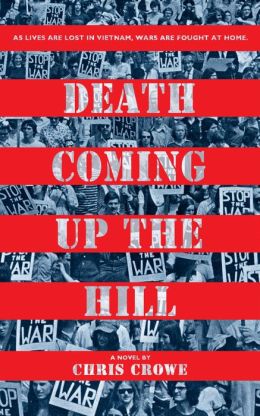
Death Coming Up The Hill. Chris Crowe. 2014. HMH. 208 pages. [Source: Review copy]
At first I was skeptical about Death Coming Up the Hill. A whole verse novel written in haiku?! I struggle with liking verse novels in general. When I do, it is more often an exception than the norm. Why haiku? Why a verse novel? But after reading the author's note, I was a bit more forgiving and appreciative. He shares why he chose to write in haiku. He says he tried writing the story in prose, he tried different things here and there. He liked the characters. He liked the story. But the words, they were stuck. When he tried writing in verse, in haiku, things became unstuck. Furthermore, the number of syllables in Death Coming Up the Hill matches precisely the number of American soldiers killed in Vietnam in 1968. So the author's note did explain the why. That being said, I haven't changed my mind about verse novels.
Death Coming Up the Hill is a coming-of-age love story set in 1968. Ashe is the protagonist. 1968 will bring him joy and sorrow. I'll start with the joy: the new girl in school, Angela Turner, will become his girl; they'll fall madly in love. She will support him. He will support her. Together they have something solid. A further joy, of sorts, is Ashe will get a baby sister, Rosa. Now for the sorrow, Rosa is not his father's child. His mom has had an affair. His parents will split up, and Ashe's family life will go from uncomfortable to unbearable. Plus, there's general angst. Angst about the war in Vietnam. Angst at home in the U.S. His father is at one extreme, his mother at the other. Ashe is growing up and deciding who he is, what he believes, what he wants and needs, what he's willing to do or not do.
As a coming of age novel, it works. As a love story, it works. So in many ways this one works. I personally don't think it's great in terms of poetry and language. But I will be the first to admit that I don't read much poetry, and, that poetry in general is subjective enough to begin with. Do I think that the novel resonates with emotion? Yes. But I don't think it resonates with emotion because of the poetry.
© 2014 SukaYuka.com of SukaYuka's Book Reviews
Showing posts with label YA Historical Fiction. Show all posts
Tuesday, December 30, 2014
Tuesday, October 28, 2014
The Right Fight (2014)
The Right Fight. Chris Lynch. 2014. Scholastic. 192 pages. [Source: Library]
I enjoyed Chris Lynch's The Right Fight. Roman, the protagonist, loves, loves, LOVES baseball. But he loves his country even more. That is why he enlisted even before America entered the war--the second world war. The book chronicles his early experiences in the war as a tank driver. Readers see him through training, war games, and going overseas, his various assignments and missions. (Most of the book sees him in North Africa). Readers experience it from his point of view and from a few letters as well. One sees how his fellow soldiers--the men in his tank specifically--form a family. One also sees the many (often-ugly) sides of war.
I enjoyed this one. I thought there was a good balance of action (war) and characterization. I liked getting to know Roman, his fiancee, his war buddies.
© 2014 SukaYuka.com of SukaYuka's Book Reviews
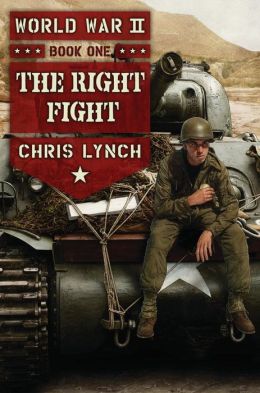
I enjoyed Chris Lynch's The Right Fight. Roman, the protagonist, loves, loves, LOVES baseball. But he loves his country even more. That is why he enlisted even before America entered the war--the second world war. The book chronicles his early experiences in the war as a tank driver. Readers see him through training, war games, and going overseas, his various assignments and missions. (Most of the book sees him in North Africa). Readers experience it from his point of view and from a few letters as well. One sees how his fellow soldiers--the men in his tank specifically--form a family. One also sees the many (often-ugly) sides of war.
I enjoyed this one. I thought there was a good balance of action (war) and characterization. I liked getting to know Roman, his fiancee, his war buddies.
© 2014 SukaYuka.com of SukaYuka's Book Reviews
Tuesday, September 2, 2014
Love by the Morning Star (2014)
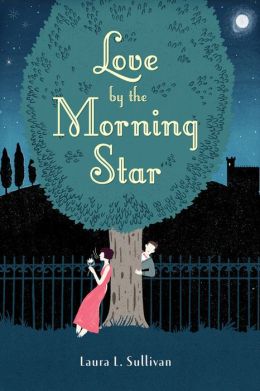
Love by the Morning Star. Laura L. Sullivan. 2014. Houghton Mifflin Harcourt. 320 pages. [Source: Review copy]
I was disappointed by Laura Sullivan's Love by the Morning Star. I wanted to love it. I did. It is a novel set in English countryside in 1938-1939. It offers an upstairs/downstairs view of life. Or supposedly so. Two young women come to Starkers. One is a gold digger spy. Her father is a Nazi-sympathizer to say the least and his gang (for lack of a better word) wants her in position at this estate. She's told she'll be a maid. The other young woman is a Jewish refugee. She is actually a relation of the family who owns the estate. She's coming to Starkers to stay with her aunt and uncle. One girl is Hannah. The other girl is Anna. One will be treated well. The other won't.
In case you haven't guessed it, mistaken identity is the name of the game. These two women also happen to fall in love with the same man.
Why was I disappointed? Well. I'm not sure if it's because of the setting or the tone. I think I might have tolerated the tone--the silliness, the lightness, the double entendres, etc. if it wasn't set during such a dark time. It's hard to make light of the Nazis gaining power and destroying the lives of the Jewish people. The subject is serious and it deserves better. If it had been set twenty-five or thirty years earlier, then, perhaps it would have worked for me.
The romance. I liked the secret meetings between the hero and the heroine. There were only a handful of these scenes, but, they kept me reading.
I just have to add that I HATED one of the characters. I disliked a few more as well. But there was one that stood out above the rest as being AWFUL.
© 2014 SukaYuka.com of SukaYuka's Book Reviews
I was disappointed by Laura Sullivan's Love by the Morning Star. I wanted to love it. I did. It is a novel set in English countryside in 1938-1939. It offers an upstairs/downstairs view of life. Or supposedly so. Two young women come to Starkers. One is a gold digger spy. Her father is a Nazi-sympathizer to say the least and his gang (for lack of a better word) wants her in position at this estate. She's told she'll be a maid. The other young woman is a Jewish refugee. She is actually a relation of the family who owns the estate. She's coming to Starkers to stay with her aunt and uncle. One girl is Hannah. The other girl is Anna. One will be treated well. The other won't.
In case you haven't guessed it, mistaken identity is the name of the game. These two women also happen to fall in love with the same man.
Why was I disappointed? Well. I'm not sure if it's because of the setting or the tone. I think I might have tolerated the tone--the silliness, the lightness, the double entendres, etc. if it wasn't set during such a dark time. It's hard to make light of the Nazis gaining power and destroying the lives of the Jewish people. The subject is serious and it deserves better. If it had been set twenty-five or thirty years earlier, then, perhaps it would have worked for me.
The romance. I liked the secret meetings between the hero and the heroine. There were only a handful of these scenes, but, they kept me reading.
I just have to add that I HATED one of the characters. I disliked a few more as well. But there was one that stood out above the rest as being AWFUL.
© 2014 SukaYuka.com of SukaYuka's Book Reviews
Friday, August 1, 2014
Reread #31 Book Thief
The Book Thief. Markus Zusak. 2006. Random House. 560 pages. [Source: Book I Bought]
First the colors. Then the humans. That’s usually how I see things. Or at least, how I try. HERE IS A SMALL FACT You are going to die. I am in all truthfulness attempting to be cheerful about this whole topic, though most people find themselves hindered in believing me, no matter my protestations. Please, trust me. I most definitely can be cheerful. I can be amiable. Agreeable. Affable. And that’s only the A’s. Just don’t ask me to be nice. Nice has nothing to do with me. REACTION TO THE AFOREMENTIONED FACT Does this worry you? I urge you—don’t be afraid. I’m nothing if not fair. —Of course, an introduction. A beginning. Where are my manners? I could introduce myself properly, but it’s not really necessary. You will know me well enough and soon enough, depending on a diverse range of variables. It suffices to say that at some point in time, I will be standing over you, as genially as possible. Your soul will be in my arms. A color will be perched on my shoulder. I will carry you gently away. At that moment, you will be lying there (I rarely find people standing up). You will be caked in your own body. There might be a discovery; a scream will dribble down the air. The only sound I’ll hear after that will be my own breathing, and the sound of the smell, of my footsteps. The question is, what color will everything be at that moment when I come for you? What will the sky be saying? Personally, I like a chocolate-colored sky. Dark, dark chocolate. People say it suits me. I do, however, try to enjoy every color I see—the whole spectrum. A billion or so flavors, none of them quite the same, and a sky to slowly suck on. It takes the edge off the stress. It helps me relax.
The Book Thief is one of those books that I've read again and again and again. I reviewed it in 2007, 2008, and 2012. I started the year knowing that I would have to include it among my rereads. It's just a great book, a great book that is not diminished by rereading. It stays compelling and beautiful. It was also recently filmed. I wanted to read the book around the same time I watched the movie.
I watched the movie before rereading The Book Thief. If I'd never read the Book Thief, I would not have felt right seeing the movie first. This worked well for me. I think it worked to the movie's benefit in fact. I was able to become absorbed in the story and the characters. I wasn't comparing every second of the movie to every word in the book. I wasn't seeing the movie within the framework of what has been left out and what has been changed. Watching the movie, I was reminded of why I love the characters I love, reminded of why they are so memorable to me. They are just as memorable to me as say Anne, Marilla, Matthew, and Gilbert. The Book Thief was a book that deserved a film of equal quality to be made, and, I think it was done beautifully. That doesn't mean that everything in the movie was in the book or that everything in the book was in the movie. One thing I did notice after reading the book was the fact that Hans did not take the accordion with him into the shelter raids. (Though it did make a great movie moment.)
I loved rereading The Book Thief. It is always an experience. I don't think I can improve upon my last review:
The Book Thief leaves me speechless. If humans leave Death, the narrator, feeling haunted, I can say the same of the narrator. Could a book have a better narrator? I doubt it. There is something so perfectly-perfectly-perfect about The Book Thief. It is beautiful and brilliant; absorbing and compelling. It goes ugly places, to be sure, but the language, the style, just can't be beat. I mean this is a novel that wows and amazes. The characters are so real, so vivid. I mean these characters are very real, very human, very flawed, but the connection is so intense.
I don't love it because it's an easy read. I don't love it because it's a happy, happy novel. I love it because it is beautiful, haunting, ugly, yet hopeful.
Favorite quotes:
© 2014 SukaYuka.com of SukaYuka's Book Reviews
First the colors. Then the humans. That’s usually how I see things. Or at least, how I try. HERE IS A SMALL FACT You are going to die. I am in all truthfulness attempting to be cheerful about this whole topic, though most people find themselves hindered in believing me, no matter my protestations. Please, trust me. I most definitely can be cheerful. I can be amiable. Agreeable. Affable. And that’s only the A’s. Just don’t ask me to be nice. Nice has nothing to do with me. REACTION TO THE AFOREMENTIONED FACT Does this worry you? I urge you—don’t be afraid. I’m nothing if not fair. —Of course, an introduction. A beginning. Where are my manners? I could introduce myself properly, but it’s not really necessary. You will know me well enough and soon enough, depending on a diverse range of variables. It suffices to say that at some point in time, I will be standing over you, as genially as possible. Your soul will be in my arms. A color will be perched on my shoulder. I will carry you gently away. At that moment, you will be lying there (I rarely find people standing up). You will be caked in your own body. There might be a discovery; a scream will dribble down the air. The only sound I’ll hear after that will be my own breathing, and the sound of the smell, of my footsteps. The question is, what color will everything be at that moment when I come for you? What will the sky be saying? Personally, I like a chocolate-colored sky. Dark, dark chocolate. People say it suits me. I do, however, try to enjoy every color I see—the whole spectrum. A billion or so flavors, none of them quite the same, and a sky to slowly suck on. It takes the edge off the stress. It helps me relax.
The Book Thief is one of those books that I've read again and again and again. I reviewed it in 2007, 2008, and 2012. I started the year knowing that I would have to include it among my rereads. It's just a great book, a great book that is not diminished by rereading. It stays compelling and beautiful. It was also recently filmed. I wanted to read the book around the same time I watched the movie.
I watched the movie before rereading The Book Thief. If I'd never read the Book Thief, I would not have felt right seeing the movie first. This worked well for me. I think it worked to the movie's benefit in fact. I was able to become absorbed in the story and the characters. I wasn't comparing every second of the movie to every word in the book. I wasn't seeing the movie within the framework of what has been left out and what has been changed. Watching the movie, I was reminded of why I love the characters I love, reminded of why they are so memorable to me. They are just as memorable to me as say Anne, Marilla, Matthew, and Gilbert. The Book Thief was a book that deserved a film of equal quality to be made, and, I think it was done beautifully. That doesn't mean that everything in the movie was in the book or that everything in the book was in the movie. One thing I did notice after reading the book was the fact that Hans did not take the accordion with him into the shelter raids. (Though it did make a great movie moment.)
I loved rereading The Book Thief. It is always an experience. I don't think I can improve upon my last review:
The Book Thief leaves me speechless. If humans leave Death, the narrator, feeling haunted, I can say the same of the narrator. Could a book have a better narrator? I doubt it. There is something so perfectly-perfectly-perfect about The Book Thief. It is beautiful and brilliant; absorbing and compelling. It goes ugly places, to be sure, but the language, the style, just can't be beat. I mean this is a novel that wows and amazes. The characters are so real, so vivid. I mean these characters are very real, very human, very flawed, but the connection is so intense.
I don't love it because it's an easy read. I don't love it because it's a happy, happy novel. I love it because it is beautiful, haunting, ugly, yet hopeful.
Favorite quotes:
Yes, often, I am reminded of her, and in one of my vast array of pockets, I have kept her story to retell. It is one of the small legion I carry, each one extraordinary in its own right. Each one an attempt—an immense leap of an attempt—to prove to me that you, and your human existence, are worth it. Here it is. One of a handful. The Book Thief. If you feel like it, come with me. I will tell you a story. I’ll show you something.
Yes, an illustrious career. I should hasten to admit, however, that there was a considerable hiatus between the first stolen book and the second. Another noteworthy point is that the first was stolen from snow and the second from fire. Not to omit that others were also given to her. All told, she owned fourteen books, but she saw her story as being made up predominantly of ten of them. Of those ten, six were stolen, one showed up at the kitchen table, two were made for her by a hidden Jew, and one was delivered by a soft, yellow-dressed afternoon.
When she came to write her story, she would wonder exactly when the books and the words started to mean not just something, but everything. Was it when she first set eyes on the room with shelves and shelves of them? Or when Max Vandenburg arrived on Himmel Street carrying handfuls of suffering and Hitler’s Mein Kampf? Was it reading in the shelters? The last parade to Dachau? Was it The Word Shaker? Perhaps there would never be a precise answer as to when and where it occurred. In any case, that’s getting ahead of myself. Before we make it to any of that, we first need to tour Liesel Meminger’s beginnings on Himmel Street...
To most people, Hans Hubermann was barely visible. An un-special person. Certainly, his painting skills were excellent. His musical ability was better than average. Somehow, though, and I’m sure you’ve met people like this, he was able to appear as merely part of the background, even if he was standing at the front of a line. He was always just there. Not noticeable. Not important or particularly valuable. The frustration of that appearance, as you can imagine, was its complete misleadence, let’s say. There most definitely was value in him, and it did not go unnoticed by Liesel Meminger. (The human child—so much cannier at times than the stupefyingly ponderous adult.)
A DEFINITION NOT FOUND IN THE DICTIONARY Not leaving: an act of trust and love, often deciphered by children
Insane or not, Rudy was always destined to be Liesel’s best friend. A snowball in the face is surely the perfect beginning to a lasting friendship.
I guess humans like to watch a little destruction. Sand castles, houses of cards, that’s where they begin. Their great skill is their capacity to escalate.
A SMALL BUT NOTE WORTHY NOTE I’ve seen so many young men over the years who think they’re running at other young men. They are not. They’re running at me.
On the ration cards of Nazi Germany, there was no listing for punishment, but everyone had to take their turn. For some it was death in a foreign country during the war. For others it was poverty and guilt when the war was over, when six million discoveries were made throughout Europe.
For some reason, dying men always ask questions they know the answer to. Perhaps it’s so they can die being right.
© 2014 SukaYuka.com of SukaYuka's Book Reviews
Tuesday, July 22, 2014
Soldier Doll (2014)
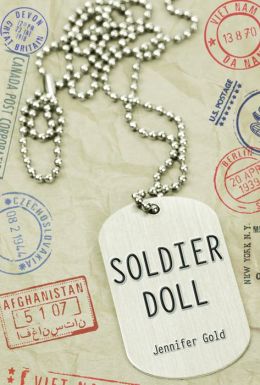
Soldier Doll. Jennifer Gold. 2014. Second Story Press. 256 pages. [Source: Review copy]
Soldier Doll is a message-driven novel with an interesting premise. Towards the end of World War I (1918), Margaret Merriweather, an English woman, gives her fiance a wooden doll. This is a doll that her own father made for her when she's a child. She paints a soldier's uniform on him. She gives him as a good luck charm, a way he can carry her with him wherever he goes. After he dies, Margaret is inspired to write a poem. This poem becomes famous. The doll itself is gone forever. Or so everyone thought. Soldier Doll follows the adventures of this wooden soldier with the baby-face. The framework for all the stories is his being discovered in Toronto in 2007 by a teen girl, Elizabeth. Elizabeth is buying her dad a DOLL for his birthday. Her dad is a soldier preparing to go to Afghanistan. A moping Elizabeth ventures into a used bookstore and discovers the poem-book by Merriweather. She's convinced she's found THE DOLL from the poem. She and her Dad team up to see if this is so... (view spoiler)
The chapters alternate between the 2007 story and the doll's adventures in the past beginning with World War I. The doll also heads to other wars: World War II, Vietnam, and the Iraq War. His ownership is passed along many times. I should clarify that readers don't get the perspective of the doll at any time. It remains just an object. What readers do get are glimpses of various soldiers from various countries. It captures scenes from life on the front.
War. War. War. That is the focus of Soldier Doll. Why do nations go to war? Why do men go to war? What is the point of it all? Those are the questions asked openly and honestly in Jennifer Gold's Soldier Doll. It is an anti-war novel, as you might imagine.
I found the 2007 story to be awkward. I found the past stories to be much better. The past sections were written in past tense. The 2007 story was written in very awkward present tense. It was third person present.
© 2014 SukaYuka.com of SukaYuka's Book Reviews
Soldier Doll is a message-driven novel with an interesting premise. Towards the end of World War I (1918), Margaret Merriweather, an English woman, gives her fiance a wooden doll. This is a doll that her own father made for her when she's a child. She paints a soldier's uniform on him. She gives him as a good luck charm, a way he can carry her with him wherever he goes. After he dies, Margaret is inspired to write a poem. This poem becomes famous. The doll itself is gone forever. Or so everyone thought. Soldier Doll follows the adventures of this wooden soldier with the baby-face. The framework for all the stories is his being discovered in Toronto in 2007 by a teen girl, Elizabeth. Elizabeth is buying her dad a DOLL for his birthday. Her dad is a soldier preparing to go to Afghanistan. A moping Elizabeth ventures into a used bookstore and discovers the poem-book by Merriweather. She's convinced she's found THE DOLL from the poem. She and her Dad team up to see if this is so... (view spoiler)
The chapters alternate between the 2007 story and the doll's adventures in the past beginning with World War I. The doll also heads to other wars: World War II, Vietnam, and the Iraq War. His ownership is passed along many times. I should clarify that readers don't get the perspective of the doll at any time. It remains just an object. What readers do get are glimpses of various soldiers from various countries. It captures scenes from life on the front.
War. War. War. That is the focus of Soldier Doll. Why do nations go to war? Why do men go to war? What is the point of it all? Those are the questions asked openly and honestly in Jennifer Gold's Soldier Doll. It is an anti-war novel, as you might imagine.
I found the 2007 story to be awkward. I found the past stories to be much better. The past sections were written in past tense. The 2007 story was written in very awkward present tense. It was third person present.
© 2014 SukaYuka.com of SukaYuka's Book Reviews
Tuesday, July 1, 2014
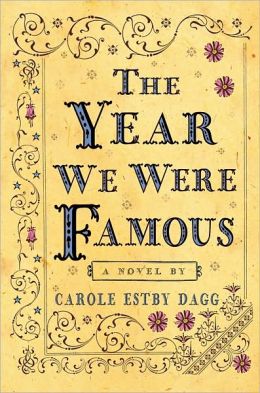
The Year We Were Famous
The Year We Were Famous. Carole Estby Dagg. 2011. Houghton Mifflin Harcourt. 256 pages. [Source: Review copy]
I definitely liked Carole Estby Dagg's The Year We Were Famous. This is historical fiction based on a true story, a true family story. It is fiction; liberties have been taken. Liberties that work in favor of a not-so-bleak ending.
Clara Estby is the heroine of The Year We Were Famous. She is the oldest daughter; she is seventeen. The family farm is in big, big trouble. Her mother, Helga, who suffers--and suffers understandably--from depression, works with her daughter to brainstorm a way to "save" the farm. Her daughter's careless comment about wanting to travel the world and be a journalist sparks an idea that can't be swept aside. Helga is determined to find sponsors, wealthy sponsors who want to test what women are capable of. She wants to make a deal. She and her daughter will walk across country, over three thousand miles, starting with no more than $5, if they reach New York City by the deadline, they will receive $10,000--more than enough to keep the farm. This is where the details are a bit fuzzy in reality because the journals and such were purposefully destroyed by the family. No one is sure *who* the sponsor was, if there even was a sponsor, the intentions of the sponsor, etc.
For over seven months May through December, these two women are on their own and on an adventure of sorts. It is dangerous and exhausting and overwhelming and a once in a lifetime opportunity. They meet new people almost every single day. They are sharing their stories with various newspapers across the country. They are speaking at suffragette events across the country. They are challenging themselves day and night...
I liked this one. It is set in 1896. I appreciated the fact that the author was inspired by her family history.
© 2014 SukaYuka.com of SukaYuka's Book Reviews
I definitely liked Carole Estby Dagg's The Year We Were Famous. This is historical fiction based on a true story, a true family story. It is fiction; liberties have been taken. Liberties that work in favor of a not-so-bleak ending.
Clara Estby is the heroine of The Year We Were Famous. She is the oldest daughter; she is seventeen. The family farm is in big, big trouble. Her mother, Helga, who suffers--and suffers understandably--from depression, works with her daughter to brainstorm a way to "save" the farm. Her daughter's careless comment about wanting to travel the world and be a journalist sparks an idea that can't be swept aside. Helga is determined to find sponsors, wealthy sponsors who want to test what women are capable of. She wants to make a deal. She and her daughter will walk across country, over three thousand miles, starting with no more than $5, if they reach New York City by the deadline, they will receive $10,000--more than enough to keep the farm. This is where the details are a bit fuzzy in reality because the journals and such were purposefully destroyed by the family. No one is sure *who* the sponsor was, if there even was a sponsor, the intentions of the sponsor, etc.
For over seven months May through December, these two women are on their own and on an adventure of sorts. It is dangerous and exhausting and overwhelming and a once in a lifetime opportunity. They meet new people almost every single day. They are sharing their stories with various newspapers across the country. They are speaking at suffragette events across the country. They are challenging themselves day and night...
I liked this one. It is set in 1896. I appreciated the fact that the author was inspired by her family history.
© 2014 SukaYuka.com of SukaYuka's Book Reviews
Tuesday, June 17, 2014
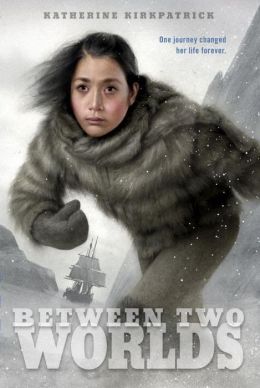
Between Two Worlds (2014)
Between Two Worlds. Katherine Kirkpatrick. 2014. Random House. 304 pages. [Source: Review copy]
Between Two Worlds was an interesting and thoughtful novel. The novel is set in Greenland at the turn of the twentieth century. It is told from the native perspective, a young woman named Eqariusaq, nicknamed Billy Bah by Robert E. Peary's wife and daughter. The novel explores the tension between the heroine's "two worlds." On the one hand, as a child, she went with Peary and lived with his family for about a year in the United States. Several years later, her parents also traveled with Peary. But they never returned, along with the other natives Peary had selected. Those natives did not have the personal connection, the friendship. These men and women were to be studied by a museum. Between Two Worlds tells young readers of their fate and treatment--or mistreatment as the case may be. Readers learn alongside the main character. On the other hand, her home is her HOME. Spending time with white people (qallunaat) did not change who she was, did not change her way of life, her culture, her beliefs. She did not trade in her spirituality, for example, for that of the white men. Since her time with Peary's family, she has grown up and gotten married. She's still super young for marriage by today's standards, but today's standards just don't apply to ANY part of this novel.
One of the novel's greatest strengths, perhaps, is that it presents the facts with little or no judgment at all. How husbands and wives treated one another, how women fit into the community and village life, it's something that modern readers will question perhaps. Especially in terms of how husbands traded their wives amongst themselves in addition to trading them to the white men. Part of a woman's value was the value she could bring her husband. A wife's body could be sold or traded. Eqariusaq's husband, Angulluk, loved to trade his wife alot, especially to the white men. He loved how he could use his wife to obtain guns and bullets and planks of wood. I should also point out that men and women could decide to separate or "divorce." Marriage did not mean forever. Women could decide to discard one man in favor of another, in favor of a better. Billy Bah takes comfort in that fact as she seriously considers leaving her husband; she has little respect for him since he's lazy and greedy.
Between Two Worlds is a contemplative novel. Our heroine is very much torn in what she wants and what she needs. She is questioning her past, her present, and her future. Her memories of the past are bitter and sweet. There are memories she cherishes, for better or worse, but she's more analytical than she was as a child. There were things that happened to her in America that through her innocence she did not see as damaging or painful, but, upon growing up and growing wise, she realizes things aren't that simple. For example, she has happy memories of Peary's wife and daughter. Seriously happy memories. Yet, as an adult, as she meets them again after years apart, she realizes the complexity of the situation. Mrs. Peary is willing to risk the lives of the natives without a thought, without a thank you. She commands and expects obedience. She simply does not see the natives as being equally human, equally of worth.
I thought it was a compelling read. It presents a whole other world to readers.
© 2014 SukaYuka.com of SukaYuka's Book Reviews
Between Two Worlds was an interesting and thoughtful novel. The novel is set in Greenland at the turn of the twentieth century. It is told from the native perspective, a young woman named Eqariusaq, nicknamed Billy Bah by Robert E. Peary's wife and daughter. The novel explores the tension between the heroine's "two worlds." On the one hand, as a child, she went with Peary and lived with his family for about a year in the United States. Several years later, her parents also traveled with Peary. But they never returned, along with the other natives Peary had selected. Those natives did not have the personal connection, the friendship. These men and women were to be studied by a museum. Between Two Worlds tells young readers of their fate and treatment--or mistreatment as the case may be. Readers learn alongside the main character. On the other hand, her home is her HOME. Spending time with white people (qallunaat) did not change who she was, did not change her way of life, her culture, her beliefs. She did not trade in her spirituality, for example, for that of the white men. Since her time with Peary's family, she has grown up and gotten married. She's still super young for marriage by today's standards, but today's standards just don't apply to ANY part of this novel.
One of the novel's greatest strengths, perhaps, is that it presents the facts with little or no judgment at all. How husbands and wives treated one another, how women fit into the community and village life, it's something that modern readers will question perhaps. Especially in terms of how husbands traded their wives amongst themselves in addition to trading them to the white men. Part of a woman's value was the value she could bring her husband. A wife's body could be sold or traded. Eqariusaq's husband, Angulluk, loved to trade his wife alot, especially to the white men. He loved how he could use his wife to obtain guns and bullets and planks of wood. I should also point out that men and women could decide to separate or "divorce." Marriage did not mean forever. Women could decide to discard one man in favor of another, in favor of a better. Billy Bah takes comfort in that fact as she seriously considers leaving her husband; she has little respect for him since he's lazy and greedy.
Between Two Worlds is a contemplative novel. Our heroine is very much torn in what she wants and what she needs. She is questioning her past, her present, and her future. Her memories of the past are bitter and sweet. There are memories she cherishes, for better or worse, but she's more analytical than she was as a child. There were things that happened to her in America that through her innocence she did not see as damaging or painful, but, upon growing up and growing wise, she realizes things aren't that simple. For example, she has happy memories of Peary's wife and daughter. Seriously happy memories. Yet, as an adult, as she meets them again after years apart, she realizes the complexity of the situation. Mrs. Peary is willing to risk the lives of the natives without a thought, without a thank you. She commands and expects obedience. She simply does not see the natives as being equally human, equally of worth.
I thought it was a compelling read. It presents a whole other world to readers.
© 2014 SukaYuka.com of SukaYuka's Book Reviews
Tuesday, May 27, 2014
By My Side (2014)
By My Side. Sue Reid. 2014. Scholastic. 176 pages. [Source: Review copy]
I definitely enjoyed reading Sue Reid's novel By My Side. This novel is told entirely through diary entries; it is set in the Netherlands during World War II during Nazi Occupation. The heroine of By My Side, Katrien, falls in love with a Jewish boy, Jan. Katrien, unlike some of her friends, is not boy crazy. She wasn't looking for a boyfriend; she wasn't planning on falling in love. But there was something different about Jan, setting him apart from other boys she knew. He was slightly older, true, but that wasn't really it. One thing she does learn early on, however, is the fact that he's Jewish. That is why he stopped attending school. That is why he's sometimes a bit hesitant to do the things she wants. At the very, very beginning, she does seem a bit oblivious and insensitive. Her intentions were always good, mind you, but she didn't stop to think about how his being Jewish could effect WHAT they do together: going to the park, going to the movies, etc. She'd never had reason really to stop and think about how many restrictions are placed on the Jews and the seriousness of the situation. Of course, after seeing him a few weeks, she's grown up quite a bit. That doesn't mean Katrien is mature and wise, mind you. She decides to keep Jan a complete secret from her parents; he wants her to be honest, he wants to come to her house as her boyfriend. She is reluctant.
I definitely enjoyed this romance. It was a quick read. By the end, it had gotten quite intense as well.
© 2014 SukaYuka.com of SukaYuka's Book Reviews
I definitely enjoyed reading Sue Reid's novel By My Side. This novel is told entirely through diary entries; it is set in the Netherlands during World War II during Nazi Occupation. The heroine of By My Side, Katrien, falls in love with a Jewish boy, Jan. Katrien, unlike some of her friends, is not boy crazy. She wasn't looking for a boyfriend; she wasn't planning on falling in love. But there was something different about Jan, setting him apart from other boys she knew. He was slightly older, true, but that wasn't really it. One thing she does learn early on, however, is the fact that he's Jewish. That is why he stopped attending school. That is why he's sometimes a bit hesitant to do the things she wants. At the very, very beginning, she does seem a bit oblivious and insensitive. Her intentions were always good, mind you, but she didn't stop to think about how his being Jewish could effect WHAT they do together: going to the park, going to the movies, etc. She'd never had reason really to stop and think about how many restrictions are placed on the Jews and the seriousness of the situation. Of course, after seeing him a few weeks, she's grown up quite a bit. That doesn't mean Katrien is mature and wise, mind you. She decides to keep Jan a complete secret from her parents; he wants her to be honest, he wants to come to her house as her boyfriend. She is reluctant.
I definitely enjoyed this romance. It was a quick read. By the end, it had gotten quite intense as well.
© 2014 SukaYuka.com of SukaYuka's Book Reviews
Tuesday, May 6, 2014
The Winter Pony (2011)
The Winter Pony. Ian Lawrence. 2011. Random House. 256 pages. [Source: Review copy]
By the time I was halfway through The Winter Pony, I knew I had made a mistake, a big mistake. It isn't just that all the animals die, the ponies, the dogs, and lots of other Antarctic animals that were killed for food or fur, or both. It isn't just the fact that almost all the human characters die too.
I think it's the fact, and this is purely subjective on my part, that it was all so pointless. What could possibly be heroic or noble about starving to death and/or freezing to death? For what did these men risk their lives? For the glory of man? For pride? The men had a choice. They, for whatever reason, were excited and motivated and aware of the risks and hardships. The animals, well, they had no choice at any point. The animals were essentially doomed from the moment they were selected to be a part of Robert Falcon Scott's quest, his mission, to be the first to the South Pole.
Why am I focusing on the animals instead of the men? For the simple fact that this book does. The Winter Pony is told through a pony's perspective. The pony hero is James Pigg. The novel opens with James Pigg free and running wild, happy and innocent. It ends with him being shot and fed to the remaining dogs and men. (The men, the dogs, the ponies, all shared the same fate, it was just a matter of when.)
The author seems to like and respect Robert Scott, and has sought to tell the story honestly for better or worse. He does point out that big mistakes were made by Scott on his journey, that the story could have had a different ending, if Scott had made different choices, better choices. One of the mistakes is that Scott failed to push the ponies hard enough at the beginning. He had planned to create a supply cache, "One Ton Depot" at a certain degree, he stopped short of his goal for the sake of the ponies. On his return journey, he never came close to reaching the much-needed supplies that would have saved his life and the lives of his men. If he had stuck to the original plan, then he would have reached his supplies. There were other mistakes made as well.
There was nothing in Ian Lawrence's novel that made me like or respect Scott.
The Winter Pony stays relatively close to the facts. James Pigg's part in the story is stretched and expanded to tell more of what it was like to be one of twenty (or is nineteen?) ponies on the expedition.
The narrative switches between the pony's perspective AND an omniscient narrator that shares plenty of information.
© 2014 SukaYuka.com of SukaYuka's Book Reviews
By the time I was halfway through The Winter Pony, I knew I had made a mistake, a big mistake. It isn't just that all the animals die, the ponies, the dogs, and lots of other Antarctic animals that were killed for food or fur, or both. It isn't just the fact that almost all the human characters die too.
I think it's the fact, and this is purely subjective on my part, that it was all so pointless. What could possibly be heroic or noble about starving to death and/or freezing to death? For what did these men risk their lives? For the glory of man? For pride? The men had a choice. They, for whatever reason, were excited and motivated and aware of the risks and hardships. The animals, well, they had no choice at any point. The animals were essentially doomed from the moment they were selected to be a part of Robert Falcon Scott's quest, his mission, to be the first to the South Pole.
Why am I focusing on the animals instead of the men? For the simple fact that this book does. The Winter Pony is told through a pony's perspective. The pony hero is James Pigg. The novel opens with James Pigg free and running wild, happy and innocent. It ends with him being shot and fed to the remaining dogs and men. (The men, the dogs, the ponies, all shared the same fate, it was just a matter of when.)
The author seems to like and respect Robert Scott, and has sought to tell the story honestly for better or worse. He does point out that big mistakes were made by Scott on his journey, that the story could have had a different ending, if Scott had made different choices, better choices. One of the mistakes is that Scott failed to push the ponies hard enough at the beginning. He had planned to create a supply cache, "One Ton Depot" at a certain degree, he stopped short of his goal for the sake of the ponies. On his return journey, he never came close to reaching the much-needed supplies that would have saved his life and the lives of his men. If he had stuck to the original plan, then he would have reached his supplies. There were other mistakes made as well.
There was nothing in Ian Lawrence's novel that made me like or respect Scott.
The Winter Pony stays relatively close to the facts. James Pigg's part in the story is stretched and expanded to tell more of what it was like to be one of twenty (or is nineteen?) ponies on the expedition.
The narrative switches between the pony's perspective AND an omniscient narrator that shares plenty of information.
© 2014 SukaYuka.com of SukaYuka's Book Reviews
Tuesday, April 29, 2014
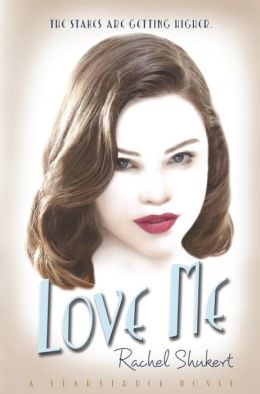
Love Me (2014)
Love Me. (Starstruck #2). Rachel Shukert. 2014. Random House. 336 pages. [Source: Review copy]
Love Me is the sequel to Rachel Shukert's Starstruck. I enjoyed Starstruck. I am not sure if I enjoyed Love Me as much. On the one hand, I could not put it down. I kept cheating. I would go to the end of the book, read a bit, and then go back to where I was. I don't ever really do that. So it did keep my interest, which, I suppose, is a good thing, right?! My favorite character is NOT a main character.
On the other hand, I found myself yelling at the characters from start to finish. I also found myself frustrated at times with the dialogue and the writing. Little things like name-dropping all the big, big stars and how they all were desperately mad to interact with these fictional characters. There were things that were just impossible to take seriously.
Love Me is definitely "darker" and messier than Starstruck. Every single character falls or fails in this one. Amanda, it turns out, had not reached her low point in Starstruck, far from it. And Gabby, well, I'm not sure Gabby makes even one good choice in this second novel. It's not that she doesn't try, it's just that her trying is hindered by her addictions. Margo's expectations are so out of control. After making one movie, she wants validation that she's the center of the universe. It doesn't happen. She whines and nags all the time. Readers, like Dane, may find themselves tuning her out.
The content of Love Me is definitely more adult than in Starstruck.
The men of Love Me:
Harry. Leftover from book one. Is there anything he does in this novel that does not make me angry?! I do NOT care for him at all. I HATE him.
Eddie. A musician. A band leader. Hints of trouble. I didn't mind him as much as Harry, because, at least he was honest about who he was and where he came from and what he was looking for. There is something refreshing about what you see is what you get.
Dexter. Another jazz musician. Not really seen as a love interest, but, an interesting guy I'd be curious to see again in a sequel if the author chooses to follow up with this character. I liked his scenes a good bit.
Dane. What can I say?! It has to be frustrating to be forced into a serious relationship with Margo. So I don't fault him for finding her annoying and frustrating and not who he hoped her to be. He wanted a girl who was smart enough not to fall for all the lies and concoctions the studio produced, and she is not that girl at all. That being said, he is far from perfect.
Don't expect Jimmy to have any scenes in this one. His name is mentioned a few times, sure, but that is it. This has me worried that Dexter won't be around in following books.
I mentioned that I "yelled" at the characters...
Dear Amanda,
Please stop obsessing over Harry. He is not worth it. Seriously. I know you want to feel loved and accepted. But it will NEVER happen with Harry no matter how much you put yourself into debt. A new dress will not change his mind. Your problems cannot be solved by going shopping every day. You've had to deal with so much, I just wish you'd be a little more grounded.
Dear Gabby,
You are the one least likely to listen, but the one who needs to hear the truth the most of all. Your mother would drive almost anyone crazy, so I don't blame you for wanting to escape it all. But the way you're doing it--drugs--is NOT the right answer.
Dear Margo,
You're so clueless that it hurts to be around you. Yes, I mean that. It hurts to see you act like a fool. Especially when it comes to Dane. You're so blinded by your so-called "love" for Dane. I have to ask: do you really love the real Dane OR are you in love with the Dane you've imagined in your own head? Do you even know there is a real Dane? Do you listen, really listen, when he talks? Do you see the way he acts around you? The way he treats you? Because I think if you had a little common sense and would just pay attention a fraction of the time, you would realize that your "relationship" with Dane is in trouble.
© 2014 SukaYuka.com of SukaYuka's Book Reviews
Love Me is the sequel to Rachel Shukert's Starstruck. I enjoyed Starstruck. I am not sure if I enjoyed Love Me as much. On the one hand, I could not put it down. I kept cheating. I would go to the end of the book, read a bit, and then go back to where I was. I don't ever really do that. So it did keep my interest, which, I suppose, is a good thing, right?! My favorite character is NOT a main character.
On the other hand, I found myself yelling at the characters from start to finish. I also found myself frustrated at times with the dialogue and the writing. Little things like name-dropping all the big, big stars and how they all were desperately mad to interact with these fictional characters. There were things that were just impossible to take seriously.
Love Me is definitely "darker" and messier than Starstruck. Every single character falls or fails in this one. Amanda, it turns out, had not reached her low point in Starstruck, far from it. And Gabby, well, I'm not sure Gabby makes even one good choice in this second novel. It's not that she doesn't try, it's just that her trying is hindered by her addictions. Margo's expectations are so out of control. After making one movie, she wants validation that she's the center of the universe. It doesn't happen. She whines and nags all the time. Readers, like Dane, may find themselves tuning her out.
The content of Love Me is definitely more adult than in Starstruck.
The men of Love Me:
Harry. Leftover from book one. Is there anything he does in this novel that does not make me angry?! I do NOT care for him at all. I HATE him.
Eddie. A musician. A band leader. Hints of trouble. I didn't mind him as much as Harry, because, at least he was honest about who he was and where he came from and what he was looking for. There is something refreshing about what you see is what you get.
Dexter. Another jazz musician. Not really seen as a love interest, but, an interesting guy I'd be curious to see again in a sequel if the author chooses to follow up with this character. I liked his scenes a good bit.
Dane. What can I say?! It has to be frustrating to be forced into a serious relationship with Margo. So I don't fault him for finding her annoying and frustrating and not who he hoped her to be. He wanted a girl who was smart enough not to fall for all the lies and concoctions the studio produced, and she is not that girl at all. That being said, he is far from perfect.
Don't expect Jimmy to have any scenes in this one. His name is mentioned a few times, sure, but that is it. This has me worried that Dexter won't be around in following books.
I mentioned that I "yelled" at the characters...
Dear Amanda,
Please stop obsessing over Harry. He is not worth it. Seriously. I know you want to feel loved and accepted. But it will NEVER happen with Harry no matter how much you put yourself into debt. A new dress will not change his mind. Your problems cannot be solved by going shopping every day. You've had to deal with so much, I just wish you'd be a little more grounded.
Dear Gabby,
You are the one least likely to listen, but the one who needs to hear the truth the most of all. Your mother would drive almost anyone crazy, so I don't blame you for wanting to escape it all. But the way you're doing it--drugs--is NOT the right answer.
Dear Margo,
You're so clueless that it hurts to be around you. Yes, I mean that. It hurts to see you act like a fool. Especially when it comes to Dane. You're so blinded by your so-called "love" for Dane. I have to ask: do you really love the real Dane OR are you in love with the Dane you've imagined in your own head? Do you even know there is a real Dane? Do you listen, really listen, when he talks? Do you see the way he acts around you? The way he treats you? Because I think if you had a little common sense and would just pay attention a fraction of the time, you would realize that your "relationship" with Dane is in trouble.
© 2014 SukaYuka.com of SukaYuka's Book Reviews
Friday, April 25, 2014
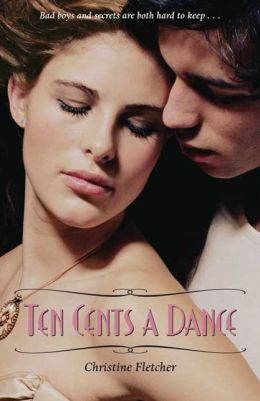
Reread #17 Ten Cents A Dance
Ten Cents A Dance. Christine Fletcher. 2008/2010. Bloomsbury USA. 368 pages. [Source: Review copy]
I first read and reviewed Ten Cents A Dance in November 2008. It was almost love. I loved the idea of loving it. I loved the setting: Chicago 1941-1942, both BEFORE and AFTER Pearl Harbor. It is narrated by Ruby Jacinski, our heroine. Ruby may not always make the best choices, the wisest in the long-term choices, but she's got gumption and fight in her.
Ruby is exhausted and frustrated by poverty. Even if she were to get a "nice" job in the meat-packing factory, she would still stink at the end of the day. And Ruby, though pretty, is feisty. (Her "nice" job in bacon didn't last long.) She IS the earner in her family; after her mother lost her job, Ruby dropped out of school and got a job.
In the opening chapters, readers see just how feisty Ruby is. Fights just seem to find her. And the opening fight, well, it just happens to bring her to the attention of a gangster-wanna-be, Paulie Suelze. He just happens to mention HOW she can earn some real money doing something she loves: dancing. He tells her of how she could be bringing home fifty dollars a week instead of ten. He tells her exactly where to go.
Ruby goes for it. It opens up a whole new world for her: for better or worse...nothing is the same after she starts working...
Ruth Etting singing "Ten Cents A Dance." Doris Day singing "Ten Cents A Dance." There is also a movie with this name from 1931.
© 2014 SukaYuka.com of SukaYuka's Book Reviews
I first read and reviewed Ten Cents A Dance in November 2008. It was almost love. I loved the idea of loving it. I loved the setting: Chicago 1941-1942, both BEFORE and AFTER Pearl Harbor. It is narrated by Ruby Jacinski, our heroine. Ruby may not always make the best choices, the wisest in the long-term choices, but she's got gumption and fight in her.
Ruby is exhausted and frustrated by poverty. Even if she were to get a "nice" job in the meat-packing factory, she would still stink at the end of the day. And Ruby, though pretty, is feisty. (Her "nice" job in bacon didn't last long.) She IS the earner in her family; after her mother lost her job, Ruby dropped out of school and got a job.
In the opening chapters, readers see just how feisty Ruby is. Fights just seem to find her. And the opening fight, well, it just happens to bring her to the attention of a gangster-wanna-be, Paulie Suelze. He just happens to mention HOW she can earn some real money doing something she loves: dancing. He tells her of how she could be bringing home fifty dollars a week instead of ten. He tells her exactly where to go.
Ruby goes for it. It opens up a whole new world for her: for better or worse...nothing is the same after she starts working...
Ruth Etting singing "Ten Cents A Dance." Doris Day singing "Ten Cents A Dance." There is also a movie with this name from 1931.
© 2014 SukaYuka.com of SukaYuka's Book Reviews
Friday, April 18, 2014
Reread #16: A Year Down Yonder
A Year Down Yonder. Richard Peck. 2000. Penguin. 144 pages. [Source: Library]
I loved A Year Down Yonder so much more than Richard Peck's A Long Way From Chicago. And I definitely enjoyed A Long Way From Chicago! While A Long Way From Chicago was told from Joey's point of view, A Year Down Yonder is told from Mary Alice's point of view. Because of the Depression, Mary Alice has been sent by her parents to live with Grandma Dowdel. Mary Alice has spent more than a few summers with her Grandma, alongside her brother, but this time she'll be there all year long, and without her brother.
While A Long Way From Chicago is fun, in many ways, it is a bit disjointed as well. Each chapter tells the story of a summer vacation. In A Year Down Yonder, the plot is more traditional. The book follows the course of an entire year. Readers get a better chance to KNOW the characters, to appreciate the characters and the small town setting. And Mary Alice is a great narrator!!! I loved her story. My favorite chapters were "Rich Chicago Girl," "Vittles and Vengeance," "Heart and Flour," and "A Dangerous Man." I loved the slight traces of romance.
I would definitely recommend both A Long Way From Chicago and A Year Down Yonder. Both books do stand alone, but, they do go together well.
I first reviewed A Year Down Yonder in May 2008.
© 2014 SukaYuka.com of SukaYuka's Book Reviews
I loved A Year Down Yonder so much more than Richard Peck's A Long Way From Chicago. And I definitely enjoyed A Long Way From Chicago! While A Long Way From Chicago was told from Joey's point of view, A Year Down Yonder is told from Mary Alice's point of view. Because of the Depression, Mary Alice has been sent by her parents to live with Grandma Dowdel. Mary Alice has spent more than a few summers with her Grandma, alongside her brother, but this time she'll be there all year long, and without her brother.
While A Long Way From Chicago is fun, in many ways, it is a bit disjointed as well. Each chapter tells the story of a summer vacation. In A Year Down Yonder, the plot is more traditional. The book follows the course of an entire year. Readers get a better chance to KNOW the characters, to appreciate the characters and the small town setting. And Mary Alice is a great narrator!!! I loved her story. My favorite chapters were "Rich Chicago Girl," "Vittles and Vengeance," "Heart and Flour," and "A Dangerous Man." I loved the slight traces of romance.
I would definitely recommend both A Long Way From Chicago and A Year Down Yonder. Both books do stand alone, but, they do go together well.
I first reviewed A Year Down Yonder in May 2008.
© 2014 SukaYuka.com of SukaYuka's Book Reviews
Labels:
2000,
books reread in 2014,
books reviewed in 2014,
family,
humor,
J Fiction,
j historical,
library book,
MG Fiction,
mg historical,
Newbery,
Richard Peck,
YA Fiction,
YA Historical Fiction
Tuesday, April 15, 2014
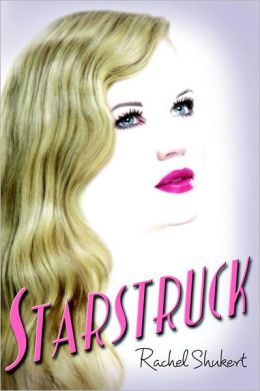
Starstruck (2013)
Starstruck. Rachel Shukert. 2013. Random House. 339 pages. [Source: Review copy]
Starstruck is delightful and fun. It is. It is set in 1938 in Hollywood. It features three heroines; the narration switches back and forth between all three throughout the novel. The three aren't always friends. But. They aren't always enemies either. Each girl has a dream, a hope, an idea of how they want their happily ever after to come about. Selfishness comes naturally, but, that doesn't mean the girls lack depth of feeling.
Margaret (Margo) Frobisher (Sterling) has dreamed of being discovered for years and years. She is more than a little obsessed with the movies, with the big stars. When she is discovered, her life will change forever. It wouldn't have to be FOREVER, but, her family makes it super-dramatic. If she signs a contract with Olympus Studios, if she chooses to become an actress, then they never want to hear from her again. No matter what. She can never come home. Margo doesn't even take a minute to consider. To be a star is her destiny!
Amanda Farraday has reinvented herself more than once. She is another hopeful under contract at Olympus. She has not had her moment to shine...yet. She is not as obsessed with BEING A STAR as Margo. I think Amanda would settle for happily ever after off screen. I think Amanda just wants to be loved. Unfortunately, she seems to be caught in a world where appearance is everything and secrets have to stay buried because no one wants to live in the real world. I really cared about Amanda's story.
Gabby Preston is a talented singer, and a fine actress. Is she a great dancer? Not really. And Olympus wants her to SING and DANCE and ACT. To make it big, she needs to have it all, and Gabby isn't quite there yet. They encourage her to lose weight. They send her to a special doctor with special pills. Gabby is enthusiastic, or, as enthusiastic as one can be when struggling. Is Gabby happy? No! She wants to be a big star. She wants a HAPPILY EVER AFTER. And that means a romance with a star. Even if that romance is dictated and scripted--the product of the studio. Gabby has never felt good enough, she's always felt like an almost. Gabby, like Amanda, could use some good unconditional love.
Starstruck also features MYSTERY and ROMANCE.
For me, this series has more potential than Luxe. I enjoyed Luxe, but, saw the flaws and weaknesses with each book. That didn't stop me from reading the series! I read each and every one. I remember liking some characters, hating some characters. There weren't any characters that I truly LOVED. In Starstruck, I actually cared about all three girls.
© 2014 SukaYuka.com of SukaYuka's Book Reviews
Starstruck is delightful and fun. It is. It is set in 1938 in Hollywood. It features three heroines; the narration switches back and forth between all three throughout the novel. The three aren't always friends. But. They aren't always enemies either. Each girl has a dream, a hope, an idea of how they want their happily ever after to come about. Selfishness comes naturally, but, that doesn't mean the girls lack depth of feeling.
Margaret (Margo) Frobisher (Sterling) has dreamed of being discovered for years and years. She is more than a little obsessed with the movies, with the big stars. When she is discovered, her life will change forever. It wouldn't have to be FOREVER, but, her family makes it super-dramatic. If she signs a contract with Olympus Studios, if she chooses to become an actress, then they never want to hear from her again. No matter what. She can never come home. Margo doesn't even take a minute to consider. To be a star is her destiny!
Amanda Farraday has reinvented herself more than once. She is another hopeful under contract at Olympus. She has not had her moment to shine...yet. She is not as obsessed with BEING A STAR as Margo. I think Amanda would settle for happily ever after off screen. I think Amanda just wants to be loved. Unfortunately, she seems to be caught in a world where appearance is everything and secrets have to stay buried because no one wants to live in the real world. I really cared about Amanda's story.
Gabby Preston is a talented singer, and a fine actress. Is she a great dancer? Not really. And Olympus wants her to SING and DANCE and ACT. To make it big, she needs to have it all, and Gabby isn't quite there yet. They encourage her to lose weight. They send her to a special doctor with special pills. Gabby is enthusiastic, or, as enthusiastic as one can be when struggling. Is Gabby happy? No! She wants to be a big star. She wants a HAPPILY EVER AFTER. And that means a romance with a star. Even if that romance is dictated and scripted--the product of the studio. Gabby has never felt good enough, she's always felt like an almost. Gabby, like Amanda, could use some good unconditional love.
Starstruck also features MYSTERY and ROMANCE.
For me, this series has more potential than Luxe. I enjoyed Luxe, but, saw the flaws and weaknesses with each book. That didn't stop me from reading the series! I read each and every one. I remember liking some characters, hating some characters. There weren't any characters that I truly LOVED. In Starstruck, I actually cared about all three girls.
© 2014 SukaYuka.com of SukaYuka's Book Reviews
Tuesday, April 1, 2014
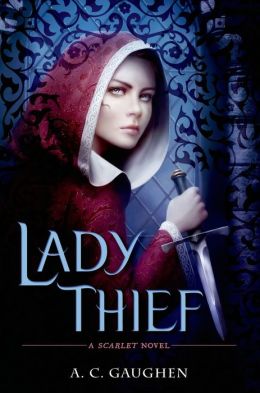
Lady Thief (2014)
Lady Thief. A.C. Gaughen. 2014. Walker Books. 304 pages. [Source: Review copy]
I definitely enjoyed Scarlet by A.C. Gaughen. But I LOVED the sequel Lady Thief even more. This one is all about "Lady" Marian and her not-so-fortunate marriage to Gisbourne. Unfortunate for several reasons: one, HE'S cruel and abusive and just wicked through and through, the puppet of Prince John; two, because her heart belongs to another: Robin Hood, of course!
I loved Lady Thief for many, many reasons:
I loved how it brings more history into the story. I loved seeing Prince John and his wife, Isabelle. I really, really, really loved seeing Eleanor of Aquitaine (the mother of King Richard and Prince John). The character of Eleanor was just awesome, I felt. It truly added something to the story to have her there, and Eleanor truly did impress and inspire Scarlet!
I loved how it uses other Robin Hood stories, but, somehow makes them even cooler. For example, in Lady Thief, Prince John comes to Nottingham to appoint a new sheriff. (The old sheriff having been killed in the first book.) Gisbourne is there, of course, eager and anxious to be appointed. He has every intention of being THE ONE. Yet, Prince John puts a twist on it: the new sheriff will be the man who wins a competition...the competition covers many things, but the last day of competition, of course, you guessed it AN ARCHERY CONTEST.
I loved the romance between Marian (whom readers know by another name) and Robin. But this is not an easily grasped love. It will be a love that demands sacrifice and hardship and call for heartbreak and angst too. If their love is to be realized, it will take both of them fighting all the odds.
I loved the characterization of Robin Hood. I loved seeing him drawn with such substance from the times in which he lived. I thought it was very well done having him suffer so horribly, so realistically, from PTSD. He is a haunted hero whose past in the crusades has left him broken and changed.
I continue to love the other characters: John Little, Much, Tuck, and in this one we meet Alan a Dale.
© 2014 SukaYuka.com of SukaYuka's Book Reviews
I definitely enjoyed Scarlet by A.C. Gaughen. But I LOVED the sequel Lady Thief even more. This one is all about "Lady" Marian and her not-so-fortunate marriage to Gisbourne. Unfortunate for several reasons: one, HE'S cruel and abusive and just wicked through and through, the puppet of Prince John; two, because her heart belongs to another: Robin Hood, of course!
I loved Lady Thief for many, many reasons:
I loved how it brings more history into the story. I loved seeing Prince John and his wife, Isabelle. I really, really, really loved seeing Eleanor of Aquitaine (the mother of King Richard and Prince John). The character of Eleanor was just awesome, I felt. It truly added something to the story to have her there, and Eleanor truly did impress and inspire Scarlet!
I loved how it uses other Robin Hood stories, but, somehow makes them even cooler. For example, in Lady Thief, Prince John comes to Nottingham to appoint a new sheriff. (The old sheriff having been killed in the first book.) Gisbourne is there, of course, eager and anxious to be appointed. He has every intention of being THE ONE. Yet, Prince John puts a twist on it: the new sheriff will be the man who wins a competition...the competition covers many things, but the last day of competition, of course, you guessed it AN ARCHERY CONTEST.
I loved the romance between Marian (whom readers know by another name) and Robin. But this is not an easily grasped love. It will be a love that demands sacrifice and hardship and call for heartbreak and angst too. If their love is to be realized, it will take both of them fighting all the odds.
I loved the characterization of Robin Hood. I loved seeing him drawn with such substance from the times in which he lived. I thought it was very well done having him suffer so horribly, so realistically, from PTSD. He is a haunted hero whose past in the crusades has left him broken and changed.
I continue to love the other characters: John Little, Much, Tuck, and in this one we meet Alan a Dale.
© 2014 SukaYuka.com of SukaYuka's Book Reviews
Thursday, March 13, 2014
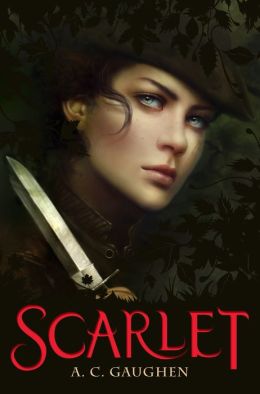
Scarlet (2012)
Scarlet. A.C. Gaughen. 2012. Walker. 292 pages. [Source: Library]
"Will Scarlet" is one of Robin Hood's best friends, a thief very good at what "he" does for the band. But what if "Will Scarlet" was just Scarlet--a young woman is disguise?!
I enjoyed this retelling of Robin Hood. Rob is young, as are his friends and fellow thieves. They have not fully matured into their heroic legends. Their mission to help the poor and needy is just getting started.
It is narrated by Scarlet, or "Scar." She's got a strong narrative voice, distinctive. (The grammar of it will either sweep you away or annoy you.) It was enjoyable to see the story through her eyes, to get to know John Little and Rob or "The Hood" through her eyes. (Also Much and Tuck). The villain of this one, besides the sheriff, is Guy Gisbourne. His presence plays a very important role in the retelling, in Scarlet's past and present.
I would definitely recommend this one. What I liked about this one was the potential, the promise. The characters--beyond Scarlet--are not developed well enough for this one to be AMAZING. But it works.
© 2014 SukaYuka.com of SukaYuka's Book Reviews
"Will Scarlet" is one of Robin Hood's best friends, a thief very good at what "he" does for the band. But what if "Will Scarlet" was just Scarlet--a young woman is disguise?!
I enjoyed this retelling of Robin Hood. Rob is young, as are his friends and fellow thieves. They have not fully matured into their heroic legends. Their mission to help the poor and needy is just getting started.
It is narrated by Scarlet, or "Scar." She's got a strong narrative voice, distinctive. (The grammar of it will either sweep you away or annoy you.) It was enjoyable to see the story through her eyes, to get to know John Little and Rob or "The Hood" through her eyes. (Also Much and Tuck). The villain of this one, besides the sheriff, is Guy Gisbourne. His presence plays a very important role in the retelling, in Scarlet's past and present.
I would definitely recommend this one. What I liked about this one was the potential, the promise. The characters--beyond Scarlet--are not developed well enough for this one to be AMAZING. But it works.
© 2014 SukaYuka.com of SukaYuka's Book Reviews
Tuesday, February 18, 2014
Hideous Love (2013)
Hideous Love: The Story of The Girl Who Wrote Frankenstein. Stephanie Hemphill. 2013. HarperCollins. 320 pages. [Source: Library]
I am familiar with the story of Mary Shelley. I am probably more familiar than the target audience would be of Mary Shelley, her sister, Claire, her lover-husband, Percy Shelley, Lord Byron, etc. I took a whole semester focusing primarily on these Romantic authors. (Claire was an extra bonus. You can't cover the lives of Mary, Percy, without mentioning Claire and her lovechild.) I was curious how the story would be presented. I am not usually a big fan of verse novels. I think some work really, really, really well. And I think others are absolutely awful. This falls into the "why is this a verse novel?" category. I think the story could have been told just as well, if not better, in prose format, in journal format in particular. We do know that Mary Shelley kept a journal, of sorts.
That being said, I do think the book did a fairly good job at capturing the ANGST that is Mary Shelley's private life. Her life was a BIG, BIG MESS. Oh, what she had to put up with! Oh, what she had to endure! Oh, the consequences of leaping into love without being ready for it! As a teenager, she runs away from home with a married man, a poet or would-be poet. She takes her sister. Because she took her sister, well, her STEP sister, with her, she'll be stuck with the sister for what seems like forever. With her husband's notion of free-love this and free-love-that, the LAST thing Mary needs is another woman in their lives who is constantly there and wanting/needing attention. Mary also suffered so very many losses. So many of her children died, died in their infancy or toddler years. And some of that was just the times they lived, and some of that was due to her husband's stupidity and stubbornness. Anyway, it is an emotionally demanding story. Far from boring. Because her husband was a poet, because she spent so much time with poets, it would be nice if this format of verse novel worked in telling her own story. However, I did not feel the verse format was one of the book's strengths. If the book works, which I think it does in a way, it is because of the emotion behind the words, not the words themselves. The writing didn't seem especially lyrical or lovely or poetic.
© 2014 SukaYuka.com of SukaYuka's Book Reviews
I am familiar with the story of Mary Shelley. I am probably more familiar than the target audience would be of Mary Shelley, her sister, Claire, her lover-husband, Percy Shelley, Lord Byron, etc. I took a whole semester focusing primarily on these Romantic authors. (Claire was an extra bonus. You can't cover the lives of Mary, Percy, without mentioning Claire and her lovechild.) I was curious how the story would be presented. I am not usually a big fan of verse novels. I think some work really, really, really well. And I think others are absolutely awful. This falls into the "why is this a verse novel?" category. I think the story could have been told just as well, if not better, in prose format, in journal format in particular. We do know that Mary Shelley kept a journal, of sorts.
That being said, I do think the book did a fairly good job at capturing the ANGST that is Mary Shelley's private life. Her life was a BIG, BIG MESS. Oh, what she had to put up with! Oh, what she had to endure! Oh, the consequences of leaping into love without being ready for it! As a teenager, she runs away from home with a married man, a poet or would-be poet. She takes her sister. Because she took her sister, well, her STEP sister, with her, she'll be stuck with the sister for what seems like forever. With her husband's notion of free-love this and free-love-that, the LAST thing Mary needs is another woman in their lives who is constantly there and wanting/needing attention. Mary also suffered so very many losses. So many of her children died, died in their infancy or toddler years. And some of that was just the times they lived, and some of that was due to her husband's stupidity and stubbornness. Anyway, it is an emotionally demanding story. Far from boring. Because her husband was a poet, because she spent so much time with poets, it would be nice if this format of verse novel worked in telling her own story. However, I did not feel the verse format was one of the book's strengths. If the book works, which I think it does in a way, it is because of the emotion behind the words, not the words themselves. The writing didn't seem especially lyrical or lovely or poetic.
© 2014 SukaYuka.com of SukaYuka's Book Reviews
Tuesday, February 11, 2014
Beauty's Daughter (2013)
Beauty's Daughter. Carolyn Meyer. 2013. Houghton Mifflin Harcourt. 352 pages. [Source: Review copy]
Beauty's Daughter is the story of Hermione and Helen of Troy. I'll be honest, Helen of Troy is more of an afterthought. The book has very little to do with her directly. Indirectly, I suppose, there is plenty having to do with Helen. The story follows Hermione and her father during the Trojan War. She goes with the armies. She befriends some of the other women. She falls in love. After they win the war, her father arranges a marriage for his daughter. She is angry but submissive. The novel then follows her through this mess of a marriage. She cannot forget her first love, Orestes, and when she learns the mess he's in, she sets out to rescue him. Accompanying her are a few of her best friends. The journey won't be easy, of course, but with the help of a god, perhaps they will succeed.
Beauty's Daughter makes Greek mythology accessible. I enjoyed it for that reason alone. Hermione may not be beautiful like her mother. But she is strong-willed and brave. She is not a particularly emotional heroine. The book isn't so much about how she feels at any given time as what she does.
Beauty's Daughter is not my favorite Meyer novel, but it is a good read.
© 2014 SukaYuka.com of SukaYuka's Book Reviews
Beauty's Daughter is the story of Hermione and Helen of Troy. I'll be honest, Helen of Troy is more of an afterthought. The book has very little to do with her directly. Indirectly, I suppose, there is plenty having to do with Helen. The story follows Hermione and her father during the Trojan War. She goes with the armies. She befriends some of the other women. She falls in love. After they win the war, her father arranges a marriage for his daughter. She is angry but submissive. The novel then follows her through this mess of a marriage. She cannot forget her first love, Orestes, and when she learns the mess he's in, she sets out to rescue him. Accompanying her are a few of her best friends. The journey won't be easy, of course, but with the help of a god, perhaps they will succeed.
Beauty's Daughter makes Greek mythology accessible. I enjoyed it for that reason alone. Hermione may not be beautiful like her mother. But she is strong-willed and brave. She is not a particularly emotional heroine. The book isn't so much about how she feels at any given time as what she does.
Beauty's Daughter is not my favorite Meyer novel, but it is a good read.
© 2014 SukaYuka.com of SukaYuka's Book Reviews
Subscribe to:
Posts (Atom)
