Wednesday, September 17, 2014

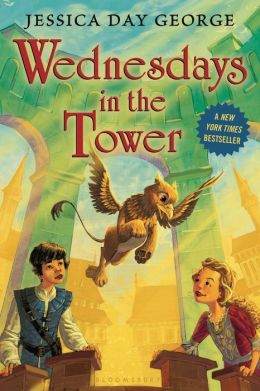
Wednesdays in the Tower (2013)

Wednesdays in the Tower. Jessica Day George. 2013. Bloomsbury. 240 pages. [Source: Library]

Even though it has only been two years since I've read Tuesdays at the Castle, I remembered very little about the characters and the plot. So I was hoping that Wednesdays in the Tower would not prove too tricky or challenging. Within pages, I was hooked. I read this one cover to cover without putting it down even once. I do have to say that it has a great opening which worked in its favor: "There are a lot of things that can hatch out of an egg. A chicken, for example. Or a dragon. And when the egg in question is the size of a pumpkin, and almost as orange, not to mention burning hot, you know that you're far more likely to get a dragon than a chicken."

Princess Celie and her family live at Castle Glower. The castle is without a doubt one of the more interesting in literature. This castle has a mind of its own. It does what it wants, when it wants. Usually on Tuesday is when it decides to add rooms, or, perhaps take away rooms. It isn't always adding or subtracting. Sometimes it's rearranging. One thing is for certain, only a handful of people know their way around all the rooms in the Castle. And Princess Celie is trying her best to provide a map or atlas of the ever-changing castle.

As I said, usually the castle is full of surprises on Tuesday. However, it is a Wednesday when Celie discovers a new room, and not just the room, but an egg. The castle leads Celie to this room again and again, but only when she's alone. Anytime she tries to bring someone else, to show them what she's found, it's vanished.

Essentially Wednesdays in the Tower concerns Celie and what hatches from the egg. Also about the magic of the castle as well, trying to understand how the castle works and why it does what it does when it does. In other words, the history of the Castle in general and how it connects with what hatched from the egg.

I found this a quick and enjoyable read. I liked Celie. I liked her siblings and parents. I liked getting to know her friends. I probably would have appreciated them all a bit more if I remembered Tuesdays at the Castle. But. Sometimes it's good to know that a book can be read alone or out of sequence.

The ending. Did it leave me wanting more? Yes. Was that how it should have been? I think so. Not that I'm a fan of cliffhanger endings. But. When the opening of a book and the ending of a book leave you wanting more it can't be a bad thing. Of course, if I'd read this book when it first came out, I might have felt frustrated. But the sequel will be out soon.

© 2014 SukaYuka.com of SukaYuka's Book Reviews

Tuesday, September 16, 2014

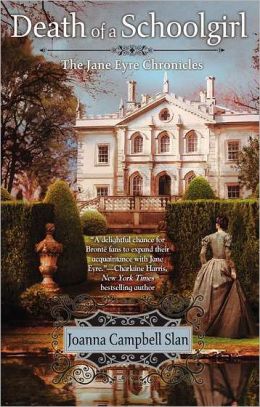
Death of a Schoolgirl (2012)

Death of a Schoolgirl (Jane Eyre Chronicles #1) Joanna Campbell Slan. 2012. Berkley Trade. 340 pages. [Source: Library]

My expectations were low, so I was quite pleasantly surprised by how enjoyable this Jane Eyre mystery was. It may not be perfectly perfect from start to finish. There might be a paragraph or two here and there that bothered me. (For example, I didn't understand why Mrs. Fairfax was pushing Jane Eyre to take the family diamonds with her on her visit to Adele's school. Here she was going to check on the child's welfare, and Mrs. Fairfax is urging her to take jewels so she can dress up for her hosts in London?! I don't know if part of me thought it was foreshadowing--for better or worse--but when she put them in her reticule, I wanted to shout WHY are you traveling with expensive jewelry?!?! Why?! And sure enough--predictably enough--Jane Eyre gets robbed on her way to London. See! I told you not to take the family jewels!) But for the most part, I found the book to be an entertaining read.

Mrs. Rochester (aka Jane Eyre) is a new mother. She loves, loves, loves her new baby boy. But. When she receives a short letter from Adele with a French message included asking--begging--for help, she decides to leave her husband and son behind to check on Adele at her boarding school. If all is well, if it is just Adele being Adele, being childish and wanting her own way, then she may leave her at the school. If the school is less than ideal, if she does not like what she sees--how she sees the children being treated, if she thinks Adele's misery is justifiable, then she may take her out of the school. Because Jane Eyre was beaten up by the thief, because she doesn't particularly look RICH and IMPORTANT, she is initially mistaken as the new German teacher who was supposed to arrive several weeks earlier. That first day Jane Eyre is a bit flabbergasted and too overwhelmed to correct anyone. She has just learned that one of Adele's classmates was murdered. Eventually, one of the teachers convinces Jane that she should continue the deception, that she should resume her teaching duties temporarily and watch over the students herself. She debates what is best. Should she take Adele immediately to safety and let others solve the crime? Or should she become an amateur detective herself and work as a team with others to help solve the case?

Is Jane Eyre the best detective ever? Not really. But to me that almost doesn't matter. I liked spending time in her company. The setting intrigued me. I had never placed Jane Eyre in the Regency time period. But here we have the sequel set during the reign of George IV, and Queen Caroline, the scandalous Queen Caroline has not died yet. This places the book within a specific time frame. The sprinkling of historical details may not speak to all readers. Little details can be easily dismissed or ignored. But to me it's the little things that help ground a book. The book does deal with prejudices and judgments: how the lower classes feel about the upper classes, how the poor feel about the rich, how the rich feel about the poor, do they see them as human, are they compassionate and kind, or, haughty or cruel. One of the characters is VERY prejudiced against French people. Again and again we see characters making judgments or being judged. Sometimes the people that are being judged in certain situations are making judgments about others just a chapter or two later.

There were places I loved this one. There were places I merely liked it. But at times it just felt RIGHT. Maybe it didn't feel RIGHT cover to cover. But I read it quickly and enjoyed it very much.
© 2014 SukaYuka.com of SukaYuka's Book Reviews
Monday, September 15, 2014

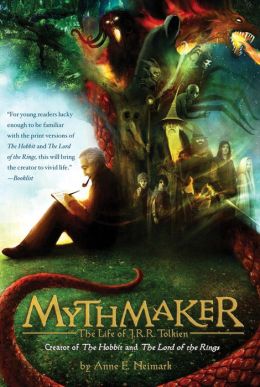
Mythmaker: Life of J.R.R. Tolkien

Mythmaker: The Life of J.R.R. Tolkien. Anne E. Neimark. 2012. Houghton Mifflin Harcourt. 144 pages. [Source: Review copy]

Mythmaker: The Life of J.R.R. Tolkien is a biography ideal for young(er) readers, perhaps readers who have shown an interest in reading The Hobbit and Lord of the Rings. This biography may not satisfy adult readers who want more or need more. (Then again, it may be a good place to start if you just want the basics.) But as a basic biography with a literary focus, it works well.

Readers learn the basics: where he was born, what his childhood was like, the hardships and successes of his growing years, his influences, his school years, his time as a soldier in World War I, etc. Readers learn about how he met his future wife, what their courtship was like, when they got married, how many children they had, where they lived, etc. But most of the focus I would say is on his writing. Readers learn about how he came to create his fantasy world, his own languages, his own mythology. Readers get a behind-the-scenes glimpse of his writing of The Hobbit and the Lord of the Rings. And also The Silmarillion. I knew he years writing that one, but, I didn't realize he spent DECADES. He started writing it during World War II and was still working on it in the 1970s! I liked how the focus was on his books, writing and publishing and the fans!
© 2014 SukaYuka.com of SukaYuka's Book Reviews
Sunday, September 14, 2014

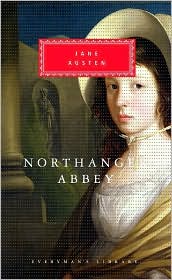
My Year with Jane: Northanger Abbey

Northanger Abbey. Jane Austen. 1817/1992. Everyman's Library. 288 pages. [Source: Library]

No one who had ever seen Catherine Morland in her infancy, would have supposed her born to be an heroine. Her situation in life, the character of her father and mother, her own person and disposition, were all equally against her. 

I know I say this with every Austen review, but, it's true: I love her novels more each time I read them. Now that I've read Northanger Abbey three or four times, I have to admit that I really do love it. Perhaps not as much as I love, love, love Persuasion. But I really am very fond of it. I am especially fond of Henry Tilney. He may just be my favorite, favorite, favorite Austen hero.

My latest review of the novel is from 2011. I am going to challenge myself to keep the summary as brief as possible:

Catherine Morland, our heroine, loves to read; she especially loves to read gothic novels. When she travels to Bath with her neighbors, she meets a new best friend, Isabella Thorpe, and a potential soul mate, Henry Tilney. While Miss Thorpe ends up disappointing her, Catherine's journey is not in vain for her crush, Henry, has a saint for a sister. When invited to visit the Tilney household, Catherine is beyond excited to accept. Her time at Northanger Abbey, the Tilney's home, proves shocking, but not at all in the way she expected.

I love the newest movie adaptation. I would definitely recommend it.

My favorite quotes:
She had reached the age of seventeen, without having seen one amiable youth who could call forth her sensibility, without having inspired one real passion, and without having excited even any admiration but what was very moderate and very transient. This was strange indeed! But strange things may be generally accounted for if their cause be fairly searched out. There was not one lord in the neighbourhood; no — not even a baronet. There was not one family among their acquaintance who had reared and supported a boy accidentally found at their door — not one young man whose origin was unknown. Her father had no ward, and the squire of the parish no children. But when a young lady is to be a heroine, the perverseness of forty surrounding families cannot prevent her. Something must and will happen to throw a hero in her way.
The master of the ceremonies introduced to her a very gentlemanlike young man as a partner; his name was Tilney. He seemed to be about four or five and twenty, was rather tall, had a pleasing countenance, a very intelligent and lively eye, and, if not quite handsome, was very near it. His address was good, and Catherine felt herself in high luck. There was little leisure for speaking while they danced; but when they were seated at tea, she found him as agreeable as she had already given him credit for being. He talked with fluency and spirit — and there was an archness and pleasantry in his manner which interested, though it was hardly understood by her. After chatting some time on such matters as naturally arose from the objects around them, he suddenly addressed her with — ”I have hitherto been very remiss, madam, in the proper attentions of a partner here; I have not yet asked you how long you have been in Bath; whether you were ever here before; whether you have been at the Upper Rooms, the theatre, and the concert; and how you like the place altogether. I have been very negligent — but are you now at leisure to satisfy me in these particulars? If you are I will begin directly.” “You need not give yourself that trouble, sir.” “No trouble, I assure you, madam.” Then forming his features into a set smile, and affectedly softening his voice, he added, with a simpering air, “Have you been long in Bath, madam?” “About a week, sir,” replied Catherine, trying not to laugh. “Really!” with affected astonishment. “Why should you be surprised, sir?” “Why, indeed!” said he, in his natural tone. “But some emotion must appear to be raised by your reply, and surprise is more easily assumed, and not less reasonable than any other. Now let us go on. Were you never here before, madam?” “Never, sir.” “Indeed! Have you yet honoured the Upper Rooms?” “Yes, sir, I was there last Monday.” “Have you been to the theatre?” “Yes, sir, I was at the play on Tuesday.” “To the concert?” “Yes, sir, on Wednesday.” “And are you altogether pleased with Bath?” “Yes — I like it very well.” “Now I must give one smirk, and then we may be rational again.” Catherine turned away her head, not knowing whether she might venture to laugh. “I see what you think of me,” said he gravely — ”I shall make but a poor figure in your journal tomorrow.”
“My journal!” “Yes, I know exactly what you will say: Friday, went to the Lower Rooms; wore my sprigged muslin robe with blue trimmings — plain black shoes — appeared to much advantage; but was strangely harassed by a queer, half-witted man, who would make me dance with him, and distressed me by his nonsense.” “Indeed I shall say no such thing.” “Shall I tell you what you ought to say?” “If you please.” “I danced with a very agreeable young man, introduced by Mr. King; had a great deal of conversation with him — seems a most extraordinary genius — hope I may know more of him. That, madam, is what I wish you to say.” “But, perhaps, I keep no journal.” “Perhaps you are not sitting in this room, and I am not sitting by you. These are points in which a doubt is equally possible. Not keep a journal! How are your absent cousins to understand the tenour of your life in Bath without one?
My dear madam, I am not so ignorant of young ladies’ ways as you wish to believe me; it is this delightful habit of journaling which largely contributes to form the easy style of writing for which ladies are so generally celebrated. Everybody allows that the talent of writing agreeable letters is peculiarly female. Nature may have done something, but I am sure it must be essentially assisted by the practice of keeping a journal.”
“What are you thinking of so earnestly?” said he, as they walked back to the ballroom; “not of your partner, I hope, for, by that shake of the head, your meditations are not satisfactory.” Catherine coloured, and said, “I was not thinking of anything.” “That is artful and deep, to be sure; but I had rather be told at once that you will not tell me.” “Well then, I will not.” “Thank you; for now we shall soon be acquainted, as I am authorized to tease you on this subject whenever we meet, and nothing in the world advances intimacy so much.”
I have no notion of loving people by halves; it is not my nature. My attachments are always excessively strong.
I consider a country-dance as an emblem of marriage. Fidelity and complaisance are the principal duties of both; and those men who do not choose to dance or marry themselves, have no business with the partners or wives of their neighbours.” “But they are such very different things!” “ — That you think they cannot be compared together.” “To be sure not. People that marry can never part, but must go and keep house together. People that dance only stand opposite each other in a long room for half an hour.” “And such is your definition of matrimony and dancing. Taken in that light certainly, their resemblance is not striking; but I think I could place them in such a view. You will allow, that in both, man has the advantage of choice, woman only the power of refusal; that in both, it is an engagement between man and woman, formed for the advantage of each; and that when once entered into, they belong exclusively to each other till the moment of its dissolution; that it is their duty, each to endeavour to give the other no cause for wishing that he or she had bestowed themselves elsewhere, and their best interest to keep their own imaginations from wandering towards the perfections of their neighbours, or fancying that they should have been better off with anyone else. You will allow all this?” “Yes, to be sure, as you state it, all this sounds very well; but still they are so very different. I cannot look upon them at all in the same light, nor think the same duties belong to them.” “In one respect, there certainly is a difference. In marriage, the man is supposed to provide for the support of the woman, the woman to make the home agreeable to the man; he is to purvey, and she is to smile. But in dancing, their duties are exactly changed; the agreeableness, the compliance are expected from him, while she furnishes the fan and the lavender water. That, I suppose, was the difference of duties which struck you, as rendering the conditions incapable of comparison.”
“The person, be it gentleman or lady, who has not pleasure in a good novel, must be intolerably stupid. I have read all Mrs. Radcliffe’s works, and most of them with great pleasure. The Mysteries of Udolpho, when I had once begun it, I could not lay down again; I remember finishing it in two days — my hair standing on end the whole time.” “Yes,” added Miss Tilney, “and I remember that you undertook to read it aloud to me, and that when I was called away for only five minutes to answer a note, instead of waiting for me, you took the volume into the Hermitage Walk, and I was obliged to stay till you had finished it.” “Thank you, Eleanor — a most honourable testimony. You see, Miss Morland, the injustice of your suspicions. Here was I, in my eagerness to get on, refusing to wait only five minutes for my sister, breaking the promise I had made of reading it aloud, and keeping her in suspense at a most interesting part, by running away with the volume, which, you are to observe, was her own, particularly her own. I am proud when I reflect on it, and I think it must establish me in your good opinion.”
“I am very glad to hear it indeed, and now I shall never be ashamed of liking Udolpho myself. But I really thought before, young men despised novels amazingly.” “It is amazingly; it may well suggest amazement if they do — for they read nearly as many as women. I myself have read hundreds and hundreds. Do not imagine that you can cope with me in a knowledge of Julias and Louisas. If we proceed to particulars, and engage in the never-ceasing inquiry of ‘Have you read this?’ and ‘Have you read that?’ I shall soon leave you as far behind me as — what shall I say? — I want an appropriate simile. — as far as your friend Emily herself left poor Valancourt when she went with her aunt into Italy. Consider how many years I have had the start of you. I had entered on my studies at Oxford, while you were a good little girl working your sampler at home!” “Not very good, I am afraid. But now really, do not you think Udolpho the nicest book in the world?”
The word ‘nicest,’ as you used it, did not suit him; and you had better change it as soon as you can, or we shall be overpowered with Johnson and Blair all the rest of the way.” “I am sure,” cried Catherine, “I did not mean to say anything wrong; but it is a nice book, and why should not I call it so?” “Very true,” said Henry, “and this is a very nice day, and we are taking a very nice walk, and you are two very nice young ladies. Oh! It is a very nice word indeed! It does for everything. Originally perhaps it was applied only to express neatness, propriety, delicacy, or refinement — people were nice in their dress, in their sentiments, or their choice. But now every commendation on every subject is comprised in that one word.” 
It was no effort to Catherine to believe that Henry Tilney could never be wrong. His manner might sometimes surprise, but his meaning must always be just: and what she did not understand, she was almost as ready to admire, as what she did.
The past, present, and future were all equally in gloom.
Wherever you are you should always be contented, but especially at home, because there you must spend the most of your time.
© 2014 SukaYuka.com of SukaYuka's Book Reviews
Saturday, September 13, 2014

Library Loot: Second Trip in September

New Loot:
  • The Right Fight by Chris Lynch
  • Fair Play by Deeanne Gist
  • The King's Curse by Philippa Gregory
  • Scaredy Squirrel by Melanie Watt
  • Scaredy Squirrel Prepares for Christmas by Melanie Watt
  • Miracle on 34th Street by Valentine Davies
  • Too Many Tamales by Gary Soto
  • The All-I'll-Ever-Want Christmas Doll by Patricia C. McKissack
  • Angelina's Christmas by Katharine Holabird
  • Disney Christmas Storybook Collection
  • Merry Christmas, Amelia Bedelia by Peggy Parish
  • The Gift of the Magi by O. Henry
  • The Trees of the Dancing Goats by Patricia Polacco
  • The Boneshaker by Kate Milford
  • The Midnight Library by Kazuno Kohara
  • Amelia Bedelia Bakes Off by Herman Parish
  • Amelia Bedelia Talks Turkey by Herman Parish
  • Amelia Bedelia's Masterpiece by Herman Parish
  • Amelia Bedelia and the Cat by Herman Parish
  • Amelia Bedelia by Peggy Parish
  • Teach us, Amelia Bedelia by Peggy Parish
  • Amelia Bedelia and the Baby by Peggy Parish
  • Amelia Bedelia, Bookworm by Herman Parish
  • Giggle, Giggle Quack by Doreen Cronin
  • The Port Chicago 50 by Steve Sheinkin
  • A Snicker of Magic by Natalie Lloyd
  • The Night Gardener by Jonathan Auxier
  • The Family Romanov by Candace Fleming
  • The Ghosts of Tupelo Landing by Sheila Turnage

Leftover Loot:
  • The Whole Life Nutrition Cookbook by Alissa Segersten and Tom Malterre
  • 100 Days of Real Food by Lisa Leake
  • Half A World Away by Cynthia Kadohata
  • Revealed by Margaret Peterson Haddix
  •  The King's Speech by Mark Logue and Peter Conradi
  • Card Games for Children by Len Collis
  • Chambers Card Games by Peter Arnold
  • Mr. and Mrs. Bunny Detectives Extraordinaire by Polly Horvath 
  • The Edge of Terror by Scott Walker
  • Silver Like Dust by Kimi Cunningham Grant
  • Until Our Last Breath by Michael Bart and Laurel Corona
  • The War of Our Childhood reported by Wolfgang W.E. Samuel
  •  The Little Girl Who Fought the Great Depression: Shirley Temple and 1930s America by John F. Kasson 
  Library Loot is a weekly event co-hosted by Claire from The Captive Reader and Linda from Silly Little Mischief that encourages bloggers to share the books they’ve checked out from the library. If you’d like to participate, just write up your post-feel free to steal the button-and link it using the Mr. Linky any time during the week. And of course check out what other participants are getting from their libraries. 

© 2014 SukaYuka.com of SukaYuka's Book Reviews

Friday, September 12, 2014

Week in Review: September 7-12

Fahrenheit 451. Ray Bradbury. 1953/1991. Del Rey. 179 pages. [Source: Bought]
Unbroken. Laura Hillenbrand. 2010. Random House. 473 pages. [Source: Library]
I Kill the Mockingbird. Paul Acampora. 2014. Roaring Book Press. 176 pages. [Source: Library]
Everything on a Waffle. Polly Horvath. 2001/2008. Square Fish. 176 pages. [Source: Review copy]
The Attenbury Emeralds. Jill Paton Walsh. 2010/2011. St. Martin's Press. 352 pages. [Source: Library]
Max and the Won't Go To Bed Show. Mark Sperring. Illustrated by Sarah Warburton. 2014. Scholastic. 32 pages. [Source: Review copy]
Red Panda's Candy Apples. Ruth Paul. 2014. Candlewick. 32 pages. [Source: Review copy]
I'm My Own Dog. David Ezra Stein. 2014. Candlewick. 32 pages. [Source: Review copy]
Peppa Pig Ballet Lesson. Adapted by Elizabeth Schaefer. 2014. Scholastic. 24 pages. [Source: Review copy]
I Feel Five. Bethanie Deeney Murguia. Candlewick. 32 pages. [Source: Review copy]
Go To Sleep, Little Farm. Mary Lyn Ray. Illustrated by Christopher Silas Neal. 2014. Houghton Mifflin Harcourt. 40 pages. [Source: Review copy]
The Scarecrows' Wedding. Julia Donaldson. Illustrated by Axel Scheffler. 2014. Scholastic. 32 pages. [Source: Review copy]
The Loch Mess Monster. Helen Lester. Illustrated by Lynn Munsinger. 2014. Houghton Mifflin Harcourt. 32 pages. [Source: Review copy]
Big Bad Bubble. Adam Rubin. Illustrated by Daniel Salmieri. 2014. Houghton Mifflin Harcourt. 40 pages. [Source: Review copy]      
Poppy the Pirate Dog's New Shipmate. Liz Kessler. Illustrated by Mike Phillips. 2014. Candlewick. 64 pages. [Source: Review copy]
Tony Baloney Buddy Trouble. Pam Munoz Ryan. Illustrated by Edwin Fotheringham. 2014. Scholastic. 40 pages. [Source: Review copy]
Biggety Bat: Hot Diggety, It's Biggety! Ann Ingalls. Illustrated by Aaron Zenz. 2014. Scholastic. 32 pages. [Source: Review copy]
Cinderella in the City. (Level 2) (Flash Forward Fairy Tales) Cari Meister. Illustrated by Erica-Jane Waters. 2014. Scholastic. 32 pages. [Source: Review copy]
Snow White and the Seven Dogs. (Level 2) (Flash Forward Tales) Cari Meister. Illustrated by Erica-Jane Waters. 2014. Scholastic. 32 pages. [Source: Review copy]
Monkey and Elephant Go Gadding. Carole Lexa Schaefer. Illustrated by Galia Bernstein. 2014. Candlewick. 48 pages. [Source: Review copy]
Racing the Waves (Tales of the Time Dragon #2) Robert Neubecker. 2014. Scholastic. 32 pages. [Source: Review copy]
Steve & Wessley in The Sea Monster. (Level 1) J.E. Morris. 2014. Scholastic. 32 pages. [Review copy]        
The Savior of the World. Benjamin B. Warfield. 1991. Banner of Truth. 270 pages. [Source: Bought]
The Early Readers Bible: New Testament. V. Gilbert Beers. Illustrated by Terri Steiger. Zonderkidz. 256 pages. [Source: Bought]
The 30 Day Praise Challenge. SukaYuka Harling. 2013. David Cook. 208 pages. [Source: Bought]

This week's favorite:

What a week! I LOVED so many books this week! There were two picture books that I just ADORED. And then there's Unbroken. What a book! It is an incredible nonfiction read. Compelling and emotional. It's a book to be experienced. Easily one of the best nonfiction books I've read this year. Yet. It's up against Fahrenheit 451! I've read Ray Bradbury's novel again and again and again. It's powerful and unforgettable and so beautifully written. I marked so many passages! I choose Fahrenheit 451.

© 2014 SukaYuka.com of SukaYuka's Book Reviews

Reread #37 Fahrenheit 451

Fahrenheit 451. Ray Bradbury. 1953/1991. Del Rey. 179 pages. [Source: Bought]

It was a pleasure to burn. 

I've written about Fahrenheit 451 quite a bit. Once in May 2007, which was the first time I read it. Twice in 2010; one was a graphic novel. I've read A Pleasure To Burn: Fahrenheit 451 Stories, a book of short stories and novellas that show the thematic evolution of Fahrenheit 451. I've reviewed the movie. I reread it in June 2012 and September 2013.

Obviously this is a book that I absolutely love.

Fahrenheit 451 is a novel set in a world where thinking is a crime. I exaggerate perhaps. Thinking deeply is dangerous. Thinking for yourself is dangerous. Thinking superficial thoughts that everyone-else-in-society is thinking--like about what to watch, what to listen to, what to buy, where to go to have a good time--that is okay, more than okay. It is to be encouraged. It is individuality and contemplation and reflection that is dangerous. Every minute of every hour of every day is to be packed full of distractions making it impossible to think, to consider, to reflect, to observe, to question, to feel anything truly and deeply. It's a more, more, faster, faster world. And it's a world that our hero, Guy Montag realizes he loathes. He is a fireman. He burns books, houses, and sometimes people. But Guy Montag is living a secret life: he doesn't like burning books; in fact, he wishes he could save them and read them. He does manage to "save" a handful here and there. But taking them home and hiding them, well, there's a risk involved. He's willing to take it because he's so miserable, and he feels that society is so unreal and pointless. He wants answers, not ads. He wants to learn, to know, to feel.

Quotes:
"People don't talk about anything."
"Oh, they must!"
"No, not anything. They name a lot of cars or clothes or swimming pools mostly and say how swell! But they all say the same things and nobody says anything different from anyone else..." (31)
"We need not to be let alone. We need to be really bothered once in a while. How long is it since you were really bothered? About something important, about something real?" (52)
Who knows who might be the target of the well-read man? Me? I won't stomach them for a minute. (58)
Ask yourself, What do we want in this country, above all? People want to be happy, isn't that right right? Haven't you heart it all your life? I want to be happy, people say. Well, aren't they? Don't we keep them moving, don't we give them fun? That's all we live for, isn't it? For pleasure, for titillation? And you must admit our culture provides plenty of these. (59)
Did you listen to him? He knows all the answers. He's right. Happiness is important. Fun is everything. (65)
"We cannot tell the precise moment when friendship is formed. As in filling a vessel drop by drop, there is at last a drop which makes it run over; so in a series of kindnesses there is at last one which makes the heart run over." (71)
Every hour so many damn things in the sky! How in hell did those bombers get up there every single second of our lives! Why doesn't someone want to talk about it! We've started and won two atomic wars since 1990! Is it because we're having so much fun at home we've forgotten the world? Is it because we're so rich and the rest of the world's so poor and we just don't care if they are? Is that why we're hated so much? Do you know why? I don't, that's sure! Maybe the books can get us half out of the cave. God, Millie, don't you see? An hour a day, two hours, with these books, and maybe. (73-4)
It’s been a long time. I’m not a religious man. But it’s been a long time.’ Faber turned the pages, stopping here and there to read. ‘It’s as good as I remember. Lord, how they’ve changed it in our parlors these days. Christ is one of the family now. I often wonder if God recognizes His own son the way we’ve dressed him up, or is it dressed him down? He’s a regular peppermint stick now, all sugar-crystal and saccharine when he isn’t making veiled references to certain commercial products that every worshiper absolutely needs.’ (81)
"You're a hopeless romantic," said Faber. "It would be funny if it were not serious. It's not books you need, it's some of the things that once were in books. The same things could be in the 'parlor families' today. The same infinite detail and awareness could be projected through the radios and televisors, but are not. (82)
 Do you know why books such as this are so important? Because they have quality. And what does the word quality mean? To me it means texture. This book has pores. It has features. This book can go under the microscope. You'd find life under the glass, streaming past in infinite profusion. The more pores, the more truthfully recorded details of life per square inch you can get on a sheet of paper, the more 'literary' you are. That's my definition, anyway. Telling detail. Fresh detail. The good writers touch life often. the mediocre ones run a quick hand over her. The bad ones rape her and leave her for the flies. So now do you see why books are hated and feared? They show the pores in the face of life. The comfortable people want only wax moon faces, poreless, hairless, expressionless. we are living in a time when flowers are trying to live on flowers, instead of growing on good rain and black loam. (83)
"Caesarians or not, children are ruinous; you're out of your mind," said Mrs. Phelps.
"I plunk the children in school nine days out of ten. I put up with them when they come home three days a month; it's not bad at all. You heave them into the 'parlor' and turn the switch. It's like washing clothes: stuff laundry in and slam the lid." Mrs. Bowles tittered. "They'd just as soon kick as kiss me. Thank God, I can kick back!" (96)
© 2014 SukaYuka.com of SukaYuka's Book Reviews