The Auschwitz Escape. Joel C. Rosenberg. 2014. Tyndale. 468 pages. [Source: Library]
The Auschwitz Escape is a compelling historical novel starring two wonderful heroes. Readers meet Jean Luc Leclerc a pastor who follows his heart and sets out to rescue as many Jews as he can. He "rescues" them by providing for the needs of refugees. He takes Jews into his home and hides them, he encourages every one in his town to do so. His rescue work continues for several years before he is arrested by the Nazis and taken to Auschwitz. Readers also meet a young Jewish man named Jacob Weisz. He is part of the Resistance, Belgium Resistance, I believe? He is doing his all to help as well. He too is captured by the Nazis and sent to Auschwitz. However they don't learn his true name for many months. Both men learn the upsetting fate of most Jews upon arrival. Both realize that it is not a work camp, but, instead a death camp. Both men are chosen by others in the camp to be part of an underground resistance. Both are chosen to be part of an escape program. They feel very strongly that several teams of two-men need to escape from the camp and seek not only immediate refuge, but, to be messengers. They feel that if the outside world had even a small clue what was happening, they would act, they would do something, they couldn't not do something, right? So Luc and Jacob are the third or maybe fourth team over a year to attempt to escape. Will their escape succeed? Will they survive? Will they be able to find help? What will happen when they speak the truth?
The Auschwitz Escape is fiction. But there were men who did manage to escape who did carry messages and horrific proof about the camp with them to share with the outside world.
I would definitely recommend this one.
© 2014 SukaYuka.com of SukaYuka's Book Reviews
Tuesday, August 5, 2014
Monday, August 4, 2014
Birth of Britain (1956)
The Birth of Britain (History of the English Speaking People #1). Winston Churchill. 1956. 496 pages. [Source: Bought]
The Birth of Britain is the first of four volumes in Winston Churchill's History of the English Speaking People series. It begins around the time of Julius Caesar and ends on Bosworth Field with the death of Richard III.
"I write about the things in our past that appear significant to me, and I do so as one not without some experience of historical and violent events in our own time."
He later writes,
Every nation or group of nations has its own tale to tell. Knowledge of the trials and struggles is necessary to all who would comprehend the problems, perils, challenges, and opportunities which confront us to-day."
And,
"Five years is a lot. Twenty years is the horizon to most people. Fifty years is antiquity. To understand how the impact of destiny fell upon any generation of men one must first imagine their position and then apply the time-scale of our own lives. Thus nearly all changes were far less perceptible to those who lived through them from day to day than appears when the salient features of an epoch are extracted by the chronicler."
I enjoyed it. I really did. I love history. I do. And British history, well, it's my favorite and best. It's a subject that more often than not I find fascinating. Not to say that I'm never puzzled as I try to absorb new information. But for a history lover, absorbing new information is part of the fun, part of the appeal. So, yes, this one could prove challenging and complex at times. But it could also prove quite entertaining. I did feel it was more balanced than say Charles Dickens' history! If you remember, I did not think Dickens treated women fairly...at all.
Table of Contents
Book I: The Island Race
Quotes:
The Birth of Britain is the first of four volumes in Winston Churchill's History of the English Speaking People series. It begins around the time of Julius Caesar and ends on Bosworth Field with the death of Richard III.
"I write about the things in our past that appear significant to me, and I do so as one not without some experience of historical and violent events in our own time."
He later writes,
Every nation or group of nations has its own tale to tell. Knowledge of the trials and struggles is necessary to all who would comprehend the problems, perils, challenges, and opportunities which confront us to-day."
And,
"Five years is a lot. Twenty years is the horizon to most people. Fifty years is antiquity. To understand how the impact of destiny fell upon any generation of men one must first imagine their position and then apply the time-scale of our own lives. Thus nearly all changes were far less perceptible to those who lived through them from day to day than appears when the salient features of an epoch are extracted by the chronicler."
I enjoyed it. I really did. I love history. I do. And British history, well, it's my favorite and best. It's a subject that more often than not I find fascinating. Not to say that I'm never puzzled as I try to absorb new information. But for a history lover, absorbing new information is part of the fun, part of the appeal. So, yes, this one could prove challenging and complex at times. But it could also prove quite entertaining. I did feel it was more balanced than say Charles Dickens' history! If you remember, I did not think Dickens treated women fairly...at all.
Table of Contents
Book I: The Island Race
- Britannia
- Subjugation
- The Roman Province
- The Lost Island
- England
- The Vikings
- Alfred the Great
- The Saxon Dusk
- The Norman Invasion
- William the Conqueror
- Growth and Turmoil
- Henry Plantagenet
- The English Common Law
- Coeur de Lion
- Magna Carta
- On the Anvil
- The Mother of Parliaments
- King Edward I
- Bannockburn
- Scotland and Ireland
- The Long-Bow
- The Black Death
- King Richard and the Social Revolt
- The Usurpation of Henry Bolingbroke
- The Empire of Henry V
- Joan of Arc
- York and Lancaster
- The Wars of the Roses
- The Adventures of Edward IV
- Richard III
Quotes:
One morning Duke Robert of Normandy, the fourth descendant of Rollo, was riding towards his capital town, Falaise, when he saw Arlette, daughter of a tanner, washing linen in a stream. His love was instantly fired. He carried her to his castle, and, although already married to a lady of quality, lived with her for the rest of his days. To this romantic but irregular union there was born in 1027 a son, William, afterwards famous.
When death drew near his sons William and Henry came to him. William, whose one virtue had been filial fidelity, was named to succeed the Conqueror in England. The graceless Robert would rule in Normandy at last. For the youngest, Henry, there was nothing but five thousand pounds of silver, and the prophecy that he would one day reign over a united Anglo-Norman nation. This proved no empty blessing.
Few mortals have led so full a life as Henry II or have drunk so deeply of the cups of triumph and sorrow. In later life he fell out with Eleanor. When she was over fifty and he but forty-two he is said to have fallen in love with “Fair Rosamond”, a damosel of high degree and transcendent beauty, and generations have enjoyed the romantic tragedy of Queen Eleanor penetrating the protecting maze at Woodstock by the clue of a silken thread and offering her hapless supplanter the hard choice between the dagger and the poisoned cup. Tiresome investigators have undermined this excellent tale, but it certainly should find its place in any history worthy of the name.
It has often been said that Joan of Arc first raised the standard of nationalism in the Western world. But over a century before she appeared an outlaw knight, William Wallace, arising from the recesses of South-West Scotland which had been his refuge, embodied, commanded, and led to victory the Scottish nation. Edward, warring in France with piebald fortune, was forced to listen to tales of ceaseless inroads and forays against his royal peace in Scotland, hitherto deemed so sure. Wallace had behind him the spirit of a race as stern and as resolute as any bred among men. He added military gifts of a high order. Out of an unorganised mass of valiant fighting men he forged, in spite of cruel poverty and primitive administration, a stubborn, indomitable army, ready to fight at any odds and mock defeat. The structure of this army is curious. Every four men had a fifth man as leader; every nine men a tenth; every nineteen men a twentieth, and so on to every thousand; and it was agreed that the penalty for disobedience to the leader of any unit was death. Thus from the ground does freedom raise itself unconquerable.
When Henry V revived the English claims to France he opened the greatest tragedy in our medieval history. Agincourt was a glittering victory, but the wasteful and useless campaigns that followed more than outweighed its military and moral value, and the miserable, destroying century that ensued casts its black shadow upon Henry’s heroic triumph.
Out of her own mouth can she be judged in each generation. She embodied the natural goodness and valour of the human race in unexampled perfection. Unconquerable courage, infinite compassion, the virtue of the simple, the wisdom of the just, shone forth in her. She glorifies as she freed the soil from which she sprang. All soldiers should read her story and ponder on the words and deeds of the true warrior, who in one single year, though untaught in technical arts, reveals in every situation the key of victory.
It was upon this community that the agonies of the Wars of the Roses were now to fall. We must not underrate either the great issues which led to the struggle or the conscious, intense, prolonged efforts made to avert it. The need of all men and their active desire was for a strong and capable Government. Some thought this could only be obtained by aiding the lawful, established régime. Others had been for a long time secretly contending that a usurpation had been imposed upon them which had now become incompetent.
Historians have shrunk from the Wars of the Roses, and most of those who have catalogued their events have left us only a melancholy and disjointed picture. We are however in the presence of the most ferocious and implacable quarrel of which there is factual record. The individual actors were bred by generations of privilege and war, into which the feudal theme had brought its peculiar sense of honour, and to which the Papacy contributed such spiritual sanction as emerged from its rivalries and intrigues. It was a conflict in which personal hatreds reached their maximum, and from which mass effects were happily excluded. There must have been many similar convulsions in the human story. None however has been preserved with characters at once so worldly and so expensively chiselled.
History has scolded this prince of twenty-two for not possessing immediately the statecraft and addiction to business for which his office called. Edward united contrasting characters. He loved peace; he shone in war. But he loved peace for its indulgences rather than its dignity.© 2014 SukaYuka.com of SukaYuka's Book Reviews
Sunday, August 3, 2014
Six Early Readers (2014)
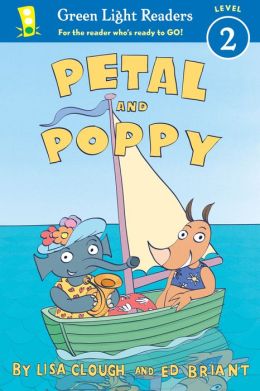
Petal and Poppy. (Level 2, Green Light Readers) Lisa Clough. Illustrated by Ed Briant. 2014. Houghton Mifflin Harcourt. 32 pages. [Source: Review copy]
Poppy is not here. It is time to practice my tuba. Bah-bwab-baah! Bwah-bu-baah!
Ack! Petal is practicing. It is time to go scuba diving!
Petal and Poppy are best friends. (Petal is the elephant. Poppy is the rhinoceros.) They are best friends, but, they are very different from one another. In this first book, readers learn that Petal can be a worrywart, and that Poppy is very understanding.
Poppy goes scuba diving. Petal comes along. She brings her tuba. She alternates playing her tuba and panicking about Poppy. Is Poppy okay? How about now? And now?
Did I like it? Sure. I didn't not like it. With the exception of Elephant and Piggie, I am unlikely to get EXCITED about any early readers I pick up.
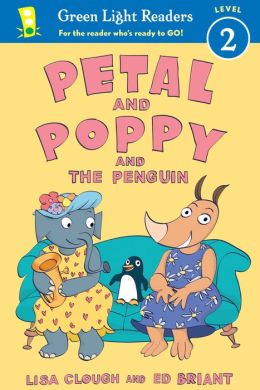
Petal and Poppy and the Penguin. (Level 2, Green Light Readers) Lisa Clough. Illustrated by Ed Briant. 2014. Houghton Mifflin Harcourt. 32 pages. [Source: Review copy]
Someone has stomped on my flowers. Uh-oh--a storm is coming! Boom! Honk, honk! Who is there? Ahhh! A monster!
Was there really a monster? Or was Petal, the elephant, just panicking again? Poppy, the rhinoceros, is such a good and understanding friend. Poppy will "save" Petal from the monster outside who is stomping on the flowers. Who is the monster making spooky sounds? A penguin, of course! It is called Petal and Poppy and The Penguin after all. These two take the penguin in. Petal very reluctantly. But these three may be great friends yet.
I liked this second book better than the first. I'm not surprised. I think with series books it can take a few books sometimes for readers to make a connection with characters. The third book in the series will be released at the end of August. Petal and Poppy and the Spooky Halloween.
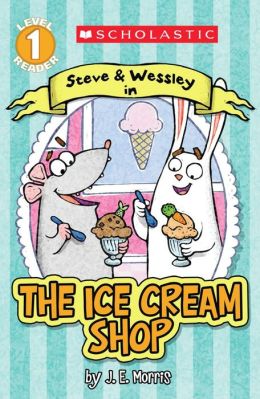
Steve & Wessley in The Ice Cream Shop. (Level 1 Reader) J.E. Morris. 2014. Scholastic. 32 pages. [Source: Review copy]
Steve walked down the street.
Steve walked by an ice cream shop.
Did someone say "ice cream"?
Steve liked ice cream.
Steve liked ice cream very much.
I like Steve. I do. He may not be very bright or smart. But there is something about him that is just likable. (Maybe he reminds me of Pinky?) In this book, Steve really wants ice cream. He wants it bad. One thing is standing in his way. The door. It won't open. Steve is very frustrated. What is the deal with this door?!
Wessley is much smarter than Steven. He realizes that some doors you push, and other doors you pull.
I liked this one fine. The second book in this new series will release at the end of August. The Sea Monster.
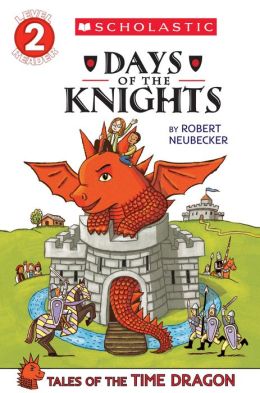
Days of the Knights. (Level 2 Reader) Robert Neubecker. 2014. Scholastic. 32 pages. [Source: Review copy]
"What's up, Joe?" asked Lilly.
"I'm doing a report on the Middle Ages." Joe shrugged.
"With knights and queens and castles? What fun!"
"I guess so," mumbled Joe.
"I'll help you research," said Lilly. She tapped the keys on the library computer...
In Days of the Knights, readers meet Lilly, Joe, and Red the Time Dragon. Red the Time Dragon is their personal guide to the middle ages. Lilly and Joe learn a handful of facts about the middle ages during their brief stay. Red the Time Dragon also manages to find time to lead a peasant revolt against Sir Vile, a selfish knight.
I don't know what to think about this new series. I really don't! The second adventure is Racing the Waves. It releases in late August.
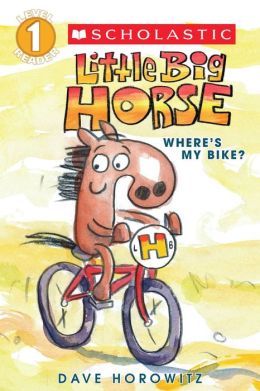
Little Big Horse: Where's My Bike? (Level 1) Dave Horowitz. 2014. Scholastic. 32 pages. [Source: Review copy]
I can't wait for class to be over.
Finally.
To the bikes!
Where is my bike? I left it right here.
Someone has stolen his bike! Who did it? Why? What motivated the crime? Will he get his bike back?
This one is very simple. Of all the books I'm reviewing today, this one is the simplest. Simple can be a good thing. Young readers need access to simple books with big font.
I liked it well enough. I liked the illustrations. I liked reading the emotions on the faces of the two characters we meet.
Drop It, Rocket! (Step 1) Tad Hills. 2014. Random House. 32 pages. [Source: Review copy]
Rocket and the little yellow bird love words. They love their word tree, too. "Are you ready to find new words for our word tree?" asks the bird. "Yes, I am!" says Rocket.
Readers may be familiar with the character of Rocket already. Rocket is the star of several picture books: How Rocket Learned to Read and Rocket Writes a Story.
This story is simple and repetitive. Rocket wants to learn new words and add new words to the word tree. He brings new things--new objects--to his friend the yellow bird. The bird tells him to "drop it" each time. Rocket is usually a good dog, so he obeys. New words are added. But what happens when Rocket does not want to drop it?
I liked this one. I liked the problem solving. It's a cute story.
© 2014 SukaYuka.com of SukaYuka's Book Reviews
Poppy is not here. It is time to practice my tuba. Bah-bwab-baah! Bwah-bu-baah!
Ack! Petal is practicing. It is time to go scuba diving!
Petal and Poppy are best friends. (Petal is the elephant. Poppy is the rhinoceros.) They are best friends, but, they are very different from one another. In this first book, readers learn that Petal can be a worrywart, and that Poppy is very understanding.
Poppy goes scuba diving. Petal comes along. She brings her tuba. She alternates playing her tuba and panicking about Poppy. Is Poppy okay? How about now? And now?
Did I like it? Sure. I didn't not like it. With the exception of Elephant and Piggie, I am unlikely to get EXCITED about any early readers I pick up.
Petal and Poppy and the Penguin. (Level 2, Green Light Readers) Lisa Clough. Illustrated by Ed Briant. 2014. Houghton Mifflin Harcourt. 32 pages. [Source: Review copy]
Someone has stomped on my flowers. Uh-oh--a storm is coming! Boom! Honk, honk! Who is there? Ahhh! A monster!
Was there really a monster? Or was Petal, the elephant, just panicking again? Poppy, the rhinoceros, is such a good and understanding friend. Poppy will "save" Petal from the monster outside who is stomping on the flowers. Who is the monster making spooky sounds? A penguin, of course! It is called Petal and Poppy and The Penguin after all. These two take the penguin in. Petal very reluctantly. But these three may be great friends yet.
I liked this second book better than the first. I'm not surprised. I think with series books it can take a few books sometimes for readers to make a connection with characters. The third book in the series will be released at the end of August. Petal and Poppy and the Spooky Halloween.
Steve walked down the street.
Steve walked by an ice cream shop.
Did someone say "ice cream"?
Steve liked ice cream.
Steve liked ice cream very much.
I like Steve. I do. He may not be very bright or smart. But there is something about him that is just likable. (Maybe he reminds me of Pinky?) In this book, Steve really wants ice cream. He wants it bad. One thing is standing in his way. The door. It won't open. Steve is very frustrated. What is the deal with this door?!
Wessley is much smarter than Steven. He realizes that some doors you push, and other doors you pull.
I liked this one fine. The second book in this new series will release at the end of August. The Sea Monster.
Days of the Knights. (Level 2 Reader) Robert Neubecker. 2014. Scholastic. 32 pages. [Source: Review copy]
"What's up, Joe?" asked Lilly.
"I'm doing a report on the Middle Ages." Joe shrugged.
"With knights and queens and castles? What fun!"
"I guess so," mumbled Joe.
"I'll help you research," said Lilly. She tapped the keys on the library computer...
In Days of the Knights, readers meet Lilly, Joe, and Red the Time Dragon. Red the Time Dragon is their personal guide to the middle ages. Lilly and Joe learn a handful of facts about the middle ages during their brief stay. Red the Time Dragon also manages to find time to lead a peasant revolt against Sir Vile, a selfish knight.
I don't know what to think about this new series. I really don't! The second adventure is Racing the Waves. It releases in late August.
Little Big Horse: Where's My Bike? (Level 1) Dave Horowitz. 2014. Scholastic. 32 pages. [Source: Review copy]
I can't wait for class to be over.
Finally.
To the bikes!
Where is my bike? I left it right here.
Someone has stolen his bike! Who did it? Why? What motivated the crime? Will he get his bike back?
This one is very simple. Of all the books I'm reviewing today, this one is the simplest. Simple can be a good thing. Young readers need access to simple books with big font.
I liked it well enough. I liked the illustrations. I liked reading the emotions on the faces of the two characters we meet.
Drop It, Rocket! (Step 1) Tad Hills. 2014. Random House. 32 pages. [Source: Review copy]
Rocket and the little yellow bird love words. They love their word tree, too. "Are you ready to find new words for our word tree?" asks the bird. "Yes, I am!" says Rocket.
Readers may be familiar with the character of Rocket already. Rocket is the star of several picture books: How Rocket Learned to Read and Rocket Writes a Story.
This story is simple and repetitive. Rocket wants to learn new words and add new words to the word tree. He brings new things--new objects--to his friend the yellow bird. The bird tells him to "drop it" each time. Rocket is usually a good dog, so he obeys. New words are added. But what happens when Rocket does not want to drop it?
I liked this one. I liked the problem solving. It's a cute story.
© 2014 SukaYuka.com of SukaYuka's Book Reviews
Nine 2014 Picture Books
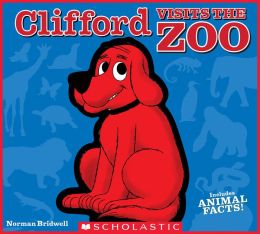
Clifford Visits the Zoo. Norman Bridwell. 2014. Scholastic. 40 pages. [Source: Review copy]
I'm Emily Elizabeth and this is my dog. His name is Clifford. Today we are going to the zoo. The people at the zoo have never seen anything like Clifford. So I tell them, Clifford is my dog. And he is very friendly. The first animals we see are penguins. The penguins are small. And Clifford is very, very big!
There are many, many books in the Clifford series. In this latest book, Norman Bridwell has Clifford visiting the zoo with Emily Elizabeth. The focus is on opposites. Readers observe one thing about an animal (the penguins are small) and note how Clifford is the exact opposite (he is very very big). This pattern continues through the entire book: animal by animal. The opposites include small and big, sleeping and awake, light and heavy, dirty and clean, noisy and quiet, slowly and quickly, hard and soft, up and down, curly and straight, wet and dry. The book concludes with a few facts about each of the animals visited at the zoo: penguins, koalas, monarch butterflies, hippopotamuses, howler monkeys, sloths, tortoises, birds, chameleons, and seals.
I liked this one. I'm not a big fan of Clifford in general, with a series this big, it would be hard to have each book in the series be of equal quality. But this one was a nice book.
Text: 3 out of 5
Illustrations: 3 out of 5
Total: 6 out of 10
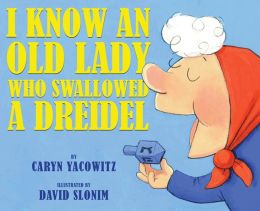
I Know An Old Lady Who Swallowed A Dreidel. Caryn Yacowitz. Illustrated by David Slonim. 2014. Scholastic. 32 pages. [Source: Review copy]
I know an old lady who swallowed a dreidel,
A Chanukah dreidel she thought was a bagel...
Perhaps it's fatal.
I know an old lady who swallowed some oil--
A pitcher of oil, 'bout ready to boil.
She swallowed the oil to wash down the dreidel,
A Chanukah dreidel she thought was a bagel…
Perhaps it's fatal.
I have read a handful of "Old Lady Who Swallowed A…" books in the past. This one fits the pattern, but with an obvious Jewish theme. Items swallowed include a dreidel, oil, latkes, sauce, brisket, gelt, menorah, and candles.
For readers of all ages who enjoy those kinds of books, then this one will prove an interesting addition. For more impatient readers who tired of the "Old Lady" books after the first or second imitation, this one is not extraordinary enough to make it a must read. At least the text alone isn't extraordinary enough. However. I must say that the illustrations are quite wonderful.
David Slonim chose classic art masterpieces to parody in his illustrations. Each spread pays unique tribute to a masterpiece while matching perfectly the text of the story. The masterpieces: Mona Lisa, The Anatomy Lesson of Dr. Nicholaes Tulp, American Gothic, The Milkmaid, The scream, Nighthawks, Campbell's Soup Cans, Spectrum II, Arrangement in Grey and Black No. 1 (Whistler's Mother), The Thinker, Doctor and Doll, Christina's World, The Starry Night, and Dance I. The illustrators note includes the name of each piece, the date, and the museum location of the original.
I definitely enjoyed this one; I enjoyed it mostly because of the illustrations. But I don't think that is a bad thing. Illustrations are very important to storytelling and reading.
Text: 3 out of 5
Illustrations: 4 out of 5
Total: 7 out of 10
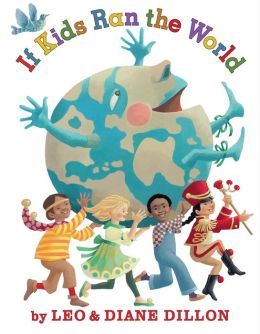
If Kids Ran the World. Leo and Diane Dillon. 2014. Scholastic. 32 Pages. [Source: Review copy]
If kids ran the world, we would make it a kinder, better place.
Maybe we'd run the world in a big tree house, and everybody would be welcome.
We'd take care of the most important things.
We know people are hungry, so all over the world, everyone would have enough to eat.
If Kids Ran The World is saturated in lessons. It's just dripping with moral messages. It's not that the message of peace and love and joy and harmony are bad. But as the Peppa Pig episode, "International Day" CLEARLY shows, "Peace and harmony in all the world," is not easily achieved even among children, or especially among children.
The book's premise is that children are more mature than adults. That somehow children are more innocent, more kind, more forgiving, more loving, more sensitive, more compassionate, more generous than adults. The premise is that children could solve problems like health care, the environment, bullying, world hunger, poverty, etc. just by being their little lovable selves. (Of course kids NEVER are selfish, ALWAYS willing to share, NEVER tell lies, ALWAYS speak kindly. NEVER exclude anyone or call names ALWAYS include everybody no matter their age or gender.)
Is that premise true? Each reader will have to decide that for themselves. Some readers may embrace the optimism and positiveness of this one. Others may question it from cover to cover.
I found this one to be very message-heavy. And the illustrations in my opinion were strange and quirky. It was little things really. Like all the slanted eyes. Like all the rosy cheeks. But there were a few big things as well that made this one, well, creepy. Like on the title page. The illustration has a globe of the Earth for a head on a body. This "person" also has wings. This globe-head character also shows up towards the end in a two-page spread that features two other creepy additions. A child's body with a lion's head and a child's body with a lamb's head.
Perhaps the illustrations are supposed to "represent" children from around the globe? But if this is the case, it has a very "It's A Small World" feel to it.
Text: 1 out of 5
Illustrations 1 out of 5
Total: 2 out of 10
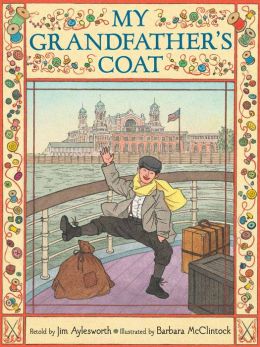
My Grandfather's Coat. Jim Aylesworth. Illustrated by Barbara McClintock. 2014. Scholastic. 32 pages. [Source: Review copy]
My grandfather came to America when he was very young. He came alone and with little more than nothing at all. The years passed, and he became a tailor. He worked very hard. And then, on the luckiest day of his life, he met my grandmother, and they fell in love. When she agreed to marry him, my grandfather went right to work. He snipped, and he clipped, and he stitched, and he sewed, and he made for himself a handsome coat…that he wore on his wedding day.
This is a retelling of a story based on the Yiddish folksong "I Had A Little Overcoat." It is a sweet story spanning the generations. The beloved coat transforms from coat to jacket to vest to tie to toy to material for a mouse's nest, to nothing but a story. It's a family-oriented story which makes it a gem in my opinion.
I loved the illustrations. I just LOVED, LOVED, LOVED the illustrations. I love seeing the story come to life. I love watching his family grow. From his own wedding to his daughter's wedding to his playing with his own grandchildren and great-grandchildren. There was just so much sweet going on. I loved it!!!
Text: 4 out of 5
Illustrations: 5 out of 5
Total: 9 out of 10
The Night Parade. Lily Roscoe. Illustrated by David Walker. 2014. Scholastic. 32 pages. [Source: Review copy]
Have you ever wondered what happens at night while mothers and fathers lie sleeping? Children wake up. They clamp out of their beds, some crawling, some running, some leaping. As the moon shines down they escape into town. To the night parade they go sneaking…
The Night Parade is a silly, imaginative book. Roscoe has created a "secret world" of sorts where children nightly sneak out of their houses and do amazing things with other children. Things like make cakes for the moon, turn somersaults in the park, dress up in costumes, tell mermaid stories, etc. They also read LOTS AND LOTS of books. By morning, all children will be safely back in their beds.
This one was okay. I didn't love it. I didn't hate it. The children are super-active, super-creative. The illustrations match the playfulness of the text. My favorite page was probably of the children marching by in their costumes. Even the moon is dressed up. Then again, I also liked the idea of all those cakes and all that frosting.
Text: 3 out of 5
Illustrations: 3 out of 5
Total: 6 out of 10
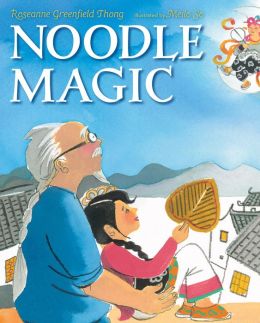
Noodle Magic. Roseanne Greenfield Thong. Illustrated by Meilo So. 2014. Scholastic. 32 pages. [Source: Review copy]
The emperor's birthday was coming, and excitement filled the air. Every day, Mei watched Grandpa Tu make magic with his hands and a bit of dough. She loved the powdery flakes that hung in the air and freckled the morning light. Every evening, Grandpa slapped the dough on the table, kneaded it with his hands, and stretched it into coils. Everyone oohed and aahed over Grandpa Tu's noodles--even the Moon Goddess, who brightened the night sky.
Mei loves, loves, loves to watch her Grandpa Tu make noodles. She thinks--the whole village in fact--thinks that there is something magical about Grandpa Tu's noodles. So everyone--Mei included--is shocked that Grandpa Tu chooses NOT to make noodles to celebrate the emperor's birthday. Instead he chooses Mei for the job. He wants her to find the magic within herself, he wants her to see that she too can do it. Readers watch as Mei tries and tries her best to make noodles special enough, magical enough, for the occasion. At times, it seems Grandpa Tu has more confidence in his granddaughter than she does in herself. Even the moon goddess thinks Mei can do it!
I liked this one. I really liked some aspects of it. I liked the writing, the language. I liked the imagery. For example, "powdery flakes that hung in the air and freckled the morning light." There were places this one worked really well for me. I also liked the focus on the grandfather-granddaughter relationship. I definitely liked the ending!
Text: 4 out of 5
Illustrations: 3 out of 5
Total: 7 out of 10
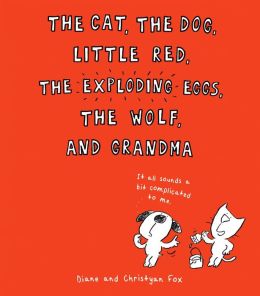
The Cat, The Dog, Little Red, the Exploding Eggs, The Wolf, and Grandma. Diane and Christyan Fox. 2014. Scholastic. 32 pages. [Source: Review copy]
The Cat, The Dog, Little Red, the Exploding Eggs, The Wolf, and Grandma celebrates storytelling. To be precise, this book celebrates interruptions at story time. The cat is trying very, very hard to tell the story of Little Red Riding Hood to the dog. By the end, this cat is VERY frustrated. The dog, you might say, has trouble focusing his attention on the actual story. Dog imagines the story a bit differently. For one, he gets the wrong impression from the very beginning. The dog hears about the red cape and instantly thinks SUPER HERO, SUPER POWERS. The cat has to veto all the dog's changes to the story, which is where the EXPLODING EGGS come into it. The dog does ask some good, solid questions. For example, if the wolf wanted to eat the little girl--as he clearly does when he's dressed up as Grandma--WHY didn't he eat her in the woods to begin with?
This book was fun and playful. I liked the focus on storytelling, liked the questioning of it too.
Text: 4 out of 5
Illustrations: 3 out of 5
Total: 7 out of 10
Thanksgiving for Emily Ann. Teresa Johnston. Illustrated by Vanessa Brantley-Newton. 2014. Scholastic. 32 pages. [Source: Review copy]
Emily Ann just had to say, she was not very thankful on Thanksgiving Day.
Her brother was mean. Her sister, a bore.
And with Grandpa in town she slept on the floor.
There was food to be cooked and chores to be done.
With everyone busy there was no time for fun.
Well, it is what it is. It's a Thanksgiving-themed story in rhyme. Emily Ann goes from ungrateful to grateful in 32 pages. The story includes all the things you'd expect: an emphasis on food, and an emphasis on family. The rhyming. Well. Some pages worked better than others. I liked the illustrations better than the text.
Text: 2 out of 5
Illustration: 3 out of 5
Total: 5 out of 10
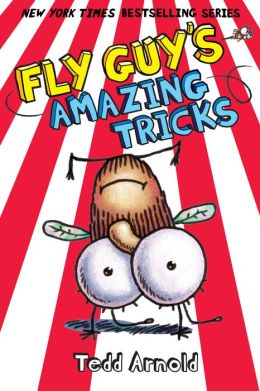
Fly Guy #14 Fly Guy's Amazing Tricks. Tedd Arnold. 2014. Scholastic. 32 pages. [Source: Review copy]
A boy had a pet fly. He named him Fly Guy. And Fly Guy could say the boy's name--Buzz!
Chapter 1: Buzz's friends came to see The Amazing Fly Guy Circus. Buzz said, "Get ready for Fly Guy's amazing new tricks!" "Now," said Buzz, "The Backstroke." "Now," said Buzz, "The Dizzy Doozie!" "And now," said Buzz, "The Big Booger!" "Time for supper, said Mom. Buzz's friends all went home.
I liked this one. Fly Guy has learned some "amazing" new tricks. The tricks went over well with his friends for their circus. The tricks do not go over well with his parents when Fly Guy performs at the dinner table. Of course that wasn't the end of Fly Guy. But. He did have to learn when NOT to perform. The last chapter is perhaps the funnest. Someone starts teasing Buzz, and, Fly Guy "saves" the day by driving the bully away.
© 2014 SukaYuka.com of SukaYuka's Book Reviews
I'm Emily Elizabeth and this is my dog. His name is Clifford. Today we are going to the zoo. The people at the zoo have never seen anything like Clifford. So I tell them, Clifford is my dog. And he is very friendly. The first animals we see are penguins. The penguins are small. And Clifford is very, very big!
There are many, many books in the Clifford series. In this latest book, Norman Bridwell has Clifford visiting the zoo with Emily Elizabeth. The focus is on opposites. Readers observe one thing about an animal (the penguins are small) and note how Clifford is the exact opposite (he is very very big). This pattern continues through the entire book: animal by animal. The opposites include small and big, sleeping and awake, light and heavy, dirty and clean, noisy and quiet, slowly and quickly, hard and soft, up and down, curly and straight, wet and dry. The book concludes with a few facts about each of the animals visited at the zoo: penguins, koalas, monarch butterflies, hippopotamuses, howler monkeys, sloths, tortoises, birds, chameleons, and seals.
I liked this one. I'm not a big fan of Clifford in general, with a series this big, it would be hard to have each book in the series be of equal quality. But this one was a nice book.
Text: 3 out of 5
Illustrations: 3 out of 5
Total: 6 out of 10
I Know An Old Lady Who Swallowed A Dreidel. Caryn Yacowitz. Illustrated by David Slonim. 2014. Scholastic. 32 pages. [Source: Review copy]
I know an old lady who swallowed a dreidel,
A Chanukah dreidel she thought was a bagel...
Perhaps it's fatal.
I know an old lady who swallowed some oil--
A pitcher of oil, 'bout ready to boil.
She swallowed the oil to wash down the dreidel,
A Chanukah dreidel she thought was a bagel…
Perhaps it's fatal.
I have read a handful of "Old Lady Who Swallowed A…" books in the past. This one fits the pattern, but with an obvious Jewish theme. Items swallowed include a dreidel, oil, latkes, sauce, brisket, gelt, menorah, and candles.
For readers of all ages who enjoy those kinds of books, then this one will prove an interesting addition. For more impatient readers who tired of the "Old Lady" books after the first or second imitation, this one is not extraordinary enough to make it a must read. At least the text alone isn't extraordinary enough. However. I must say that the illustrations are quite wonderful.
David Slonim chose classic art masterpieces to parody in his illustrations. Each spread pays unique tribute to a masterpiece while matching perfectly the text of the story. The masterpieces: Mona Lisa, The Anatomy Lesson of Dr. Nicholaes Tulp, American Gothic, The Milkmaid, The scream, Nighthawks, Campbell's Soup Cans, Spectrum II, Arrangement in Grey and Black No. 1 (Whistler's Mother), The Thinker, Doctor and Doll, Christina's World, The Starry Night, and Dance I. The illustrators note includes the name of each piece, the date, and the museum location of the original.
I definitely enjoyed this one; I enjoyed it mostly because of the illustrations. But I don't think that is a bad thing. Illustrations are very important to storytelling and reading.
Text: 3 out of 5
Illustrations: 4 out of 5
Total: 7 out of 10
If Kids Ran the World. Leo and Diane Dillon. 2014. Scholastic. 32 Pages. [Source: Review copy]
If kids ran the world, we would make it a kinder, better place.
Maybe we'd run the world in a big tree house, and everybody would be welcome.
We'd take care of the most important things.
We know people are hungry, so all over the world, everyone would have enough to eat.
If Kids Ran The World is saturated in lessons. It's just dripping with moral messages. It's not that the message of peace and love and joy and harmony are bad. But as the Peppa Pig episode, "International Day" CLEARLY shows, "Peace and harmony in all the world," is not easily achieved even among children, or especially among children.
The book's premise is that children are more mature than adults. That somehow children are more innocent, more kind, more forgiving, more loving, more sensitive, more compassionate, more generous than adults. The premise is that children could solve problems like health care, the environment, bullying, world hunger, poverty, etc. just by being their little lovable selves. (Of course kids NEVER are selfish, ALWAYS willing to share, NEVER tell lies, ALWAYS speak kindly. NEVER exclude anyone or call names ALWAYS include everybody no matter their age or gender.)
Is that premise true? Each reader will have to decide that for themselves. Some readers may embrace the optimism and positiveness of this one. Others may question it from cover to cover.
I found this one to be very message-heavy. And the illustrations in my opinion were strange and quirky. It was little things really. Like all the slanted eyes. Like all the rosy cheeks. But there were a few big things as well that made this one, well, creepy. Like on the title page. The illustration has a globe of the Earth for a head on a body. This "person" also has wings. This globe-head character also shows up towards the end in a two-page spread that features two other creepy additions. A child's body with a lion's head and a child's body with a lamb's head.
Perhaps the illustrations are supposed to "represent" children from around the globe? But if this is the case, it has a very "It's A Small World" feel to it.
Text: 1 out of 5
Illustrations 1 out of 5
Total: 2 out of 10
My Grandfather's Coat. Jim Aylesworth. Illustrated by Barbara McClintock. 2014. Scholastic. 32 pages. [Source: Review copy]
My grandfather came to America when he was very young. He came alone and with little more than nothing at all. The years passed, and he became a tailor. He worked very hard. And then, on the luckiest day of his life, he met my grandmother, and they fell in love. When she agreed to marry him, my grandfather went right to work. He snipped, and he clipped, and he stitched, and he sewed, and he made for himself a handsome coat…that he wore on his wedding day.
This is a retelling of a story based on the Yiddish folksong "I Had A Little Overcoat." It is a sweet story spanning the generations. The beloved coat transforms from coat to jacket to vest to tie to toy to material for a mouse's nest, to nothing but a story. It's a family-oriented story which makes it a gem in my opinion.
I loved the illustrations. I just LOVED, LOVED, LOVED the illustrations. I love seeing the story come to life. I love watching his family grow. From his own wedding to his daughter's wedding to his playing with his own grandchildren and great-grandchildren. There was just so much sweet going on. I loved it!!!
Text: 4 out of 5
Illustrations: 5 out of 5
Total: 9 out of 10
The Night Parade. Lily Roscoe. Illustrated by David Walker. 2014. Scholastic. 32 pages. [Source: Review copy]
Have you ever wondered what happens at night while mothers and fathers lie sleeping? Children wake up. They clamp out of their beds, some crawling, some running, some leaping. As the moon shines down they escape into town. To the night parade they go sneaking…
The Night Parade is a silly, imaginative book. Roscoe has created a "secret world" of sorts where children nightly sneak out of their houses and do amazing things with other children. Things like make cakes for the moon, turn somersaults in the park, dress up in costumes, tell mermaid stories, etc. They also read LOTS AND LOTS of books. By morning, all children will be safely back in their beds.
This one was okay. I didn't love it. I didn't hate it. The children are super-active, super-creative. The illustrations match the playfulness of the text. My favorite page was probably of the children marching by in their costumes. Even the moon is dressed up. Then again, I also liked the idea of all those cakes and all that frosting.
Text: 3 out of 5
Illustrations: 3 out of 5
Total: 6 out of 10
Noodle Magic. Roseanne Greenfield Thong. Illustrated by Meilo So. 2014. Scholastic. 32 pages. [Source: Review copy]
The emperor's birthday was coming, and excitement filled the air. Every day, Mei watched Grandpa Tu make magic with his hands and a bit of dough. She loved the powdery flakes that hung in the air and freckled the morning light. Every evening, Grandpa slapped the dough on the table, kneaded it with his hands, and stretched it into coils. Everyone oohed and aahed over Grandpa Tu's noodles--even the Moon Goddess, who brightened the night sky.
Mei loves, loves, loves to watch her Grandpa Tu make noodles. She thinks--the whole village in fact--thinks that there is something magical about Grandpa Tu's noodles. So everyone--Mei included--is shocked that Grandpa Tu chooses NOT to make noodles to celebrate the emperor's birthday. Instead he chooses Mei for the job. He wants her to find the magic within herself, he wants her to see that she too can do it. Readers watch as Mei tries and tries her best to make noodles special enough, magical enough, for the occasion. At times, it seems Grandpa Tu has more confidence in his granddaughter than she does in herself. Even the moon goddess thinks Mei can do it!
I liked this one. I really liked some aspects of it. I liked the writing, the language. I liked the imagery. For example, "powdery flakes that hung in the air and freckled the morning light." There were places this one worked really well for me. I also liked the focus on the grandfather-granddaughter relationship. I definitely liked the ending!
Text: 4 out of 5
Illustrations: 3 out of 5
Total: 7 out of 10
The Cat, The Dog, Little Red, the Exploding Eggs, The Wolf, and Grandma. Diane and Christyan Fox. 2014. Scholastic. 32 pages. [Source: Review copy]
The Cat, The Dog, Little Red, the Exploding Eggs, The Wolf, and Grandma celebrates storytelling. To be precise, this book celebrates interruptions at story time. The cat is trying very, very hard to tell the story of Little Red Riding Hood to the dog. By the end, this cat is VERY frustrated. The dog, you might say, has trouble focusing his attention on the actual story. Dog imagines the story a bit differently. For one, he gets the wrong impression from the very beginning. The dog hears about the red cape and instantly thinks SUPER HERO, SUPER POWERS. The cat has to veto all the dog's changes to the story, which is where the EXPLODING EGGS come into it. The dog does ask some good, solid questions. For example, if the wolf wanted to eat the little girl--as he clearly does when he's dressed up as Grandma--WHY didn't he eat her in the woods to begin with?
This book was fun and playful. I liked the focus on storytelling, liked the questioning of it too.
Text: 4 out of 5
Illustrations: 3 out of 5
Total: 7 out of 10
Thanksgiving for Emily Ann. Teresa Johnston. Illustrated by Vanessa Brantley-Newton. 2014. Scholastic. 32 pages. [Source: Review copy]
Emily Ann just had to say, she was not very thankful on Thanksgiving Day.
Her brother was mean. Her sister, a bore.
And with Grandpa in town she slept on the floor.
There was food to be cooked and chores to be done.
With everyone busy there was no time for fun.
Well, it is what it is. It's a Thanksgiving-themed story in rhyme. Emily Ann goes from ungrateful to grateful in 32 pages. The story includes all the things you'd expect: an emphasis on food, and an emphasis on family. The rhyming. Well. Some pages worked better than others. I liked the illustrations better than the text.
Text: 2 out of 5
Illustration: 3 out of 5
Total: 5 out of 10
Fly Guy #14 Fly Guy's Amazing Tricks. Tedd Arnold. 2014. Scholastic. 32 pages. [Source: Review copy]
A boy had a pet fly. He named him Fly Guy. And Fly Guy could say the boy's name--Buzz!
Chapter 1: Buzz's friends came to see The Amazing Fly Guy Circus. Buzz said, "Get ready for Fly Guy's amazing new tricks!" "Now," said Buzz, "The Backstroke." "Now," said Buzz, "The Dizzy Doozie!" "And now," said Buzz, "The Big Booger!" "Time for supper, said Mom. Buzz's friends all went home.
I liked this one. Fly Guy has learned some "amazing" new tricks. The tricks went over well with his friends for their circus. The tricks do not go over well with his parents when Fly Guy performs at the dinner table. Of course that wasn't the end of Fly Guy. But. He did have to learn when NOT to perform. The last chapter is perhaps the funnest. Someone starts teasing Buzz, and, Fly Guy "saves" the day by driving the bully away.
© 2014 SukaYuka.com of SukaYuka's Book Reviews
Saturday, August 2, 2014
Library Loot: My First trip in August
New Loot:
© 2014 SukaYuka.com of SukaYuka's Book Reviews
- The Boleyn King by Laura Andersen
- Elephant Company by Vicki Constantine Croke
- A Murder at Rosamund's Gate by Susanna Calkins
- My Cousin Rachel by Daphne du Maurier
- Three Things You Need To Know About Rockets by Jessica A. Fox
- Flight by Elephant by Andrew Martin
- Useful Enemies: John Demjanjuk and America's Open-Door Policy for Nazi War Criminals by Richard Rashke
- Simply Satisfying Over 200 Vegetarian Recipes You'll Want to Make Again and Again by Jeanne Lemlin
- Simple Faith by Anna Schmidt
- The Family Romanov by Candace Fleming
- The Little Girl Who Fought the Great Depression: Shirley Temple and 1930s America by John F. Kasson
- Palace of Spies by Sarah Zettel
- Rebecca by Daphne du Maurier
- The Fantastic Laboratory of Dr. Weigl by Arthur Allen
- Death of a Dowager by Joanna Campbell Slan
- The Quaker and the Rebel by Mary Ellis
- The Family Cooks: 100+ Recipes to Get Your Family Craving Food That's Simple, Tasty, And Incredibly Good for You by Laurie David, recipes by Kirstin Uhrenholdt
© 2014 SukaYuka.com of SukaYuka's Book Reviews
Week in Review: July 27 - August 2
From August:
The Book Thief. Markus Zusak. 2006. Random House. 560 pages. [Source: Book I Bought]
From July:
The Girl From the Tar Paper School. Teri Kanefield. 2014. Abrams. 56 pages. [Source: Library]
Dualed. Elsie Chapman. 2013. Random House. 304 pages. [Source: Library]
To Love And Be Wise. (Inspector Grant #4) Josephine Tey. 1951. Simon & Schuster. 208 pages. [Source: Bought]
China Dolls. Lisa See. 2014. Random House. 376 pages. [Source: Library]
Don't Even Think About It. Sarah Mlynowski. 2014. Random House. 336 pages. [Source: Review copy]
Full Steam Ahead. Karen Witemeyer. 2014. Bethany House. 352 pages. [Source: Library]
50 Days of Heaven: Reflections That Bring Eternity to Light. Randy Alcorn. 2006. Tyndale. 288 pages. [Source: Bought]
This week's favorite:
The Book Thief. I love, love, love, LOVE The Book Thief. I don't love it because it's a happy, happy novel. I love it because it is beautiful, haunting, ugly, yet hopeful.
© 2014 SukaYuka.com of SukaYuka's Book Reviews
The Book Thief. Markus Zusak. 2006. Random House. 560 pages. [Source: Book I Bought]
From July:
The Girl From the Tar Paper School. Teri Kanefield. 2014. Abrams. 56 pages. [Source: Library]
Dualed. Elsie Chapman. 2013. Random House. 304 pages. [Source: Library]
To Love And Be Wise. (Inspector Grant #4) Josephine Tey. 1951. Simon & Schuster. 208 pages. [Source: Bought]
China Dolls. Lisa See. 2014. Random House. 376 pages. [Source: Library]
Don't Even Think About It. Sarah Mlynowski. 2014. Random House. 336 pages. [Source: Review copy]
Full Steam Ahead. Karen Witemeyer. 2014. Bethany House. 352 pages. [Source: Library]
50 Days of Heaven: Reflections That Bring Eternity to Light. Randy Alcorn. 2006. Tyndale. 288 pages. [Source: Bought]
This week's favorite:
The Book Thief. I love, love, love, LOVE The Book Thief. I don't love it because it's a happy, happy novel. I love it because it is beautiful, haunting, ugly, yet hopeful.
© 2014 SukaYuka.com of SukaYuka's Book Reviews
Friday, August 1, 2014
Reread #31 Book Thief
The Book Thief. Markus Zusak. 2006. Random House. 560 pages. [Source: Book I Bought]
First the colors. Then the humans. That’s usually how I see things. Or at least, how I try. HERE IS A SMALL FACT You are going to die. I am in all truthfulness attempting to be cheerful about this whole topic, though most people find themselves hindered in believing me, no matter my protestations. Please, trust me. I most definitely can be cheerful. I can be amiable. Agreeable. Affable. And that’s only the A’s. Just don’t ask me to be nice. Nice has nothing to do with me. REACTION TO THE AFOREMENTIONED FACT Does this worry you? I urge you—don’t be afraid. I’m nothing if not fair. —Of course, an introduction. A beginning. Where are my manners? I could introduce myself properly, but it’s not really necessary. You will know me well enough and soon enough, depending on a diverse range of variables. It suffices to say that at some point in time, I will be standing over you, as genially as possible. Your soul will be in my arms. A color will be perched on my shoulder. I will carry you gently away. At that moment, you will be lying there (I rarely find people standing up). You will be caked in your own body. There might be a discovery; a scream will dribble down the air. The only sound I’ll hear after that will be my own breathing, and the sound of the smell, of my footsteps. The question is, what color will everything be at that moment when I come for you? What will the sky be saying? Personally, I like a chocolate-colored sky. Dark, dark chocolate. People say it suits me. I do, however, try to enjoy every color I see—the whole spectrum. A billion or so flavors, none of them quite the same, and a sky to slowly suck on. It takes the edge off the stress. It helps me relax.
The Book Thief is one of those books that I've read again and again and again. I reviewed it in 2007, 2008, and 2012. I started the year knowing that I would have to include it among my rereads. It's just a great book, a great book that is not diminished by rereading. It stays compelling and beautiful. It was also recently filmed. I wanted to read the book around the same time I watched the movie.
I watched the movie before rereading The Book Thief. If I'd never read the Book Thief, I would not have felt right seeing the movie first. This worked well for me. I think it worked to the movie's benefit in fact. I was able to become absorbed in the story and the characters. I wasn't comparing every second of the movie to every word in the book. I wasn't seeing the movie within the framework of what has been left out and what has been changed. Watching the movie, I was reminded of why I love the characters I love, reminded of why they are so memorable to me. They are just as memorable to me as say Anne, Marilla, Matthew, and Gilbert. The Book Thief was a book that deserved a film of equal quality to be made, and, I think it was done beautifully. That doesn't mean that everything in the movie was in the book or that everything in the book was in the movie. One thing I did notice after reading the book was the fact that Hans did not take the accordion with him into the shelter raids. (Though it did make a great movie moment.)
I loved rereading The Book Thief. It is always an experience. I don't think I can improve upon my last review:
The Book Thief leaves me speechless. If humans leave Death, the narrator, feeling haunted, I can say the same of the narrator. Could a book have a better narrator? I doubt it. There is something so perfectly-perfectly-perfect about The Book Thief. It is beautiful and brilliant; absorbing and compelling. It goes ugly places, to be sure, but the language, the style, just can't be beat. I mean this is a novel that wows and amazes. The characters are so real, so vivid. I mean these characters are very real, very human, very flawed, but the connection is so intense.
I don't love it because it's an easy read. I don't love it because it's a happy, happy novel. I love it because it is beautiful, haunting, ugly, yet hopeful.
Favorite quotes:
© 2014 SukaYuka.com of SukaYuka's Book Reviews
First the colors. Then the humans. That’s usually how I see things. Or at least, how I try. HERE IS A SMALL FACT You are going to die. I am in all truthfulness attempting to be cheerful about this whole topic, though most people find themselves hindered in believing me, no matter my protestations. Please, trust me. I most definitely can be cheerful. I can be amiable. Agreeable. Affable. And that’s only the A’s. Just don’t ask me to be nice. Nice has nothing to do with me. REACTION TO THE AFOREMENTIONED FACT Does this worry you? I urge you—don’t be afraid. I’m nothing if not fair. —Of course, an introduction. A beginning. Where are my manners? I could introduce myself properly, but it’s not really necessary. You will know me well enough and soon enough, depending on a diverse range of variables. It suffices to say that at some point in time, I will be standing over you, as genially as possible. Your soul will be in my arms. A color will be perched on my shoulder. I will carry you gently away. At that moment, you will be lying there (I rarely find people standing up). You will be caked in your own body. There might be a discovery; a scream will dribble down the air. The only sound I’ll hear after that will be my own breathing, and the sound of the smell, of my footsteps. The question is, what color will everything be at that moment when I come for you? What will the sky be saying? Personally, I like a chocolate-colored sky. Dark, dark chocolate. People say it suits me. I do, however, try to enjoy every color I see—the whole spectrum. A billion or so flavors, none of them quite the same, and a sky to slowly suck on. It takes the edge off the stress. It helps me relax.
The Book Thief is one of those books that I've read again and again and again. I reviewed it in 2007, 2008, and 2012. I started the year knowing that I would have to include it among my rereads. It's just a great book, a great book that is not diminished by rereading. It stays compelling and beautiful. It was also recently filmed. I wanted to read the book around the same time I watched the movie.
I watched the movie before rereading The Book Thief. If I'd never read the Book Thief, I would not have felt right seeing the movie first. This worked well for me. I think it worked to the movie's benefit in fact. I was able to become absorbed in the story and the characters. I wasn't comparing every second of the movie to every word in the book. I wasn't seeing the movie within the framework of what has been left out and what has been changed. Watching the movie, I was reminded of why I love the characters I love, reminded of why they are so memorable to me. They are just as memorable to me as say Anne, Marilla, Matthew, and Gilbert. The Book Thief was a book that deserved a film of equal quality to be made, and, I think it was done beautifully. That doesn't mean that everything in the movie was in the book or that everything in the book was in the movie. One thing I did notice after reading the book was the fact that Hans did not take the accordion with him into the shelter raids. (Though it did make a great movie moment.)
I loved rereading The Book Thief. It is always an experience. I don't think I can improve upon my last review:
The Book Thief leaves me speechless. If humans leave Death, the narrator, feeling haunted, I can say the same of the narrator. Could a book have a better narrator? I doubt it. There is something so perfectly-perfectly-perfect about The Book Thief. It is beautiful and brilliant; absorbing and compelling. It goes ugly places, to be sure, but the language, the style, just can't be beat. I mean this is a novel that wows and amazes. The characters are so real, so vivid. I mean these characters are very real, very human, very flawed, but the connection is so intense.
I don't love it because it's an easy read. I don't love it because it's a happy, happy novel. I love it because it is beautiful, haunting, ugly, yet hopeful.
Favorite quotes:
Yes, often, I am reminded of her, and in one of my vast array of pockets, I have kept her story to retell. It is one of the small legion I carry, each one extraordinary in its own right. Each one an attempt—an immense leap of an attempt—to prove to me that you, and your human existence, are worth it. Here it is. One of a handful. The Book Thief. If you feel like it, come with me. I will tell you a story. I’ll show you something.
Yes, an illustrious career. I should hasten to admit, however, that there was a considerable hiatus between the first stolen book and the second. Another noteworthy point is that the first was stolen from snow and the second from fire. Not to omit that others were also given to her. All told, she owned fourteen books, but she saw her story as being made up predominantly of ten of them. Of those ten, six were stolen, one showed up at the kitchen table, two were made for her by a hidden Jew, and one was delivered by a soft, yellow-dressed afternoon.
When she came to write her story, she would wonder exactly when the books and the words started to mean not just something, but everything. Was it when she first set eyes on the room with shelves and shelves of them? Or when Max Vandenburg arrived on Himmel Street carrying handfuls of suffering and Hitler’s Mein Kampf? Was it reading in the shelters? The last parade to Dachau? Was it The Word Shaker? Perhaps there would never be a precise answer as to when and where it occurred. In any case, that’s getting ahead of myself. Before we make it to any of that, we first need to tour Liesel Meminger’s beginnings on Himmel Street...
To most people, Hans Hubermann was barely visible. An un-special person. Certainly, his painting skills were excellent. His musical ability was better than average. Somehow, though, and I’m sure you’ve met people like this, he was able to appear as merely part of the background, even if he was standing at the front of a line. He was always just there. Not noticeable. Not important or particularly valuable. The frustration of that appearance, as you can imagine, was its complete misleadence, let’s say. There most definitely was value in him, and it did not go unnoticed by Liesel Meminger. (The human child—so much cannier at times than the stupefyingly ponderous adult.)
A DEFINITION NOT FOUND IN THE DICTIONARY Not leaving: an act of trust and love, often deciphered by children
Insane or not, Rudy was always destined to be Liesel’s best friend. A snowball in the face is surely the perfect beginning to a lasting friendship.
I guess humans like to watch a little destruction. Sand castles, houses of cards, that’s where they begin. Their great skill is their capacity to escalate.
A SMALL BUT NOTE WORTHY NOTE I’ve seen so many young men over the years who think they’re running at other young men. They are not. They’re running at me.
On the ration cards of Nazi Germany, there was no listing for punishment, but everyone had to take their turn. For some it was death in a foreign country during the war. For others it was poverty and guilt when the war was over, when six million discoveries were made throughout Europe.
For some reason, dying men always ask questions they know the answer to. Perhaps it’s so they can die being right.
© 2014 SukaYuka.com of SukaYuka's Book Reviews
Subscribe to:
Posts (Atom)