Saturday, January 10, 2015

Seuss on Saturday #2

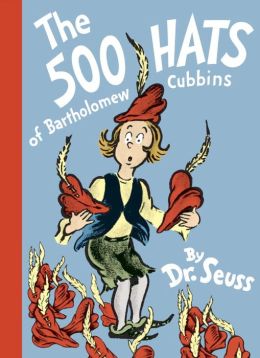
The 500 Hats of Bartholomew Cubbins. 1938/1965. Random House. 56 pages. [Source: Library]

First sentence:
 In the beginning, Bartholomew Cubbins didn't have five hundred hats. He had only one hat. It was an old one that had belonged to his father and his father's father before him. It was probably the oldest and the plainest hat in the whole Kingdom of Didd, where Bartholomew Cubbins lived.
Premise/plot. Bartholomew Cubbins gets into big, big trouble when he "refuses" to remove his hat in the presence of the king. The king gets more and more flustered as he sees the "insolence" of Bartholomew. To Bartholomew's credit, he is trying very hard to remove his hat. But every time he removes a hat, another appears on his head. What is going on?! What will the king do?!

My thoughts: I have only read this one twice. It definitely has more text than And To Think That I Saw it On Mulberry Street. And it also is written in prose. It does not rhyme. The story is just as over-the-top as And To Think That I Saw It On Mulberry Street, but it definitely has a different feel to it. According to Wikipedia, it was received well by reviewers. What did I think? Well, it was silly. I think the key to enjoying it is in focusing on the king and his reaction to the "problem." Seeing the king and those close to him try to solve the problem. For example, at one point he calls in seven black-gowned magicians:
Low and slow, they were chanting words that were strange...
"Dig a hole five furlongs deep,
Down to where the night snakes creep,
Mix and mold the mystic mud,
Malber, Balber, Tidder, Tudd."
In came seven black-gowned magicians, and beside each one stalked a lean black cat. They circled around Bartholomew Cubbins muttering deep and mysterious sounds.
It's never fun to be frustrated yourself. But the king's frustration proves comical. There are no real questions answered in this one.  But the ending proves satisfying enough.

Have you read The 500 Hats of Barthomew Cubbins? Did you like it? love it? hate it? What age do you think it works best for?

If you'd like to join me in reading or rereading Dr. Seuss' picture books (chronologically) I'd love to have you join me! The next book I'll be reviewing is The King's Stilts.


© 2015 SukaYuka.com of SukaYuka's Book Reviews

Glamourpuss (2015)

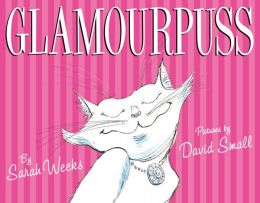
Glamourpuss. Sarah Weeks. Illustrated by David Small. 2015. [January 2015] Scholastic. 40 pages. [Source: Review copy]

First sentence: Once upon a pillow sat a glamorous cat named Glamourpuss. Glamourpuss lived with Mr. and Mrs. Highhorsen in a giant amnion on the top of a hill where they were waited on hand and foot by a pair of devoted servants named Gustav and Rosalie.

I enjoyed reading Sarah Weeks' Glamourpuss. I thought it was a charming picture book about a fabulous cat who was sometimes selfish and sometimes sweet. Glamourpuss, the star of the book, does not like it when Eugenia and Bluebelle come to visit Mr. and Mrs. Highhorsen, her owners. She finds Bluebelle and her many costumes ridiculous. But to her surprise, all the adults seem to find Bluebelle precious and wonderful and even glamorous. Shocking! Can't they tell the difference between tacky and refined?! When Glamourpuss realizes that Bluebelle actually HATES wearing clothes and performing tricks, the two bond. Glamourpuss gives her real lessons on how to behave, how to take her bow-wow to WOW, just as Glamourpuss has taken her meow to ME.

I found the story cute and charming. But I think it was the illustrations that really persuaded me that this story was wonderful. I loved the many expressions of Glamourpuss. I did. David Small did a great job of capturing this cat's magnificent personality. I think some of my favorite illustrations were when she is teaching Bluebelle how to be more refined.

Definitely recommended for cat lovers!

Text: 4 out of 5
Illustrations: 5 out of 5
Total: 9 out of 10

© 2015 SukaYuka.com of SukaYuka's Book Reviews
Owl Diaries: Eva's Treetop Festival

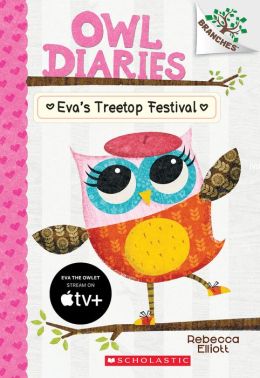
Eva's Treetop Festival (Owl Diaries #1) Rebecca Elliott. 2015. Scholastic. 80 pages. [Source: Review copy]

Tuesday
Hello Diary,
My name is Eva Wingdale. I live at Treehouse 11 on Woodpine Avenue in Treetopolis. 

 Plot/Premise: Eva, the owl, shares her diary. Readers learn about Eva, what she likes/loves, what she does NOT like/love. Readers get to know her and her family/friends. They also get to see Eva at school and home. Eva gets inspired to plan a big event--the Bloomtastic Festival. The diary shows day by day or night by night, I suppose, how that is going for her! Eva has some lessons to learn definitely!

My thoughts: The book just has a cute feel to it. It's cute from cover to cover. It's heavily illustrated. Which is a good thing, I think. Some of the text is narration: diary entries to be precise. But some of the text is dialogue in speech bubbles. This early chapter book is a fun choice for young girls.

The first book in the series releases this month. The second book releases in May.

© 2015 SukaYuka.com of SukaYuka's Book Reviews
Library Loot: Second Trip in January

New Loot:
  •  Station Eleven by Emily St. John Mandel
  • A Game of Thrones by George R.R. Martin
  • The Blue Cotton Gown by Patricia Harman
  • The Midwife of Hope River by Patricia Harman
  • The Book of Three by Lloyd Alexander
  • Socks by Beverly Cleary
  • The Midnight Dress by Karen Foxlee
  • On the Banks of Plum Creek by Laura Ingalls Wilder
  • The Cat in the Hat by Dr. Seuss
  • The Cat in the Hat Comes Back by Dr. Seuss
  • On Beyond Zebra by Dr. Seuss
  • Horton Hears a Who by Dr. Seuss
  • If I Ran the Circus by Dr. Seuss
Leftover Loot:
  • Almost Super by Marion Jensen
  • Space Case by Stuart Gibbs
  • Introducing Agatha Raisin: The Quiche of Death and The Vicious Vet by M.C. Beaton
  • On Track for Treasure by Wendy McClure
  • Copper Magic by Julia Mary Gibson
  • The Unlikely Pilgrimage of Harold Fry by Rachel Joyce
  • The Killings at Badger's Drift by Caroline Graham
  • Death of a Hollow Man by Caroline Graham
  • The Trumpeter of Krakow by Eric P. Kelly
  • Peter Nimble and His Fantastic Eyes by Jonathan Auxier
  • Shadows of the Workhouse by Jennifer Worth
  • Farewell to the East End by Jennifer Worth
  • The Forgotten 500: The Untold Story of the Men Who Risked All for the Greatest Rescue Mission of World War II by Gregory A. Freeman
  • The Shining Girls by Lauren Beukes
  • Don't Give Up, Don't Give In: Lessons From an Extraordinary Life by Louis Zamperini 
  • Bo at Iditarod Creek by Kirkpatrick Hill
  • Little Town on the Prairie by Laura Ingalls Wilder
  • These Happy Golden Years by Laura Ingalls Wilder
  •  Zebra Forest by Adina Rishe Gewirtz
  • Hope by LouAnn Gaeddert
  •  A Great and Glorious Adventure by Gordon Corrigan
  • The Upstairs Room by Johanna Reiss
  • Invincible Louisa by Cornelia Meigs
  • Bomb by Steve Sheinkin
  •  Quinny & Hopper by Adriana Brad Schanen 
  • Nuts to You by Lynne Rae Perkins
  • The Zoo at the Edge of the World by Eric Kahn Gale
   Library Loot is a weekly event co-hosted by Claire from The Captive Reader and Linda from Silly Little Mischief that encourages bloggers to share the books they’ve checked out from the library. If you’d like to participate, just write up your post-feel free to steal the button-and link it using the Mr. Linky any time during the week. And of course check out what other participants are getting from their libraries.  

© 2015 SukaYuka.com of SukaYuka's Book Reviews
Friday, January 9, 2015

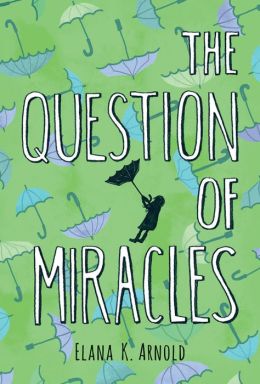
The Question of Miracles (2015)

The Question of Miracles. Elana K. Arnold. 2015. HMH. 240 pages. [Source: Review copy]


Iris Abernathy has recently moved to Oregon, and she HATES it. Her parents are sympathetic and supportive. (Iris visits a counselor, Dr. Shannon, somewhat regularly. Not because of her angst about the move, but, for other issues.) Iris misses her old life and her old friends. Most particularly she misses her friend Sarah. Part of Iris thinks it would be impossible to ever be happy here,  to ever have another best friend. But this "impossibility" is challenged a bit in The Question of Miracles.

There were a few things that I liked about The Question of Miracles. I liked Iris's new friend, Boris. I liked the slow-and-steady progression of their friendship. I liked getting to know him. I think he was good for Iris. And I think Iris was good for him. I like how their friendship made them both stronger as individuals.

I also liked the families within the novel. I liked getting to know Iris' family and Boris' family. Overall, characterization of even minor characters was well done.

The Question of Miracles is at the very least a sad novel, perhaps a dark one. (By dark, I don't mean as dark as it could possibly be and without any hope or redemption.) How do you move on after losing a best friend? after witnessing her die in the parking lot? Life does go on, but, it feels like it can't, like it shouldn't. The Question of Miracles is about Iris' life after a big loss.

The Question of Miracles is one girl's quest for the answer to all her why questions. Does Iris get her answers? Adults are probably not surprised that she doesn't--not really. But she does come to accept her loss and begin living life again.

I didn't like everything about this one. There were a few things that bothered me--mainly bothered me as a Christian--things that may not bother other readers. (For example, her seeking out a psychic and trying to communicate with her friend's spirit.)

© 2015 SukaYuka.com of SukaYuka's Book Reviews
Thursday, January 8, 2015

Audacity (2015)

Audacity. Melanie Crowder. 2015. Penguin. 400 pages. [Source: Review copy]

I loved Melanie Crowder's Audacity. It was a fascinating read focusing on the life and work of Clara Lemlich. It would pair well with Margaret Peterson Haddix's Uprising and Katherine Paterson's Bread and Roses, Too. Also Margarita Engle's The Lightning Dreamer and Andrea Davis Pinkney's The Red Pencil.

What did I love most about Audacity? I loved, loved, loved Clara herself. I loved her strength, her determination, her ambition, her loyalty, her persistence. Whether in Russia or America, Clara dreamed of one thing above all others: getting an education and making something of herself. She wanted to be able to read and write. She wanted to be able to think and form her own opinions and express them. She was raised in an environment, a community, where education was ONLY for men, the message that was reinforced over and over again (not specifically by her parents, but by the community) was that equated a woman going to school and learning with a prostitute. An educated woman brought shame to her family. It wasn't just that it was pushed aside or made a low priority. It was discouraged and forbidden. Clara wanted a voice of her own, and she wanted to be heard. There were many intense places in Audacity. Some within the Russia setting. Some within America. Some within her own home. Some outside the home. Audacity isn't a light-hearted read.

The novel opens with Clara and her family in Russia at the turn of the twentieth century. After facing persecution--the Jewish community within Russia facing brutal persecution--her family emigrated to America. The focus remains on Clara: her dreams and her reality. For example, while her father and brothers stay home to be scholars, she works seven days a week in a mill. The conditions under which she works, under which all the women work, were horrible. She gives her paycheck to her family faithfully, dutifully. But not without some regret. Why must she be the one working so hard while others take it easy?! Much of the book focuses on her struggle: her struggle to hold onto her dreams, her struggle to hold onto dignity, her fight for right, to see justice done.

Audacity is a novel written in verse. It was powerful and compelling. The verse worked for me. It just wowed me in places! This fascinating book is easy to recommend. It's an emotional read, but oh so worth it!

© 2015 SukaYuka.com of SukaYuka's Book Reviews

Wednesday, January 7, 2015

The Girl with the White Flag

The Girl With The White Flag. Tomiko Higa. Translated by Dorothy Britton. 1989. 130 pages. [Source: Bought]

The Girl with the White Flag is the story of the author's childhood in war-time Japan. It begins by giving the reader ample background into the time and culture and place.

One of the first events she shares with readers is the death of her mother. She then relates what life was like with her father, two older sisters, and her older brother. This portion is hard to navigate. I think in some ways it is just as hard for modern readers to understand the family life--the harshness, the strictness, the discipline, as it is to understand the monstrosities of war and soldiers and starvation. (Or maybe that's just my take on it.)

About halfway through the narrative, the father disappears. He was on his somewhat routine mission of delivering food to the Japanese soldiers, but on this occasion he never returned home. The four children are left to fend for themselves. The American soldiers have just begun their invasion, their battle to capture this island. The children become refugees and the fight to survive has begun. The children ranged in age from 17 to 6. Somewhere along the way, however, two things happen--big things--that make this event even scarier: 1) Their brother dies one night from a stray bullet. 2) Within a few days of burying their brother, our narrator--the six/seven year old girl becomes lost--separated--from her sisters.

The book recounts what it was like to be seven and alone and wandering in and out of danger. There was no safe place. Not really. Japanese soldiers weren't "safe." In fact, in her brief encounters with them she was almost killed. No, being near soldiers wasn't safe. The only "safe" soldier was a dead soldier. She did in fact scavenge around the dead soldiers looking for food.

Her will to survive was strong. Her stamina incredible in my opinion. The sights. The sounds. The smells. All surrounded her. Could have potentially traumatized her and paralyzed her into inaction.

If there is power in the Girl with The White Flag it is in its rawness, its simplicity, its boldness when it comes to being straightforward and honest. The story is incredible is powerful because it's true. Here is an eyewitness account of what it means to be seven and a refugee in a war zone. It can be brutal. It can be intense. But there is more to it than that.

I found The Girl with The White Flag to be an incredibly compelling read, a must-read for adults.

© 2015 SukaYuka.com of SukaYuka's Book Reviews