Showing posts with label 2004. Show all posts

Friday, May 16, 2014

Reread #20 The Phoenix and the Carpet

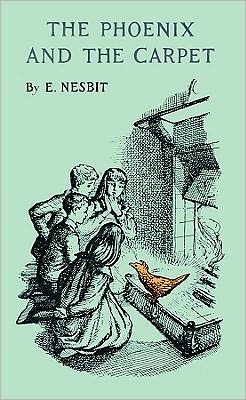
The Phoenix and the Carpet. E. Nesbit. 1904. 224 pages. [Source: Bought]

I've read The Phoenix and the Carpet three times now, and, I think I've decided I love it even more than Five Children and It. (It wasn't an easy decision. But. I think I'm ready to admit the truth.) (The first review was June 2010; the second review was August 2011.)

The Phoenix and the Carpet is the sequel to Five Children and It. Readers can continue to read about the adventures and misadventures of five delightful-but-not-always-obedient children: Cyril, Robert, Anthea, Jane, and Lamb. (I like how Anthea is nicknamed "Panther" and how Lamb is always referred to by his nickname, "Lamb" because Baa was his first word. It is little details that charm me best perhaps.)

More wishes. More magic. More mischief. It's everything I loved about the first book, and then some!

So how do they meet the Phoenix? How do they get a magic carpet? Well, it all starts when the children decide that it would be a very good idea, a very fun idea, to try out their fireworks--to make sure they work properly--INSIDE the house, inside the nursery to be precise. And when one of the fireworks seems to not be lighting, one of the children pours paraffin on it while another lights it again. While the results are not horribly tragic, the nursery must be repainted/repaired, and a new carpet is a must. The carpet that replaces the old is magical, of course. And inside this roll of carpet is an egg. But not an ordinary egg. Though of course, they don't know that until it accidentally falls into the fire in their nursery. And the Phoenix emerges....

I loved the adventures. I loved seeing them get in and out of trouble. And most of all I love the writing. I love E. Nesbit. I do!!!
Favorite quotes:
It has been said that all roads lead to Rome; this may be true, but at any rate, in early youth I am quite sure that many roads lead to BED, and stop there — or YOU do.
‘We’re very much luckier than any one else, as it is,’ said Jane. ‘Why, no one else ever found a Psammead. We ought to be grateful.’ ‘Why shouldn’t we GO ON being, though?’ Cyril asked—’lucky, I mean, not grateful. Why’s it all got to stop?’ ‘Perhaps something will happen,’ said Anthea, comfortably. ‘Do you know, sometimes I think we are the sort of people that things DO happen to.’
‘Well,’ said the Phoenix, seeming on the whole rather flattered, ‘to cut about seventy long stories short (though I had to listen to them all — but to be sure in the wilderness there is plenty of time), this prince and princess were so fond of each other that they did not want any one else, and the enchanter — don’t be alarmed, I won’t go into his history — had given them a magic carpet (you’ve heard of a magic carpet?), and they had just sat on it and told it to take them right away from every one — and it had brought them to the wilderness. And as they meant to stay there they had no further use for the carpet, so they gave it to me. That was indeed the chance of a lifetime!’
You can always keep the Lamb good and happy for quite a long time if you play the Noah’s Ark game with him. It is quite simple. He just sits on your lap and tells you what animal he is, and then you say the little poetry piece about whatever animal he chooses to be. Of course, some of the animals, like the zebra and the tiger, haven’t got any poetry, because they are so difficult to rhyme to. The Lamb knows quite well which are the poetry animals. ‘I’m a baby bear!’ said the Lamb, snugging down; and Anthea began: ‘I love my little baby bear, I love his nose and toes and hair; I like to hold him in my arm, And keep him VERY safe and warm.’ And when she said ‘very’, of course there was a real bear’s hug. Then came the eel, and the Lamb was tickled till he wriggled exactly like a real one: ‘I love my little baby eel, He is so squidglety to feel; He’ll be an eel when he is big — But now he’s just — a — tiny SNIG!’ Perhaps you didn’t know that a snig was a baby eel? It is, though, and the Lamb knew it. ‘Hedgehog now-!’ he said; and Anthea went on: ‘My baby hedgehog, how I like ye, Though your back’s so prickly-spiky; Your front is very soft, I’ve found, So I must love you front ways round!’ And then she loved him front ways round, while he squealed with pleasure. It is a very baby game, and, of course, the rhymes are only meant for very, very small people — not for people who are old enough to read books, so I won’t tell you any more of them.
‘If you wanted me you should have recited the ode of invocation; it’s seven thousand lines long, and written in very pure and beautiful Greek.’
‘He says,’ the Phoenix remarked after some time, ‘that they wish to engage your cook permanently.’ ‘Without a character?’ asked Anthea, who had heard her mother speak of such things. ‘They do not wish to engage her as cook, but as queen; and queens need not have characters.’ There was a breathless pause. ‘WELL,’ said Cyril, ‘of all the choices! But there’s no accounting for tastes.’
Mother was really a great dear. She was pretty and she was loving, and most frightfully good when you were ill, and always kind, and almost always just. That is, she was just when she understood things. But of course she did not always understand things. No one understands everything, and mothers are not angels, though a good many of them come pretty near it. The children knew that mother always WANTED to do what was best for them, even if she was not clever enough to know exactly what was the best.
Every one was a little cross — some days are like that, usually Mondays, by the way. And this was a Monday.
‘My hat!’ Cyril remarked. ‘I never thought about its being a PERSIAN carpet.’ Yet it was now plain that it was so, for the beautiful objects which it had brought back were cats — Persian cats, grey Persian cats, and there were, as I have said, 199 of them, and they were sitting on the carpet as close as they could get to each other. But the moment the children entered the room the cats rose and stretched, and spread and overflowed from the carpet to the floor, and in an instant the floor was a sea of moving, mewing pussishness, and the children with one accord climbed to the table, and gathered up their legs, and the people next door knocked on the wall — and, indeed, no wonder, for the mews were Persian and piercing. ‘This is pretty poor sport,’ said Cyril. ‘What’s the matter with the bounders?’ ‘I imagine that they are hungry,’ said the Phoenix. ‘If you were to feed them—’ ‘We haven’t anything to feed them with,’ said Anthea in despair, and she stroked the nearest Persian back. ‘Oh, pussies, do be quiet — we can’t hear ourselves think.’ She had to shout this entreaty, for the mews were growing deafening, ‘and it would take pounds’ and pounds’ worth of cat’s-meat.’ ‘Let’s ask the carpet to take them away,’ said Robert. But the girls said ‘No.’ ‘They are so soft and pussy,’ said Jane. ‘And valuable,’ said Anthea, hastily. ‘We can sell them for lots and lots of money.’ ‘Why not send the carpet to get food for them?’ suggested the Phoenix, and its golden voice came harsh and cracked with the effort it had to be make to be heard above the increasing fierceness of the Persian mews. So it was written that the carpet should bring food for 199 Persian cats, and the paper was pinned to the carpet as before. The carpet seemed to gather itself together, and the cats dropped off it, as raindrops do from your mackintosh when you shake it. And the carpet disappeared. Unless you have had one-hundred and ninety-nine well-grown Persian cats in one small room, all hungry, and all saying so in unmistakable mews, you can form but a poor idea of the noise that now deafened the children and the Phoenix. The cats did not seem to have been at all properly brought up. They seemed to have no idea of its being a mistake in manners to ask for meals in a strange house — let alone to howl for them — and they mewed, and they mewed, and they mewed, and they mewed, till the children poked their fingers into their ears and waited in silent agony, wondering why the whole of Camden Town did not come knocking at the door to ask what was the matter, and only hoping that the food for the cats would come before the neighbours did — and before all the secret of the carpet and the Phoenix had to be given away beyond recall to an indignant neighbourhood. The cats mewed and mewed and twisted their Persian forms in and out and unfolded their Persian tails, and the children and the Phoenix huddled together on the table.
The Lamb was very glad to have his brothers and sisters to play with him. He had not forgotten them a bit, and he made them play all the old exhausting games: ‘Whirling Worlds’, where you swing the baby round and round by his hands; and ‘Leg and Wing’, where you swing him from side to side by one ankle and one wrist. There was also climbing Vesuvius. In this game the baby walks up you, and when he is standing on your shoulders, you shout as loud as you can, which is the rumbling of the burning mountain, and then tumble him gently on to the floor, and roll him there, which is the destruction of Pompeii.
© 2014 SukaYuka.com of SukaYuka's Book Reviews

Friday, May 2, 2014

Reread #18 A Teacher's Funeral

The Teacher's Funeral. Richard Peck. 2004. Penguin. 208 pages. [Source: Library]
If your teacher has to die, August isn't a bad time of year for it. You know August. The corn is earring. The tomatoes are ripening on the vine. The clover's in full bloom. There's a little less evening now, and that's a warning. You want to live every day twice over because you'll be back in the jailhouse of school before the end of the month. Then our teacher, Miss Myrt Arbuckle, hauled off and died. It was like a miracle, though she must have been forty. You should have seen my kid brother's face. It looked like Lloyd was hearing the music of the spheres. Being ten that summer, he was even more willing to believe in miracles than I was. 
 The Teacher's Funeral is my favorite, favorite, favorite Richard Peck novel. It is one of my favorite historical fiction books. I loved the humor. I loved the writing--the narration. One humorous incident after another, just more and more to love. I also loved the characters. I loved Russell, the narrator. I loved his sister, Tansy. I loved their Dad who was oh-so-wise. I loved Charlie, Russell's best friend, and it was fun to see Glenn Tarbox as well. I was cheering for him through the book! But one of my FAVORITE, FAVORITE characters, and probably secretly the reason I ADORE the book so very, very much is LITTLE BRITCHES (aka Beulah).

This historical fiction novel is set in 1904. Most of the action occurs in a one room school house. The teacher is Russell's OLDER sister. Russell had been hoping--dreaming really--that since their teacher literally died a day or two before school was to start, that there would be NO MORE SCHOOL. He was dreaming of FREEDOM. What he got, of course, is his sister for a teacher. A sister who could see through him, who knew him backwards and forwards, and could tell when he was TROUBLE. He can do pranks, sure enough, but she always knows it was HIM and she punishes him.

This one has plenty of laugh-out-loud moments. And there is a lovely audio book edition of it as well.


 My first review October 2006. My second review March 2011. 

Favorite quotes:

This was the night me and Lloyd always went to the crick and camped out. It was a sacred part of our year. After the Case Special came through, we always spent that night at the crick, and hung on till morning, no matter what. It was how we kissed the summer goodbye before the darkness of learning fell about us. (13)
"Who died?" I inquired.
"Take a guess," Charlie said. "Go ahead."
"Somebody we know?"
"You can believe that."
"Somebody old or young?"
"Old," Charlie said, "as the hills."
Lloyd was looking back and forth between us, clutching J.W. He was on the hook again, and I was getting there.
"Old as Old Man Lichtenberger?"
"Nobody's that old," Charlie said.
"Man or woman?"
"That'd be tellin' too much."
"Somebody we like?"
"Not hardly," Charlie said.
"Somebody who's been feeling poorly late?" I was wracking my brains.
Charlie shrugged his big shoulders. "She must of felt pretty poorly tonight. She died."
"So it's a woman!"
"More or less," Charlie said.
The truth burst over me. "You don't mean Miss Myrt Arbuckle!" (24)

Nobody would miss Miss Myrt, so Preacher Parr got them to miss the good old days when the winters were worse and the kids were better. At a funeral you want to miss something. (39)

When Pearl came back, she had a grip on the little kid who didn't want to be anywhere near here. Her bonnet hung by its strings. Her dinner pail scraped the floor. She kept setting her bare heels. "Turn me loose," she squawked. "I don't wanna, and I'm not gonna!"
Pearl pushed her toward Tansy and resumed her seat.
Tansy pulled the small girl's skirttails free of her drawers and settled her skirts for her. But it was too late. Forever more, she was known as "Little Britches." Even unto the distant day of her wedding. Besides, come to find out her real name was Beulah.
"Who are you?" Tansy asked with an arm around her.
"I ain't sayin'," said Little Britches. "I ain't stayin'."
"Then whisper who you are in my ear before you go."
Little Britches whispered. It would turn out that she was a Bradley. They were a family who hadn't had anybody in school for some years. Little Britches was an afterthought. "I'm goin' on home now." She wiggled free of Tansy. "Pleased to meetcha."
"Well, you can go home at noon, Tansy told her. "Till then just wait up there at my desk. You can...help me be teacher." (80-1)

"Tansy, how come the female sex think they know more than the male sex?"
"Because we do. What's the capital of Delaware?"
"I don't know."
"Know by tomorrow," Tansy warned. "I'm the teacher, and I won't have dumb brothers." (107)

I thought we'd need a block and tackle to lift her. But getting Aunt Fanny Hamline out of the ditch became one of Tansy's most famous days of teaching. It was a lesson in engineering too. It should have been studied at Purdue University. (127)

© 2014 SukaYuka.com of SukaYuka's Book Reviews

Monday, April 21, 2014

Meet Me in St. Louis (2004)

Meet Me in St. Louis: A Trip to the 1904 World's Fair. Robert Jackson. 2004. HarperCollins. 144 pages. [Source: Bought]

Meet Me in St. Louis is a fascinating book about the 1904 World's Fair. I found this nonfiction book for young readers to be entertaining and wonderful from cover to cover. It was well-organized. The narration was great--never a dull moment. It was detailed. If you love discovering "I didn't know that?!" facts, this is one to treasure. I found myself wanting to find people to enlighten. I learned so much from reading it.

Chapter one is a direct appeal to readers. Jackson writes in second person. He wants YOU to join him at the fair. This chapter gives a brief overview of the fair, inviting you to "experience" it through your five senses.
"The giant wheel lurches into motion; you hold your breath and feel yourself moving. How is it possible for such a large car, stuffed to the gills with sixty people, to rise into the air like this? You bravely take a first peek out the windows. Off to the near right, you spot the Abraham Lincoln Exhibit, which houses the actual log cabin where Lincoln lived as a child in Kentucky. Then the rolling gardens and peaceful ponds of the Japanese Pavilion opens up in front of you. A bit higher and you can see all of the Jerusalem Exhibit, a miniature version of that Middle Eastern city filled with replicas of ancient buildings. Can this be St. Louis, or have you been transported to a whole new world?" (10)
Chapter two chronicles the preparation and construction.
Chapter three tells of opening day.

Chapters four and five tells of buildings and exhibits. It tells about each of the palaces at the World's Fair. There was, for example, the palace of mines and metallurgy, palace of varied industries, palace of education and social economy, palace of fine arts, palace of liberal arts, palace of manufactures, palace of transportation, palace of electricity and machinery, palace of agriculture, palace of horticulture, palace of forestry, fish, and game. One of my favorite places to read about was the Model Playground.

Chapter six is a great for capturing the unique entertainments. It focuses on "the Illusions on the Pike." Jackson writes,
 "Plays, concerts, circus tricks--more than forty different shows were staged in all, some in theaters and others right in the center of the wide walkway. Fifteen hundred animals, from zebras to polar bears, lived on the Pike during the fair, and many of them were entertaining performers too. Without a doubt, the Pike was the loudest area on the fairgrounds. Dozens of men called "spielers" or "barkers" shouted into megaphones for hours, trying to attract people to rides and shows." (73) This chapter also mentions Geronimo. "He signed autographs for ten cents each; depending on his mood, the price for his photograph ranged between fifty cents and two dollars. Geronimo would even sell his hat for the wildly expensive price of five dollars--then coolly pull a new one from under the table, place it on his head, and wait for another buyer." (83)
Chapter seven focuses on the debut of the Ferris Wheel, or "Observation Wheel."

Chapter eight is titled, "Faces of the Fair." I thought this was a well done chapter that examines, with honesty, the diversity of the Fair; in many places, it addresses racism and exploitation. The fair, as we've read so far, may have been educational, and it may have been FUN, but, it wasn't always fair and just.
"While blacks were not the only minority group treated with disrespect, at least they were free to boycott the fair if they wanted. Others were not able to protest. Several ethnic groups had been brought from their homelands to St. Louis--in some cases by force. Men, women, and children were put on display so that fairgoers could take a first-hand look at them and, in theory, learn about their cultures. The largest of these "anthropological" exhibits came from the Philippines. Hundreds of exploited Filipinos lived on the fairgrounds in open huts and flimsy thatched cabins. Cramped and filthy, the housing offered almost no privacy. The Filipinos were forced by fair managers to sit quietly while crowds of curious visitors gawked at them; they were also told to sing, dance, and perform other activities against their will. Instead of learning about the Filipinos and gaining respect for this culture, most fairgoers concluded they were a primitive race of inferior beings." (100)
And later from the same chapter,
 "Some people were disturbed by the exploitation of ethnic groups, including a magazine reporter named Laura Ingalls Wilder. Long before the Little House on the Prairie books made her a well-known children's author, she traveled from her home in southern Missouri to write about the fair. Wilder enjoyed the palaces, foreign buildings, and the Pike, but she was appalled by the mistreatment of many of the foreign and Native American people. She reportedly even tried to stop exhibitors from forcing them on display. One day, a young man from Africa was being exploited during a typically cruel stage show. Wilder stood up in the middle of the audience and demanded that the show stop immediately." (103-4)
Chapter nine is about "special events." The chapter covers many such events. But the BEST, BEST, BEST part of this chapter is devoted to the 1904 Olympic Games in St. Louis!!! There were a dozen little things that I found fascinating in this section. At least a dozen!
"Because the Games were fairly new--and therefore disorganized--many bizarre and amusing things happened. After a disagreement over who won the fifty-meter race, two swimmers got into a brawl and just agreed to race again. There was no such thing as instant replay in 1904, of course. And American gymnast George Eyser ambled off with five medals, including two golds, after competing with a wooden leg. He had lost one leg after being run over by a train years earlier." (114) 
And
 "A pair of Zulu tribesmen, Len Taunyane and Jan Mashiani, became the first African athletes to compete in the Olympics, even though they were supposed to be part of the Boer War Exhibit. Taunyane might have won, but a fierce dog chased him nearly a mile off course, and he finished in ninth place." (116)
Chapter ten focuses on the last days of the fair.

I would definitely recommend this one!!

© 2014 SukaYuka.com of SukaYuka's Book Reviews

Sunday, March 2, 2014

Two Picture Books Turning Ten

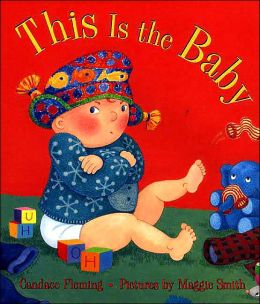
This is The Baby. Candace Fleming. Illustrated by Maggie Smith. 2004. FSG. 40 pages. [Source: Book I Own]

This is the baby who hates to be dressed.
"No! No! Nooo!"
This is the diaper, often a mess, that goes on the baby who hates to be dressed.
"No! No! Nooo!"
This is the T-shirt, wrinkled a lot, that snaps over the diaper, often a mess, that goes on the baby who hates to be dressed.
"No! No! Nooo!"
This is the sweater, itchy and hot, that covers the T-shirt, wrinkled a lot, that snaps over the diaper, often a mess, that goes on the baby who hates to be dressed.
"No! No! Nooo!"
These are the jeans, stiff in the knee....

I love this one. I do. I like true picture books. Stories that reflect every day situations and struggles, stories that look at life realistically. The book is also fun and playful. I also like picture books that are repetitive or that have refrains, making it easy for little ones to join in during the reading.

In This is the Baby, readers meet one stubborn mother and one just-as-stubborn baby. Who will win the battle?!

This one has a good twist on it, a bit predictable perhaps, but still fun! I would definitely recommend this one to parents who have little ones who like to wiggle and giggle free and undressed...

Text: 5 out of 5
Illustrations: 4 out of 5
Total: 9 out of 10

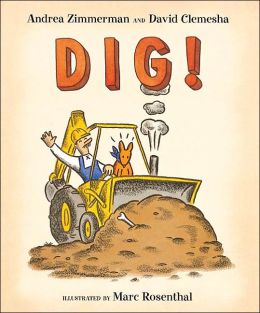
Dig! Andrea Zimmerman and David Clemesha. Illustrated by Marc Rosenthal. 2004. Harcourt. 32 pages. [Source: Book I Own]

Mr. Rally drives a big yellow backhoe. It has a scooper and a pusher. Mr. Rally loves to dig in the dirt. So does his dog, Lightning. Mr. Rally buckles his overalls and pulls on his boots. He has five big digging jobs to do today. He counts them. One. Two. Three. Four. Five. Job #1 up ahead. One is a bridge on the ridge. 

Dig is a fun picture book that I really enjoy. Readers meet Mr. Rally and his dog, Lightning.

Readers see the two get excited about digging in the dirt. This one has a repeating refrain: "Dig up rock and dig up clay! Dig up dirt and dig all day!" This refrain is repeated at all five jobs, as is the congratulating refrain of "Good job, Mr. Rally! Good job, Lighting!" 

After a long day of work, you might think Mr. Rally would want to go home and relax. And he does, in his own way, I suppose. But at the end of his day, Mr. Rally can still be found digging alongside Lightning. He loves to dig for work and play, of course. He loves to dig at home in his garden.

Text: 4 out of 5
Illustrations: 4 out of 5
Total: 8 out of 10

© 2014 SukaYuka.com of SukaYuka's Book Reviews
Monday, February 24, 2014

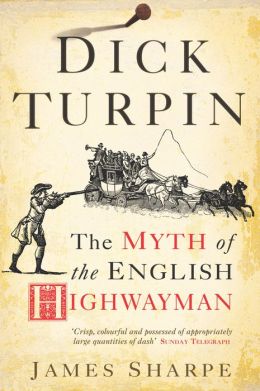
Dick Turpin: The Myth of the English Highwayman

Dick Turpin: The Myth of the English Highwayman. James Sharpe. 2004. Profile Books. 258 pages. [Source: Book I bought]
At least he died well, in what the eighteenth century considered the appropriate manner for its condemned criminals. Determined to look his best when he met his end, he had, a few days previously, bought himself a new frock coat and a pair of pumps. He had also, as a further preparation, on the day before his execution appointed five men as his mourners, and given them three pounds and ten shillings to be shared among them for following the cart that would carry him to the gallows and for overseeing his subsequent interment. He distributed hatbands and gloves to several other people, and left a gold ring and two pairs of shoes and clogs to a married woman with whom he had consorted, despite reports that he had a wife and child living in the south, while he lived under an assumed identity at the Humberside township of Brough.
I found this book to be mostly fascinating. It isn't just a book about eighteenth century criminals; it isn't just a book about romanticizing the past and creating legends out of thin air; it isn't just a book about the role of history in culture. Yes, it does all three things to some extent. It focuses on what we do know about Dick Turpin. It places Dick Turpin into a larger context by discussing crime rates, law and order, and famous criminals. Readers will learn about other highwayman: men that were more popular and well-known in their day, men like Claude Duval. Turpin, for example, was largely forgotten for a century.

But at the same time it examines culture and popularity: in other words what sells and what entertains. Why was there an INCREDIBLE market for books about criminals--specifically highwaymen? What was it that readers found so exciting? What was it that others feared about this popular form of entertainment? What connections did people make then between reading about crime and committing crime. While a third of this nonfiction book examines the facts of 'the real' Dick Turpin, I would say that probably two-thirds of this one focuses on HOW the legend of "Dick Turpin" came to be; how this one person came to personify the ultimate highwayman. This speaks of the culture. The legend of Dick Turpin was crafted--well-crafted--intentionally crafted. And the legend became something above and beyond what anyone could have predicted.

Since I read Rookwood by William Harrison Ainsworth last fall, I found that chapter to be very interesting indeed! Ainsworth's novel is discussed in depth--its strengths and weaknesses. Also Sharpe examines--perhaps more briefly--the other writers who followed. He discusses penny dreadfuls, plays (good and bad), folk traditions, collectibles (did you know there were porcelain figures, toys, and games?!), comic strips, movies, parodies, TV shows and miniseries. And pubs. He definitely mentions all the "Dick Turpin drank here" pubs.

It concludes by focusing on the shaping and reshaping of history, and what happens when pop culture becomes involved--perhaps too involved--playing historian.

I sought out this book, I admit, because the Horrible Histories' Dick Turpin song is just too much fun. The song both tells the truth--some facts about the real Dick Turpin--and celebrates the legend. It does this through the costumes and acting. He may be saying he was no romantic hero, but, he looks every bit the romantic hero. I was mostly curious to see if the last part was true. Was he REALLY "stitched up by a postie"?! Did a postman really recognize John Palmer's handwriting as being none other than Dick Turpin's handwriting? This book answered that question and so many more!!!

Quotes:
Dick Turpin is one of that select band of figures from England’s past (others might include Henry VIII, Queen Victoria, Sir Winston Churchill and, interestingly, Robin Hood) who are instantly recognisable to everyone.
Turpin is a figure who is instantly recognisable to the bulk of the population, and around whom a potent mythology has gathered. None of this would have been apparent to those who apprehended, guarded, executed, or gave evidence against him in 1739. Yes, he was a notorious criminal: but one or two of those emerged every year in the eighteenth century, to enjoy a brief fame before they, too, ended their career on the gallows... But it is Turpin we remember, Turpin who has passed into the popular consciousness, not the dozens of others. So with Dick Turpin we encounter two other issues. The first is the nature of legend, of how it gets created and perpetuated, an issue that also leads us into contemplating the nature of fame. The second is the relationship between history and legend, and, by extension, of how the two operate in our modern culture, and how we draw on both of them to imagine our past.
Overall, it is clear that most highwaymen, particularly those based in the London area, were firmly locked into the unglamorous world of pickpocketing, street robbery, burglary, prostitution, and the fencing of stolen goods, all of these facets of the well-developed criminal underworld in the capital. Thus the modern observer is left wondering how, why and when the highwayman was selected as the romantic figure of later, and to some extent seventeenth- and eighteenth-century, legend.
© 2014 SukaYuka.com of SukaYuka's Book Reviews